
Case Replay: ABB's Look-First, Enter-Second Workflow for AI-Powered Electrical Inspection
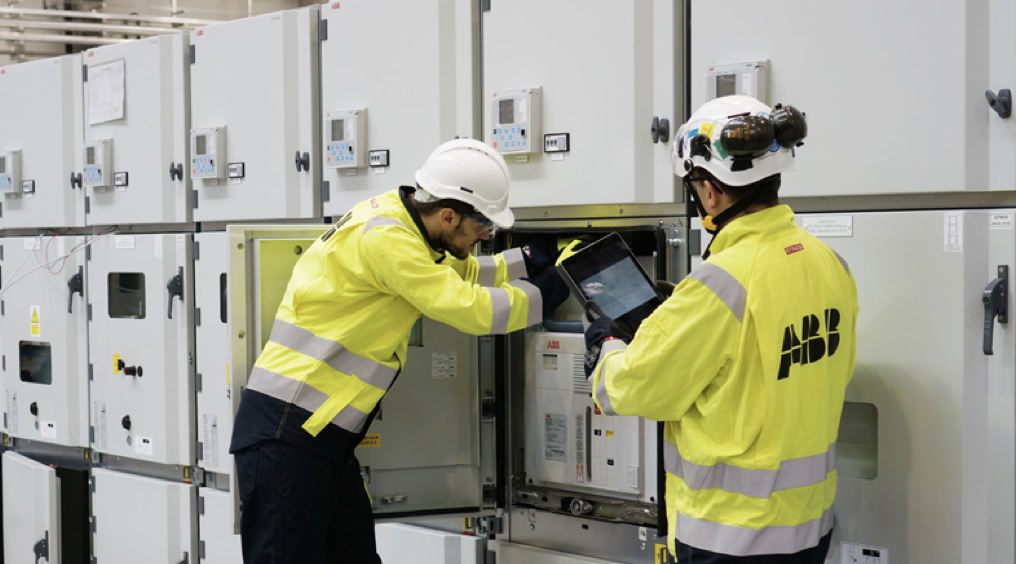
A report lands: something is warm, noisy or arcing inside a live switchgear room. Under the playbook the industry has run for decades, the answer to "who finds out what is actually in there?" is a qualified person walking in first, with partial information. This AIdataNewsGlobal AIApplications case replay takes that decision apart, because it is exactly the point where an AI application either stays a demo or becomes a repeatable business process. ABB frames the alternative as automated inspection built around robotics, advanced sensors and AI: get the site into focus before the crew is exposed to it.
Case file at a glance
- Trigger: a fault report or a scheduled check on a live electrical asset, with the site condition unknown until someone surveys it in person.
- Reframed step: a robotic platform and remote sensing gather the first picture, so the pre-entry brief is built on readings rather than assumptions.
- Data payload: thermal, acoustic and visual captures from hard-to-reach locations, analyzed far faster than traditional approaches allow.
- AI's actual job: convert bulky inspection output into prioritized, actionable recommendations, so teams spot issues earlier, rank their inspection work and arrive better prepared.
- Maturity check: suitable robotic platforms are already commercially available and improving fast; the electrical-service-specific application layer is largely still at prototype stage.
- Outcome being claimed: lower human exposure, higher visibility of asset condition, and service teams that act with greater confidence — not a smaller engineering org.
The scenario under review: an essential expert, sent in blind
Take the live switchgear room. Today a qualified engineer may have to enter to assess its condition, frequently with limited information about what will be found. The expertise on site is genuinely essential — which is the problem in miniature: critical decisions get made before the full picture is available.
For decades this loop barely changed. A problem is reported, the service team visits, assesses, and picks the best course of action. It is highly skilled work, often performed in challenging conditions. Electrical infrastructure has become an asset critical to business operations, and as reliance on dependable power grows, expectations of electrical service shift with it. Technology now makes service work safer and more effective, and it also invites a revisit of the assumption underneath: must field service engineers always be the first to enter a potentially hazardous environment?
Robotic inspection platforms draw interest for one reason above all. They cut direct human exposure while still delivering the quality and depth of information needed to judge a high-risk environment, and they hand service teams something they rarely had: visibility before exposure.
Replaying the workflow: six steps from alarm to asset record
- Log the event and stop short of dispatch. The alarm, defect note or upcoming routine check enters the service queue. The difference from the old loop is that the first response is a question about data availability, not a calendar slot.
- Collect the first picture remotely. A platform or fixed sensor set pulls thermal, acoustic and visual readings from areas a person would otherwise have to reach. That information helps teams understand operating conditions and identify potential hazards before work begins.
- Run the AI pass. Artificial intelligence has become the critical enabler here: it turns large volumes of inspection data into actionable recommendations, flagging candidate findings and their relative urgency.
- Engineer sets the plan. A service engineer decides what should be inspected, interprets the findings and recommends the course of action — now with more context and a clearer understanding of asset condition.
- Enter on the team's terms. Isolation, permits, correct protective equipment, spares and tooling are arranged around a known condition picture instead of an unknown one, so exposure shrinks and preparation improves.
- Write the result back. Findings, images and measurements land in the asset record, where they feed trending and the next round of prioritization — the point where an inspection tool becomes part of asset management rather than a one-off gadget.
What each signal buys the crew
| Signal type | What it reveals in an electrical room | Where it plugs into the workflow |
|---|---|---|
| Thermal imaging | Loose connections, overloaded circuits and abnormal heating patterns behind panels | Step 2: pre-entry hazard list; sets isolation scope before anyone opens a compartment |
| Acoustic / ultrasonic readings | Insulation-related discharge activity that often precedes failure | Step 3: AI ranking input; supports earlier detection than a walk-up survey |
| Visual capture | Physical damage, contamination, corrosion, position of components in cramped or unreachable spaces | Steps 2 and 5: tooling, access and PPE planning; step 6: before/after evidence |
| AI analysis layer | Patterns across volumes of readings, ranked recommendations, triage of what matters | Steps 3 and 4: prioritization of inspection activity and preparation quality |
Prototype reality: general-purpose hardware, very specific rooms
None of this is a far-off scenario, and the honest version of the story is that much of the work remains at prototype stage. Platforms that could carry the sensors exist commercially and improve rapidly. The bottleneck is adaptation: combining service expertise, software development and engineering knowledge into an application layer, so robotic platforms can operate effectively in complex, safety-critical electrical environments and integrate seamlessly with broader asset management systems.
Integrating humans and technology will not be straightforward. Electrical environments are complex, safety-critical and highly specific, and adapting general-purpose technologies so they become genuinely useful in a high voltage switchroom or a live substation requires sustained investment in research, software and digitalization. The aim is not to adopt robots for their own sake; the objective is to see how emerging technologies solve real-world service challenges and create meaningful improvements in safety, efficiency and operational resilience.
That is also where the industry's broader progress helps. In a September 2025 announcement, ABB Robotics described its investment in California-based LandingAI as a way to make robotic vision faster and more accessible, with a stated target of cutting vision AI training and deployment time by up to 80 percent (new.abb.com/news/detail/129010). Shorter model-training cycles matter to field service, because the scarce asset in every pilot is the qualified engineer-hours spent teaching a system what a normal switchgear compartment looks like.
Production evidence from adjacent AI applications
While the robot chassis for hazardous rooms matures, the "software half" of this pattern is already running on real assets — and it is worth studying, because it shows what a successful first year of an AI deployment looks like operationally.
Announced in June 2026, ABB and Ørsted A/S — Denmark's largest utility — began piloting an AI-based fault prediction solution at Avedøre Power Station, the combined electricity and district heating plant near Copenhagen. The pilot deliberately builds on the site's existing electrical infrastructure and is being introduced as part of an ongoing relay replacement program, analyzing data already available in relay and control systems to catch subtle changes that may point to a developing fault (new.abb.com/news/detail/136748). Søren Bagge Skou of ABB summarized the logic plainly: most electrical faults build up over time but are usually discovered late, leaving little room to respond, so the aim is earlier warning and more time to act. The same interview reframes the maintenance model — a move from periodic inspection toward earlier detection, faster diagnosis and more informed maintenance decisions. Two operational details are the transferable part: ABB supports Ørsted throughout the first year of the pilot and works closely with site teams so the insights are relevant and actionable.
ABB's emissions-monitoring side offers a second, closer analogue for the service workflow. Its latest ABB Remote Condition Monitoring uses Genix Copilot AI to interpret analyzer health reports, suggest possible causes and guide operators, providing around-the-clock visibility into system performance (new.abb.com/news/detail/139108; control.com, October 2026). That is the same shape as the switchgear problem: continuous remote signal, AI-assisted interpretation, a human deciding what the recommendation justifies.
Method notes: what the sensors are reading is not new science
One reason the thermal-plus-acoustic combination is credible is that both methods already sit in established electrical maintenance practice. US maintenance standard guidance around NFPA 70B, for example, accepts acoustic imaging as a technique for partial discharge surveys (flir.com), and ultrasonic methods are valued for detecting discharge activity without shutting equipment down. On the safety side, NFPA 70E practice requires an arc flash risk assessment for equipment rated 50 volts or more, refreshed on a defined cycle — commonly cited as every five years — and after major facility changes (tuvsud.com/en-us; nfpa.org). Two implications for AI teams: automated pre-entry data can enrich the evidence that feeds those assessments and PPE decisions, but it cannot substitute for the assessment itself, for de-energization where required, or for the permit process. A model that produces findings without a compliance pathway attached to them simply creates another queue for the same engineer.
Five misconceptions this case should retire
- "Automation here is a headcount plan." Human judgment is irreplaceable because of the complexity of the environment and the stakes of every decision. The ambition is to strengthen human capability, not replace it.
- "Buy the platform, the insight follows." The value of automated inspection technologies ultimately comes from the insights they gather and the actions they enable — which lives in the application layer, not the vehicle.
- "A general-purpose robot works in a switchroom out of the box." Highly specific, safety-critical environments are precisely where adaptation effort concentrates.
- "Prototype stage means nothing usable today." Remote data collection, AI triage and integration with asset management systems are already shipping in adjacent electrical services.
- "More data means better decisions." Without ranking, thresholds and a human gate, extra readings are noise at volume — the tasks engineers should be spared.
Action checklist for teams piloting automated or AI-assisted inspection
- Inventory your entry decisions. List the asset classes where a first visit happens under incomplete information. Exposure minutes, permit cycles and rework rates make better baselines than vague safety sentiment.
- Start with the data contract, not the hardware. Fix formats and naming for thermal, acoustic and visual captures, and store a baseline per asset; AI recommendations are only as auditable as the inputs behind them.
- Pilot narrowly with pre-agreed metrics. Track earlier issue detection, accuracy of prioritized inspection activity, preparation quality (one mobilization instead of two) and unplanned downtime avoided.
- Keep a human gate at every recommendation. Engineers define what should be inspected, interpret findings and approve the action — the model ranks, the person decides.
- Wire output into the asset record. Seamless integration with broader asset management systems is what converts a demo into a durable process and makes trending possible.
- Align with your safety governance. Map the pre-scan against arc flash assessment cycles, PPE category selection and isolation procedures so findings trigger compliant actions.
- Contract for the first year, not the handover. The Ørsted pilot includes vendor-side joint working with site teams for a full year to keep insights relevant; mirror that in your own procurement terms.
- Treat it as capability, not cost-cutting. Inspection technology is best framed as a way for service teams to achieve more with the same resources — better tools, better information, better support.
Reusable takeaways from this replay
The transferable lesson is sequencing. Teams that get value first do not chase a robot; they re-order a workflow so that the cheap, safe step — collecting and interpreting condition data — happens before the expensive, risky one. They then measure the shift in exposure rather than the shift in headcount. Although many advanced inspection capabilities remain in development, the direction is clear, and the intention is never to remove people from field service: the goal is that when engineers enter complex electrical environments, they do so with less exposure to risk than ever before.
Automated inspection technologies are seen as having the potential to improve safety, deliver a higher level of visibility of asset conditions, and help service teams act with greater confidence. For anyone running an AI program, the electrical field case is a useful template: a narrow, high-stakes workflow; multimodal data; AI as a prioritization layer; a human decision-maker retained by design; and a first year of joint working before anyone claims the process is scaled.
Case replay for the AIApplications column by David Nakamura, AI & Data News (AIdataNewsGlobal). Editorial contact: editorial@aidatanews.com.