
AIdataNewsGlobal AIApplications Compared: Publisher-Led GEO vs. AI Visibility Dashboards, and What a Citation Cannot Prove
Publisher-led GEO and AI-visibility dashboards answer different questions: one manufactures citable content, the other counts where a brand shows up. If your bottleneck is content supply, buy the publisher's editorial pipeline; if it is measurement, license a dashboard. Neither, on its own, establishes a sale. That separation is the decision this comparison works through.
Start from a concrete architecture decision. A brand team has budget for one of two pipes: the first routes a consumer question through an editor and lands a page a model may quote; the second samples model outputs and reports how often the brand appears. Treating them as substitutes is the category error at the center of this market.
What is publisher-led GEO, and what is ECHO actually selling?
Conclusion: it sells the production of citable explanations, not a promise of clicks or purchases. BDG's version is called ECHO, and it is a content-service contract rather than a performance-media buy.
Internally the offer is called ECHO. It leans on analytics from Profound, which flags questions where a brand is missing or thinly represented. BDG then writes for its own titles—Bustle, Nylon, Scary Mommy—and checks whether systems such as ChatGPT, Gemini and Google AI Overviews cite those pages. The unit sold is a measurable chance to shape an answer, not a guaranteed sale.
Read as a data flow, ECHO adds a content stage before the measurement stage most dashboards stop at. That is the whole product: source development aimed at AI discovery, reported with citation share and rank.
Why does a citation matter when nobody clicks?
Conclusion: exposure can happen inside the answer, with no visit to the publisher. The trade-off is that you give up the ad impression that used to justify the spend.
Pew Research Center's March 2025 analysis found that Google users who encountered an AI summary clicked a traditional result in 8% of visits, versus 15% when no summary appeared. That gap is the structural reason a new product exists, and the reason visibility cannot be booked as traffic.
The content side is not guesswork. The term generative engine optimization traces to a paper by Aggarwal and colleagues at KDD 2024, which reported that adding citations, quotations and statistics could lift visibility in generative answers by up to 40%. That is the basis for BDG's bet that editorial structure makes content more machine-readable and more likely to be quoted.
BDG is not alone in probing the format. Daily Mail was testing publisher-led GEO with brands before a 2027 product, with up to 15 GEO tests noted by ContentGrip.

How does the ECHO workflow actually run?
Conclusion: the pipeline runs question set, brief, machine-assisted drafting, human editing, distribution, measurement, with the accountability boundary held by the publisher's editors.
BDG says the process starts with the advertiser's business questions, not a fixed article template. The sequence, as the company describes it:
- Frame the question set. In a research phase, BDG and Profound identify the subjects and prompts the brand wants to influence, then review competitor mentions and the sources AI tools already cite.
- Make the brief machine-aware. Profound analytics feed BDG's internal AI agents, trained on material from its publishing brands, which shape an editorial strategy and content briefs.
- Keep a human in the loop. Human creative staff prepare the finished articles, with formats and explanatory detail matched to the questions tracked.
- Push distribution beyond the page. The publisher also runs live content on Reddit through paid media, joining source development with audience distribution rather than relying only on technical changes to a webpage.
- Report, then re-brief. Citation share and rank are tracked across AI platforms and supplied to advertisers.
BDG's Graham Howes, senior vice president of distribution and AI intelligence, said creative development stays with its own editors rather than the advertiser. That boundary matters: a plainly promotional ad is a poor answer to a consumer's product question.
Profound's Josh Blyskal framed the operating challenge: "You've got to be able to connect analytics into action." For a buyer, the test is whether the dashboard yields a different, more useful article, not merely a flattering figure.
What do the Pampers and Innisfree cases actually show?
Conclusion: both tie a product detail to a real information need; neither proves the content caused the lift, nor that an AI recommendation produced a purchase.
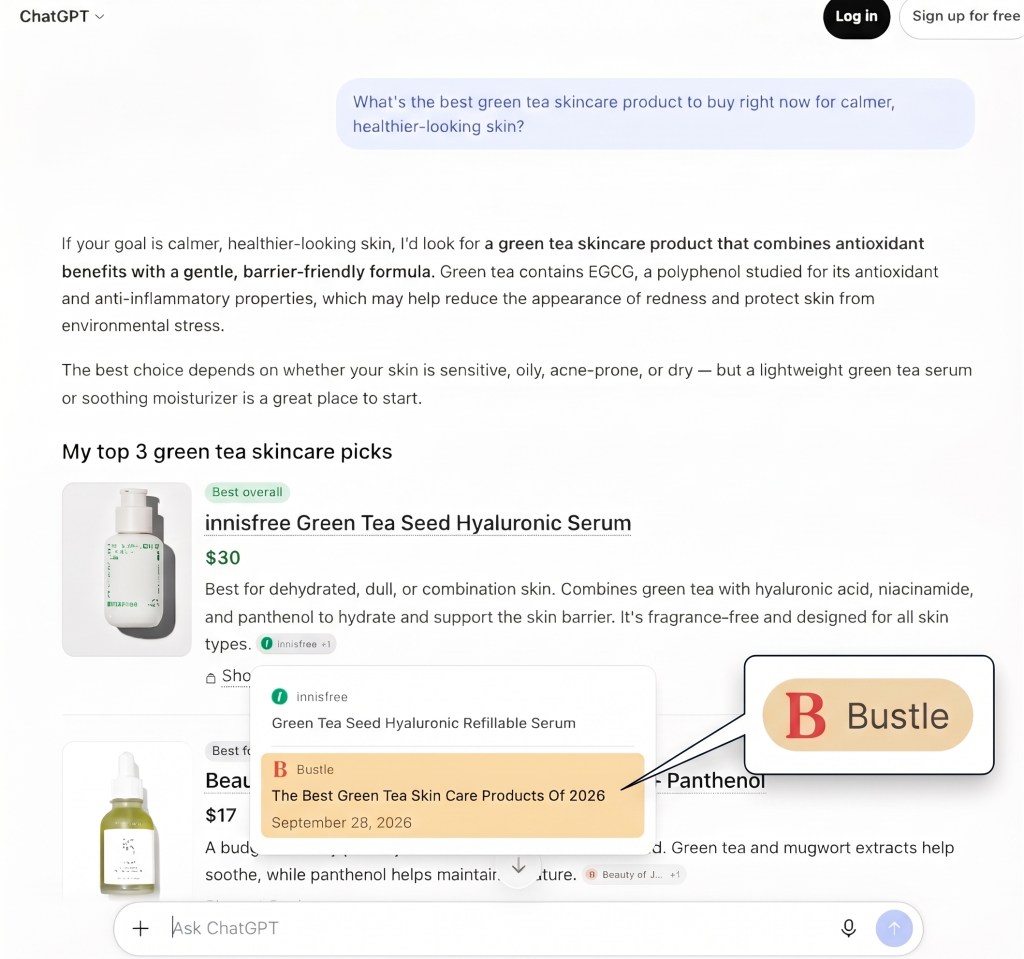
Innisfree is the cleaner illustration. BDG used Bustle's beauty coverage to answer questions about green tea skin care, including a September 2026 product guide that recommended the brand's serum, and tracked AI responses to a defined group of product questions during the campaign.
A BDG and Profound case study, as described by the companies, reported 30% higher AI visibility across 200 tracked skincare prompts for August 11 to September 30. It also said Bustle's citation rank improved from 709 to 12 within the monitored set. Read that precisely: it is the vendor's AI-citation rank, not Bustle's Google search position, and not evidence of product purchases.
Pampers took a different subject. A Scary Mommy explainer addressed the shift to fragrance-free Swaddlers, the kind of product question a parent might put to an AI search tool. For fragrance-free diaper questions, BDG said the brand moved from second to first in tracked AI visibility after the campaign.
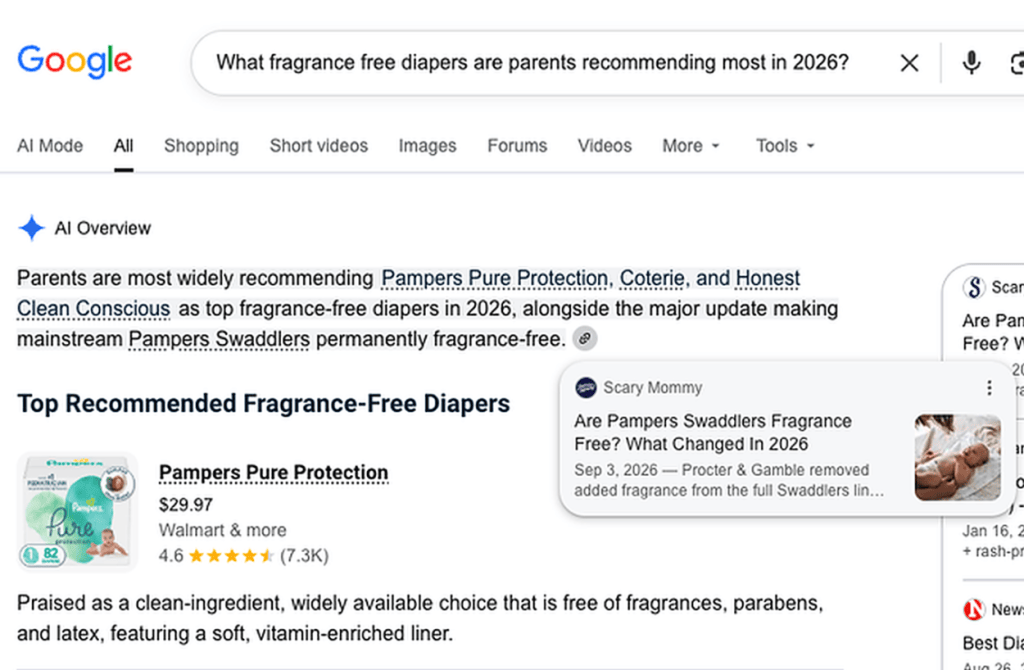
Both figures are vendor-reported and depend on which prompts, platforms and periods were sampled. A citation screenshot is not a conversion study.
Publisher-led GEO vs. dashboards: which fits your team?
Conclusion: they are complements, not substitutes. A publisher buys content and distribution; a dashboard buys measurement. Pick by bottleneck.
BDG's offer sits beside a wider set of tools that measure brand presence in AI answers. Adobe Brand Visibility, previously LLM Optimizer, and Semrush's AI Visibility Toolkit also evaluate visibility, mentions and citations. BDG's distinct commercial pitch is adding content creation and distribution through its own publishing properties.
| Approach | Primary output | Verifiable anchor | Best fit | Watch-out |
|---|---|---|---|---|
| BDG ECHO, publisher-led | Citable editorial plus paid Reddit distribution | Innisfree and Pampers cases | Teams without in-house content supply | Vendor-reported metrics |
| Adobe Brand Visibility, formerly LLM Optimizer | Enterprise tracking plus prescriptive fixes | Launched as LLM Optimizer on June 16, 2025 | Enterprises already on the Adobe stack | Measures presence, not causality |
| Semrush AI Visibility Toolkit | Mentions, citations, prompt and competitor benchmarking | Announced March 4, 2025; AI features listed from $199/mo | SEO teams adding an AI layer | Snapshot visibility, not sales |
Those approaches address related problems, not identical ones. Do not fold every metric into a single return-on-investment claim.
Which metrics should you not book as sales?
Conclusion: visibility, citation share and conversions are three layers. Collapsing them into one ROI figure is the most common budget error.
| Measurement | What it can establish | What it cannot establish alone |
|---|---|---|
| Brand visibility | How often a brand appears in selected AI answers | Incremental consumer demand |
| Publisher citation share | Whether monitored answers reference a publisher's pages | That readers visited or trusted those pages |
| Sales and conversions | Downstream customer action where tracked | Which AI answer caused it, absent attribution evidence |
BDG tracks citation share and rank across AI platforms and supplies campaign reporting. Yet Profound has acknowledged the gap between finding a brand through an AI answer and showing how that discovery affects a later sale. A rigorous click-level audit can tell you which click came from which placement; it still cannot tell you which answer shaped the consideration behind that click.
Treat AI-answer visibility as an upper-funnel outcome. Do not automatically report a rise in tracked mentions as revenue created.
What are the common mistakes when buying AI answer visibility?
- "Citation rank is Google rank." The 709 to 12 move is an AI-citation rank inside the vendor's monitored set, not a Google search position.
- "One prompt set is universal." Results depend on sampled prompts, platforms and dates; a different window tells a different story.
- "The advertiser should write the article." BDG deliberately keeps editors in control because overt ads make weak answers.
- "A screenshot equals a conversion study." It records visibility at a moment, not downstream action.
- "More mentions mean more revenue." Profound itself flags the attribution gap.
FAQ
Is a BDG citation the same as a Google ranking?
No. The Innisfree case's 709 to 12 figure is a citation rank in Profound's monitored set, explicitly not the publisher's Google search position, and it says nothing about purchases.
Can I attribute a sale to an AI answer?
Not from visibility data alone. You need attribution evidence linking the answer to downstream action; Profound has acknowledged exactly this gap.
Do I need a publisher or a dashboard?
If content supply is your constraint, a publisher-led program such as ECHO; if measurement is, a dashboard such as Adobe Brand Visibility or Semrush's AI Visibility Toolkit. Many teams end up using both.
What should I ask before signing?
Which prompts, platforms and date window are sampled, who writes the content, where editorial control sits, and how results are reported apart from sales.
References
- Aggarwal et al., "GEO: Generative Engine Optimization," KDD 2024 (arXiv:2311.09735)
- Pew Research Center, "Google users are less likely to click on links when an AI summary appears," July 22, 2025
- Adobe newsroom, "Adobe LLM Optimizer," June 16, 2025
- Semrush, "AI Visibility Toolkit" documentation
- Profound, "Profound Index" launch, June 2026
Decision checklist
- Define the consumer question, not just the brand name, as Pampers (fragrance-free) and Innisfree (green tea) did.
- Audit the source page: does it answer the question clearly and transparently?
- Set targets for sampled mentions or citations, but report them alongside referral and sales data where the link is reliable.
- Confirm who writes the content and where editorial control sits.
- Record the prompt set, platforms and date window for every reported figure.
- Book visibility as upper-funnel; keep it out of revenue attribution until you have evidence.