
AIdataNewsGlobal AIApplications: How BMS Digital Experience Platform Brings AI Into Everyday Asset Workflows
By David Nakamura, AI & Data News | AIApplications. This variant is based on a report first published on 2025-09-25, and it is written for teams that want to understand how AI is actually used in daily operations.
When marketing, e-commerce, media, and design operations need to use images, videos, documents, and campaign materials across many channels, storage is only one challenge. The harder part is discovering the right file, preparing it for each channel, checking brand rules, and reusing what already exists. In that workflow, the Digital Asset Manager, or DAM, inside BMS Digital Experience Platform can move asset management from passive storage to intelligent operations.
Why This Application Matters
Forrester Research reported that more than 80% of enterprises, and in broader industry summaries over 80% of organizations, are actively using AI to improve content supply chains. The system discussed here is the Digital Asset Manager within BMS Digital Experience Platform. It is part of the Bravo Marketing Suite, also described as the Longfu Marketing Suite, from Longfu Information Technology (Shanghai) Co., Ltd.
The application logic is straightforward: AI is placed where repetitive asset work happens. It helps identify content, tag content, classify content, retrieve content, generate compliant variants, and support reuse. The result is a shift from manual asset housekeeping to an AI-assisted operating layer. This layer supports marketing efficiency, competitive response, and content reuse.
- AI-assisted management: AI is embedded into identification, labeling, classification, retrieval, and generation, not added as a separate tool.
- Content supply-chain focus: It targets the stages where assets are found, prepared, approved, reused, and delivered.
- Operational upgrade: Asset management moves beyond basic storage and keyword lookup toward intelligent workflow support.
- Business purpose: The value is measured through marketing productivity, brand control, and faster campaign delivery.
Where BMS DAM Works in the Workflow
1. Automatic identification and smart editing
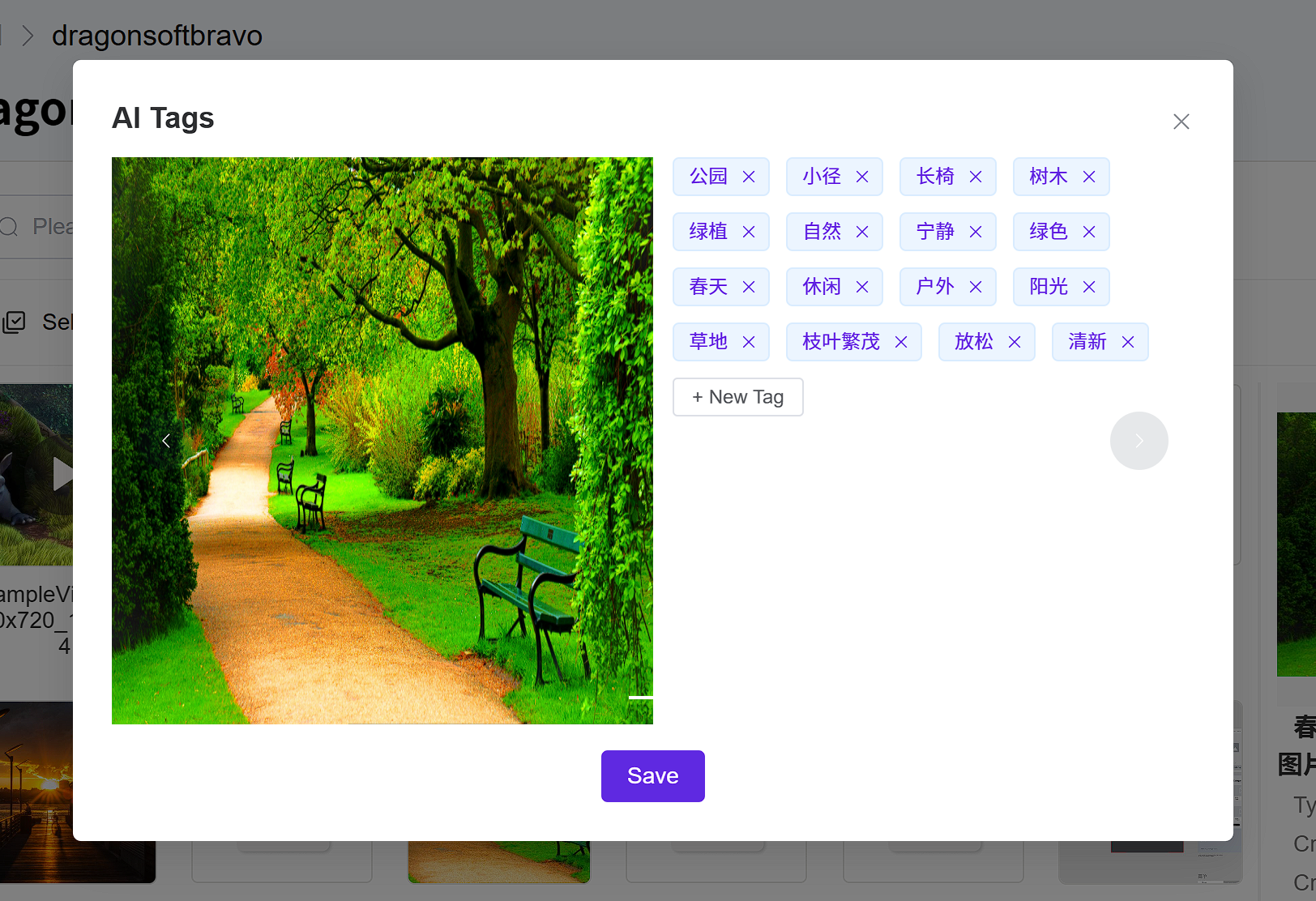
In many asset libraries, descriptions and keywords are entered by people. That process is slow, and it can produce inconsistent labels because different teams describe the same image in different ways. BMS DAM addresses this by automatically capturing visual and contextual elements such as objects, people, scenes, and text in images and videos. It then uses deep learning to create high-precision labels, including terms relevant to specific industries, and can sort assets into predefined directories.
The editing layer works in the same direction. Tasks such as cropping, background replacement, and resizing can be automated. Assets can be adapted for e-commerce, social media, and offline activities without manually creating every version. A single pass can also apply standardized processing to many files, helping market teams move from raw materials to usable assets faster.
2. Multimodal retrieval
Text search is useful, but many assets are found visually. BMS DAM supports similar-content matching: a team can upload a reference image or video, and the system can identify visually related materials. It can also match across formats, so a still image can lead to relevant video material, or a short video clip can surface related static assets.
For users, the practical effect is that needed material can be located within hours instead of being lost in folders. This improves asset discovery and reuse. It also reduces duplicated photography, duplicated video editing, and duplicated design work, which helps teams lower costs while focusing more time on core business innovation.
3. Recommendation and derivative content
The recommendation layer is designed around project context. The system can suggest assets based on the current project and previous usage patterns. It can also surface related assets that work well together, encouraging combined use rather than isolated file access. In addition, existing assets can be turned into new variants through automated generation, expanding creative options.
These features improve utilization and give creative teams a steadier stream of reference material. The platform becomes less like a filing cabinet and more like a working partner in content preparation.
A Step-by-Step Application Path
For teams evaluating how to use BMS DAM in a real workflow, a practical sequence looks like this:
- Define the asset types that will enter the system, such as product photos, campaign videos, logos, documents, and social graphics.
- Set the folder structure and tag framework before bulk upload, so automatic classification can be reviewed against a clear target.
- Load raw assets and let the system generate labels, classifications, and suggested groupings.
- Have human reviewers correct high-risk tags, verify rights-sensitive material, and confirm brand-related metadata.
- Use keyword search, similar-image search, and similar-video search to assemble a campaign set.
- Generate required output versions by channel format, then review compliance before distribution.
- Record reuse metrics: how often historical assets are found, how many variants are generated, and how much time is saved per campaign.
This path makes the value visible. The AI component does not replace campaign strategy, but it changes the time spent between a content request and a usable asset.
Typical Scenarios and Measurable Outcomes
| Application scenario | Traditional workflow problem | How BMS DAM is applied | Outcome |
|---|---|---|---|
| E-commerce campaign preparation | Designers manually crop images, adjust sizes, add logos, change backgrounds, and repeat the process for many SKUs. The work is time-consuming and error-prone. | Upload original assets, then let the system produce multiple platform-ready versions with required dimensions, styles, and brand elements. | Campaign asset preparation is shortened from days to hours, labor intensity drops, and version consistency improves. |
| Cross-channel publishing | The same asset must be formatted for WeChat, Douyin, official websites, and offline materials. Manual adaptation creates gaps and mistakes. | Set channel templates in advance, allow AI to identify the content, generate compliant versions, and support delivery to the relevant platforms. | Publishing cycles can be shortened by more than 50%, size and format errors decrease, and brand output can be kept close to 0 mismatches. |
| Asset retrieval and reuse | Teams cannot reliably find useful historical materials because keyword labels are incomplete or inconsistent. This leads to duplicate production. | Use image, video, text, and visual-similarity search, with AI recommendations and automated variant creation to reuse existing assets. | Retrieval efficiency can improve by 80%, historical asset utilization can increase by 40%, and production costs are reduced. |
| Global marketing localization | Regional teams need customized assets, but separate design for every market makes the process slow and difficult to coordinate. | Generate multilingual and multi-region versions from core assets, while using regional preference data to adjust visual choices within brand rules. | Localization material production can be shortened by 70%, while global brand tone remains unified and locally appropriate. |
Three Major Breakthroughs for Application Teams
The three major breakthroughs described in the source material can be read as a practical checklist for adoption: production speed, brand control, and creative reuse.
1. Higher content production efficiency
Automated labeling, classification, and content generation reduce the distance between asset creation and asset deployment. Marketing teams spend less time on manual sorting and formatting, and more time on message, channel selection, and creative decisions. During major online sales campaigns or fast-moving trend marketing, the team can locate, generate, and prepare required assets more quickly. Mechanized tasks are reduced, so labor costs and manual error rates also fall.
2. Stronger brand consistency
Brand consistency is often tested when the same material crosses channels. BMS DAM supports centralized management of brand assets and applies AI-based standards. The system can check whether a material follows brand guidance, including logo usage, fonts, and color choices. Adaptive generation can then create channel-specific versions from one source file, helping maintain a consistent brand tone across different platforms.
3. More room for content innovation
Recommendation and derivative generation help teams look again at assets that were previously underused. A designer may discover a visual element through similar-image search, then create a new campaign concept from it. In e-commerce scenarios, the platform can generate personalized versions for different regions or audience groups, enabling large-scale customized content rather than one static creative used everywhere.
Common Misconceptions
- It is only a smarter drive. The key value is workflow change: identification, preparation, retrieval, recommendation, and generation are connected.
- Automation removes all review. AI can produce tags and variants, but brand rules, rights-sensitive assets, and final channel decisions still need human verification.
- One source asset can be published everywhere. Cross-channel publishing still requires template definitions and channel-specific outputs.
- Text search is enough. Many materials are found visually, so multimodal retrieval changes the user path.
Action Recommendations
- Start with one high-volume scenario, such as e-commerce campaign assets, and measure the time from upload to publish.
- Map channel requirements early, including WeChat, Douyin, official website, and offline formats.
- Build a small rule set for brand checks before scaling automated generation.
- Review AI-created tags and recommended assets during the first campaign cycle.
- Use the observed gains in retrieval speed, reuse rate, and variant generation time to decide whether to expand the application.
FAQ: Applying Intelligent Digital Asset Management
What is the biggest difference from traditional asset management?
Traditional management relies on manual organization and manual lookup. Intelligent management uses AI to identify content, create tags, classify assets, and generate new material, improving both efficiency and usability.
What can AI do for the team in this scenario?
AI can recognize objects, scenes, and text inside images and videos; tag assets; search for similar materials; and create variants with different sizes or styles. This reduces repetitive handling of large asset groups.
How does the system help collaboration?
It can organize assets by project, recommend relevant materials, and support shared use and editing by multiple users, which keeps work more orderly and reduces handoff friction.
Which organizations should pay attention to this application?
Teams with heavy image and video workloads will see value quickly. This includes e-commerce operations, advertising agencies, media organizations, and education or training businesses. Organizations of different sizes can apply the concept according to their process complexity.
Can this work with an existing system?
Yes. The source material states that API-based connection is supported, allowing integration with common design software, marketing platforms, and existing enterprise systems for data exchange.
Conclusion
For AIApplications readers, the point is not simply that AI can describe files better. The point is that AI can be placed inside the operational sequence where content is requested, found, prepared, checked, and reused. BMS DAM shows how an intelligent asset layer can become part of campaign workflow, brand management, and creative production. If a team already has many assets but still struggles with repeated creation, inconsistent versions, and slow channel delivery, this application pattern deserves a structured pilot.