
AI Applications in the Climate Workflow: Seven Field Cases, a Playbook and the Failure Modes to Watch
By David Nakamura | AIdataNewsGlobal — AIApplications desk
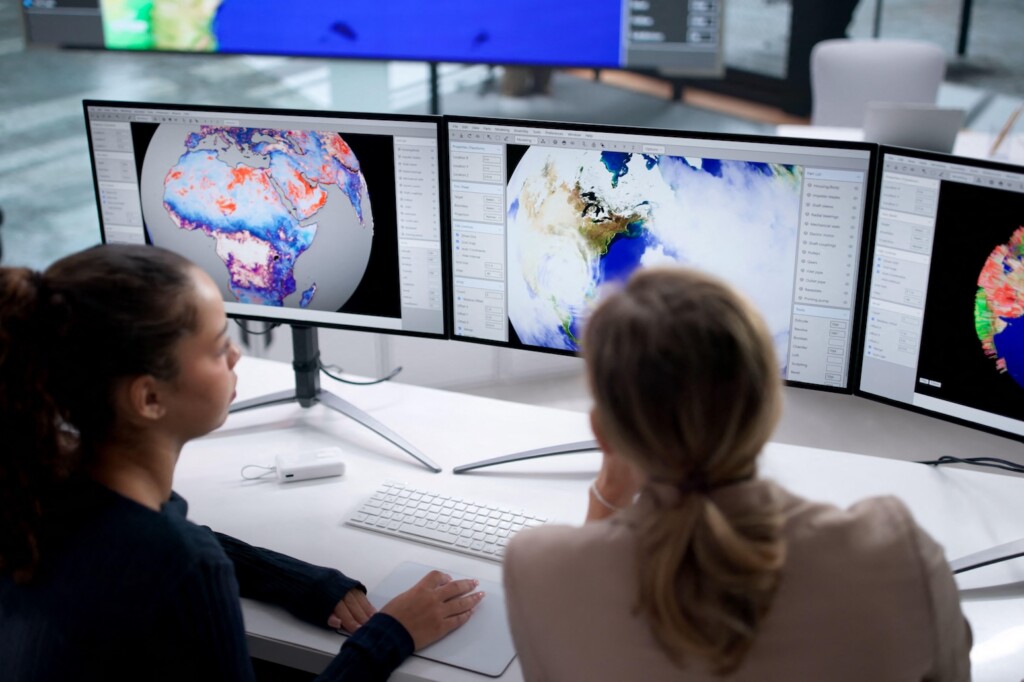
Weather-pattern displays in a forecast operations room. Credit: Andriy Popov / Alamy Stock Photo
Software earns a permanent seat in an operation only when it attaches to a task somebody was already doing by hand. That rule, familiar to anyone who has shepherded a tool into a production team, explains what is happening in climate work better than the usual hype cycle does. An expert survey carried out by Carbon Brief spoke to 10 experts whose jobs range from producing decadal projections to reading the electricity grid, and their answers read like deployment notes rather than a technology review: which stage of the pipeline the model entered, what it saved, where it failed quietly, and what had to be built around the output before anyone could act on it. The seven cases below reconstruct those deployments; the final sections convert them into a step sequence, a pre-pilot checklist and a risk register that non-algorithmic teams can reuse.
Intake sheet: scope, questions and respondents
Seven lines of enquiry frame the material, and every case in this review answers one or more of them:
- the benefits and limits of AI in weather and climate forecasting
- other active uses of AI inside research work today
- how AI is being used in climate policy and action
- what adoption is likely to look like in the coming years
- the misconceptions that distort expectations and funding
- whether AI closes or widens inequalities in who gets climate information
- the risks and blockers left on the table
Respondents include modelling leads at the UK Met Office, the University of East Anglia and the Barcelona Supercomputing Centre, a polar scientist at New York University, an energy-systems researcher from the Massachusetts Institute of Technology, a policy-cycle analyst at Politecnico di Milano, a scenario specialist at the PBL Netherlands Environmental Assessment Agency, and Prof Detlef van Vuuren, whose agency work feeds the assessment cycle described below.
Case 1 — Forecast operations: running an AI model beside the physics engine
The setup
Dr Doug McNeall, science lead in data-driven climate modelling at the UK Met Office, treats machine-learned forecast models as the most consequential recent development in his field. The mechanism is easy to explain to a non-specialist: the system learns from very large volumes of weather data, predicts the next few hours, then repeatedly feeds that prediction back into itself to build a forecast reaching two weeks into the future.
The operational proof point came from the European Center for Mid-Range Weather Forecasts. Prof William Collins, professor of AI for climate science at the University of East Anglia, notes that the centre now deploys an AI forecast system alongside its traditional system as part of official communication of weather predictions to the European community — and the centre's own publications date that shift precisely, recording that its Artificial Intelligence Forecasting System became operational in early 2025 and runs in parallel with the conventional model rather than retiring it (ecmwf.int). Collins' assessment of capability: these systems are good enough to be absolutely competitive with the world's leading numerical weather prediction.
What actually changed
Price per run. The models demonstrated that AI can produce accurate predictions while needing far less computing power than existing numerical models, which simulate the climate through explicit mathematical equations. For an in-house team the transferable finding is simple: once the marginal cost of a forecast stops dominating the budget, you can afford more runs, more users and a finer update cadence.
Where the case breaks
The ingredients that made the pilot work disappear one level up the timescale. Short-range forecasting benefits from dense observations — temperature, rainfall, sea ice extent — and lets performance be evaluated quickly and rigorously. Climate prediction is structurally different: useful information requires projections of future climates that lie outside the observational record. "We're literally trying to predict the future. We don't have observations of it," Collins says, and that absence of data is, in his words, the central challenge the community is trying to overcome.
Pattern worth copying
McNeall's recommendation is a blended architecture: use AI to emulate or accelerate existing models rather than relying solely on purely data-driven approaches, which could make climate risk information far more accessible and affordable to produce while keeping the physical understanding that underpins confidence in projections. Operationally: ship the AI output as a parallel channel, keep the physics baseline as the control, and publish the gap between the two instead of asking users to trust a single new box.
Case 2 — Extreme events: the failure mode that matters most for adaptation
Dr Amirpasha Mozaffari, a researcher in Earth artificial intelligence at the Barcelona Supercomputing Centre, describes a consistent operational picture: AI forecast models perform well on typical weather yet underperform physics-based models on record-breaking and unprecedented extremes — precisely the events that matter most for adaptation to climate change.
Benchmarking work outside the survey sharpens the warning. A comparison published in Science Advances reports that the ECMWF high-resolution numerical forecast still consistently outperformed leading AI systems — GraphCast, Pangu-Weather and Fuxi, in both research and operational variants — on record-breaking heat, cold and wind, with forecast errors growing larger toward the tails (science.org).
Mozaffari frames the fix as the field's central open problem and names three routes: hybrid models that combine AI with traditional models; physical constraints, where rules based on the laws of physics are implemented so the system cannot produce impossible output; and new ways of evaluating models on what they have not seen. The deployment lesson for anyone putting AI behind a threshold — a flood trigger, a heat-action day, a grid stress alert — is blunt: never retire the physics baseline during a pilot, and gate go-live on tail behaviour rather than average skill.
Case 3 — Satellite analytics: converting pixels into an alert somebody can act on
Dr Stefano Materia, a researcher in climate variability and change at the Barcelona Supercomputing Centre, describes the binding constraint as volume rather than scarcity: the proliferation of Earth-observation satellites has produced a massive influx of geospatial data, including imagery showing deforestation or sea ice melt, and AI is being used to translate raw pixel data into actionable climate intelligence. Methane tracking and ecosystem monitoring are two examples already in service.
Methane is a potent greenhouse gas whose leaks are largely invisible and hard to track. Algorithms now automatically scan hyperspectral imagery — data drawn from across the electromagnetic spectrum — from satellites to pinpoint specific industrial methane leaks globally, alerting operators in near real time.
On the ecosystem side, machine-learning models process thousands of satellite images daily to detect illegal logging, track land-use changes and monitor glacier retreat long before humans could manually review the footage.
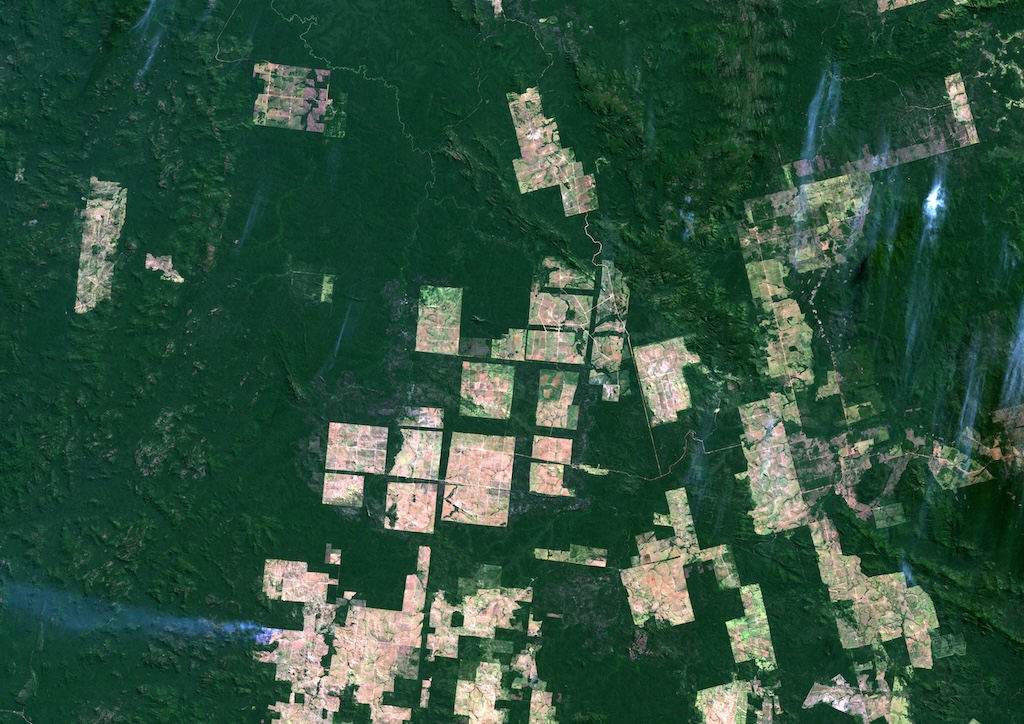
Satellite image showing deforestation in Para, Brazil. Credit: Universal Images Group North America LLC / Alamy Stock Photo
Pattern worth copying
The reusable part of this case is not the classifier but the routing. A detection only has value when it terminates in an owner — an operator who can switch a valve, a ranger who can be dispatched, an agency that can cite a location. Teams that copy this pipeline should specify the alert recipient, the response window and the false-positive tolerance before they specify the model.
Case 4 — Sea ice: extracting signal from a thin, fragmented archive
Dr Clare Eayrs, a polar research scientist at the Environmental Fluid Dynamics Lab at New York University, says machine learning is now used across the whole sea ice modelling workflow rather than parked at a single stage. The most mature applications are extraction problems: mapping fine-scale sea ice deformation from ship radar, and classifying snow layers inside micropenetrometer profiles, which measure the hardness or softness of different layers of snow.
Forecasting is the most visible application. Ice Net was an early demonstration that a deep-learning system — built on models inspired by the layers of a human brain — could outperform a leading physical model in seasonal Arctic forecasts; today machine-learning systems are used to predict variables such as sea ice concentration, thickness and drift.
The limiting factor is time depth. Much of what we know about Antarctic sea ice comes from the satellite era, which begins in 1979 — a short record for a system with strong decadal variability. Ship logs, whaling records, expedition photographs and early aerial and pre-1979 satellite imagery carry the earlier conditions, and machine learning is well suited to extracting it. Lengthening the observational record, she notes, would improve almost everything else we do, including training and testing AI systems.
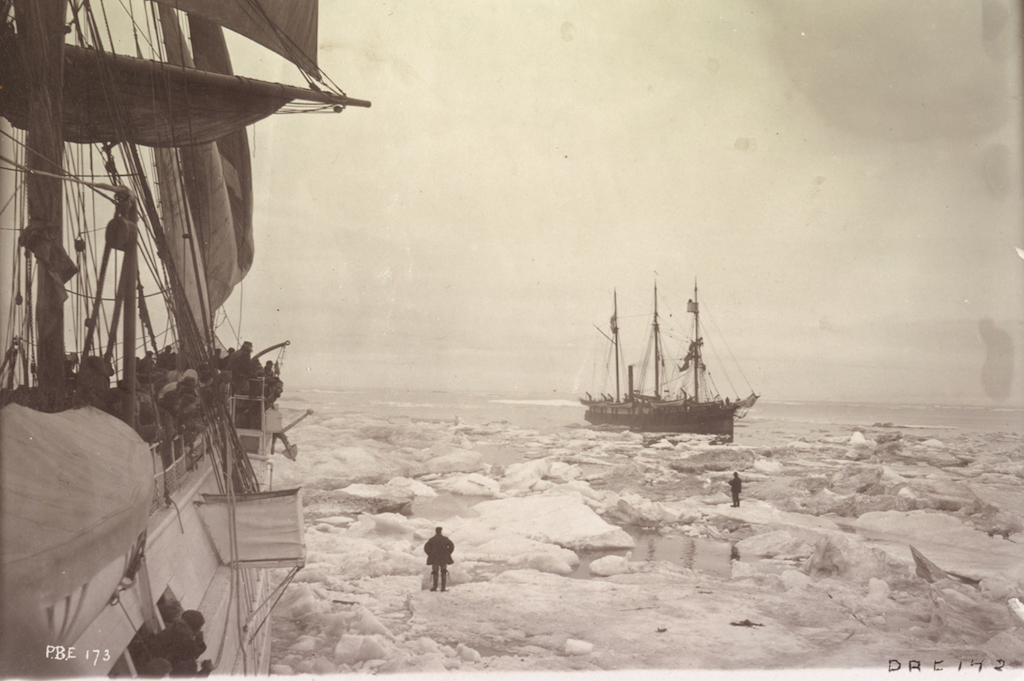
"The Bear" whaling ship getting free from the ice pack. Credit: New Bedford Whaling Museum
Case 5 — Research infrastructure: intercomparison projects and a much shorter transfer time
Prof Cristiana Stan, vice-chair of the World Climate Research Programme (WCRP), says AI now appears across all major parts of the programme. The "weather prediction model intercomparison project" — an initiative to create a centralised database of physics-based, machine-learning and hybrid model forecasts — is her worked example: because it is focused on operational models it offers a direct comparison between state-of-the-art systems, is intended to accelerate the deployment of the next generation of operational models, and contributes to development of metrics needed to assess relative strengths and weaknesses of models. Downscaling is her second example, using AI to refine coarse-resolution model output into high resolution.
Dr William Collins points to the institutional milestone: the Intergovernmental Panel on Climate Change (IPCC) is performing its seventh assessment report (AR7), and this time, for the very first time, there is a model intercomparison project just for models using AI for weather and climate forecasting. He reads that as a real milestone, a proof of principle and the harbinger of many more developments of this kind.
Transfer speed has collapsed. Mozaffari recalls that a few years ago it took two or three years for a new architecture to make its way from the machine-learning community into weather and climate work; today it is a matter of months, with diffusion models, foundation models and generative ensembles arriving almost as soon as they appeared elsewhere. He also notes that the cost of running a global forecast has dropped by orders of magnitude, which in principle changes who can produce weather and climate information at all.
Case 6 — Power systems: forecasting renewables and steering flexible assets
Prof Priya Donti, assistant professor at the Massachusetts Institute of Technology and co-founder of Climate Change AI, frames the grid problem as an operations problem: as more solar, wind and other renewable energy is introduced into the power grid, we need to rethink how we actually manage the various sources on it.
She describes two distinct insertions for AI. One is simply trying to get better predictions of solar and wind power production in order to reduce that uncertainty and allow us to plan with a little more foresight. The other major use is helping to optimise and control the various components we have on power grids — the power generators, the batteries, flexible loads like industrial loads, or the batteries in your electric vehicles or heating and cooling systems.
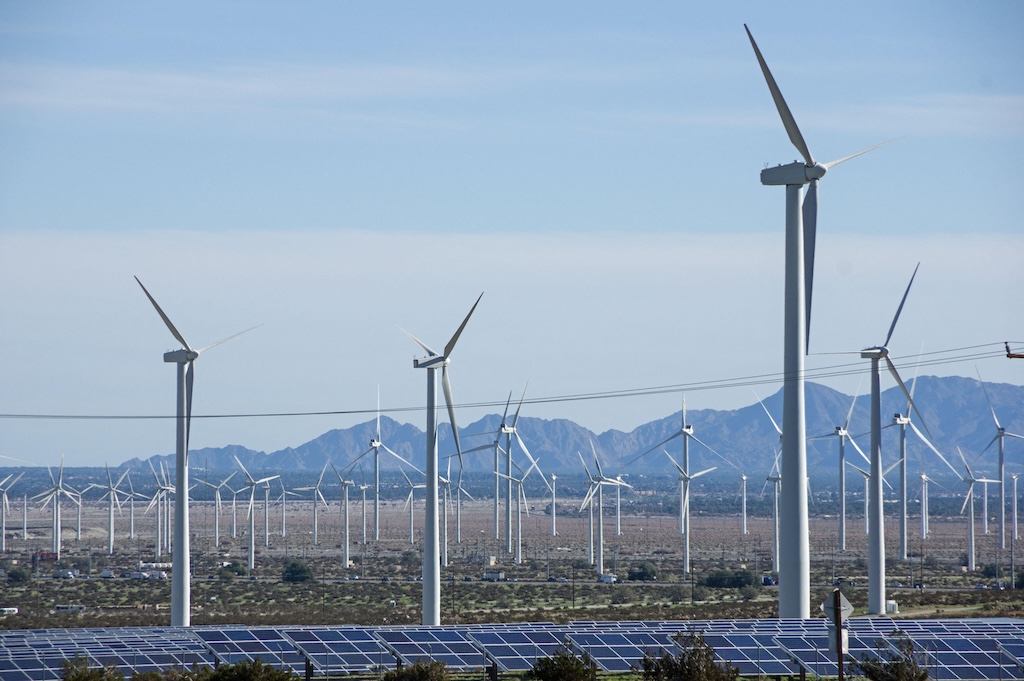
Wind turbines and solar panels in California. Credit: Tom Grundy / Alamy Stock Photo
Case 7 — Policy units: three stages of a cycle that AI now touches
Dr Carlos Rodriguez-Pardo, postdoctoral researcher at Politecnico di Milano and affiliated scientist at the European Institute on Economics and the Environment and at the Euro-Mediterranean Center on Climate Change, says AI is already useful at every stage of the climate policy cycle, and maps it in order.
The first stage is measurement: understanding what is happening, what has been tried and who is exposed. Machine learning helps us process satellite imagery to estimate emissions, improve air quality monitoring, harmonise fragmented policy databases and map a scientific literature that has grown far beyond what any human team could read.
The second stage is modelling futures. The models used to explore climate and economic scenarios are computationally very expensive, so AI-based emulators — simple models that stand in for more complex ones — that reproduce their behaviour at a small fraction of the cost are transforming what we can do: instead of a handful of scenarios, we can explore thousands and quantify uncertainties that were previously out of reach. Reinforcement learning, a type of AI in which a computer programme learns to make decisions through trial and error, is also allowing the study of how multiple actors, such as countries or electricity producers, compete and cooperate under different policy designs, revealing strategies that classical analysis misses.
The third stage is evaluation, where causal machine learning extends the toolkit used to answer whether a policy actually worked — a different and much harder question than predicting what will happen next.
Forward calendar: what the next assessment cycle changes for users
Stan reports that the WCRP has established a task team to address exactly this question, with focus areas covering modelling and projections; data and observations; impacts and services; engagement with the private sector supporting development and integration of AI and machine learning into climate research and applications; and the scientific rigour and trustworthiness of AI and machine learning methods.
Collins goes further: the IPCC's eighth assessment, likely due in the late 2020s, may itself largely be written using large language models, since the job of the people writing the report is to synthesise. His own condition is that AI should be telling us the known unknowns, not the known knowns, because that is what shows where the science should be heading. He adds that AI will also be an integral part of the eighth Coupled Model Intercomparison Project, with machine-learning codes running alongside traditional climate models. Governance is arriving on the same timetable: in September 2026 the IPCC established an "informal group" on AI to "provide timely guidance on the responsible use of AI and emerging digital technologies in IPCC processes". Outside the IPCC, an extraordinary session of the World Meteorological Congress endorsed integrating AI into the organisation's global observation and forecasting framework in October 2025, which tells national agencies that a compliance conversation is now unavoidable (wmo.int).
Materia describes the research-side trajectory as a paradigm shift rather than a swap-out: hybrid modelling merges the mathematical rigour and physical consistency of traditional process-based Earth system models with the pattern-recognition power and speed of machine learning. Used that way, he says, it will be able to overcome computational bottlenecks, replace unresolved subgrid processes that are too small to be captured by a model's grid cells, improve the terrestrial biosphere, narrow down the uncertainties on the terrestrial carbon sink, and accurately pinpoint emergent constraints and non-linear tipping points.
Common misconceptions: the reason pilots get funded for the wrong reason
Dr David Rolnick says AI is frequently thought of as large generative models, like those developed by large tech companies, but that is not mostly what is useful in AI for tackling climate change. The same applies to the energy debate: the massive energy and other requirements of AI systems refer to those large-scale generative and agentic systems, not mostly to the kinds of AI systems actually used to fight climate change. Water use and societal impact are very real worries, and the fleet-level numbers explain why the question is asked at all — the International Energy Agency projects global data centre electricity consumption to more than double to around 945 TWh by 2030, growing roughly 15% a year across the decade (iea.org). A team evaluating a climate use case should not, however, measure a methane classifier against a chatbot's footprint.
Donti sees the same distortion upstream of the lab: the general public thinks of AI as one specific thing, often large language models, chatbots and similar tools such as ChatGPT, Claude and Gemini. People who are making allocation decisions about who funds scientists might have a mismatched understanding of what needs to happen, which means the right science does not necessarily get funded.
Inequality ledger: who trains the model, who is measured by it, who benefits
Dr Amirpasha Mozzafari warns that frontier models are built almost exclusively in the global north, trained on data that is densest where observations are richest and validated against benchmarks that reflect the same regions. Cheap inference does not fix that on its own: being able to run someone else's model is not the same as having a say in what it is trained on, how it is evaluated, or whether it serves your decisions. Without deliberate effort to share data infrastructure, evaluation metrics that centre on people's wellbeing and genuine co-production of knowledge, he argues, AI risks automating and amplifying the existing divide in the global climate information system rather than closing it.
Rodriguez-Pardo sees the opposite polarity if the work is done well: developing AI-based Earth system models could dramatically lower barriers to entry, letting a small research group, or an agency in a data-poor region, adapt a pre-trained model on modest hardware rather than building bespoke systems from scratch. That matters because the data is thinnest and the resolution gap is largest exactly where vulnerability to climate change is highest.
Rolnick, associate professor in the school of computer science at McGill University and co-founder of Climate Change AI, puts it as a design question: climate action should fundamentally be about democratisation of action and equitable response, both in mitigation and in adaptation, and the consolidation of large-scale AI can often work counter to those goals by consolidating power in certain geographies and stakeholders, and by defining action based upon the goals of those stakeholders. When technology is built in specific institutions, they do not necessarily understand the needs of the majority of the world's population or local stakeholders from other geographies.
Risk register: trust, plausible answers and the observation budget
Eayrs names trust as the biggest challenge, with a checklist attached: good performance is necessary, but it is not enough; teams also need independent evaluation, physical credibility, process-based validation, robustness and some degree of interpretability. Shared benchmark suites are the practical version of the first item — WeatherBench 2, developed by Google Research together with the ECMWF for assessing data-driven global weather models, exists precisely so that a builder is not the only judge of the build (developers.google.com). Her deeper worry is budgetary: the apparent success of these systems could be read as a reason to invest less in observations, when AI is not a substitute for observation, physical understanding or careful evaluation. Especially for Antarctic sea ice, where observations of sea ice and snow thickness remain sparse and understanding of snow-ice processes remains limited, we need more targeted observations, not fewer, and far better documentation of them and their uncertainties.
Collins states the epistemic risk as a testing discipline: the challenge is always making sure that you are getting the right answer for the right reason, and the risk is getting a plausible answer that is "truthy", but not the truth. Ask a computer for an answer and it will give you one; it is very good, it will always obey, it will always give you an answer. The question is whether that answer is valid.
Rolnick's first and foremost risk is political rather than technical: AI diverging attention from other forms of climate action.
Implementation playbook: seven steps these cases support
- Name the task, not the technology. Start from the manual step that already exists — a two-week forecast roll, a hyperspectral scan, a policy-database reconciliation — and define the human output it replaces.
- Keep a control channel running. Every case that worked ran the learned system alongside the conventional one before it was allowed to lead; publish the delta between the two.
- Test on the tails. Score the system on record-breaking and unprecedented conditions, not only on average skill, because alert value lives in the extremes.
- Convert the compute saving into coverage. With global forecasts now orders of magnitude cheaper, spend the difference on more scenarios, more regions and a finer update cadence.
- Build the alert loop before the model. Decide who receives an automated detection, within what response window, and what happens to false positives.
- Log provenance and representativeness. Record where training observations came from and which regions are thin, so the equity question can be answered rather than assumed.
- Protect the observation budget. Treat a model's success as evidence that collection is working, not as a substitute for it, and document uncertainty alongside every product.
Pre-pilot checklist: ten questions before AI touches your workflow
- Is the target task short-horizon and data-rich, or long-horizon and outside the observational record?
- Is there an independent evaluation the model's builder did not author?
- Can a domain expert explain the physical mechanism behind a typical output?
- What is the fallback if the learned component is unavailable for a week?
- Which extremes are in scope, and how will performance there be verified?
- Who owns the output when the model is wrong — a person, a desk, a legal unit?
- What is the energy and infrastructure budget, and what is the counterfactual use of that money?
- Are the training data regionally representative of the people who will act on the result?
- Is every input observation, and its uncertainty, documented well enough to audit later?
- Would this capacity be better spent on a non-AI climate intervention?
Action recommendations for practitioners
Read these cases as an adoption sequence rather than a verdict. The evidence supports starting where observations are dense, the horizon is short and verification is fast; it supports keeping the physics or human baseline in the loop until tail performance is proven; and it supports spending the compute saving on breadth of coverage instead of on one headline model. Where the workflow is a policy or equity workflow, the harder design work is organisational: who co-produces the data, whose wellbeing defines the success metric, and which office receives the alert.
The two failure patterns worth guarding against are mirror images. One is treating a plausible number as a correct one — the answer that keeps a decision moving while nothing about the world has been verified. The other is treating a cheap model as a reason to stop measuring the world, which removes the only resource future systems will be trained on. Teams that internalise both warnings, and that run AI as a parallel channel with a named owner and a documented uncertainty range, are the ones whose deployments in this review are still running a year later — which is the practical definition of a successful application.