
AIdataNewsGlobal AIApplications Playbook: Turning AI Security Scans Into Fixes Maintainers Actually Ship
By Sophia Baker · AIdataNewsGlobal AIApplications desk. Questions and corrections: editorial@aidatanews.com.
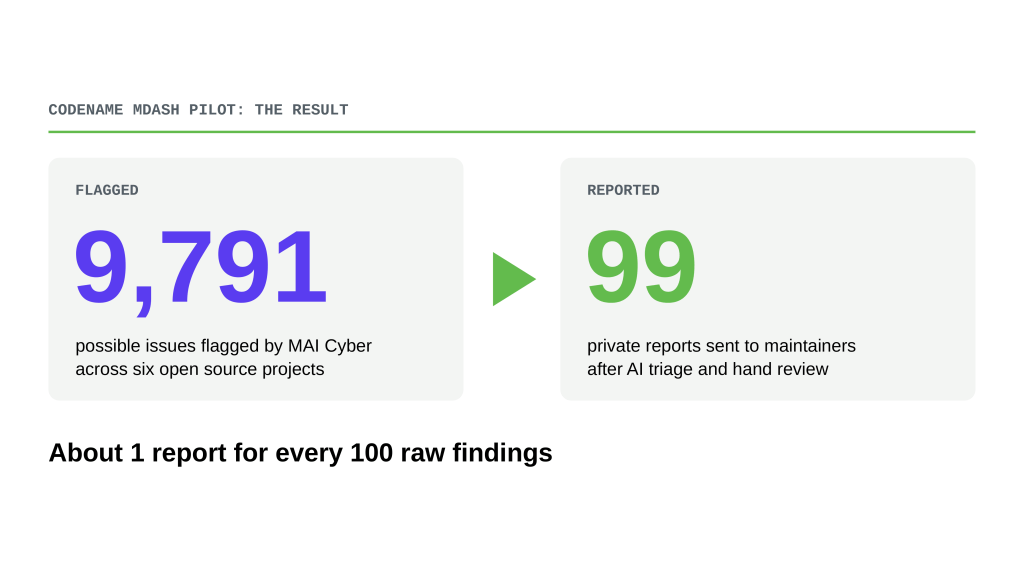
An AI-generated security report is worth sending only if someone has already verified it and attached a fix a maintainer can merge. The GitHub and Microsoft pilot set that bar in measurable terms: seven Microsoft FORGE Lab researchers hand-checked Codename MDASH scan output across six projects down to 99 private reports, maintainers had fixed 55 of them as of November 15, and 14 of those fixes were already in a release.
Start from the funnel, not the demo: thousands of possible issues went in, 55 verified fixes came out, at a verification cost of about two days per project. This playbook reconstructs the pipeline stage by stage — what each stage removes, what you can reuse today, and where the approach still breaks — written for the practitioner who has to run it, not the vendor selling it.
Why does a raw scan dump fail maintainers?
Verification, not discovery, is the constraint. Scanners surface potential vulnerabilities quickly and cheaply, but judging which ones deserve action still takes a human — and in open source that human is the maintainer, already absorbing AI-generated findings, duplicates and outright non-vulnerabilities. Christian Grobmeier, a maintainer of Log4j, framed the bar bluntly: the AI defending open source has to be better than the AI attacking it. Against that bar, an unverified dump has negative value: it converts maintainer review time into sender-side noise.
GitHub and Microsoft therefore built the pilot around two goals: only findings that matter should be sent, and no maintainer should receive an unverified finding. The central question was whether AI could help maintainers ship fixes instead of handing them more findings.
How does the five-stage pipeline actually run?
The pipeline ran on Codename MDASH, Microsoft's multi-model agentic scanning harness from Microsoft Security, and every stage was designed to remove work from the maintainer's side of the table:
- Find. Codename MDASH scanned each project with Microsoft's MAI Cyber model and drafted fixes for what it flagged.
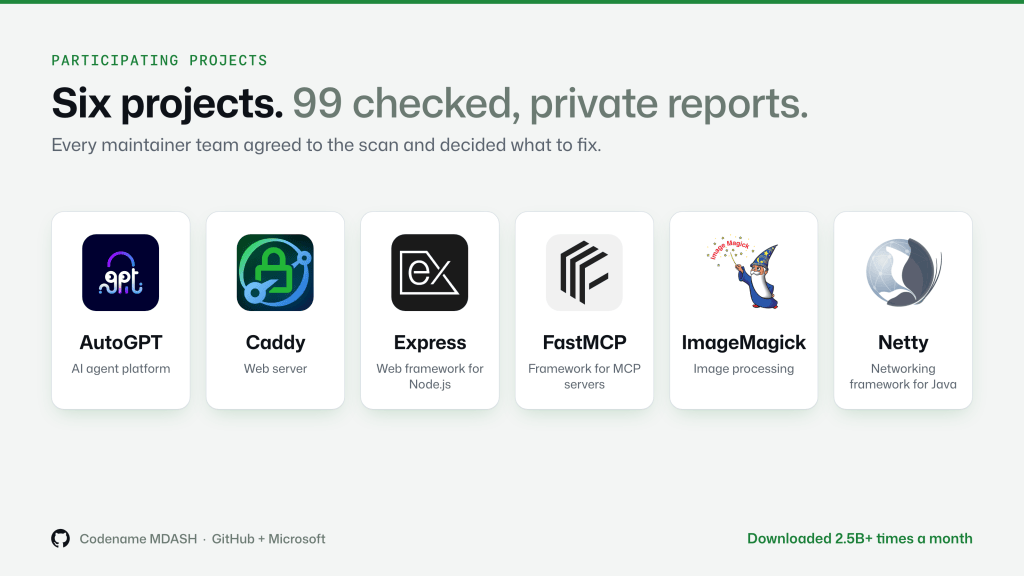
- Filter. An AI triage agent from the GitHub Security Lab, built on tailored Copilot skills, removed duplicates, checked validity and concentrated on high-impact bugs, so maintainers never saw raw scan output.
- Verify. Microsoft FORGE Lab researchers checked every surviving finding by hand.
- Report privately. Reports reached maintainers through GitHub private vulnerability reporting, each with a proof of concept and a suggested fix.
- Fix. Maintainers decided what to fix, how, and on what schedule.
Reports and fixes stayed on GitHub, where maintainers already work — no new tooling to adopt. The division of labor held throughout: AI did the finding, researchers did the checking, and maintainers stayed in charge, a pattern worth copying in any workflow where agent output lands in a human queue.
What do the numbers actually show?
Across the six projects, Codename MDASH flagged thousands of possible issues. After AI triage plus hand review by seven Microsoft FORGE Lab researchers, maintainers received 99 private reports; as of November 15, they had fixed 55, and 14 of those fixes were already in a release. Treat it as a funnel: candidate count is noise, delivered-and-verified reports are the signal, and the merge rate on those reports is the number that justifies the pipeline.
| Project | What maintainers reported | Headline figure |
|---|---|---|
| Caddy | Fixed 22 of the reports in a week or less, using the suggested fixes as written or with changes | First fixes shipped about a week after the initial scan |
| AutoGPT | A newly shipped check was broken; the report landed three days later and pointed at the right line; maintainers went beyond the suggested patch | Fix written within a day, in production less than a week later |
| ImageMagick | A two-person team received 22 reports; one report that looked familiar turned out to be new, with the summary pointing at the exact lines of code | Fix pushed in 15 minutes, against around 30 minutes to 1 hour on average for a normal advisory |
| Netty | "Finding vulnerabilities is no longer our bottleneck. Fixing them is the hard part, and that depends on maintainers." | Fix capacity, not scan capacity, is the ceiling |
| Express | "Codename MDASH is very useful for cutting through the noise of vulnerability reports." | Short list beats flood |
| FastMCP | "The Codename MDASH scan provided unique insights into the security of our project above and beyond what AI scanners have provided us in the past." | Coverage beyond prior scanner output |
One ImageMagick report shows why a precise summary matters as much as the patch: it resembled an issue class the maintainers knew, the report's summary showed it wasn't, and the exact line pointers were enough to push a fix in 15 minutes. An ImageMagick maintainer put the economics plainly: "Normally, a security advisory would take us around 30 minutes to 1 hour on average to read, understand, and make a fix. It is a huge difference."
How do you run the same workflow on your own project?
You do not need Codename MDASH to adopt the delivery standard. The maintainer-side setup is short and mostly configuration:
- Turn on private reporting. Enable GitHub private vulnerability reporting; gh-secure switches on core security features in about two minutes.
- Stand up private-fork CI. Run the test suite on a private fork against each suggested fix, so verification never happens in public.
- Reproduce before you merge. Confirm the proof of concept triggers on the vulnerable build and stops triggering on the patched build; this is where access to a cyber-capable model earns its keep.
- Adapt the patch. Review the suggested fix against your threat model and security policy; treat it as a starting point, not a drop-in.
- Publish the advisory. A reviewed advisory feeds the GitHub Advisory Database, and Dependabot alerts every downstream repository that depends on the package.
- If you are downstream, not a maintainer: turn on Dependabot alerts so you learn when a dependency needs a security update.
If you are on the sending side, hold your own reports to the pilot's standard: check each finding against what the project already knows, its threat model and its security policy; report it privately; include a suggested fix and let maintainers set the pace. Repositories using GitHub code security can also use agentic autofix with Copilot to remediate alerts automatically.
What are the common pitfalls?
- Measuring scan volume instead of verified fixes. The pilot's persuasive number is 55 of 99, not thousands of candidates. Measurement guidance points the same way: count what gets verified and fixed, because verification and repair are now the bottleneck (securing.ai, October 3, 2026).
- Ignoring patch absorption capacity. The Cloud Security Alliance's November 2026 whitepaper on the disclosure bottleneck recommends managing the rate at which fixes can be absorbed, tested and deployed — not discovery counts.
- Assuming an AI scanner alone is a deliverable. Anthropic's OSS Scanner (launched October 8, 2026) runs free opt-in periodic scans of open-source projects — a useful complement, but the pilot's defining difference is that researchers verified each finding before delivery. Without that step, triage moves back to the maintainer.
- Flooding private reporting channels. GitHub has introduced daily rate limits on new private vulnerability reports to curb low-quality and automated submissions (DevOps.com, October 5, 2026). Bulk unverified reports now risk both rate limits and sender credibility; low-quality reports still reach maintainers every day.
- Underestimating verification cost. Seven researchers spent about two days per project checking findings by hand. That is today's price of "no maintainer receives an unverified finding," and it does not scale yet.
Who should adopt this, and what does it cost?
Maintainers first: the private-reporting setup above costs minutes and changes what a security report costs you — a checked, private report with a suggested fix takes less of your time, and triaging scanner output is the sender's job. Downstream users second: enable Dependabot alerts. Senders of AI-generated reports last: meet the standard before you send.
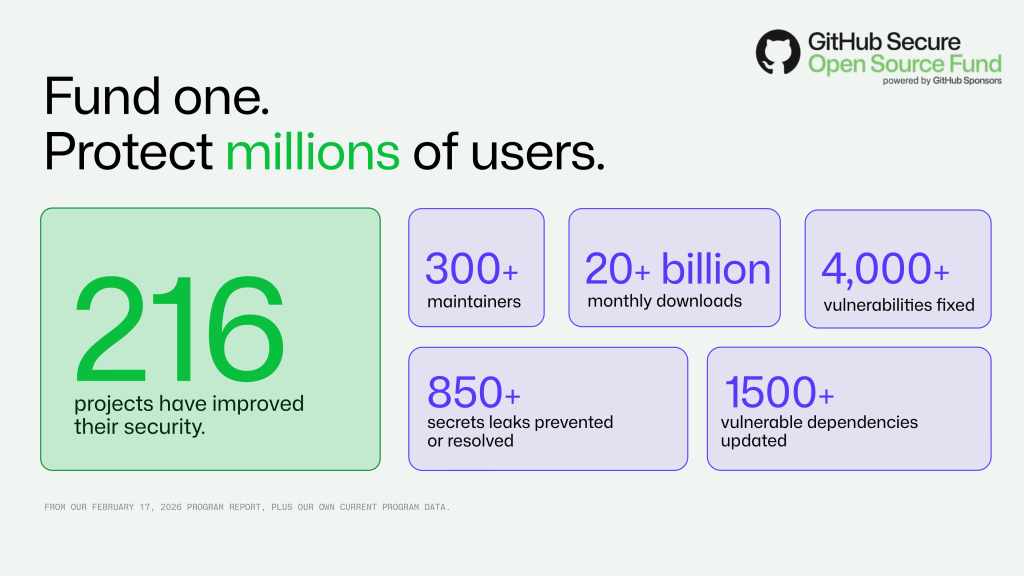
The infrastructure behind the pilot is the GitHub Secure Open Source Fund: each project receives $10,000 through GitHub Sponsors, plus security training and Azure credits from Microsoft for Startups. That support sits alongside Microsoft’s European Security Program and the Secure Future Initiative, whose principle is security above all else. Scale to date: 216 projects, more than 300 maintainers, more than 4,000 vulnerabilities fixed in software downloaded more than 20 billion times a month. Fund alumni also receive GitHub Copilot Max, and GitHub will offer every alumni project AI security scans with findings checked before private reporting.
What happens next?
Today Microsoft announced MAI Cyber 2; the pilot ran on the earlier MAI Cyber model, and GitHub and Microsoft will keep working together on open source security, bringing these lessons into private vulnerability reporting and security advisories, where the GitHub Security Lab is already investing to reduce the burden of low-quality reports. The pilot's six participants — AutoGPT, Caddy, Express, FastMCP, ImageMagick and Netty — are all Fund alumni, and an AutoGPT maintainer's closing observation doubles as the decade's hiring note: "Features are easier and easier to ship, but in the future maintaining software will probably come down to who cares enough to manage the security."
Frequently asked questions
Do I need Microsoft's scanner to benefit from this?
No. The maintainer-side improvements — private reporting, private-fork CI, PoC reproduction — work with any researcher or scanner. What the pilot establishes is the delivery standard: verified, private, with a suggested fix.
What should I measure to know the workflow is working?
Verified reports delivered, fixes merged, time from report to release, and the share of reports that were true vulnerabilities. A raw findings count is a label, not an outcome — the same measurement trap we flagged when asking whether a label proves incremental lift in ad systems.
How is this different from free opt-in AI scanners?
Verification happens before delivery. OSS Scanner sends scan reports; this pipeline sends findings a researcher has already checked, with a proof of concept and a patch. The maintainer's first action shifts from triage to review.
I use open source but don't maintain a package. What is my move?
Turn on Dependabot alerts, and when a maintainer publishes a security advisory reviewed for the GitHub Advisory Database, apply the update promptly — the pilot's fastest fixers showed a week from report to production is achievable.
Conclusion and failure boundaries
Reproduce it like this: enable GitHub private vulnerability reporting (about two minutes with gh-secure), run CI on a private fork for every suggested fix, reproduce the PoC on vulnerable and patched builds, then merge, adapt or reject on your own schedule, and publish an advisory so Dependabot alerts carry the fix downstream. For senders: verify, report privately, attach the patch.
Where it breaks: six projects is a small sample, so treat every lesson as early. Human verification costs about two days per project and does not yet scale without researcher staffing. Suggested fixes were used "some as written and some with changes" — budget review time, because they are not drop-in. And the binding constraint stays maintainer-side, as the Netty maintainer said: finding is no longer the bottleneck, fixing is, and that depends on maintainers. If your project cannot accept private reports yet, that is the first gap to close.
Corrections and reproduction notes are welcome at editorial@aidatanews.com.
Full roster of GitHub Secure Open Source Fund alumni
AI and machine learning systems
- ACI.dev
- AlbumentationsX
- ArviZ
- AutoGPT/GravitasML
- CAMEL-AI
- Caracal
- CocoIndex
- Code-Graph-RAG
- CodeCarbon
- Cognee
- Deep Agents
- DIPY
- DocsGPT
- FastMCP
- Jupyter
- LadybugDB
- LangChain
- Matplotlib
- n8n-MCP
- Nasiko
- NumPy
- Ollama
- ONNX
- OpenBB Platform
- OpenClaw
- OpenCV
- OpenMetadata
- OpenSearch
- PageIndex
- pandas
- Pydantic
- PyMC
- Ruby-OpenAI
- Scenic
- scikit-learn
- SciPy
- Serena
- TokenOps
- TraceRoot
- Zeus
Build, release and supply-chain tooling
- Apache Airflow
- Babel
- Bluefin
- bootc
- Browserslist
- Changesets
- Colima
- Concourse
- Cucumber
- CycloneDX Python Library
- Flux
- Foundry
- Gitoxide
- golangci-lint
- GoReleaser
- hardhat-deploy
- Jenkins
- JReleaser
- Jupyter Docker Stacks
- NixOS/Nixpkgs
- node-lru-cache
- oapi-codegen
- PostCSS
- PyPI/Warehouse
- rimraf
- Task
- Termux
- Terra
- Turborepo
- Warpgate
- webpack
- zizmor
Core languages, runtimes and foundational libraries
- Apache Commons
- Apache Groovy
- Byte Buddy
- core-js
- CPython
- FS2
- Gleam
- Himmelblau
- htmx
- LLVM
- modernc.org/sqlite
- NAPI-RS
- Node.js
- Pkl
- Pyodide
- Rustls
- termcolor
- time-rs
Developer and productivity platforms
- AirQo
- API Dash
- ArduPilot
- AssertJ
- AsyncAPI Initiative
- Bevy
- Bootstrap
- calibre
- Charset Normalizer
- Cheerio
- Ciphey
- Cobra
- CodeRunner
- CSS Declaration Sorter
- DataJourney
- Diesel
- DIGIT
- Electron
- ERPNext
- fabric.js
- GitPython
- Hoppscotch
- jQuery
- js-yaml
- jsoup
- JUnit
- libyt
- LORIS
- MapStruct
- Mastodon
- Mathesar
- Mautic
- Mermaid
- MessageFormat
- Mockoon
- NativeScript
- Next.js
- Nuxt
- nvm
- Oh My Zsh
- p5.js
- Path-to-RegExp
- Pelias Geocoder
- Pest
- Pillow
- Polly
- Proyecto Respira
- PypeIt
- python-benedict
- qs
- React Starter Kit
- Readest
- Resolve
- Rocket.Chat
- Selenium
- shadcn/ui
- Sphinx
- Spyder
- ssh_config
- StackQL
- Stirling PDF
- Svelte
- Thunderbird for Android
- ToolJet
- Two.js
- Viper
- virtualenv
- Vuetify
- Wagmi
- WebdriverIO
- xyflow
- YAML
- Yii Framework
- Yjs
Web, networking and infrastructure services
- actix-web
- aiohttp
- Apache APISIX
- Apache Shiro
- Apache Solr
- Apache ZooKeeper
- Arkime
- Caddy
- cmux
- Cryptomator
- curl
- CycloneDX .NET Library
- CycloneDX cdxgen
- Ente
- etcd
- evcc
- Express
- external-secrets
- FastAPI
- Fastify
- Haraka
- Helmet.js
- Home Assistant
- Hummingbird
- jose
- Keycloak
- Keyshade
- kgateway
- Log4j
- mimetype
- NetBird
- Netty
- Oauth2 (Ruby)
- OAuthlib
- openapi-stack
- OpenWISP
- PGPainless
- quic-go
- ScanAPI
- ScanCode
- Sniffnet
- Social Auth App Django
- Stalwart
- Starlette
- UAParser.js
- urllib3
- Vapor
- varlock
- Veramo
- WebAuthn (Go)
- ZITADEL
References
- GitHub, "Maintainers don't need more AI bug reports. They need fixes." — https://github.blog/open-source/maintainers/maintainers-dont-need-more-ai-bug-reports-they-need-fixes/
- GitHub Docs, "Privately reporting a security vulnerability" — https://docs.github.com/code-security/security-advisories/guidance-on-reporting-and-writing/privately-reporting-a-security-vulnerability
- GitHub Blog, "Private vulnerability reporting now generally available" (April 19, 2023) — https://github.blog/security/supply-chain-security/private-vulnerability-reporting-now-generally-available/
- DevOps.com, "GitHub Slams the Brakes on Private Vulnerability Reports" (October 5, 2026) — https://devops.com/github-slams-the-brakes-on-private-vulnerability-reports
- Anthropic, "An opt-in vulnerability-finding service for open-source software" (October 8, 2026) — https://www.anthropic.com/research/launching-opt-in-vuln-finding-service-for-open-source
- Cloud Security Alliance, "The Disclosure Bottleneck: When AI Discovery Outpaces Patch" (November 6, 2026) — https://labs.cloudsecurityalliance.org/research/csa-whitepaper-ai-vulnerability-disclosure-bottleneck-202611/
- securing.ai, "AI-Enabled Security Testing: Count What Gets Verified and Fixed" (October 3, 2026) — https://securing.ai/ai-security-testing/