
Brands in the Answer Engine: What Mars Snacking's Agentic Shopping Prep Actually Looks Like
By Cleo Howard · AIApplications
Mars Snacking is not waiting for AI shopping to settle into a fixed shape. The company is testing how its brands surface in LLM-generated recommendations, reorganizing its commercial teams into One Demand squads, and treating product data quality as a discoverability asset rather than back-office hygiene. None of it is a finished system: it is baseline measurement, coordination, and a rebuilt relationship with retail execution — plumbing, in other words, before agents.
The context is concrete. Neil Reynolds, Mars's global chief customer officer, described exploratory partnerships with emerging technology companies aimed at understanding how products surface in large language models and which information sources sway those results. The effort is still about establishing a baseline; it is not a declaration that AI assistants are already buying groceries for Mars customers. The newer disclosure concerns the organizational and measurement steps Mars is taking in response to that October research with Kantar and Synthesis.
Why a search answer is becoming a shelf
Consumer brands have long vied for search visibility, retail listings and prominent spots in-store. AI shopping assistants add another layer between a shopper's request and the products that get considered, and that layer has no aisle, no endcap and no planogram, yet it still decides what enters consideration.
Mars is starting by asking what evidence explains whether its brands appear in those answers. Reynolds put the central question this way: "how do we make sure our brands are discoverable by the LLMs". His answer was not a finished optimization system; the company is working with emerging technology partners to learn how its products currently show up and where that information comes from.
The commercial stakes are getting quantified. The October research, built on more than 180,000 global signals, reported that AI referrals to e-commerce brands jumped 752% year over year during the 2025 holiday season, with AI-driven e-commerce projected to grow to $788 billion by 2035. For snacks — a category built on routine replenishment and impulse — the open question is which of those two modes an assistant absorbs first.

AI search visibility has an attribution problem — AI search attribution is pushing marketers to combine visibility data, first-party signals, and modeling to estimate how answer-engine presence affects revenue. (ContentGrip)
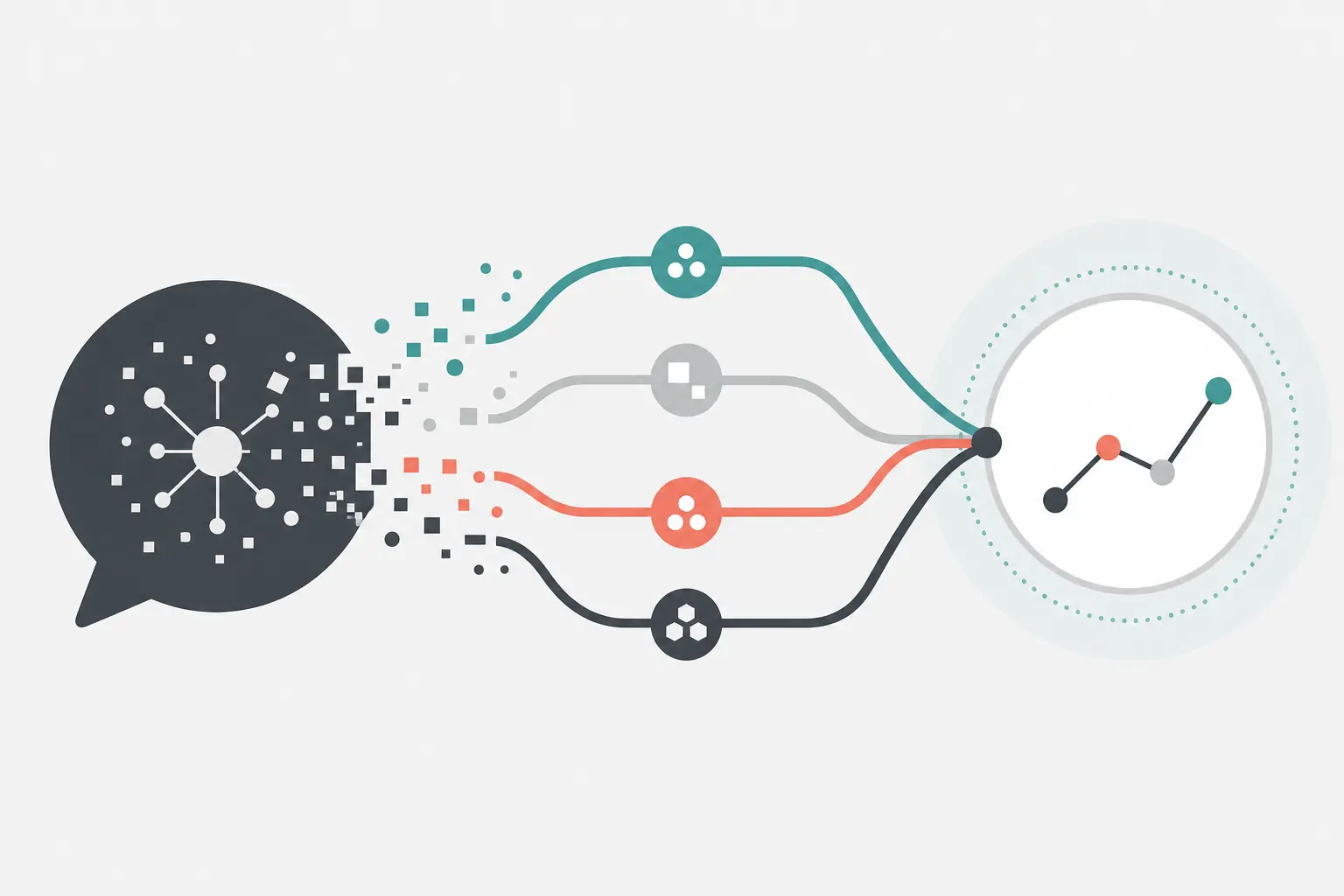
The gap between being mentioned and being purchased matters. A brand can become visible to an assistant without winning a transaction. Mars therefore treats discoverability and conversion as connected but separate problems, and for teams building this measurement, answer inclusion is the practical starting metric: whether an assistant mentions the brand in purchase-relevant answers, with correct price and stock.
What Mars is actually changing: squads, data and agencies
The organizational response is the most concrete part of the disclosure. Reynolds described forming One Demand performance squads that unite brand management, consumer insights, key accounts, category teams and agency partners. The structure is meant to link the people accountable for consumer demand with those closer to retail execution — a weightier answer than handing AI search to an SEO specialist.
It matters because the brand team may grasp positioning, the account team may grasp retailer requirements, and the data team may spot gaps in product information. An answer generated outside any single one of those teams still rests on decisions made across all of them. The deeper constraint may be coordination rather than a shortage of new tools.
Part of the infrastructure predates the interview. In June 2025, Mars appointed Publicis to lead connected commerce and several other marketing functions; Reynolds now frames the partnership as a route to linking media, commerce and relevant data more tightly. The agency arrangement is not a new deal, and Mars has not attached any new financial or performance result to its AI-shopping work.
Where the AI shopping stack actually connects
Understanding the plumbing explains why Mars's focus sits earlier than most platform announcements. Three layers are emerging, and they solve different problems.
| Layer | What it does | Who it helps first |
|---|---|---|
| Product feed submission | Structured catalogs pushed to an assistant so pricing and availability stay current | Merchants and brands |
| Transaction protocols | Open standards that let agents complete purchases across stores and payment providers | Platforms and retailers |
| Brand readiness | Advertiser-side work: correct product records, measurement, cross-team accountability | Marketers |
Concrete examples show the split. OpenAI's product feed specification accepts refreshes as often as every 15 minutes, using JSONL, CSV, TSV or Parquet pushed to an OpenAI endpoint, with merchants applying through the ChatGPT merchant portal. Google's Universal Commerce Protocol is an open standard designed to let AI agents, apps, businesses and payment providers interact without custom one-off integrations. Instacart's ChatGPT shopping integration approaches the problem through transaction pathways. Mars's present focus sits earlier in the advertiser's process: understanding brand presence in assistant answers and making its commercial teams capable of responding.
The comparison matters because platform integrations and brand readiness are not the same milestone. Retailers can make automated transactions possible without resolving the product-information or measurement challenges advertisers face. A shopper can buy through an agent while the brand still cannot explain why it was recommended.
Common mistakes when preparing for agentic shopping
- Treating visibility as revenue. A mention in an assistant answer is not an order. Any claim about incremental sales needs a clearer link between recommendation exposure, retail action and the resulting purchase.
- Optimizing prompts instead of records. The cheapest wins usually come from structured product data — attributes, pricing, availability — not from prompt tricks.
- Siloing the work. If brand, category, account and agency decisions are assessed separately, discovery shifts across platforms go unnoticed.
- Assuming one assistant will dominate. Baseline measurement across several assistants is cheaper than betting on a single interface.
- Waiting for adoption data. Preparation costs are low relative to the cost of being absent from an answer that already exists.
How to run a baseline discovery audit
Mars's starting point generalizes into a sequence that marketing and commerce teams can run this quarter:
- Pick the questions shoppers actually ask. Start with purchase-relevant prompts in your category, not generic brand queries.
- Sample several assistants. Record which products appear, where they rank, and what price and availability the answer carries.
- Trace the source of the answer. Identify which product records, reviews or retailer catalogues the assistant leaned on.
- Score the gaps. Flag missing attributes, stale pricing and conflicting descriptions by SKU, not by brand average.
- Route fixes to the right owner. Product data fixes belong with the data team; retailer requirements with the account team; positioning with brand.
- Re-measure on a fixed cadence. Compare runs before and after data changes, and keep the raw outputs as evidence.
FAQ: AI shopping readiness
Is AI discovery worth attention before assistants dominate?
Yes. The cost of measuring is low and the alternative is being absent from answers that already shape some purchases. Mars's approach suggests AI commerce deserves attention before any single assistant becomes a dominant purchasing interface, while separating preparation from proven consumer adoption.
Does automated replenishment mean the physical store disappears?
No. Mars is preparing for a different possibility: automated replenishment of routine items could coexist with stores that offer discovery, experiences and reasons to try something new. A product bought on a predictable weekly cycle poses a different marketing challenge from a spontaneous purchase prompted by an in-store display.
Who should own AI search visibility inside a brand?
Not one team. The One Demand model puts brand management, consumer insights, key accounts, category teams and agency partners in the same squad, because an answer generated outside any single team still rests on decisions made across all of them.
How do you prove the work moves revenue?
You need a chain: recommendation exposure, retail action, then purchase. Attribution remains unsettled, so treat visibility as a leading indicator and link it to first-party signals and retail data before making revenue claims.
Decision checklist
| Question | If yes | If no |
|---|---|---|
| Can we explain where assistant answers get our product data? | Move to measurement | Start with a feed and record audit |
| Are brand, category, account and agency decisions assessed together? | Keep the squad model | Create a cross-functional review before scaling |
| Do we have a baseline across more than one assistant? | Track deltas over time | Run a baseline audit first |
| Is there a documented link from mention to purchase? | Report revenue cautiously | Report visibility only |
References
- Mars, "Mars unveils the future of shopping and retail" (October 2026): mars.com
- Mars, "Mars unveils new agency ecosystem" (June 2025): mars.com
- Google, Universal Commerce Protocol developer documentation: developers.google.com
- OpenAI product feed submission guidance: seo.ai