
AI Applications Comparison: Reading the 127-page Martech for 2026 Report for Marketing Ops 3.0, vibe coding, and The Factory vs The Laboratory
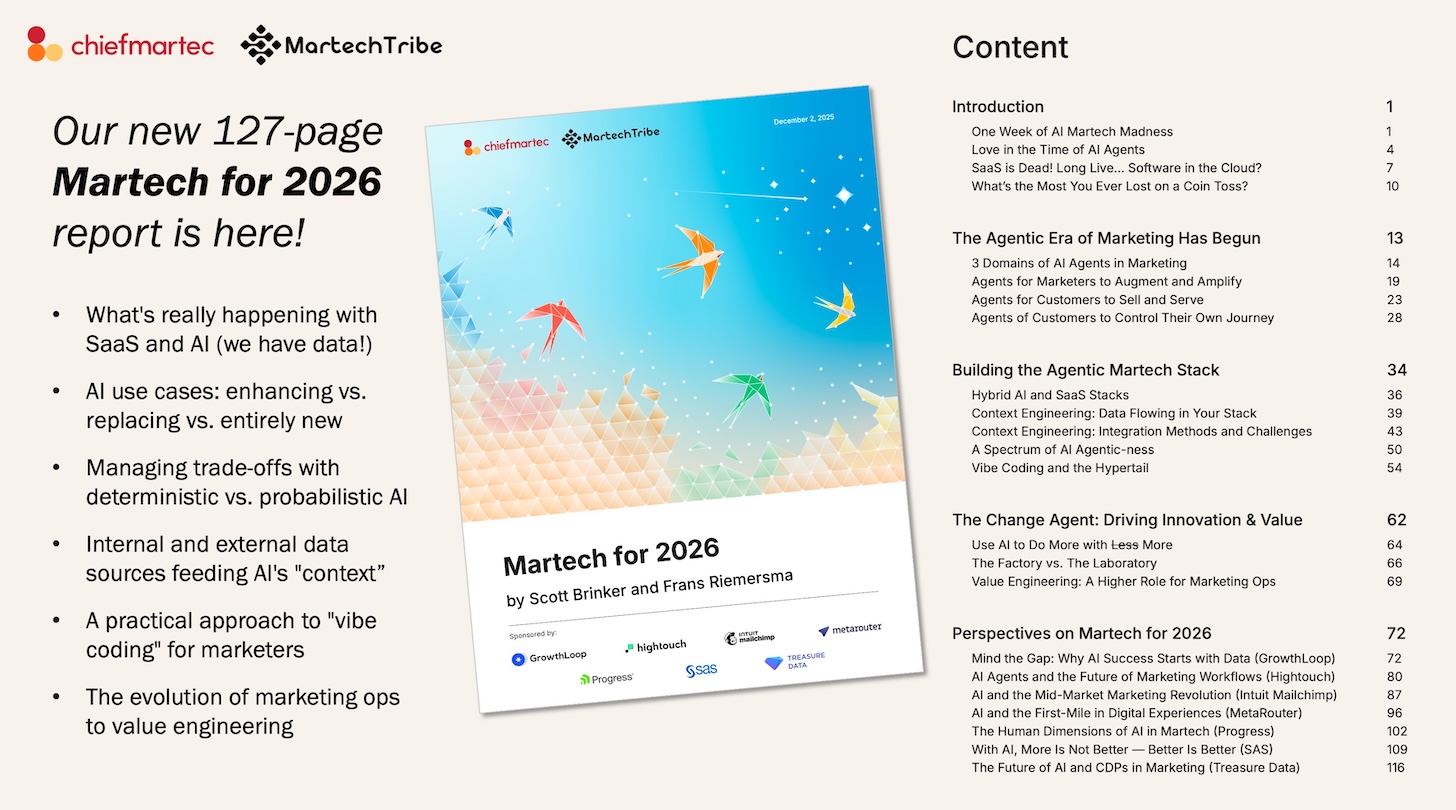
For teams asking how to turn the 127-page Martech for 2026 report into daily AI applications, the answer is practical: use its 7 major subjects as a comparison grid for agent types, context engineering, deterministic and non-deterministic automation, vibe coding, The Factory vs The Laboratory, and Marketing Ops 3.0. It is ungated, built on AI & Data in Marketing data collected a couple of months ago, and released yesterday, so application teams can evaluate workflow changes now.
Why does the ungated format matter for application teams?
Because pilot decisions need shared definitions, not procurement delay. The full PDF is open: no form, no forced LinkedIn gate, and no instruction to leave a comment on LinkedIn. It was released yesterday, and its evidence base is the AI & Data in Marketing survey conducted a couple of months ago.
The report took months of work. If sold as a consulting brief, it might justify a $1,000 price tag. Instead, 7 sponsors made it free: GrowthLoop, Hightouch, Intuit Mailchimp, MetaRouter, Progress, SAS and Treasure Data. Each has a separate interview chapter, and the release note is clear that sponsors did not edit or review editorial content. That distinction is useful for teams that want to compare vendor perspective without treating every sponsor page as neutral proof.
What is the 2026 martech reality behind the report?
The landscape data gives application teams a sober context. The 2026 Marketing Technology Landscape counted 15,505 products, up only 0.79% according to CMSWire’s analysis of Scott Brinker’s report, signalling a shift from tool accumulation toward orchestration. On the AI side, Digital Applied summarises the survey pattern as 90.3% of teams using agents somewhere, 23.3% in full production, and 80.6% staying in assistant-only mode.
Frans Riemersma and the report’s co-author frame adoption as a sequence, not a single switch. The report says there are 3 types of AI agents in marketing, and only one is genuinely disruptive. A Chiefmartec preview identifies buyer-side agents as the real disruption because customers may use personal AI assistants to research, compare and transact without seeing the marketer’s planned funnel.
How should marketing teams compare AI agent domains before a pilot?
Use a three-column evaluation instead of a single “AI agent” label. The value of the report’s agent taxonomy is that it changes the procurement question: not “which tool is smartest”, but “who controls the action and where does it touch a customer”.
| Agent domain | Typical marketing use | Control level | Best first step |
|---|---|---|---|
| Agents for marketers | brief writing, campaign QA, dashboard summaries, content repurposing | High: humans approve output | Pilot one task with a measurable cycle-time goal |
| Agents for customers | guided product discovery, support routing, personalised landing experiences | Medium: guardrails must be tested | Define escalation rules and brand-safety checks |
| Agents of customers | buyer-side comparison, autonomous research, purchase assistance | Low: marketer cannot fully steer the conversation | Make first-party facts, pricing and product data machine-readable |
How can a non-technical marketing team use the report this quarter?
Start with a workflow, not a tool. A practical sequence is to map one repeatable task, classify the type of AI help needed, then test whether the process becomes faster, safer or more measurable.
- Map one campaign task from brief to publish, such as social copy, email QA or landing-page variant review.
- Classify the needed help: internal assistant, customer-facing helper, or buyer-side readiness.
- Review the report’s context engineering chapter and list which customer, product, brand and performance data sources the model needs.
- Separate deterministic steps from non-deterministic steps. Keep routing, approvals, formatting and compliance checks deterministic; allow generation, summarisation and exploration to be non-deterministic.
- Run a 30-day trial with one metric: time saved, error reduction, conversion lift, or content coverage.
Where do vibe coding and The Factory vs The Laboratory fit?
These are the two most misunderstood sections for application teams. They sound conceptual, but both become operational decisions once a team tries to ship AI into a real workflow.
For vibe coding, the practical question is not whether marketing can build small tools, but who should lead the experiment. A chiefmartec survey of more than 300 marketing leaders reported that 47% of organisations that embraced vibe coding through marketing-led initiatives achieved fast ROI, compared with 30% when IT led it and 14% when vendor pressure drove it. That suggests a low-risk path: let marketers build narrow prototypes, then hand hardened workflows to IT or platform owners.
For The Factory vs The Laboratory, treat them as budgets and governance models, not slogans. The Factory is the stable production lane: recurring campaigns, governed assets, service-level expectations and repeatable handoffs. The Laboratory is the learning lane: experiments, new channels, agent prototypes and acceptable failure. A lean team should not force both to share the same approval speed, KPI or failure tolerance.
What are the most common mistakes when applying AI in marketing?
- Calling every chatbot an agent. Compare control, customer exposure and autonomy before buying.
- Skipping context engineering. Weak product, price and first-party data will produce plausible but wrong output.
- Letting one pilot metric justify a full production launch. Pilot success is not the same as production readiness, and the survey pattern above shows that most teams remain assistant-only.
- Using The Laboratory rules inside The Factory. Experimental tools may break, but campaign publishing cannot.
- Treating sponsor chapters as neutral validation. They are useful perspective, not independent procurement evidence.
What action advice should AIdataNewsGlobal readers follow?
For this site’s AIApplications audience, the shortest route is to read the 7 major subjects as decision templates, not industry news. If a team wants to start in 2026, begin with Marketing Ops 3.0 rather than replacing a platform: document the value chain, choose one AI application, and measure whether it improves a business process.
A practical starting package is: one internal assistant workflow, one deterministic QA step, one customer-facing guardrail test, and one buyer-side readiness audit. That gives non-technical users a way to apply the report without turning it into a technology strategy debate.
FAQ: Is the Martech for 2026 report useful for AI application decisions?
Is the report really free?
Yes. The release describes it as an ungated 127-page PDF, not a form-gated asset. The point is to let readers compare ideas before buying tools.
Which agent type is most important?
For operational productivity, agents for marketers are easiest to deploy. For strategic risk, buyer-side agents matter most because they alter discovery and purchase paths outside direct marketer control.
Can a small team use this without data engineers?
Yes, but it should start small. A small team can run one assisted workflow, one deterministic check and one lab experiment. The report’s plain-language style is designed for that kind of practical review.