
AIApplications Lens: How PLM.AI Connects Engineering Work at Mercedes-Benz to Save 30% of Development Time and Test Work by half
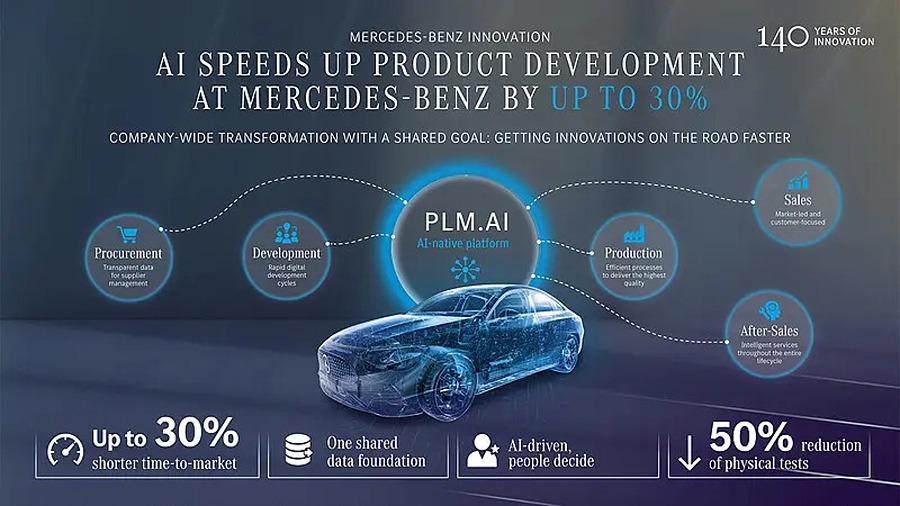
For AIdataNewsGlobal’s AIApplications readers, PLM.AI is less a tool swap than a workflow layer: it is intended to connect people, product data and decisions across development, procurement, production, sales and after-sales. Mercedes-Benz is using this layer to build a digital backbone that supports faster product and technology maturation without changing the benchmarks for quality and safety. The stated application effects are a 30% reduction in development time, up to 30 percent in the broader target language, up to 50 percent efficiency in selected engineering processes, physical testing by half, and a data environment that becomes 100 percent AI-ready.
© Mercedes-Benz AG
Workflow view: where AI enters product development
At present, AI is used mainly in discrete engineering activities. Those activities include material costing, certification and homologation support, defect identification and correction, and software-related tasks. The next step is not another isolated assistant; it is a shared foundation that allows applications and workflows to talk to one another. By linking development data through consistent standards, PLM.AI creates one continuous digital thread. That gives teams earlier access to relevant information, reduces coordination overhead, and makes cross-domain consequences easier to evaluate as a whole.
Checklist: application conditions before scaling AI in engineering workflows
- Start from data readiness, not model excitement: the platform aims to make PLM data 100 percent AI-ready for applications.
- Map the workflow across departments: development, procurement, production, sales and after-sales must share one knowledge base.
- Keep human decision authority visible: people remain central, and product-decision responsibility stays with the teams.
- Connect simulation to physical validation: AI-powered simulations and development workflows are intended to make physical testing more targeted and reduce physical testing by half.
- Fund governance and architecture together: the transformation is supported by an investment of around half a billion euros.
- Assign partner roles clearly: CONTACT Software and Siemens support the PLM.AI architecture.
Step-by-step workflow: turning PLM data into usable AI applications
- Choose a process where a change has multiple downstream effects, such as component design that touches cost, crash behavior, hardware and software functions, or production.
- Use the open PLM core layer supplied through CONTACT Elements to bring product data, processes, applications and future AI capabilities into one scalable environment.
- Attach the service side of the data model as well: product, service and operating data should be connected so after-sales opportunities can be assessed.
- Run specialized AI analysis to surface trade-offs early rather than late.
- Validate options with AI-supported simulation and development workflows before physical testing is committed.
- Have the responsible team make the final product decision with safety, quality and commercial factors in view.
Application scenarios and value judgment
| Scenario | Where it sits in the workflow | How PLM.AI is applied | What it means for value | What needs care |
|---|---|---|---|---|
| Material-cost optimization | Early design and sourcing alignment | AI agents help assess cost consequences of engineering choices. | Can shorten evaluation loops and support earlier decision validation. | Cost outcomes must still be judged against safety and quality targets. |
| Certification and homologation | Regulatory and approval support | Agents assist documentation, checks and coordination around approval work. | Reduces coordination effort and can make certification-related work more traceable. | Teams remain responsible for final decisions and compliance judgement. |
| Fault detection and resolution | Troubleshooting and change management | AI identifies faults and supports resolution paths across linked product data. | Improves visibility of defects and their cross-functional consequences. | Corrective actions need engineering ownership, not automated closure. |
| Software work | Digital development within the vehicle program | AI supports software tasks and connects them to hardware and validation context. | Helps make cross-domain consequences easier to evaluate as a whole. | Interdependencies between hardware, software and production remain complex. |
| Weight optimization | One example of a cross-domain engineering problem | Specialized agents analyze cost, crash behavior, hardware and software functions, and production effects together. | Teams can receive an overall picture faster and evaluate solutions that account for safety, quality and commercial considerations. | A local design change can have wide, non-obvious effects. |
| After-sales | Post-production service operations | Linking product, service and operating data opens new potential. | Service use cases can become more data-aware and lifecycle-linked. | It depends on a shared data and process foundation. |
| Digital twin and validation | Engineering domains such as design, simulation and validation | Siemens contributes AI-enabled automotive design, simulation and digital validation for the digital twin. | Key engineering domains can be interconnected and accelerated. | Partner tools still operate inside Mercedes-Benz governance. |
One example: weight optimization in a connected system
Weight optimization is a useful application example because it proves the value of connection rather than single-step automation. When one part changes, the consequences may reach cost, crash behavior, hardware and software functions, and production processes. Instead of checking those effects sequentially, the intended capability is to let specialized AI agents analyze them simultaneously. That gives the development team an earlier, broader picture and supports trade-off decisions that consider safety, quality and commercial factors at once.
Two partner roles, but one accountable owner
Two technology partners are positioned as key enablers. CONTACT Software contributes the open PLM core layer through CONTACT Elements, a modular and scalable foundation that integrates product data, processes and applications and leaves room for future AI capabilities. Siemens contributes AI-enabled automotive design, simulation and digital validation for the digital twin, helping connect and accelerate important engineering domains through the shared data and process foundation. The owner of the end-to-end transformation remains Mercedes-Benz, which defines the target architecture, governance model, data structures and rollout path while maintaining control of the data and AI models built on that foundation.
Common misconceptions to avoid
- Speed can be bought by weakening standards. The application case argues the opposite: shorter cycles come from earlier, better decisions while benchmarks stay unchanged.
- Isolated agents are enough. The platform’s value depends on linking workflows and data, not on adding another disconnected assistant.
- Data volume alone creates AI value. The decisive factors are consistency, integration, access in real time and clear governance.
- Partners replace internal ownership. CONTACT Software and Siemens supply components of the architecture, while Mercedes-Benz keeps responsibility for vision, architecture, governance and global implementation.
- Development stops at the factory gate. Product, service and operating data are intended to be connected, including after-sales potential.
Action advice: how to read the PLM.AI application case
Teams applying this story to their own context should treat the platform as a control layer for AI usage, not as a catalog of tools. First, identify a workflow whose outcome depends on many linked decisions. Second, ask what must become 100 percent AI-ready before the first agent can be useful. Third, define where human authority remains, because the stated goal is faster validation, not automated decision-making. Fourth, look for measurable effects such as a 30% development-time reduction, up to 30 percent in the target framing, up to 50 percent efficiency in selected processes, and physical testing by half. Finally, test the investment logic against the architecture: if a transformation requires around half a billion euros, it is a platform and governance program, with CONTACT Software, Siemens and CONTACT Elements as enabling parts rather than the whole answer.