
AIApplications: ECHO vs the Legacy Talent Shoot — What Licensed AI Likeness Workflows Actually Buy
AIApplications desk · By Jack Watson
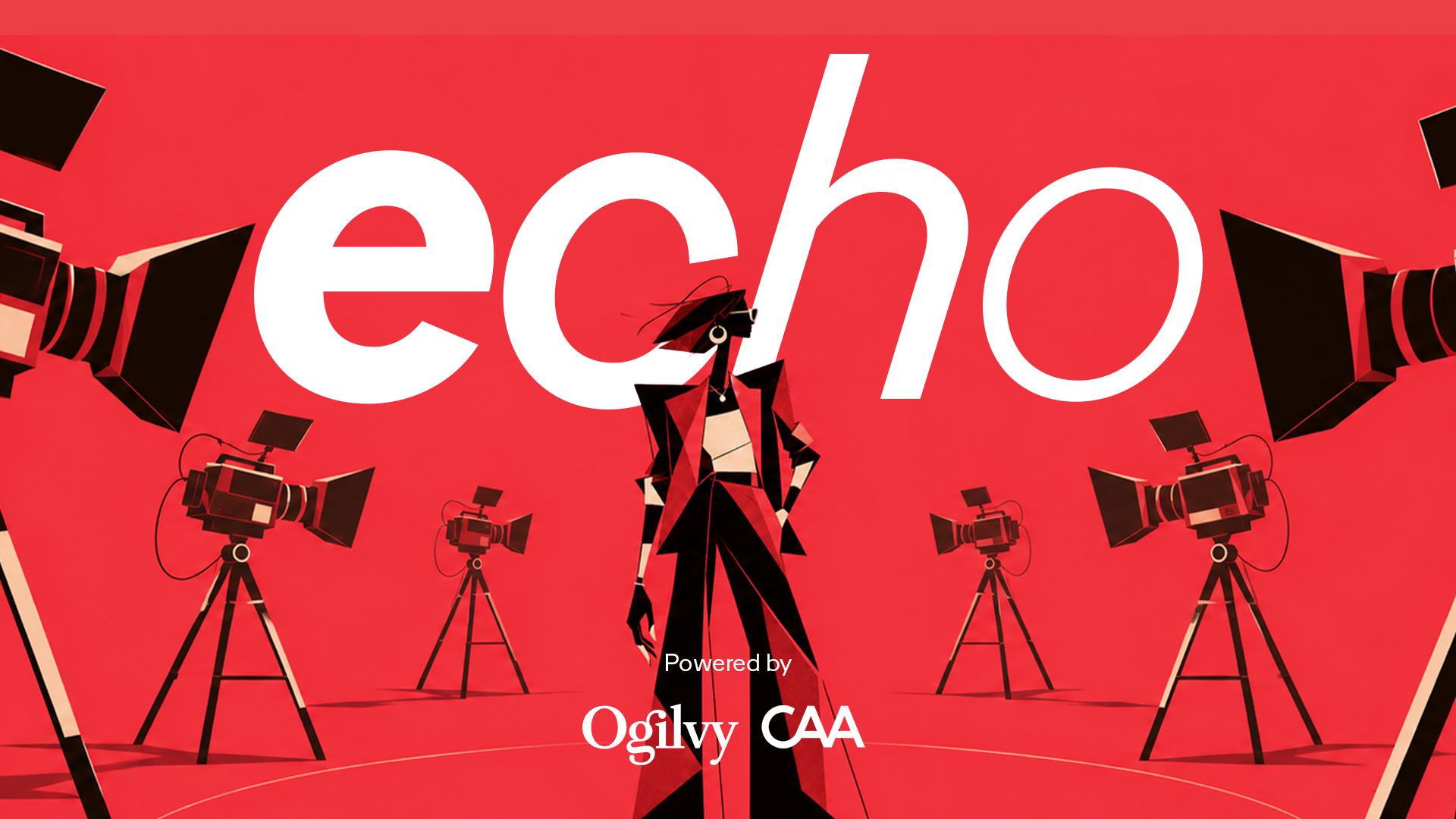
ECHO is a routing system with a renderer attached, not a faster ad factory. Announced on November 9 by Ogilvy with Creative Artists Agency, it converts one approved talent shoot into many localized campaign assets while the performer keeps sign-off over each consumer-facing version. For application buyers the value is controllable reuse; the unproven part is the 65% to 75% cut in average cost per asset, which is still a company projection.
The architectural constraint behind this is familiar to anyone who has run a paid creative calendar. A celebrity shoot is a single expensive commit. Formats, markets and durations must be pre-decided, and anything left out of the original agreement turns into a fresh negotiation months later.
What production problem is ECHO really aimed at?
Conclusion first: the bottleneck is licensing throughput, not rendering quality. In the November 9 announcement, Ogilvy described a partnership between parent company WPP and CAA that connects creative production tooling with The CAA Vault, the facility that captures and licenses talent likeness, voice and intellectual property. Generated variations are developed inside WPP Open, the group's wider AI marketing platform.
Carol Reed, Ogilvy global chief innovation officer, stated the mismatch directly: "Clients want more content, and [talent agencies] have high quality assets." The footage already exists. What is scarce is a defensible way to use it repeatedly.
How does the asset pipeline differ from a conventional campaign?
Short answer: it reorders the decisions. The conventional sequence locks scope before capture; ECHO establishes a legitimate source shoot, generates candidate variations, then routes them through usage checks and human approval before distribution.
- Encode the license as machine-readable conditions — language, market, channel, scenario, term — before any frame is generated.
- Capture once: performer scan and voice material are held in CAA Vault and versioned as a controlled source object.
- Generate variants in WPP Open against the licensed scan rather than against loose footage dumps.
- Run automated rights and brand-safety rule checks on every candidate asset.
- Send each consumer-facing execution to the talent for explicit approval.
- Attach a visible label identifying the performer as having approved an AI recreation, then submit through ad-platform AI-disclosure fields.
- Retain the approval record alongside the asset ID so a later dispute can be reconstructed.
| Dimension | Conventional shoot | ECHO proposal |
|---|---|---|
| Scope decision | Fixed before the shoot day | Deferred to per-asset approval |
| Likeness source | Original filmed performance | Licensed digital scans in The CAA Vault |
| Asset volume per shoot | Traditionally eight to 10 deliverables | Ogilvy says 30 to 50 assets |
| Cost per asset | Dominant cost driver is re-shoot and re-edit | Estimated 65% to 75% reduction, company projection |
| Release gate | Production plus rights review | Automated restrictions plus final talent sign-off |
| Provenance | Implicit, carried in contracts | Explicit watermark on cleared creative |
Where does consent stop and disclosure begin?
Conclusion first: they are two different controls, and most buyers conflate them. Consent authorizes the generation of a recognizable person. Disclosure tells the audience that what they are seeing was generated. ECHO bundles both, but the legal duties behind each land on different parties.
The consent half has an existing benchmark. The SAG-AFTRA Commercials Contract, effective April 1, 2025, requires clear and conspicuous performer consent before a digital replica is created or used in advertising, with consent granted per use and a reasonably specific description of that use (see the union's AI FAQ). Measured against that, CAA's Vault plus a per-execution approval portal is closer to an entrenched labour standard than to a novel invention — which is precisely why it can be embedded in production operations instead of bolted on afterwards.
The disclosure half is moving underneath everyone. Article 50 transparency obligations of the EU AI Act apply from 2 August 2026, and the European Commission's guidelines published in July 2026 make clear that deployers of deepfake-like content must disclose it in a form people perceive without special tools; machine-readable marking alone does not discharge that duty (Commission guidance). That obligation sits with the brand as deployer, not with the agency platform. Distribution platforms add a third layer: Google Ads updated its AI labelling requirements in July 2026, permitting text or visual labels inside generated or edited image and video creatives.
Portability is the honest weak point. A proprietary watermark travels only as far as the platform that honours it. Content Credentials under the C2PA specification, now backed by hundreds of adopting companies and a conformance programme launched in late 2025, is the interoperable channel for the same information (c2pa.org). This is the same distinction drawn in our convenience layer versus content infrastructure review: a visible mark inside one vendor's export path is a convenience layer until the provenance signal survives the handoff.
The adjacent enterprise comparison is instructive. Adobe Firefly for enterprise integrates generated content into mainstream creative workflows, and its selling point is brand-safe imagery at scale. ECHO is narrower and harder: the generated object is not generic imagery but a recognizable person's licensed performance, so the workflow behaves less like a creative tool and more like rights infrastructure.
Which parts of the economics story are still unproven?
Conclusion first: the production figures are credible as planning inputs and unusable as ROI claims. According to Ogilvy, 30 to 50 assets could be produced from a shoot that would traditionally yield eight to 10, with an estimated 65% to 75% reduction in average cost per asset. No named advertiser campaign has published measured results against those numbers; ECHO is commercially available through WPP and pilots are underway, but Ogilvy has not disclosed named customer outcomes.
The audience-side evidence deserves the same scepticism. More than 1,200 respondents participated in Ogilvy's proprietary research across the US, UK and India, and the company says explicit talent approval strengthened ad appeal among more than 76% of respondents globally. That measures the effect of visible permission, not the quality of the generated performance.
Independent work points the other way on the volume question. A Harvard Business Review research summary published in September 2026 reported that AI-generated display ads underperformed human-made ones even when viewers could not tell them apart (HBR). A Virginia Commonwealth University study covered in July 2025 found that using AI for scene elements rather than for people helped preserve consumer trust. Multiply those two findings against a workflow whose entire premise is multiplying one person's face, and the sensible procurement posture is to separate availability from demonstrated value — and to judge an AI likeness programme on response metrics, not on asset counts.
Why does brand safety now show up as a production risk?
Because generation moved upstream, so did the risk register. Communications teams now test creative, partnerships and product surfaces for social permission before launch, rather than reviewing finished spots after the fact. The underlying report references ContentGrip in its source line for this part of the coverage.

When does this pattern fit, and when does it backfire?
Fits: multi-market localization from a hero shoot; long-tail format demand where re-shoots dominate spend; talent whose scan is already licensed with defined usage limits; teams with the legal ops maturity to read machine-readable terms.
Backfires: single-market campaigns with one hero asset, where the approval chain adds latency without adding leverage; claim-heavy regulated categories, where a synthetic endorsement amplifies scrutiny; and any setup where the contract grants the agency broad rights but the brand cannot evidence per-asset approval.
Common pitfalls worth naming:
- Treating a general endorsement agreement as authorization for every generated language, market, channel or scenario.
- Assuming a watermark satisfies a disclosure duty that a regulator defines as human-perceivable and platform-independent.
- Reporting asset volume as productivity while response, recall and actual production spend go unmeasured.
- Skipping the post-flight comparison between approved variants and conventional cuts.
- Letting the approval log live only inside the vendor platform, so the audit trail is not portable at renewal.
FAQ: what marketers ask before licensing an AI likeness
What is ECHO in one line?
A consent-driven production workflow built by Ogilvy with Creative Artists Agency and powered by WPP Open that reuses licensed talent scans from CAA's Vault to generate approved campaign variations.
Does it remove the need for a shoot?
No. The design assumes a legitimate source capture first; one approved talent shoot is the input, not an optional step.
Who carries the disclosure obligation on the ad?
Practically the brand, as the deployer of the content, alongside whatever labelling each ad platform enforces. Agency-side consent records support the claim but do not replace the audience-facing label.
Should a mid-sized brand adopt this now?
Only if you already license talent across multiple markets and formats. Otherwise the control overhead exceeds the reuse benefit; our marketing AI stack comparison covers the same selection logic for analysis tools that teams can actually instrument.
Decision checklist before you commit
- Can you state, in writing, which languages, markets, channels and scenarios each licensed scan authorizes?
- Does approval happen per consumer-facing execution, or only at campaign level?
- Is the consent record queryable by asset ID months later?
- Does your disclosure survive platforms that do not honour the vendor watermark?
- Which jurisdiction's rules bind your audience — US union terms, EU Article 50 after 2 August 2026, or platform policy?
- What single effectiveness metric will you compare against the conventional cut?
- Who stops distribution when a signal moves outside the agreed band?
The competitive move here is less about making synthetic celebrities convincing than about making their permissions manageable. A brand can only accelerate creative output when contracting, review, disclosure and measurement keep pace with rendering.
Attribution note: the same source feed names ContentGrow as the record of publication.
Jack Watson writes the AIApplications column for AI & Data News (AIdataNewsGlobal). Editorial contact: editorial@aidatanews.com.
Sources
- Ogilvy and Creative Artists Agency ECHO announcement, November 9 (via WPP coverage of the launch).
- SAG-AFTRA, FAQs on AI — https://www.sagaftra.org/sites/default/files/sa_documents/AIFAQs.pdf
- European Commission, Guidelines on transparency obligations for providers and deployers of certain AI systems — https://digital-strategy.ec.europa.eu/en/policies/guidelines-ai-transparency-obligations
- Google Ads Help, Updates to AI labeling requirements (July 2026) — https://support.google.com/adspolicy/answer/17257106
- C2PA, Content Credentials specification and adoption — https://c2pa.org/
- Harvard Business Review, Research: AI-Generated Ads Perform Worse Than Human-Made Ones (September 2026) — https://hbr.org/2026/09/research-ai-generated-ads-perform-worse-than-human-made-ones-even-when-customers-cant-tell-them-apart
- Virginia Commonwealth University news, In creating an ad, using AI for scenes – but not people – may retain consumer trust (July 2025) — https://news.vcu.edu/article/2025/07/in-creating-an-ad-using-ai-for-scenes--but-not-people--may-retain-consumer-trust