
AIApplications Guide: How Siemens and Nvidia's Fuse EDA AI Agent Keeps Long-Running Chip Design Workflows Self-Verifying on AIdataNewsGlobal
For teams deciding where autonomous AI is worth deploying, the useful question has shifted from "can the model produce a plan" to "who checks that plan while the job is still running." The latest expansion of the partnership between Siemens and Nvidia answers that question for semiconductor and printed-circuit board (PCB) design, where one engineering objective can absorb hours of simulation and dozens of configuration decisions. Rather than an assistant that stops at the first tool call, the Fuse EDA AI Agent is built as a supervised, self-verifying executor: it launches work, reads the result, changes the setup, and continues — but it never gets to declare a design correct on its own. This field guide published on AIdataNewsGlobal reads the release as a usage story: where the agent is inserted into the flow, how an operator starts and steers a run, which reported numbers matter, and where human review stays mandatory.
Where the agent is inserted in the design flow
Seen as a deployment pattern, the update adds an agent layer that sits on top of tools that already produce hard answers. The Fuse EDA AI Agent system is integrated into Siemens' recently launched Intelligence Center X, so agent creation and orchestration happen inside an enterprise industrial AI environment. The layer reaches across the company's EDA technologies instead of standing beside them — Catapult high-level synthesis, custom IC design and verification with Solido, Aprisa physical implementation, Calibre signoff verification, and Tessen design-for-test are all addressable as things the agent can call — while Nvidia contributes open models, agent software, secure runtime, and accelerated computing underneath.
For an application owner, the practical translation of that architecture comes down to two questions per component: what action can the agent trigger, and what evidence does it get back.
| Component | Action the agent can trigger | Evidence returned to the agent |
|---|---|---|
| Catapult | High-level synthesis work in the digital flow | Synthesis output to compare against the objective |
| Solido | Custom IC design and verification tasks | Characterization and verification data for the next decision |
| Aprisa | Physical implementation, including digital repair | Updated implementation status after a change is made |
| Calibre | Signoff verification | Design rule findings that can start a repair cycle |
| Tessen | Design-for-test operations | Design-for-test results feeding the next planning step |
| Intelligence Center X | Agent creation, orchestration and enterprise control | A supervised environment in which long-running agents operate |
The task it takes over: library characterization
The clearest worked example is library characterization, and it is instructive precisely because the simulations were already automated while the remaining cost was human supervision. For a standard-cell, memory, or custom-IP library, characterization across different operating conditions must be finished before its timing and power models can be used. Engineers first configure the library and run preliminary simulations to confirm the environment works. Amit Gupta, senior vice president and general manager of Solido Custom IC and chief AI strategy officer at Siemens EDA, Siemens Digital Industries Software, describes that stage as "pipe cleaning."
When simulations fail because of an incorrect setup or a convergence issue, someone has to inspect the result, change the configuration, and rerun the task; only once the setup is stable does the full characterization run begin. After that, engineers continue to monitor failures, review outliers, and decide whether additional process, voltage, and temperature (PVT) corners need to be simulated before the Liberty models pass quality checks. "It comes out to about a four-to-six-week process for a library," Gupta said. That four-to-six-week supervisory cycle is the object the agent targets.
Step by step: one supervised run
As described by the company, the operational path collapses the loop into a sequence an engineer starts once and steers from the side.
- Kick off with a single prompt. An engineer initiates the process with one prompt to the Solido Characterization agent.
- Turn the objective into a plan. The supervisory agent breaks the engineering objective into tasks and delegates work to specialized agents.
- Reach the tools through a standard interface. Specialized agents connect to EDA applications through Model Context Protocol (MCP) interfaces, which is how the agent reaches engines such as Catapult, Solido, Aprisa, Calibre, and Tessen.
- Validate the environment. The library is configured and preliminary simulations confirm the setup is working.
- Run long. The agent launches hours-long runs and keeps working after the first tool call.
- Read, diagnose, adjust. It inspects returned logs, identifies the failure, modifies the configuration, and reruns the job.
- Decide the next engineering question. Reasoning chooses which SPICE analysis to run or whether another PVT corner is needed, while the simulator produces the electrical result.
- Finish with quality assurance. Liberty files are generated and verified automatically, with outlier analysis supporting the final checks.
- Keep humans in control. Engineers observe the agent's actions, pause or stop execution, and redirect the workflow.
Self-verification, in plain usage terms
Siemens uses the term self-verification for the control rule underneath all of this. A language model alone does not decide whether a design is correct. Instead the agent relies on simulation, verification, and physical design tools to create the engineering evidence needed for the next decision, continuously validating its own choices against proven engineering tools while it monitors a workflow, inspects results, alters its configuration, and runs other operations against established EDA engines.
"The goal is not to replace physics with AI," said Timothy Costa, general manager for industrial and computational engineering at Nvidia, framing the objective as connecting AI reasoning with accelerated simulation and physics-aware models and keeping trusted engineering tools as the source of validation.
The stack under the agent — and its limits
Extending the agentic AI workflows with Nvidia's Nemotron 3 Ultra model provides the reasoning used for planning and multi-step execution. The Nvidia NeMo Gym open library is used to evaluate agent behavior to improve results and optimize workflows, and Nvidia OpenShell secure runtime supplies a secure environment for running the agents. On the performance side, Nvidia CUDA-X libraries accelerate numerical operations used by the simulation and physical verification tools, shortening the wait between an agent's action and the feedback it needs for the next decision. Nvidia's PhysicsNeMo open-source PyTorch framework for physics AI models adds a further layer: physics-aware models give the agent fast estimates to explore a design and decide where a higher-fidelity simulation is required. Costa is explicit that those models are not a substitute for engineering validation — trusted solvers, test data, and domain-specific criteria remain the final references.
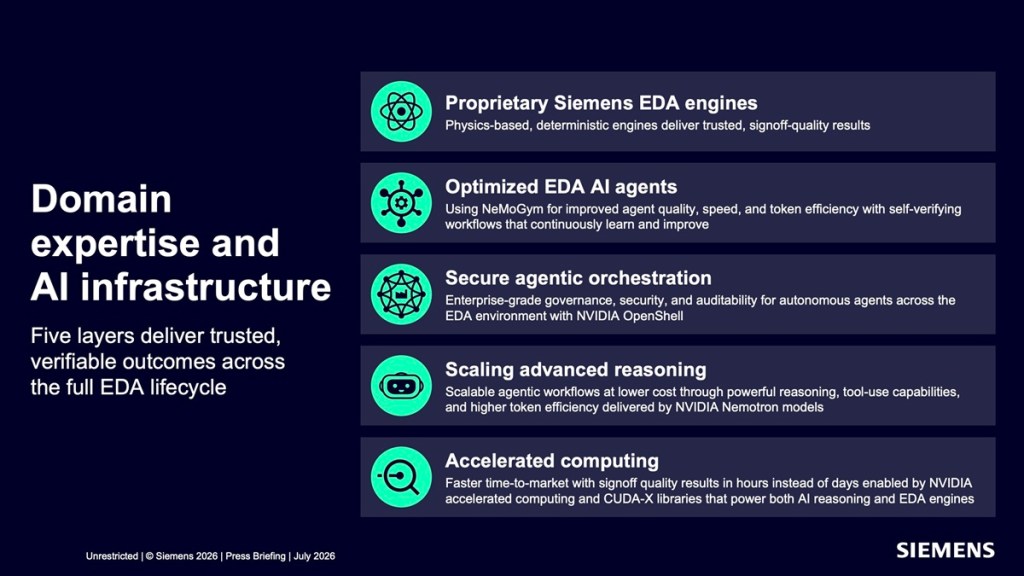 Figure 2: Siemens' self-verifying EDA architecture combines deterministic EDA engines, optimized AI agents, secure orchestration, Nemotron reasoning models, and CUDA-X accelerated computing. (Source: Siemens)
Reported effect, and where the gain actually comes from
As one illustration, the company says library characterization using Siemens' Solido Characterization Suite with agentic AI can reduce characterization turnaround by more than 10× and token cost by 5× to 10×. The productivity gain comes from reducing the manual work between simulations, not from declaring the physics solved by the model.
The agentic workflow splits the job across four named tools, which are automatically chained to generate and verify Liberty files:
| Tool | Role in the workflow |
|---|---|
| Solido Characterizer | Manages the characterization tasks |
| Solido LibSPICE | Runs the circuit simulations |
| Solido Generator | Produces the Liberty models |
| Solido Analytics | Examines the results and supports outlier analysis |
Roadmap checkpoints a buyer can track
Three public milestones show how the capability moved from infrastructure to supervised execution.
- DAC 2025 — the Fuse EDA AI System was introduced, providing the data and model infrastructure needed to apply generative AI to EDA data.
- Nvidia GTC, March 2026 — the Fuse EDA AI Agent added an execution layer, with a supervisory agent that decomposes objectives, delegates to specialized agents, and connects to EDA applications through MCP.
- DAC 2026 — the expansion adds long-running agents that continue working after the first tool call, for example launching a simulation, inspecting returned logs, identifying a failure, modifying the setup, and trying again.
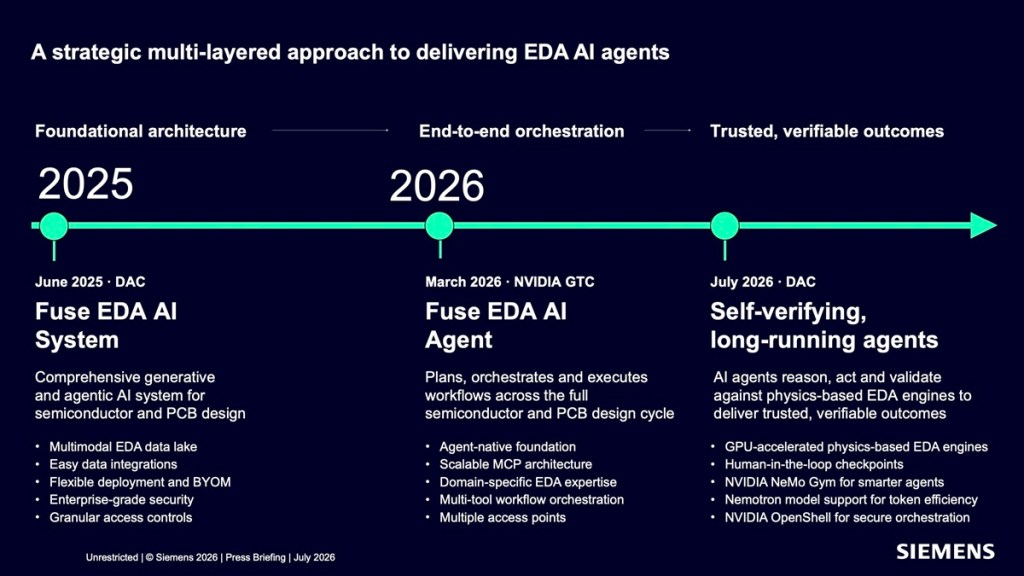 Figure 1: The Fuse EDA AI platform roadmap advances from a foundational AI architecture in 2025 to end-to-end orchestration and self-verifying, long-running agents in 2026. (Source: Siemens)
Common misconceptions about this class of agent
- "The model grades its own work." The opposite is the design rule: a language model alone does not decide whether a design is correct, and every check is made against established EDA engines.
- "Long-running means unattended." Near-term deployment remains domain-scoped and supervised, and engineers still need to observe, pause or stop, and redirect.
- "Fast approximations retire the validators." PhysicsNeMo-based physics-aware models help the agent explore a design and locate where higher-fidelity simulation is required, but trusted solvers, test data, and domain-specific criteria are the final references.
- "More connected applications equal cross-domain autonomy." The harder requirement is understanding how different representations of the same design correlate to one another.
- "Reported multipliers transfer to every workflow." The more than 10× turnaround and 5× to 10× token figures are reported for library characterization with the Solido Characterization Suite — a flow with well-defined inputs, tools, and acceptance checks.
Checklist: is your process a candidate?
- The underlying computation is already automated and deterministic.
- A trusted engine can return pass or fail evidence for each decision the agent makes.
- Elapsed time is dominated by the supervisory loop between runs rather than by a single run.
- Inputs, tools, and acceptance checks are well defined within one domain.
- A named human role can watch the agent's actions and halt execution.
- Consequences that cross stages are visible — or cross-domain scope can be deferred.
- Turnaround and token cost can be measured as separate operational metrics.
Action recommendations for teams adopting agentic workflows
- Start with one domain-scoped workflow with clear acceptance checks before considering stitched-together flows.
- Inventory the deterministic tools that will serve as validators, and record what evidence each one returns.
- Expose tools through a standard interface such as MCP rather than bespoke scripts, so agents can select and execute steps.
- Instrument the manual steps between runs — setup edits, log inspection, reruns, outlier review — because that is where the gain appears.
- Track token cost alongside turnaround, since both are reported as separate improvement lines.
- Establish the execution boundary first, in a secure runtime such as OpenShell, before agents act on sensitive engineering data.
- Evaluate agent behavior continuously rather than accepting first-pass plans, the function NeMo Gym performs here.
- Write down who may pause, stop, or redirect an agent mid-run, and rehearse it.
- Begin mapping how the same object is represented across your tools, the requirement Siemens is addressing with EDA ontologies.
- Watch the upcoming releases carrying these capabilities, since availability follows the AI-native EDA portfolio schedule.
From single-domain runs to stitched flows
Library characterization is a workflow with well-defined inputs, tools, and acceptance checks, which is why an agent can supervise it. Extending the same autonomy across several EDA domains is more difficult. Gupta said Siemens is currently focused on long-running agents within individual areas such as custom IC design, digital verification, design-for-test, and Calibre physical verification. "What we see as the next step is being able to stitch those product families together," he added.
An early demonstration shows what that looks like operationally: Calibre detects a design rule violation, and the agent invokes Aprisa semiconductor software for a digital physical design repair or Solido for an analog repair. That moves the agent from identifying a problem to changing the design, and it creates new verification requirements, because fixing a local design rule check violation can create a timing, congestion, or signal integrity problem somewhere else in the design.
The challenge is more than exposing additional applications through MCP. Even a cross-domain agent has to understand how different representations of the same design correlate to one another, which is why Siemens is developing EDA ontologies that map relationships between different domains and improve the models' ability to understand the different data types. That context is necessary because a change in one stage may invalidate results elsewhere, and human judgment therefore remains part of the design and verification workflow.
What to carry away from this release
Set against any other industry's adoption plan, the value here is a reusable template rather than a product announcement: the practical unit of automation is a supervised loop, not a conversation. Deploy that loop where a deterministic engine can certify each step, measure the manual minutes between runs, and let the model hold only the right to propose the next action. Agentic EDA does not displace the physics-based tools used to design and verify chips; the agent keeps the workflow moving and chooses what happens next, while deterministic engines and human engineers decide whether the results can be trusted. Broader autonomy arrives only when engineering intent survives agents moving across multiple tools, data models, and verification steps. The expanded EDA AI capabilities are scheduled to ship in upcoming releases of the Siemens AI-native EDA portfolio.