
AIdataNewsGlobal AIApplications: Sixfab AI HAT+ Adds Local Camera and Language Inference to Raspberry Pi 5
Teams building small vision or language products often keep the camera loop, business rules and device control on the host board. A dedicated accelerator is useful only when the host CPU cannot absorb the workload. This AIApplications guide looks at how the Sixfab AI HAT+ for Raspberry Pi 5 adds DEEPX DX-M1M acceleration for local AI, why a three-watt NPU changes product design, and which applications benefit most.
Raspberry Pi has given millions of engineers, students and makers a low-cost path to experiment. For application teams, the practical question is whether to stay with Raspberry Pi's own AI HAT+ and HAT+ 2 options, or adopt ecosystem add-ons such as Sixfab hardware with DEEPX silicon. The answer depends on whether the workload must remain local, power constrained and continuously running.
Why the three watts budget is an application design variable
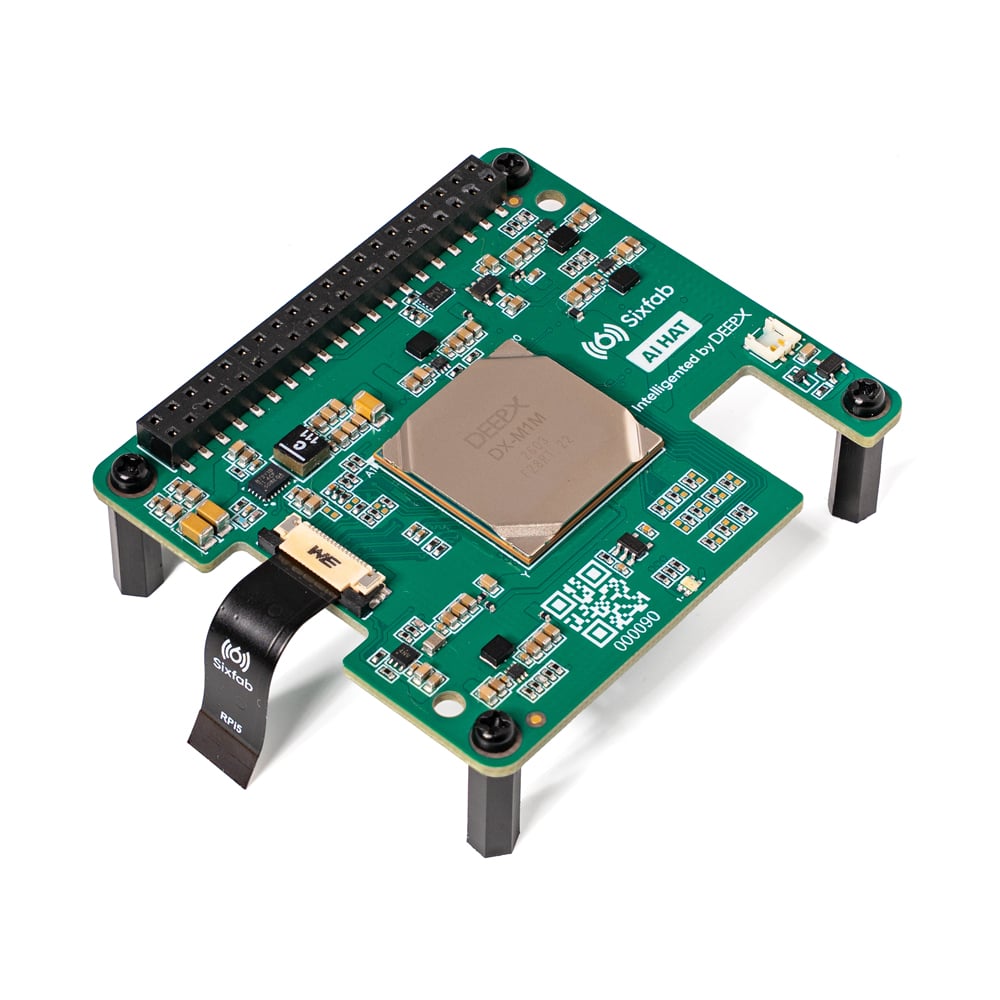
The Sixfab AI HAT+ for Raspberry Pi 5 is a third-party AI accelerator board built around the DEEPX DX-M1M NPU. It brings 25 TOPS of dedicated acceleration while keeping the NPU around 3 W during typical sustained use, so the Raspberry Pi CPU can continue to handle cameras, application logic, networking and control. The important number for a product manager is not the headline TOPS alone; the three watts and ~3 W envelope determine enclosure size, cooling, uptime and whether an edge camera can operate offline. In practice, a single-digit-watt design budget makes continuously running local AI easier to justify in smart cameras, robots, industrial equipment and distributed sensors.
Engineering note: the ~3 W figure describes typical sustained NPU power for the 25 TOPS DX-M1M option, not complete system wall power. Always measure the final Raspberry Pi configuration with its actual camera, storage, workload and cooling.
One NPU, three classes of application intelligence
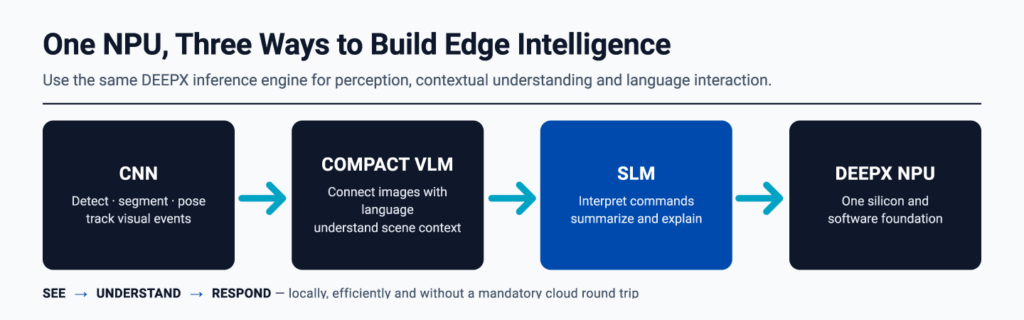
Most applications start with perception. A CNN can detect an object, segment a work area, estimate a pose or flag an abnormal event. The next requirement is context: explain what was detected and respond to a natural-language query. To support that path with one toolchain, the DX-M1M is positioned for three classes of workloads: CNN, compact VLM and SLM.
CNN: turn pixels into structured events
DEEPX ModelZoo includes pre-optimised examples such as YOLO-family detectors, segmentation and pose models. DX-Stream connects these models to GStreamer pipelines for capture, inference and post-processing. This is useful when the application needs structured events, not just a classification score.
Compact VLM: add meaning to visual results
A compact vision-language model can describe a scene, answer a focused question about an image or interpret an event in natural language locally, with nothing leaving the device. In edge applications, the model is used for bounded understanding, not general chat.
SLM: provide a local command interface
A small language model can interpret a user command, summarise local events or generate a concise explanation. That creates a natural interface for cameras, robots and machines without routing every interaction through the cloud.
Memory capacity
When developers consider language models at the edge, the first question is how much memory is available and how large a model will fit. The DX-M1M module carries 2 GB of dedicated on-module LPDDR4x, which is the capacity referenced for supporting VLM and SLM workloads alongside vision models.
How to judge accuracy in real application conditions
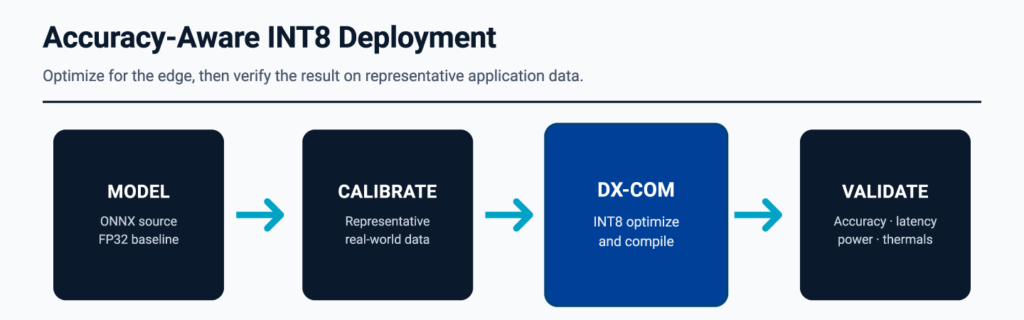
Edge AI performance is only useful if the model stays accurate on the images and conditions the application actually faces. DEEPX treats INT8 optimisation as an accuracy-aware engineering process, not a simple conversion step.
- Start with a known FP32 accuracy baseline and a clearly defined application metric.
- Calibrate with representative data from the real deployment environment, not only clean sample images.
- Compile and optimise the model with DX-COM into a portable .dxnn deployment artifact.
- Compare accuracy, latency, power and thermal behaviour on the final Raspberry Pi system.
This matters most in difficult conditions edge cameras actually meet: low light, glare, motion blur, occlusion and unusual angles. A credible result shows both the efficiency gain and the retained application accuracy.
Measured speed on Raspberry Pi 5
Numbers are useful only when the test system and workload are stated. The figures below were measured on a Raspberry Pi 5 (8 GB) running the shipping Sixfab software release, comparing the DX-M1M and DX-M1 NPUs:
| Workload | DX-M1M (NPU) | DX-M1 (NPU) |
|---|---|---|
| mobilenet_v2, 240×240 | 2361 FPS | 3223 FPS |
| deeplabv3plus, 512×512 | 155 FPS | 231 FPS |
| Qwen3-1.7B, 96 prefill tokens | TTFT: 599.04 ms TPS: 4.64 tok/s | TTFT: 544.58 ms TPS: 11.60 tok/s |
* The DX-M1 uses LPDDR5, while the DX-M1M uses LPDDR4x; the performance difference results from their memory bandwidths.
Step-by-step first boot to first inference
The fastest way to understand the platform is to verify the hardware, run a packaged model and observe the NPU. The path below is a compact tutorial for application teams.
- Install the Sixfab repository on Raspberry Pi OS by running
sudo apt update && sudo apt install apt-repo-sixfab. - Install the runtime package with
sudo apt update && sudo apt install sixfab-dx. - Confirm device and software status with
dxrt-cli -s. - Run
run_hello_worldto execute a packaged example. - Observe the NPU in real time with
dxtop. - Pick an optimised ModelZoo workload or bring your own supported ONNX model through DX-COM.
- Deploy the resulting .dxnn file through DX-RT C++ or Python APIs, while the Raspberry Pi application keeps handling cameras, business logic, user interfaces, networking and control.
Software stack at a glance for application teams
| Component | What it does in the application path |
|---|---|
| DX-COM | Optimises and compiles supported ONNX models into DEEPX .dxnn artifacts. |
| DX-RT | Runs .dxnn models through C++ or Python APIs on the target device. |
| DX-Stream | Builds GStreamer-based capture, inference and post-processing pipelines. |
| ModelZoo | Provides pre-optimised examples across detection, classification, segmentation, pose and other model types. |
| dxrt-cli and dxtop | Show device status, utilisation, temperature, clocks and memory at a glance. |
Common misconceptions and risk checks
- Do not treat 25 TOPS as proof that every workload will meet product targets; peak TOPS must be checked against sustained power, thermal headroom and application accuracy.
- Do not read the ~3 W value as total wall power; it refers to typical sustained NPU power, so measure the final Raspberry Pi configuration with its actual camera, storage, workload and cooling.
- Do not use the accelerator for applications that require broad world knowledge, very long conversational context or continuous learning; those fit better in cloud environments where compute and memory are effectively unconstrained.
- Do not confuse local vision-language AI with a general chatbot; the defensible scope is tightly bounded camera, sensor and on-device event work.
Where this creates practical application value
Start with small, local loops that can run without constant cloud access. A camera on a workbench can recognise when a 3D print has failed and send a snapshot with a one-line description. A front-door camera can tell the difference between a courier, a neighbour's cat and someone loitering, then summarise the day's events locally. A garden or pet monitor can alert users only about events worth seeing. Each example follows the same flow: a CNN sees the event, a compact VLM adds context, an SLM explains it or interprets the next command, and the Raspberry Pi application decides and acts.
The same pattern scales into production work. It can support continuous local detection in smart cameras with reduced cloud dependence, low-power visual quality and safety monitoring beside a production line, perception and compact multimodal intelligence on robots while the Raspberry Pi runs ROS 2 and control logic, and privacy-aware occupancy or behaviour analytics in retail and smart spaces.
Availability, community and next steps
Everything needed to evaluate the platform is public: DX-AllSuite and ModelZoo are on GitHub, while the DEEPX Developer Portal hosts documentation, guides and support channels where developers can ask questions and file issues. The 25 TOPS Sixfab AI HAT+ for Raspberry Pi 5 is available now from Sixfab, with the 13 TOPS version expected to launch toward the end of 2026. Documentation, the Sixfab AI HAT+ Quickstart and DEEPX DX-M1 product information provide further detail.