
AIdataNewsGlobal | AIApplications: How The Grid Applies AI Scheduling to Massachusetts Circuit Board Production
AI & Data News is publishing this AIApplications analysis Today to explain how a factory-scale robot in Massachusetts, known as The Grid, is being used to manufacture circuit boards on demand. The article focuses on workflow fit: where AI scheduling, learned models, and classic optimizers are placed inside electronics production, and what hardware teams should consider before adopting such an application.
Application context
For 30 years, electronics manufacturing shifted away from the West because assembly depended heavily on labor availability. Teams kept design in the US and placed production in China when that arrangement was economical. That history shapes the problem The Grid addresses.
Automation has become more useful when volume is very high. The Starlink example is often cited: SpaceX is producing Starlink dishes by the million in Bastrop, Texas. A dedicated line is easier to justify when the same unit repeats at enormous scale.
Most engineering organizations do not operate at that scale. Their need is ten here, a hundred there, and a new revision due next week. That mixed pattern is harder to automate because each design can require setup and manual changeover.
How the AI application is embedded
The Grid is not presented as a fixed assembly line that must be rebuilt for every job. It is described as one large robot. Levitating transport moves each board and its parts between stations that print solder paste, place components, reflow, solder, and inspect.
Software scheduling is the part most relevant to an AIApplications reader: learned models, AI agents, and classic optimizers coordinate the flow. Each board can follow its own path. There is no per-design setup and no changeover, so 100 different designs can be handled as simply as 100 units of one design.
Prototype work and production batches can share the same equipment, which changes how product managers think about schedule and capacity.
Step tutorial: evaluating fit in your own workflow
- Inventory low-volume hardware needs, including test stations, tooling, R&D, and small production batches, because these categories can exist even in large companies.
- Separate repeat high-volume products from mixed, frequently revised work. The Grid's value is strongest for the mixed pattern, where a request for ten or a hundred boards can collide with a next week revision.
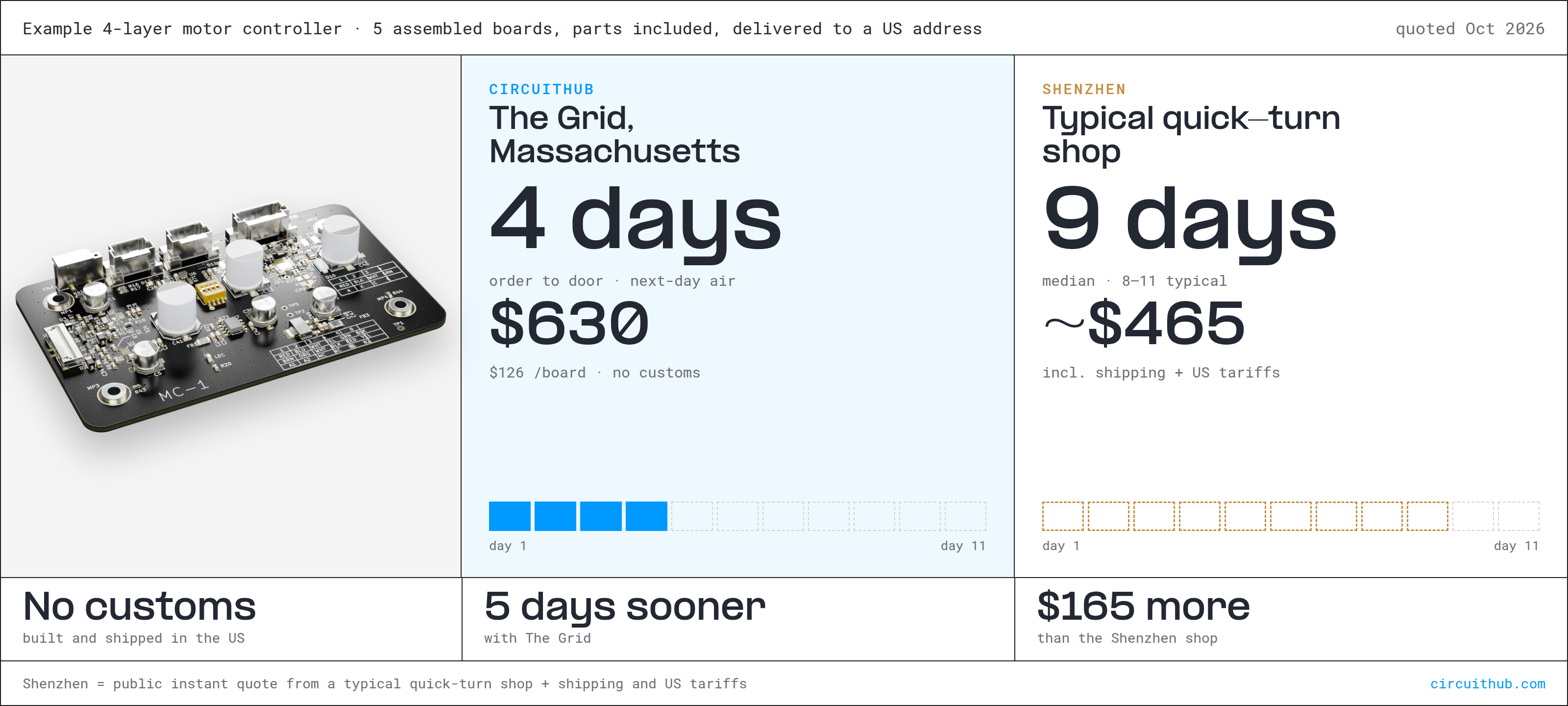
- Compare delivery quality, not unit price alone. The published example uses a 4-layer motor controller with 118 parts per board, including 38 unique parts, and orders five assembled boards with parts included, delivered to a US address.
- Check operational constraints. The system uses The Grid in Massachusetts, not a generic overseas quick-turn queue, so logistics, customs, and lead-time predictability are part of the evaluation.
- If the team has a board to build, request an instant quote and compare it with the current quick-turn path.
What the comparison shows
AI & Data News keeps the original visual reference below because it frames the trade-off.
| Route | Lead time | Price condition |
|---|---|---|
| The Grid | 4 days to your door | $630, parts included, no customs |
| Typical quick-turn shop in Shenzhen | 9 days at the median | about $465 after shipping and US tariffs |
The example therefore costs about $165 more than the Shenzhen option, but arrives five days sooner, without customs handling and with a more predictable supply path. For many hardware teams, saving five days of engineering time may be more valuable than the $165 difference.
Scale already in operation
The Grid has served customers for five years. It already builds tens of millions of dollars of electronics a year. Across CircuitHub, the operating history includes more than 2.2 million boards shipped, more than 150 million parts placed, and more than 26,000 engineers served.
Common misconceptions
- This only matters at Starlink scale. The article's point is the opposite: high-volume lines are useful, but most teams need ten, a hundred, and next week.
- The Grid is just another prototype. It has been running for customers for five years.
- Quick-turn is always cheaper. The sample comparison shows a higher total cost by $165 but a better time-to-door.
- Automation requires a dedicated line. The system uses a single robot and per-board routing.
Capacity outlook and action suggestions
Demand is described as ahead of build capacity. This year, the plan is to increase capacity by 5x, with another major step expected in 2027.
- Map which boards are truly high volume and which are mixed-volume bottlenecks.
- Treat lead time, revision speed, and customs exposure as cost variables.
- Pilot with a small order such as five assembled boards before changing the supply policy.
- Use the instant quote path as the first operational test, not as a full commitment.
The broader lesson for AIApplications readers is that value comes from embedding AI where the workflow is irregular. The Grid's scheduling logic helps make a small, shifting set of electronics jobs economically workable. That does not erase the 30 years of manufacturing history, but it offers a way for the US and other Western teams to keep more work nearby while serving customers who need ten, a hundred, and next week.
By David Nakamura, AI & Data News. Editorial contact: editorial@aidatanews.com.