
2026 LEAP Award Results: What the Software Winners Reveal About Agentic Engineering, AI Design Review and Synthetic Sensor Data
Independent juries rarely produce headlines on their own; what they do produce is a signal about where industrial software investment is going. The software podium of the 2026 LEAP Award cycle points at three pressure points in engineering organizations: automating physics-constrained workflows, catching design errors before human review, and removing real-world data collection as the bottleneck for edge AI.
An expert, independent judging panel recognized the winning companies for technical achievement rather than promotional claims — a distinction that matters for decision-makers allocating tooling budgets.
How the program works, and who placed this time
Each year, the LEAP Awards — Leadership in Engineering Achievement Program — convene a specialist panel to single out innovation that moves worldwide industries forward. The 2026 review spanned multiple categories; in software, the panel's ranking resolved into a Gold, Silver and Bronze set of platforms.
- Gold — Synera: an agentic AI platform for engineers, covering CAD and CAE workflow execution.
- Silver — CoLab Software AutoReview: AI-assisted checking of 3D parts and 2D engineering drawings ahead of formal design review.
- Bronze — TDK SensorGPT: synthetic sensor data generation intended to scale edge AI development.
Gold: agentic engineering that keeps physics, rules and audit trails
Synera
Synera positions itself as an agentic AI platform for engineers.
The judges' assessment frames the value proposition: “Synera presents an impressive agentic engineering environment that combines specialist AI agents with deterministic engineering rules, physics constraints and extensive CAD, CAE and enterprise-system integration. Its demonstrated industrial adoption and substantial reductions in engineering turnaround time make it a highly sophisticated and practically valuable platform.”
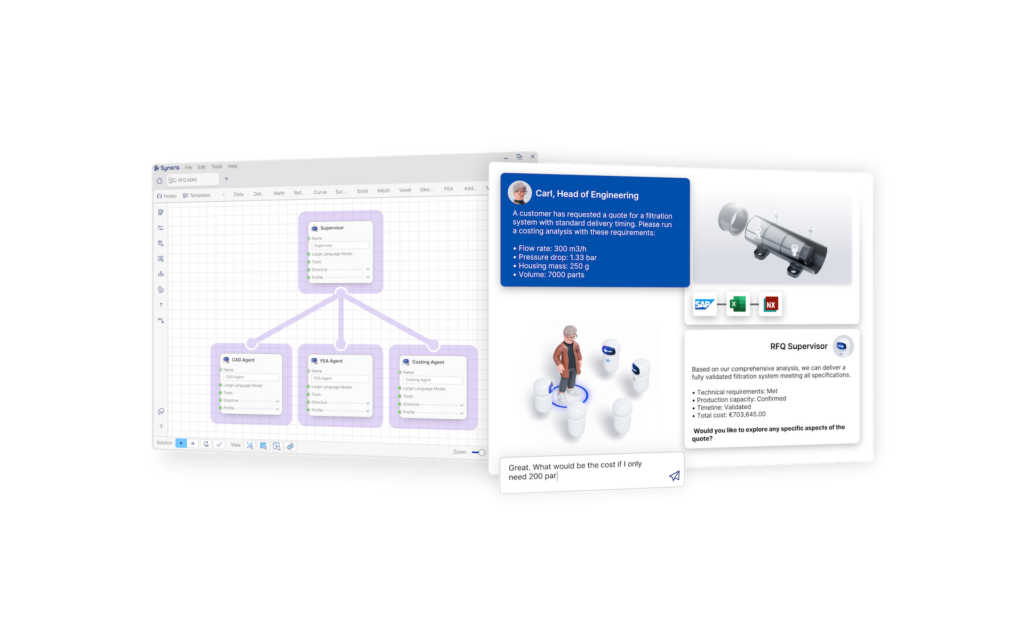
For mechanical engineering, the problem being addressed is the automation of complex workflows that are simultaneously bounded by physics and scattered across fragmented tool ecosystems, while determinism and auditability survive the automation. Rather than depending on general-purpose LLMs that reason probabilistically, the platform drives specialized agents controlled by rule-based logic and physics constraints. Those agents edit 3D parametric geometry, run and interpret FEA simulations, and guide iterative design refinement through engineering rules rather than statistical inference. Every decision path is logged and auditable — a requirement in regulated sectors including aerospace, automotive, defense and consumer goods.
The scope of digitized processes includes RFQ generation, design-to-cost optimization, tolerance stack-up analysis and manufacturability assessment. Specialized agents negotiate engineering trade-offs in real time and coordinate end-to-end workflows across 80+ CAD, CAM, CAE, PLM and other solutions through native APIs. On-premises deployment preserves data security and sovereignty, a requirement for global manufacturers defending intellectual property against cyber threats. Institutional knowledge is combined with AI-driven execution; the platform was developed with several Synera customers and underwent two years of real-world testing before public release.
The efficiency data cited by the vendor arrived with the March 2026 release of its advanced multi-agent capabilities: 10x faster product development cycles, 99% time savings, and turnaround times reduced from weeks to minutes, alongside lower material and production costs. Adopters named include NASA, Airbus, BMW, Hyundai, Volvo Trucks and Miele.
Silver: an AI peer checker that works before the review meeting
CoLab Software
AutoReview
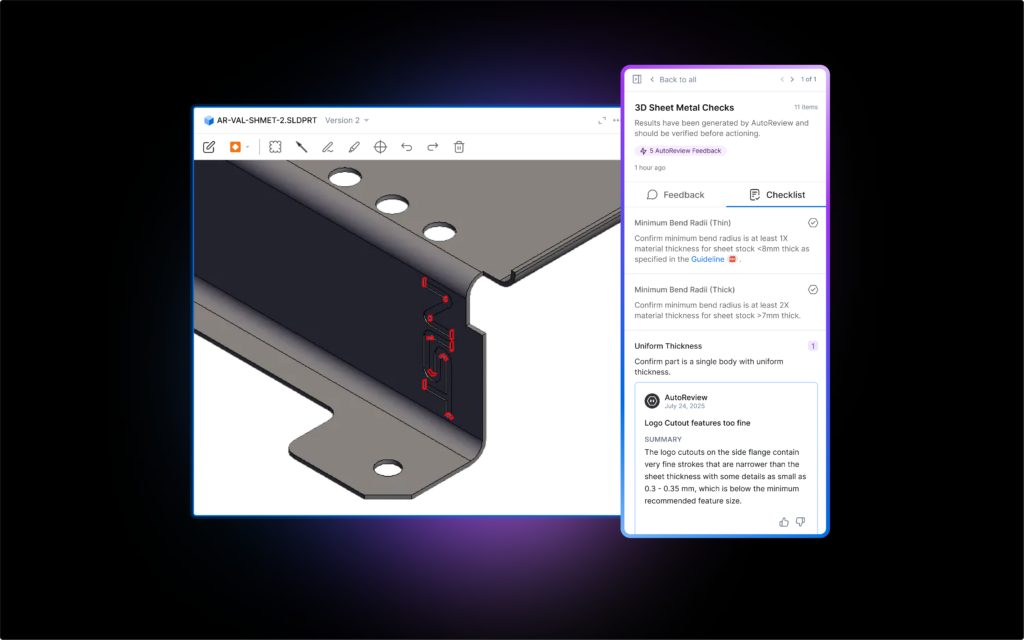
CoLab AutoReview analyzes 3D parts and 2D engineering drawings as an AI peer checker ahead of formal design review. Architecturally, CoLab built AutoReview as a team of specialized agents rather than relying on one general-purpose model: large language models, purpose-built system prompts and organization-specific standards and feedback are brought together inside CoLab's design review platform.
The interaction model matters as much as the detection capability. When an issue is found, markups and comments are placed directly on the surface or feature of the design, preserving exact context so feedback is easy to understand and implement, and the specific guideline or standard violated is cited so engineers can retrieve it. When humans enter the process, they can review the AI-generated feedback and convert it into a tracked issue for resolution.
Check dimensions run in parallel: non-conformance to standards, design flaws in 3D parts, DFM optimization, ambiguous or incomplete drawings, and inconsistencies in technical data such as mismatched materials or title block discrepancies. Conflicts with lessons learned are also examined — common expert feedback, root causes of failures and repeat errors are surfaced, so organizational experience is applied without manual searching.
In production today, dozens of engineering teams are using the tool, including Fortune 500 manufacturing companies. It runs inside CoLab's secure infrastructure, already trusted by engineers at Schaeffler, Lockheed Martin and Bombardier, and meeting SOC 2 Type 2, ISO 27001 and FedRAMP High standards.
Bronze: manufacturing the data that edge AI cannot collect fast enough
TDK
TDK SensorGPT
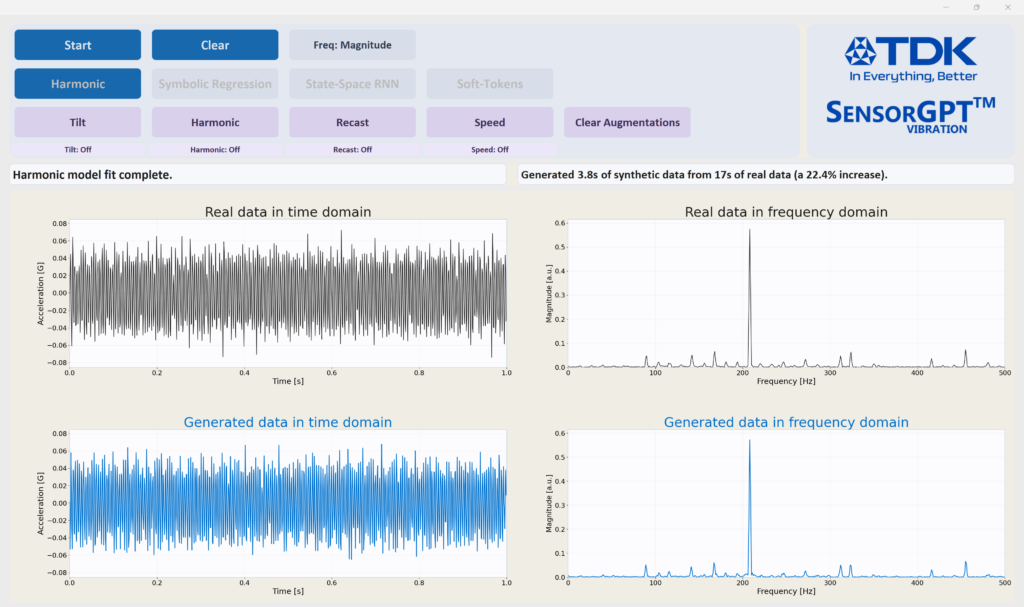
TDK SensorGPT is a smart IoT platform aimed at accelerating the development and scaling of edge AI solutions. Its premise is a scheduling problem: real-world data collection weighs heavily on traditional AI development and can account for up to 80% of development time. Synthesizing high-fidelity sensor data at scale is intended to cut real data dependency to as little as 10%, enabling faster model development and deployment.
Synthetic datasets with up to 90% similarity to real-world conditions are generated, allowing engineers to prototype, train and deploy edge AI models in weeks rather than months. Large, diverse datasets improve model robustness, expand coverage across edge cases and lower overall development costs. Applications span industrial IoT, wearables and Ambient IoT, with the stated effect of reducing costs, accelerating innovation and making intelligent systems more accessible.
The three winners side by side
| Placement | Platform | Problem addressed | Headline data point |
|---|---|---|---|
| Gold | Synera | Physics-constrained CAD/CAE workflow automation with determinism and auditability | 10x faster development cycles; 99% time savings |
| Silver | CoLab AutoReview | Automated pre-review checking of 3D and 2D design deliverables | Dozens of engineering teams, incl. Fortune 500 manufacturers |
| Bronze | TDK SensorGPT | Real-world sensor data collection as a development bottleneck | Data dependency cut to as little as 10% |
FAQ
What is LEAP? Leadership in Engineering Achievement Program. Each year the LEAP Awards convene an expert judging panel that selects category winners; the complete list of 2026 LEAP Award winners across all categories is available at designworldonline.com.
Why is auditability emphasized in the Gold winner? Because every decision path is logged, the platform can operate in regulated industries including aerospace, automotive, defense and consumer goods, where probabilistic reasoning alone is not sufficient.
Does AutoReview replace human reviewers? No. It acts as a peer checker before formal design review; humans can examine the AI-generated feedback and convert it into a tracked issue for resolution.
What does synthetic sensor data change for edge AI teams? It reduces the share of development time consumed by collecting real-world data — cited as up to 80% — and substitutes datasets with up to 90% similarity to real-world conditions, compressing prototype-to-deployment timelines from months into weeks.
What to watch next
Read across the three entries and a common constraint emerges: industrial AI is being evaluated on how much of the existing workflow it can be trusted to touch. Deterministic rules and logged decision paths in the Gold entry, standards citation and tracked issues in the Silver entry, and quantified similarity to real-world conditions in the Bronze entry all answer the same question in different terms — what evidence does an engineer get that machine output is usable? For 2026, the panel rewarded platforms that answered with verifiable process rather than model capability alone.