
Driverless Delivery Fleets in 2026: A Decision-Maker's Q&A on Cost, Road Rights and Liability
By David Nakamura — AI & Data News, General desk. Editorial contact: editorial@aidatanews.com.
The short answer first. Unmanned parcel vehicles became impossible to ignore in 2026 because the unit economics finally cleared the bar. A bare robot van now sells for RMB 20,000–30,000 with an annual autonomy service fee of just over RMB 20,000, putting all-in monthly running cost near RMB 2,500 — a fraction of the RMB 7,700 a drivered logistics van consumes. Everything that still frustrates users — patchwork road rights, blurry fault attribution, conservative algorithms — is downstream of that breakthrough, not the cause of the boom.
The longer context: hardware that spent years circling campuses and industrial parks is now sharing arterial roads with cars, buses and e-bikes; it has produced a cottage industry of street memes and it has attracted the largest single autonomous-driving cheque raised in China this year. For operators, city officials and ordinary pedestrians, the useful way to read the story is as a sequence of decisions, each with a price and a rule attached.
What is the machine, and why did 2026 change its status?
It is a pre-mapped, low-speed cargo robot with no steering wheel and no driver's seat. Development in China began as early as ten years ago inside companies whose core business already involved moving parcels or hot food — JD.com, Cainiao and Meituan among them. For years the technology outran the permission: with no mature autonomy stack and no regulatory cover, the vehicles circled schools, gated residential estates and corporate parks.
The switch flipped in 2021, when the first lawful public-road rights appeared. Only after that did fleets leave the starter village, as the Hangzhou-based technology writer Shichao puts it. The visible result in 2026 is that these vehicles are no longer a demonstration but a working tier of freight capacity, and capital markets have responded accordingly.
Why did investors back a vehicle that makes people laugh?
Because the revenue line is now easier to defend than the joke reel. A few days ago, Neolix disclosed the close of its Series E, a round of nearly US$400 million announced on 20 October 2026 and reported by TechNode as led by Boyu Capital with a state-backed fund alongside; cumulative fundraising for the company has passed 10 billion yuan, the deepest pocket in the sector. Money chasing a machine that also stars in short videos is the defining tension of this market: spectacle and balance sheet, same object.
How much does it actually cost, and where is the break-even?
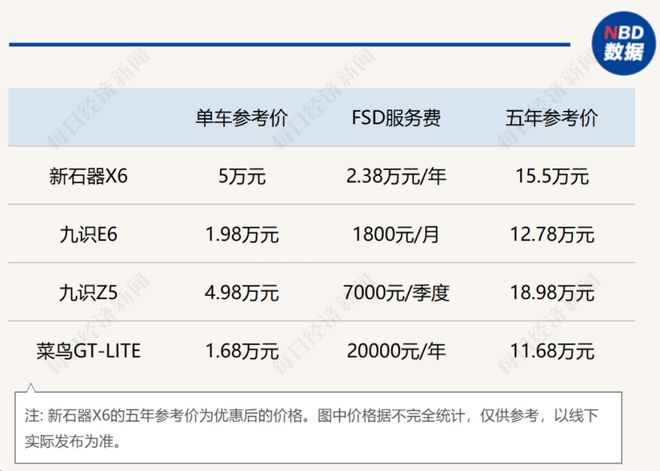
Cost is the whole thesis. In 2018 a unit was still a million-yuan-level asset. Last year the bare vehicle had dropped to RMB 20,000–30,000, with an annual service fee of just over RMB 20,000; measured over five years, total ownership usually lands around RMB 120,000. Securities analysts working the same figures land on a monthly comparison that makes the substitution obvious:
| Cost line | Unmanned logistics vehicle | Traditional logistics van |
|---|---|---|
| Monthly cost | Around RMB 2,500 (vehicle depreciation, FSD service fee, electricity) | RMB 7,700 (depreciation, driver wages, fuel) |
| Supervision | One remote operator watches several, or more than a dozen, vehicles | One driver per vehicle |
| Typical role | Station-to-station shuttling on pre-set routes | Door-to-door and irregular trips |
Multiply that delta across an express group the size of SF Express, whose last-mile vehicle pool runs to tens of thousands, even over a hundred thousand units, and the saving is simply profit. The caveat is scope: the cheap units are entry-level shuttles, and the robots people actually see outside are mostly this grade. County-seat-to-county-seat or village-to-village legs require higher-spec vehicles, and that is a different invoice entirely.
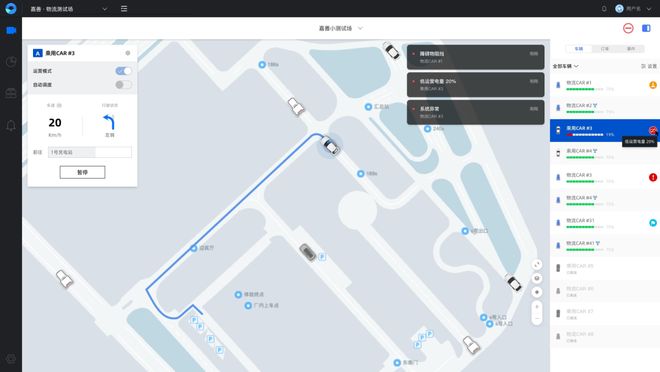
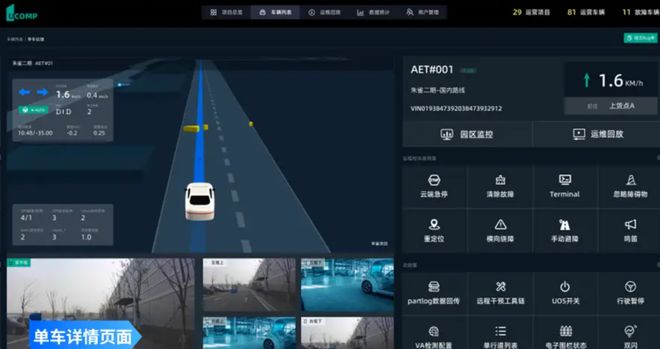
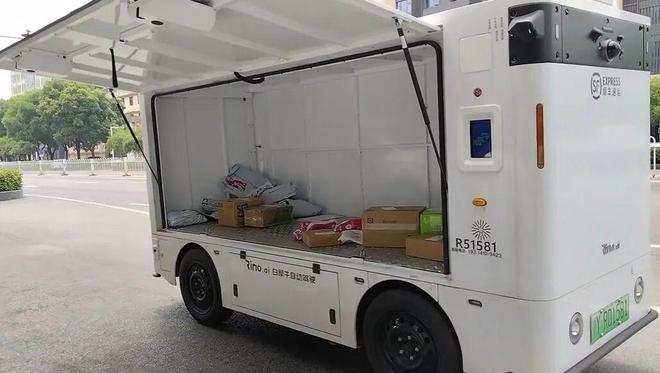
Operationally the workflow is deliberately simple: routes are pre-loaded, parcels are dropped into the box, the vehicle departs. A remote safety operator monitors the fleet and takes over when something goes wrong; the console shows where each vehicle is, whether it is executing a task, whether an obstacle is blocking it, system faults and low battery.
Per-vehicle consoles even allow a manual horn.
How large are the fleets, and does "covered" mean "city-wide"?
Conclusion first: scale is real, granularity is not. As of now, the biggest unmanned-vehicle logistics operator in the country is China Post, which reported in late July that it had deployed nearly 5,000 vehicles across 31 provinces and 263 cities, carrying more than 130 million parcels. Shichao adds the warning that matters to anyone reading a rollout press release: much of that "coverage" is a single district or a handful of approved lanes, not the entire municipality.
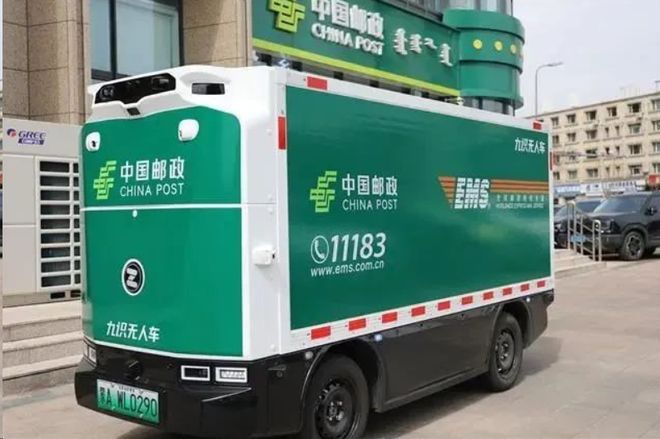
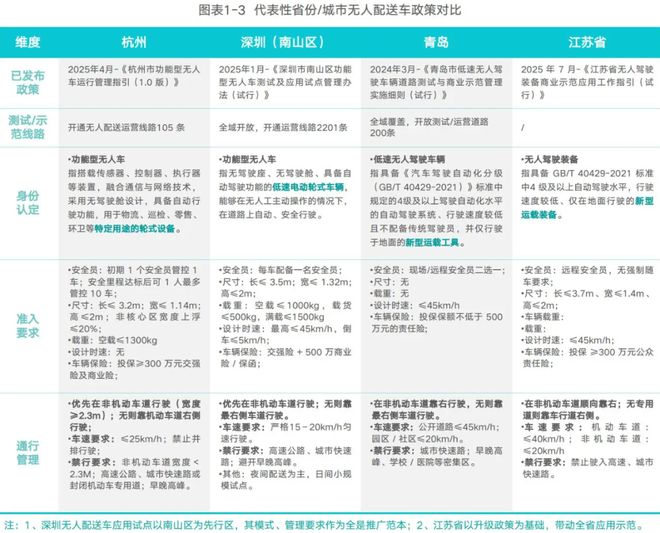
The units do carry registration plates, and they are expected to obey the same traffic law as any other road user, which is why rules vary city by city — on vehicle dimensions, maximum speed, safety-operator ratios and insurance configuration, with some jurisdictions setting the sum insured at the million-yuan level.
Can it legally drive everywhere? Road rights remain the binding constraint
No, and holding a permit is not the same as full-capability operation. A courier told Shichao that his station once ran several of these vehicles but that traffic police now control their use: they are barred during morning and evening peak hours and during school drop-off and pick-up windows, so in practice many of them only trickle out at quiet times. A second courier described the hidden labour cost — the job is lighter, but "if it doesn't come back for ages, you have to go find it, and see where it is stuck."
The regulatory floor moved this year. On 1 July 2026 the Ministry of Public Security's industry standard GA/T 2388-2026, covering road-testing and demonstration traffic safety for intelligent connected vehicles, came into force — the first national instrument that explicitly names unmanned delivery vehicles. As summarised by Sina Finance, it introduces graded limits: roughly 20 km/h on auxiliary and non-motorised lanes, 30 km/h on main and secondary arterials, a ban on expressways and elevated roads, movement between 22:00 and 06:00 restricted to closed parks and approved dedicated corridors, mandatory stops at un-signalised junctions, and suspension of service in bad weather. Because it is a public-safety industry standard rather than a statute, local discretion survives — a point 36Kr's global desk also stresses.
"Without road rights we absolutely do not put a vehicle on the road — that is the industry's bottom line," Sun Shuaijun, a regional unmanned-vehicle service provider, told Sina Finance in July 2026, describing the manual map capture, back-office filing and traffic-authority registration each new line requires.
Who pays if a robot hits someone — or if someone hits a robot?
The money is provided; the process is still ugly. Accident handling formally follows the same route as a human-driven crash, with traffic police issuing the fault determination. What remains unresolved is the responsible subject: with no driver in the seat, accountability disperses across manufacturer, operator and remote monitor, so even cases that conclude correctly can take a long, irritating route there.
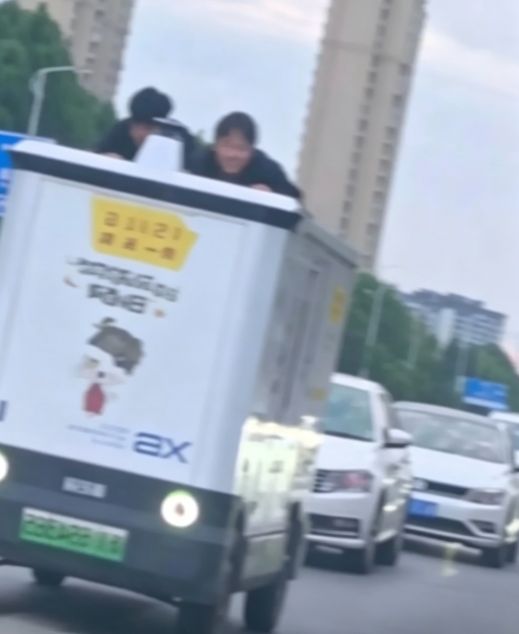
Shichao's advice to pedestrians is blunt — keep your distance, because a robot may brake hard or pull away without the tells a human driver gives. Do not touch the vehicle; and do not step in front of it.
Why has the internet turned them into a punchline?
Because their failure modes are comically legible. Missing a parcel used to mean suspecting a lost shipment; now it can genuinely mean the package was detained by a dog. In one widely shared clip a stalled robot is surrounded by three of them — some viewers read it as a re-enactment of an ancient battle, others as puppies meeting their first gadget, and the obsessives noted a black dog running on three legs, apparently fetching its friends.
The bigger pattern is spatial. The vehicles wander into the motor-vehicle lane, into the bicycle lane, sometimes halt in the middle of the carriageway, occasionally take the pavement, and have been filmed driving the wrong way down a one-way street and crossing on a zebra crossing. Shichao jokes that there must be Lu Xun inside their CPU, grinding over 0 and 1 until reaching the line, "actually there were originally no roads on the earth; but as many people walked, they became roads."
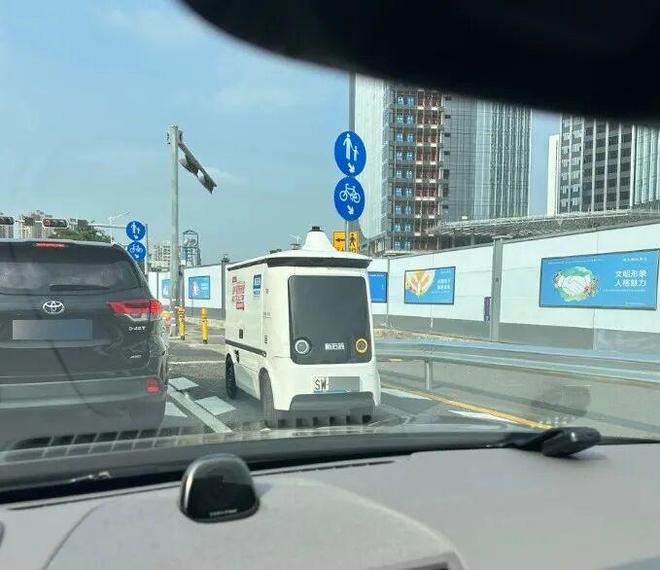
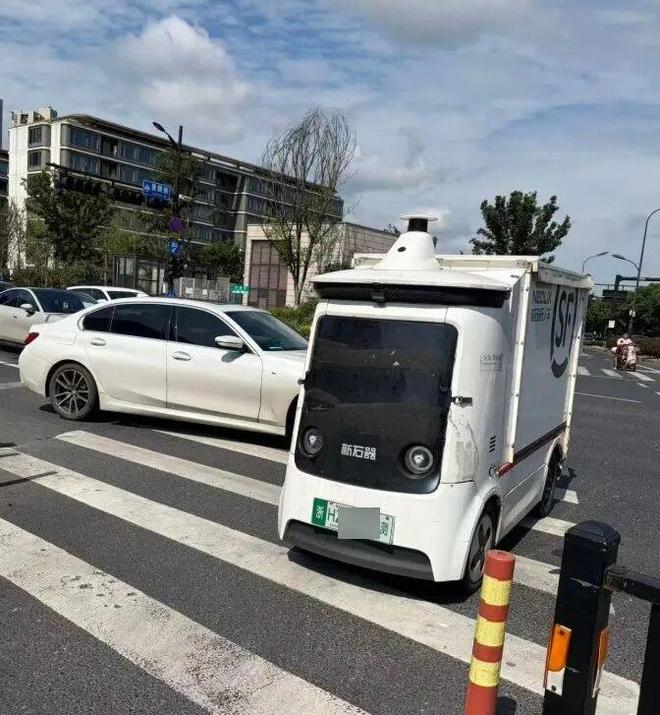
The punchline also carries a real complaint. Insisting on one's own path has a second half: leaving everyone else without one — for instance, stopping dead in the middle of the road during the morning rush hour and blocking commuters who are late for work.
Will these robots take couriers' jobs? Treat this as analysis, not forecast
The on-the-ground evidence points to task substitution rather than headcount elimination. What the robot absorbs is the repetitive shuttle leg between depot and station; what remains with people is loading, exception recovery and the final doorstep step. The remote-operator ratio — one person to several, or more than a dozen, vehicles — creates a supervisory function that did not previously exist. The economics weaken wherever routes are irregular, so displacement pressure concentrates on fixed-line driving rather than on the whole job.
What else can an autonomous cargo box do besides carry parcels?
The trade's preferred term is unmanned logistics vehicle, precisely because "parcels only" undersells the asset. Jiushi Intelligence said this year that express-delivery work now accounts for less than 40% of its fleet's activity, against about 50% in Q3 last year — so the other 60% is generic point-to-point hauling: supermarket replenishment, instant logistics, and small-parcel trips that would otherwise be sent by ride-hailing car on the Didi model.
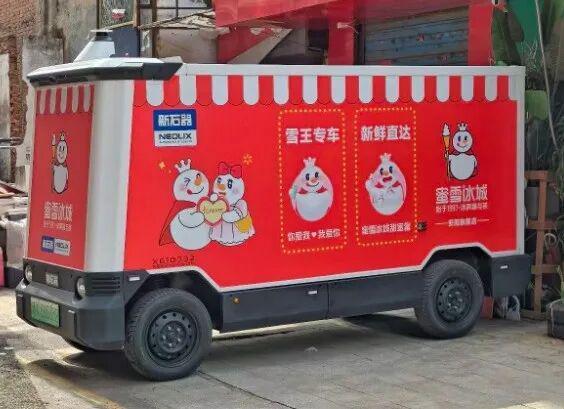
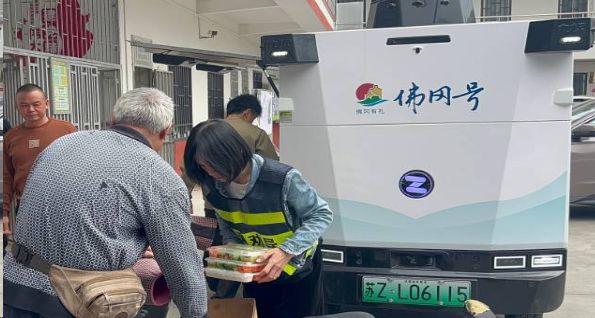
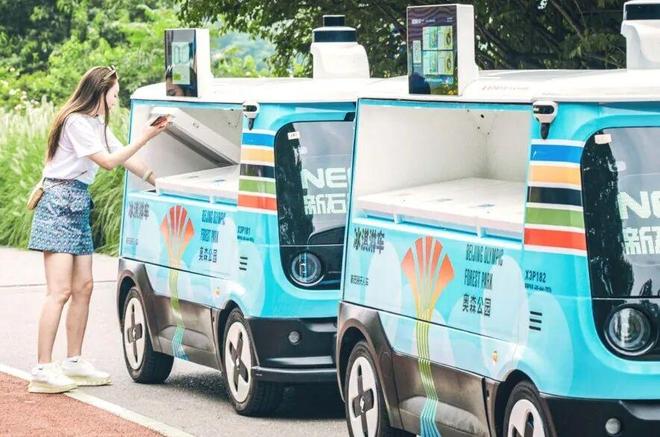
Two categories look structurally well matched. First, public-service runs with too many stops to justify a dedicated driver: delivering meals to home-bound older residents across more than 10 meal-delivery points a day, where the robot parks at the site and volunteers do the handing out. Second, mobile retail: fit a freezer into the cargo bay and the same chassis sells ice cream in scenic areas and business parks while its body-mounted screen plays advertising.
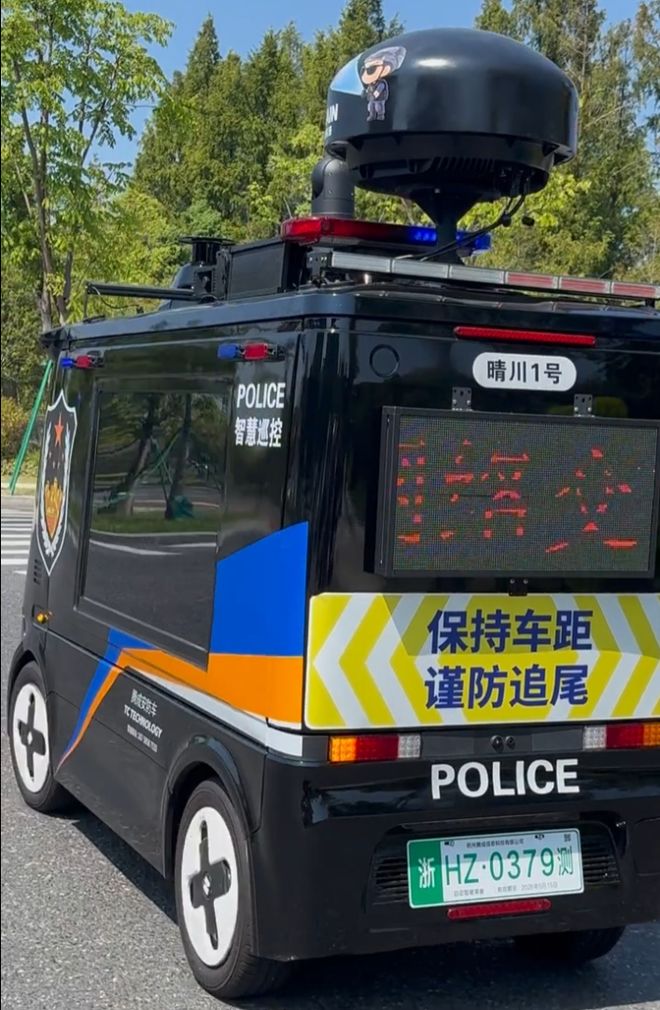
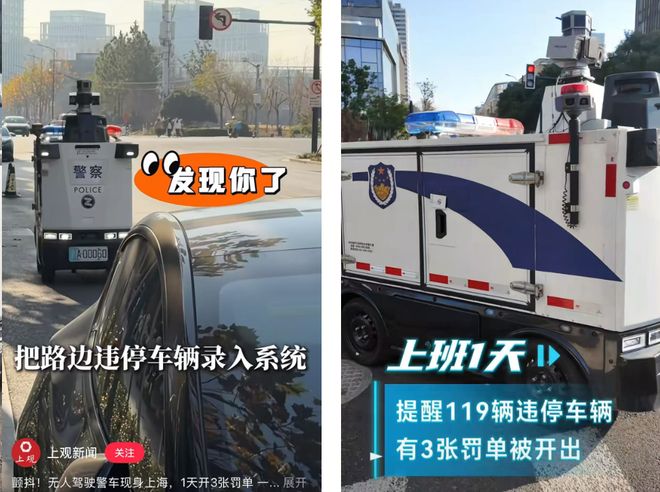
Hangzhou residents know a third variant. In Yuhang, unmanned police vehicles patrol the streets, flagging violations and photographing them for human review back at the police station; a one-touch alert button on the body links straight to that police station, and the cargo bay carries first-aid and fire-response supplies that officers can unlock remotely in an emergency.
How does this compare with the rest of the world?
Globally, the same business model grew at smaller scale and on a different piece of infrastructure. Starship Technologies said it passed 10 million autonomous deliveries in April 2026 and, as of June 2026, reported 3,000-plus robots running across 300-plus locations in eight countries, concentrated on university campuses and grocery contracts (company press releases). Bloomberg's October 2026 feature on China's night-shift robots counts more than 100 Chinese cities that have opened at least some roads to unmanned delivery vehicles. The distinction is road class, and it explains the regulatory pressure: Western fleets mostly ride pavements, where motor-vehicle law barely applies, while Chinese fleets operate in mixed traffic.
Buyer's checklist: deploy, pilot or wait
- Deploy now where the trip is fixed-line and repetitive: depot-to-station, station-to-village-point, and overnight transfer between a sorting centre and a last-mile outlet while the road network is empty.
- Pilot first where volumes are seasonal — big-sale peak smoothing is a capacity argument, not a labour-substitution argument.
- Verify before you sign: route-level road rights (city-wide versus a single corridor), peak-hour and school-window exclusions, insurance sum insured at the million-yuan level, remote-coverage ratio, and compliance headroom against the night-time and speed caps in GA/T 2388-2026.
- Wait if your lanes cross un-signalised junctions frequently or run along arterial roads, where conservative stopping converts into congestion complaints.
- Price the exception handling: staff time spent walking out to a stranded vehicle is a real line item that vendor decks usually omit.
FAQ: what readers ask first
Are these vehicles legal on public roads?
Only where a city has granted route-level rights. Rights are still issued per route in most places, and morning and evening peak hours plus school drop-off and pick-up windows are commonly excluded even inside permitted areas.
What does one cost to run?
A bare unit is RMB 20,000–30,000 with an annual service fee of just over RMB 20,000; over five years that is typically around RMB 120,000, or roughly RMB 2,500 a month all-in, against RMB 7,700 for a drivered van.
What should a pedestrian do when one approaches?
Give it space and do not touch it. Robots can emergency-stop or restart without human cues, and fault attribution involves operator, manufacturer and remote monitor rather than a single named driver.
Do they deliver to the door?
No. In current fleets they handle station-to-station and station-to-point legs; the doorstep step still belongs to people, which is also why couriers describe the trade-off as "easier, until the vehicle does not come back."
Is this a China-only story?
No, but the models differ. Sidewalk robots such as Starship's dominate overseas delivery counts; China's differentiator is mixed-traffic road operation, which is why national traffic standards now matter more than hardware specifications.
What to watch next
Three signals will decide whether 2026 was a beginning or a local peak: whether a binding administrative rule replaces the current non-binding industry standard; whether remote-operator ratios improve enough to push monthly cost further below the RMB 2,500 mark; and whether fleets that today stop short of arterial roads can be trusted at densities that public tolerance, still generous, will not absorb. As a widely circulated industry interview put it, scattered deployments of a few thousand robots across many cities are still forgiven — at hundreds of thousands, tolerance drops sharply.
References
- TechNode — Neolix closes nearly $400 million Series E (20 October 2026): https://technode.com/2026-10-20/autonomous-delivery-vehicle-maker-neolix-raises-nearly-400-million-in-series-e-funding/
- Gasgoo Auto News — Series E described as China's largest single autonomous-driving raise this year (22 October 2026): https://autonews.gasgoo.com/articles/news/seeds-neolix-closes-nearly-400-million-series-e-round-largest-single-autonomous-driving-fundraising-in-china-this-year-2113103853427240960
- Sina Finance — new traffic rules for unmanned vehicles take effect (23 July 2026): https://finance.sina.cn/2026-07-23/detail-iniiuwta9459474.d.html
- 36Kr Global — how far the driverless courier model can go, and the status of GA/T 2388-2026: https://eu.36kr.com/en/p/3887792964352647
- Starship Technologies press office — 10 million deliveries, fleet and country counts (April and June 2026): https://www.starship.xyz/press/
- Bloomberg — Chinese delivery robots move onto the night shift (8 October 2026): https://www.bloomberg.com/news/features/2026-10-08/china-s-delivery-robots-are-learning-to-tackle-the-night-shift