
Adobe's Local MCP Preview Explained: What Agent Access to Native Creative Files Changes | AIdataNewsGlobal General
Adobe's local MCP integrations would let an outside AI agent edit native Photoshop, Illustrator, Premiere and After Effects projects while leaving layers, vectors, bins and sequences editable. Previewed on November 10, they are planned as a private beta for early 2027; nothing is generally available today, and Adobe has disclosed no measured time savings. Read the announcement as a scope-and-risk statement rather than a shipping capability.
By Sophia Baker · AIdataNewsGlobal General
Creative production is already crowded with automation that returns a flattened artifact. So the interesting question is not whether an agent can output a poster or a cut — it can — but what lands on the next person's desk when it does. Adobe's answer in this preview is a file the next person can keep editing, and that single design choice is what shifts the review economics.
What exactly did Adobe announce on November 10?
An agent a professional already uses could call Creative Cloud desktop applications locally, on that person's own machine, instead of only receiving an exported asset through a separate interface. The integrations are built on Model Context Protocol, or MCP, the open standard for wiring AI agents to external tools and data sources.
Adobe names 4 creative applications in the preview: Photoshop, Illustrator, Premiere and After Effects. The company states that the editable structure survives the agent's pass — layers, vectors, bins and sequences stay intact for a professional to refine. Timing is explicit and conditional: a private beta for the local integrations in early 2027.
Two negative facts carry as much weight as the positive ones. There is no general-availability date. And Adobe has not published measured time savings, benchmark numbers or campaign performance results for these integrations. Any efficiency figure circulating now is inference, not a disclosed number.
Why is a native project file a different handoff from an export?
Because the cost of the next revision collapses. A campaign asset usually needs several passes before it is usable — a different crop, an adjusted sequence, a changed visual treatment. When an agent works inside the native file, those decisions stay in the production environment instead of being rebuilt downstream.
Adobe's framing puts human judgment at the center rather than at the end. "The ideas, taste, style and vision that creative professionals bring to their work are what make their work stand out," per Deepa Subramaniam, Adobe's vice president of product marketing for Creative Cloud.
The standard automation story says value comes from reducing human touches. Creative production can also gain from making the next human touch cheap. A generated image that a designer must reconstruct before changing one layer is not a time saving; it is a deferred rebuild. An editable project pulls review earlier and pushes rework later, which is a different economic shape — and therefore a different measurement target.
How does the workflow actually run end to end?
Adobe describes a connected chain: an agent pulls a brief from Google Docs, works on a project through Creative Cloud, and shares the result in Slack. Every hop assumes that agent is also wired to the relevant tool. The announcement does not promise identical capabilities across assistants or account tiers.
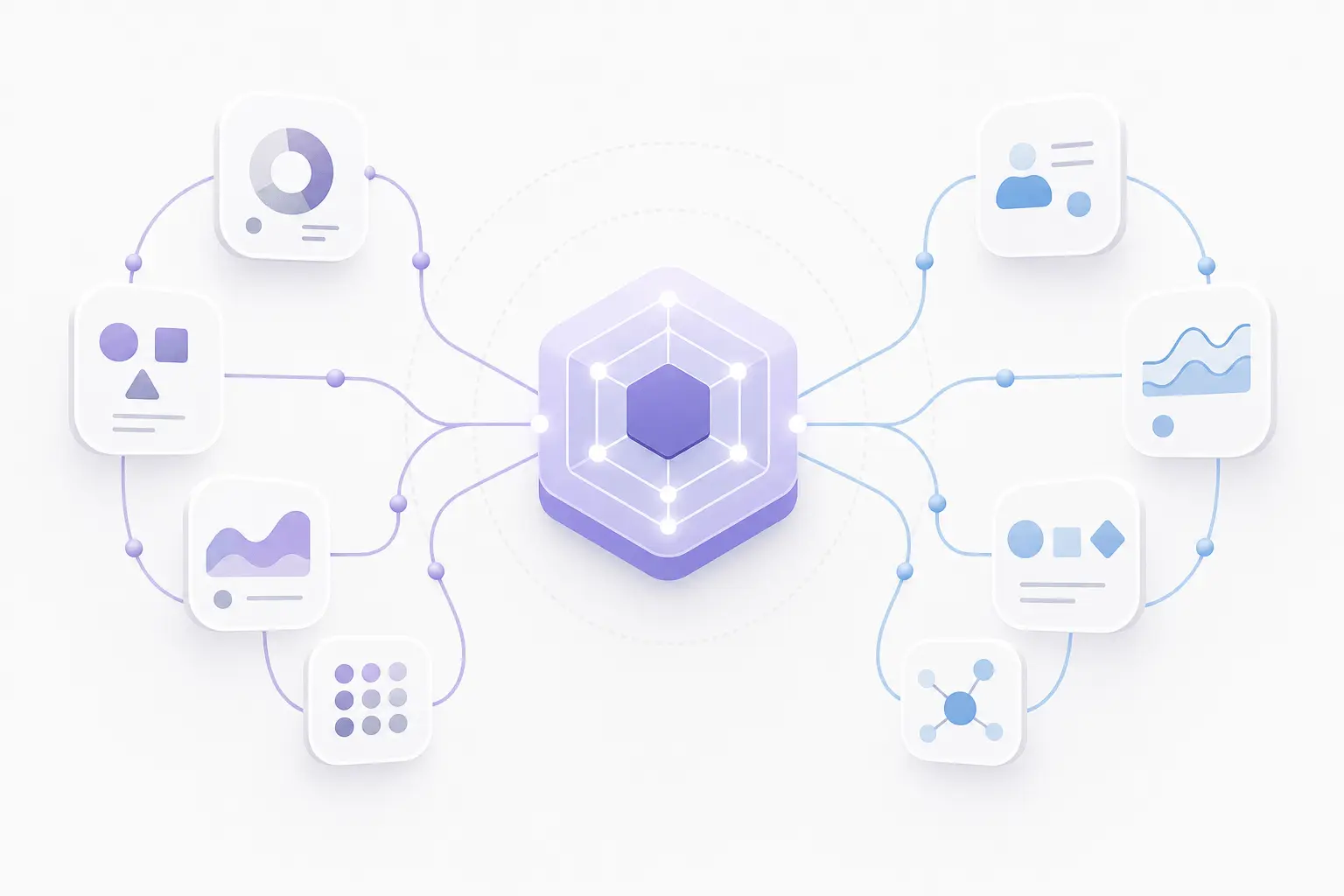
Treat that chain as three authorization problems rather than one feature. The agent needs read access to the brief, write access to a local project file, and permission to post the outcome. A failure at any hop produces a plausible-looking but incomplete handoff — a brief the agent never read, or an edit that was never queued for review.
Inside Premiere, Adobe also describes its Adobe Creative Agent applying effects across a sequence and adjusting color or exposure across clips. That illustrates the repetitive production task Adobe is targeting. It should not be read as a promise about the exact tool set every outside agent will receive.
Where does this sit next to Firefly Builder, Adobe Creative Agent and CX Coworker?
They are separate products with separate release states, and collapsing them into one mental model is the fastest way to mis-plan a pilot. The table below separates capability, driver and stated availability.
| Adobe capability | Who drives it | Workflow and stated availability |
|---|---|---|
| Local Creative Cloud MCP integrations | The user's chosen outside agent | Agents working in native desktop projects in Photoshop, Illustrator, Premiere and After Effects; private beta planned for early 2027. |
| Adobe Creative Agent assistants | Adobe | Adobe's own assistance inside flagship desktop apps; beta availability, with Photoshop assistance in its beta app. |
| Firefly Builder | Adobe | Prompt-to-prototype for websites, presentations and apps, with a design system holding the output on brand; private beta. |
| CX Enterprise Coworker integrations | Outside assistants | Previously announced access to Adobe's marketing orchestration agent through external AI assistants. |
The local-file preview is therefore distinct from the earlier CX Coworker rollout. One concerns work in creative applications; the other concerns access to a marketing orchestration system. Before treating either as a substitute for the other, evaluate the task you actually need to complete.
ContentGrip separately reported that Adobe is bringing CX Enterprise Coworker to ChatGPT, Claude and Copilot, alongside new MCP connectors to advertising and marketing systems. That is a distribution story about a marketing agent; it is not evidence that desktop project files are open to outside agents today.
The same November 10 cycle also carried Firefly Design (beta) and Firefly Graph (beta) alongside Firefly Builder in private beta, per Adobe's newsroom. Three of those four items are gated. A planning document that lists any of them as available is already out of date.
What breaks when an agent holds a native file open?
Three failure modes, none of them hypothetical for anyone who has pointed a tool-using agent at a local application.
- Prompt injection through the brief. If the agent reads a Google Docs document, that document is an input channel. Security researchers have documented workflow hijacking in agentic setups, where injected instructions push an agent into unauthorized actions; the class of failure is unchanged when the tool it can call is a desktop app with write access.
- Permission sprawl. MCP connectors inherit whatever credentials the host grants. Excessive permissions and weak defaults remain the dominant MCP risk category, and the protocol's own roadmap work on enterprise-managed authorization targets exactly that gap.
- Non-deterministic edits on deterministic files. A layer rename or a timeline trim that looks cosmetic can break templates, downstream automation or brand-controlled exports. Native editability is valuable because the file carries structure — which is also what an agent can damage.
None of this argues against the preview. It argues against piloting it without a diff and a rollback. Version control for creative files is immature next to code, so the practical mitigation is unglamorous: snapshot before the agent runs, diff afterward, and confine writes to a scratch copy of the project.
How would a team test this before early 2027?
The private beta cannot be tested yet. The assumptions it rests on can be, with today's files and today's tooling.
- Name the handoff. Decide whether the deliverable is a finished export, an editable project or a proposed set of changes. Each creates a different review owner and different acceptance criteria.
- Baseline the revision loop. Time the current path from brief to first cut to approved asset, including every re-export. That is the number a pilot must beat, and it is the number Adobe has not published.
- Instrument the diff. Log what the agent changed, not only what it produced. Layer count, sequence duration, linked assets and color profile are cheap, comparable signals.
- Keep availability visible. The local MCP integrations are an early-2027 private-beta plan. Existing Creative Agent beta features can be evaluated separately; their availability does not bring the local preview forward.
- Start with a reversible task. A crop variant or a color pass on a scratch sequence is a better first target than a locked brand master.
Verifying an agent's output is a memory problem as much as a rendering problem: you need a record of what the system believed it was doing. The same uncertainty-flagging logic appears in other agent stacks, including MIT's UQ-DAAAM approach to uncertain robot memory.
Teams already running agent-assisted video edits meet the same review bar; the checklist on whether Decart Lucy 2.6 fits a live video workflow covers the equivalent handoff question for generated footage.
Who should care now, and who should wait?
Care now if you run multi-tool review loops across marketing or studio teams and your bottleneck sits in revision rather than in first drafts. Wait if you cannot version creative files today, or if nobody owns agent permission scopes. For that second group, a beta would simply move an ungoverned process into a faster loop.
The integration layer becomes part of the creative brief. The expected file, the next reviewer and the connected tools all shape what a useful result looks like, and as agents absorb more production steps, marketing teams will need to describe collaboration with the precision they currently reserve for brand guidelines.
MCP itself is not new. Anthropic published the specification as an open standard in November 2024, and the maintainers have since shipped stable enterprise-managed authorization for centralized access provisioning. That maturity explains why a vendor would put a desktop application behind the protocol at all. What remains unresolved is not the transport layer. It is ownership of the diff.
Frequently asked questions
Is Adobe's local MCP integration available today?
No. It was previewed on November 10, a private beta is planned for early 2027, and no general-availability date has been published.
Will ChatGPT, Claude and Copilot all get the same access?
Adobe's own example depends on the agent being connected to the relevant tools, and the announcement does not establish identical capabilities for every assistant or account. Per-client capability is a support question, not a protocol guarantee.
What does "native project files" mean in practice?
It means the agent works inside the application's own file format, so Photoshop layers, Illustrator vectors, and the bins and sequences in Premiere and After Effects stay structurally editable instead of being baked into a flat render.
Does the agent see my entire project library?
Adobe has not detailed scoping publicly. For planning purposes assume least privilege: scope the agent to specific files and specific operations, and treat default scoping as undocumented until Adobe says otherwise.
How should success be measured?
Measure the full loop, including review and re-export, not just generation time. Adobe has disclosed no measured time savings for these integrations, so any benchmark has to come from your own files.
Reference sources
- Adobe newsroom, "Adobe Transforms its Creative Cloud Tools into Agentic Workflows…" — news.adobe.com
- Adobe newsroom, "Adobe Firefly Expands as the AI Creative Studio…" — news.adobe.com
- Anthropic, "Introducing the Model Context Protocol," November 2024 — anthropic.com
- Model Context Protocol blog, "Enterprise-Managed Authorization: Zero-touch OAuth" — blog.modelcontextprotocol.io
- Harmonic Security, "The Dark Side of MCP: Security Risks and How to Regain Control of Agentic AI Workflows" — harmonic.security
This article is produced by ContentGrow. Editorial handling for AIdataNewsGlobal General: Sophia Baker, editorial@aidatanews.com.