
Mouser Electronics, Inc. Carries the Advantech MIC-743-AT: Three Edge AI Cases Behind the Jetson Thor Bet
Mouser Electronics, Inc. has begun stocking the Advantech MIC-743-AT AI inference system, a compact industrial box built on NVIDIA Jetson Thor T4000/T5000 modules that advertises up to 2,070 TFLOPS (FP4) for language, vision-language and video models running without a cloud link. Read as a catalogue update, the news is routine. Read next to three documented deployments, it shows why vendors now treat on-site inference as the default architecture for robotics and industrial AI.
The wider context is timing. Jetson Thor modules became broadly purchasable on August 25, 2025, when NVIDIA opened global sales of its AGX Thor developer kit (from $3,499) and Jetson T5000 production modules through authorised distribution; the company has consistently described NVIDIA Jetson Thor modules as the compute spine for physical AI. A listing by Mouser Electronics, Inc. is therefore the second step in that chain: the platform stops being a reference design for early adopters and becomes standard inventory that engineering teams can spec into a machine, a shuttle or an inspection line.
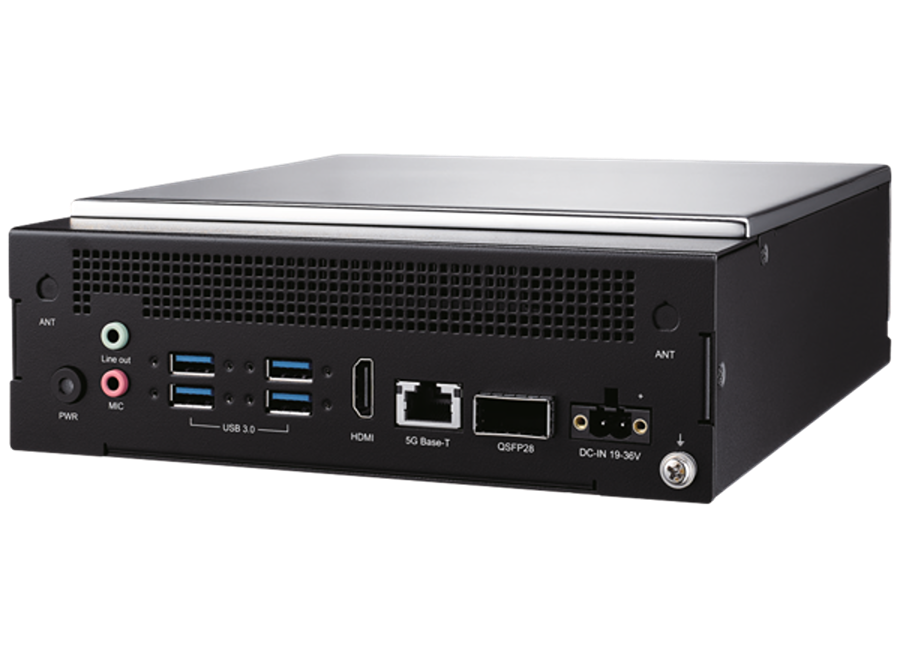 The Advantech MIC-743-AT AI Inference System as offered through the distributor channel. Image: Advantech.
What does this platform add over the previous edge generation?
The short answer is throughput per watt and memory headroom, not a new class of algorithm. Advantech rates the system at up to 2,070 TFLOPS of AI compute, and NVIDIA's product documentation for the same silicon states a configurable module power window of 40 W to 130 W along with 7.5x the AI performance and 3.5x the energy efficiency of the outgoing Jetson AGX Orin generation. Those are vendor figures, but they line up with what integrators have been asking for: a single unit that can hold a multimodal stack in memory while answering a camera stream in milliseconds.
Two numbers should not be conflated. The 40 W to 130 W figure is a module power configuration; the platform's 19V to 36V figure is the system-level input rail, which points to industrial and vehicle-mounted 24 V supplies rather than wall power.
| Dimension | Declared figure | Why a buyer should care |
|---|---|---|
| Peak AI throughput | up to 2,070 TFLOPS (FP4) | Determines how many concurrent LLM, VLM or analytics streams the box can serve |
| CPU | 14-core Arm Neoverse V3AE, 64-bit SMP | The automotive-enhanced ("AE") cores matter for safety-relevant control loops beside the accelerator |
| Accelerator | 2560 NVIDIA CUDA cores, 96 5th Gen Tensor cores, 1.57 GHz MAXN | Kernel scheduling, not just peak FLOPS, drives real tokens-per-second and frames-per-second |
| Memory | 128 GB LPDDR5X | Capacity, not compute, is usually what blocks a large model from running locally |
| Storage | 1 TB SSD pre-installed | Room for model weights, recordings and a rollback image |
| Host I/O | HDMI, USB 3.2 Gen 2, M.2 AEkey (Wi-Fi), M.2 Bkey (LTE); Advantech's product page adds 1x QSFP28 and 1x 5GbE | Multi-camera and multi-sensor ingest is the actual bottleneck in vision workloads |
| Software | NVIDIA Jetpack 7.0 installed | Fixes the runtime, TensorRT and CUDA version set the project inherits |
Case 1 — the video-analytics pilot: what the May 2025 demo actually proved
Process. At COMPUTEX, on May 19, 2025, Advantech ran a live full-stack demonstration of its MIC-743 hardware paired with NVIDIA Video Search and Summarization (VSS), fusing sensors and AI acceleration in one mobile-ready enclosure rather than a rack of GPUs.
Result. The company's own framing was operational rather than benchmark-driven: reduced system complexity and deployment time, a better form factor and energy efficiency than a traditional workstation-based setup, and scaling across mobility and industrial use cases with minimal engineering. NVIDIA's VSS documentation supports the direction of travel, noting that summarisation runs up to 100x faster than manual review on accelerated hardware and that a built-in vision-language model, tightly coupled to the video decode pipeline, gives the lowest latency.
Reusable lesson. Value at the edge is created by the pipeline, not the chip. Teams that demo a Thor-class box by running a single model inference get a misleading picture; the honest test is a sustained multi-camera ingest, a VLM pass, retrieval over stored clips and a natural-language query answered against the result.
Case 2 — humanoids as the reference workload
Process. Around the August 25, 2025 launch, coverage of the robot-sector response highlighted Unitree, UBTech and AGIBOT adopting the new Thor "robot brain"; AGIBOT publicly stated that its next-generation G2 would use Jetson Thor as its core domain controller. At CES, reported on January 5, 2026, NVIDIA's newsroom described humanoid developers, including NEURA Robotics, unveiling machines integrated with Jetson Thor.
Result. A workload profile emerged that industrial buyers now inherit: one enclosure running perception, a vision-language model, a policy model and a controller simultaneously, with all data staying on the machine.
Reusable lesson. If your application fuses cameras, inertial sensors and language queries, spec for memory bandwidth and I/O first and treat FLOPS as the second filter. The 128 GB of unified LPDDR5X memory is what makes a large multimodal stack loadable at all; the throughput figure determines how fast it answers. That trade-off also explains the T4000/T5000 split in Advantech's offering: the modules differ in memory, power ceiling and therefore in the model sizes they can host, so the SKU choice should be made before, not during, procurement.
Case 3 — the budget retrospective that moved inference off the cloud
The economic case is the least visible and the most decisive. A May 2025 report by edge-AI software firm Latent AI, summarised by ITBrief, described a manufacturer running defect detection on a cloud deployment that required roughly 50 GPUs and cost $224,000 in hardware per site; after edge optimisation the same site needed 4 GPUs and $18,000, a saving of more than $200,000 per site and about $2.07 million across ten sites, alongside 73% lower memory use, 73% faster inference and 65% to 80% less energy.
Latency points the same way: A3's automation glossary describes deterministic edge response in the 10 ms to 100 ms range, against 50 ms to 500 ms or more when the round trip leaves the building.
Editorial caution: the report is vendor-published and describes an optimised deployment, so treat the magnitudes as directional rather than a guarantee. Our own reading is that a fixed-cost, multi-year asset such as the MIC-743-AT competes not on peak compute but on the elimination of per-image cloud charges, egress fees and rework caused by slow feedback to the line.
Where distribution enters the story
Mouser is a global authorised distributor, and buyers should expect 100% certified, genuine products that are fully traceable back to each manufacturer partner; the company also publishes engineering collateral through its Technical Resource Center to shorten design cycles. In a category where several industrial vendors now sell carrier boards on the same NVIDIA modules, authorised sourcing is a practical control against mixed module revisions, and traceability is what makes a field recall possible at all.
What the fine print says about thermal, power and software
Three constraints decide whether a Thor-class box survives a real installation:
- Operating window. The system is rated from -10°C to 35°C with 0.7 m/s airflow. Near a heat-generating press or in a sealed cabinet that ceiling is reachable; plan forced ventilation or a cold aisle, and validate with a thermal soak test before sign-off.
- Input rail. A 19V to 36V range fits machine and vehicle 24 V systems, but needs a converted supply wherever mains power is all that is available, and a wide-input design in mobility.
- Software and benchmark deltas. With NVIDIA Jetpack 7.0 preinstalled — version 7.0 pins the runtime stack — teams should confirm model-runtime compatibility early. Note also that the vendor's development boards deliver up to 1,200 FP4 TFLOPS while the production platform is rated at 2,070 TFLOPS, so prototype measurements need re-basing before they are projected to production.
Checklist before specifying a Thor-class edge system
- Write down the model you intend to run, its parameter count and quantisation, then check it against memory capacity — not against the headline TFLOPS figure.
- Count sensors and compute aggregate ingest; confirm the connector set (HDMI, USB 3.2 Gen 2, QSFP28, 5GbE, M.2 AEkey and M.2 Bkey) covers cameras, wireless backup and LTE failover.
- Model the ambient temperature at the mounting point against the 35°C ceiling and the stated 0.7 m/s airflow assumption.
- Define the latency budget the workload must meet, then test end-to-end pipeline latency rather than isolated inference.
- Decide the module tier (T4000 or T5000) before ordering, and source through an authorised distributor to keep revisions traceable.
- Plan the update path for the JetPack image, model weights and rollback, and check what the Technical Resource Center offers for your design-in stage.
FAQ: what buyers ask first
What is the MIC-743-AT AI inference system for?
It is an industrial edge inference platform from Advantech for smart factories, robotics, autonomous mobility and generative or agentic applications that must reason locally, where round trips to a datacentre are too slow, too costly or not permitted.
How much compute does it claim, and how should that be read?
Advantech states up to 2,070 TFLOPS (FP4) for the platform, using NVIDIA Jetson Thor modules. Low-precision FP4 numbers flatter peak capability: sustained tokens per second or frames per second depend on quantisation, batch size and how much of the pipeline is memory-bound.
Can it run a large model on device?
The published hardware set — 14-core Arm Neoverse V3AE 64-bit CPU, 2560 NVIDIA CUDA cores with 96 5th Gen Tensor cores at 1.57 GHz, 128 GB LPDDR5X and a 1 TB pre-installed SSD — has enough capacity to load tens-of-billions-parameter models under aggressive quantisation. This is our analysis, not a vendor claim: throughput, context length and concurrency must be measured on the actual checkpoint.
Where does it sit in the software stack?
It ships with NVIDIA Jetpack 7.0 installed, and the vendor positions the development-board variants, rated at up to 1,200 FP4 TFLOPS, as the path for generative and agentic AI deployment and testing.
Is this a robotics-only product?
No. The same profile — multi-sensor ingest, real-time perception, local model hosting — applies to quality inspection cells, autonomous internal transport, mobile robots and research rigs, which is why a components distributor rather than only a systems integrator is carrying it.
What to watch next
Three markers: whether module and board pricing keeps falling from the developer-kit level of $3,499 toward the $2,999 per-unit level NVIDIA quoted for 1,000-plus T5000 volumes; whether the vendor's January 6, 2026 announcement of an AI-brain platform built on NVIDIA Jetson T4000 pulls the mid-tier of the line ahead of full Thor configurations; and how quickly JetPack 7.0 support, including model runtimes, matures on production carrier designs. Trade coverage of the launch also describes the chassis as compact — reported at 195 x 200 x 71.5 mm and 2.4 kg — which is what allows the same compute to be mounted on a machine instead of racked beside it.
Sources consulted
- NVIDIA Jetson Thor product page (module throughput, 40 W to 130 W configurable power, 7.5x and 3.5x comparisons): https://www.nvidia.com/en-us/autonomous-machines/embedded-systems/jetson-thor/
- NVIDIA Newsroom, "NVIDIA Blackwell-Powered Jetson Thor Now Available", August 25, 2025 (pricing and availability): https://nvidianews.nvidia.com/news/nvidia-blackwell-powered-jetson-thor-now-available-accelerating-the-age-of-general-robotics
- NVIDIA Developer Blog, "Introducing NVIDIA Jetson Thor, the Ultimate Platform for Physical AI" (JetPack 7, distribution): https://developer.nvidia.com/blog/introducing-nvidia-jetson-thor-the-ultimate-platform-for-physical-ai/
- Advantech MIC-743-AT product page (QSFP28, 5GbE, USB, clock and memory detail): https://www.advantech.com/en-us/products/mic-743-at
- Advantech press coverage, May 19, 2025, COMPUTEX full-stack Jetson Thor demonstration with NVIDIA Video Search and Summarization: https://www.advantech.com/en/resources/news/advantech-demonstrates-live-full-stack-nvidia-jetson-t
- NVIDIA documentation, Video Search and Summarization blueprint deployment guide: https://docs.nvidia.com/vss/2.4.0/content/vss_dep_docker_compose_x86.html
- AGIBOT statement on adopting Jetson Thor as the G2 domain controller: https://www.agibot.com/article/231/detail/28.html
- NVIDIA Newsroom CES 2026 physical-AI roundup, January 5, 2026: https://nvidianews.nvidia.com/news/nvidia-releases-new-physical-ai-models-as-global-partners-unveil-next-generation-robots
- Latent AI edge-versus-cloud report as summarised by ITBrief, May 2025: https://itbrief.co.nz/story/edge-ai-deployment-enables-enterprises-to-save-2-07-million
- A3, "Edge vs Cloud AI" glossary entry (latency bands): https://www.automate.org/glossary/edge-vs-cloud-ai
Compiled for AI & Data News by David Nakamura. Corrections or additions: editorial@aidatanews.com — visit https://aidatanewsglobal.com for our wider coverage of AI models, data governance and infrastructure.