
AI Compute and Memory Lift Global Chip Sales in Q3: A 2027 Buyer's Q&A
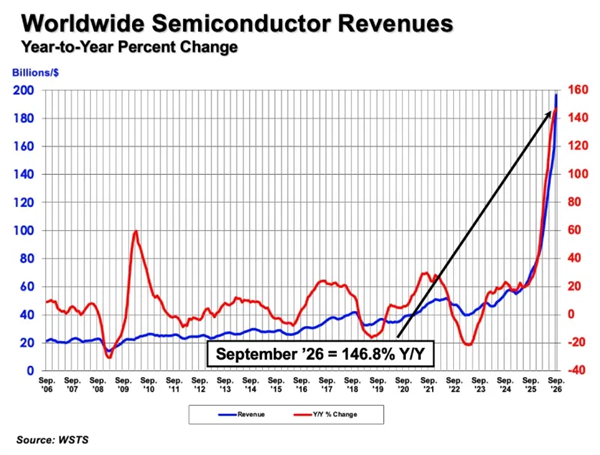
Global semiconductor sales expanded on every major region at once in September, and the third quarter marked the third straight period of more than 20% quarter-over-quarter growth. The cause is structural rather than cyclical: AI compute build-outs are absorbing memory capacity faster than fabs can add it. For buyers, that means allocation, not price list, now decides delivery dates — and the squeeze is likely to run into 2027.
What exactly happened in the third quarter?
Short answer: demand re-accelerated everywhere at the same time. The Semiconductor Industry Association (SIA) reported that worldwide chip sales reached $517.7 billion in Q3 2026, up 24.1% from the second quarter, with September alone at $172.6 billion, up 146.8% year over year and 7.9% month over month (SIA, 3 November 2026; monthly figures are compiled by the World Semiconductor Trade Statistics organization on a three-month moving average).
Single-month September results show every regional market growing strongly against a weak 2025 comparison base:
| Region | September 2026, year-over-year growth | September 2026, month-over-month growth |
|---|---|---|
| The Americas | 191.7% | 11.0% |
| Asia Pacific and other regions | 141.4% | 6.9% |
| China | 124.9% | 4.2% |
| Europe | 102.5% | 8.1% |
| Japan | 73.4% | 8.7% |
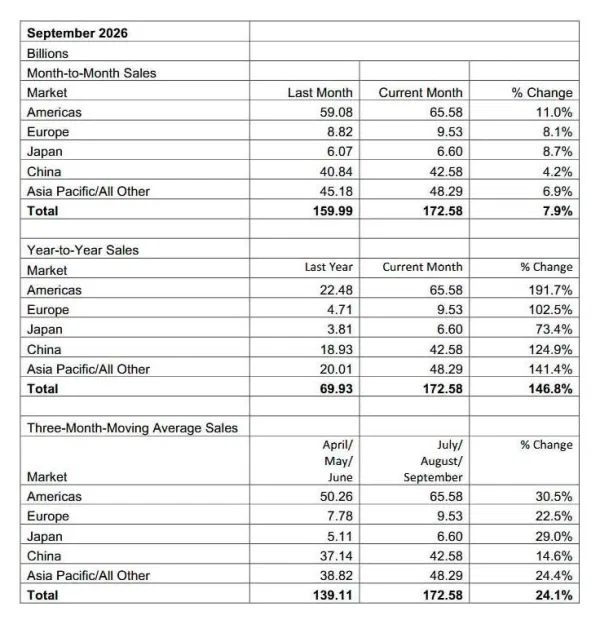
Two readings stand out. First, the growth is synchronized — no region is being drained to feed another, so the driver sits upstream in AI infrastructure rather than in one market's inventory restocking. Second, the month-over-month pattern differs from the year-over-year ranking: The Americas leads on both measures, while China posts the slowest sequential gain despite triple-digit year-over-year growth, which suggests its September surge rests more on the 2025 comparison base than on fresh momentum. This is an interpretation of SIA's regional splits, not a separate industry forecast.
Why are AI compute and storage the engine of this cycle?
Short answer: because the accelerator boom consumes memory, and memory capacity cannot be created quickly. AI servers demand enormous volumes of HBM and DDR5-class storage, and the wafer capacity used for those parts crowds out general-purpose memory, keeping prices firm across the whole stack.
The forecasters and the actual print now agree on the scale. Omdia projected that global semiconductor revenue in Q3 2026 would break the $500 billion barrier, and that cumulative revenue for the first three quarters of 2026 had already exceeded the full-year 2025 total by more than 50%. Omdia's own quarterly releases frame the same point: 2Q26 revenue jumped 31% to a record $425 billion, and the firm expects the first three quarters of 2026 to top $1.25 trillion.
Pricing power comes from supply tightness, not from a demand illusion. A Goldman Sachs research note calculated the 2026 supply-demand gaps for DRAM, NAND and HBM at 4.9%, 4.2% and 5.1% respectively — the widest shortfalls since 2011 for all three categories. Market checks point the same direction: TrendForce's 30 September 2026 memory survey expected conventional DRAM contract prices to rise 10–15% quarter over quarter in the fourth quarter of 2026 and NAND flash contract prices to rise 15–20%, with growth slowing from earlier quarters but supply still short of demand.
How long does the upcycle run — and who is already locked in?
Short answer: through 2027, on current commitments. SIA President and CEO Michael Robbins said the global chip market delivered strong growth across the third quarter, that worldwide sales have posted more than 20% sequential gains for three consecutive quarters, and that year-over-year sales remained robust in all major regional markets — evidence, in his words, of the irreplaceable role semiconductors play in driving innovation, raising productivity and strengthening economic competitiveness. He added that AI infrastructure investment shows no sign of slowing, so this semiconductor upcycle, driven jointly by compute and storage, will most likely extend into 2027.
That view is consistent with how memory suppliers are behaving. SK Hynix and Micron have publicly announced that all of their 2026 HBM capacity is sold out, and some customers have begun locking in supply for 2027 to 2028. In other words, a seller's market is converting AI compute demand into booked revenue rather than into spot-price hope.
Capital budgets behind that demand are still rising, though less steeply. Goldman Sachs expects the largest hyperscalers to lift infrastructure spending to $1.2 trillion in 2027, and S&P Global Ratings projected AI infrastructure investment above $1.3 trillion by 2027. Growth rates, however, are decelerating: Goldman expects hyperscaler capex growth to fall from nearly 100% in 2026 to 54% in 2027 and 12% in 2028, and to fund roughly a third of 2027 spending with debt. For component buyers, a slowing but still expanding market is the worst combination — enough demand to keep allocation tight, enough financing pressure that projects can be reprioritised at short notice.
What should enterprises actually do now? A decision checklist
Short answer: buy certainty before price. The following moves follow directly from the SIA, Omdia, Goldman Sachs and TrendForce figures above.
- Move memory from spot to term. With HBM fully allocated at SK Hynix and Micron and some customers booking 2027 to 2028 supply, a 12-to-18-month contract with committed volumes beats quarterly bidding, even at a premium.
- Front-load 2027 hardware purchases into the current quarter. TrendForce still expects contract prices to climb in the fourth quarter of 2026, so deferring server and storage refreshes raises cost rather than reducing it.
- Design for the constrained parts, not the cheap ones. Where architecture allows, prefer configurations that stay inside conventional DDR5 and enterprise SSD lanes; HBM-adjacent accelerators are the tightest bottleneck in the stack.
- Treat regional exposure as a risk variable. The Americas, growing 191.7% year over year in September, concentrates the sharpest demand pressure; buyers with supply chains centred there should expect longer allocation queues.
- Stress-test the demand assumption. Hyperscaler capex growth is set to slow from nearly 100% in 2026 to 54% in 2027; multi-year take-or-pay commitments should survive a 2028 deceleration, not just a 2027 one.
- Watch consumer-facing margins. Consumer demand is weakening while AI server demand holds firm, so PC and device budgets compete with data-centre buyers for the same wafers at retail-inflated prices.
Frequently asked questions
Did global chip sales really grow in every region?
Yes. SIA data show positive year-over-year growth in all five tracked markets in September: The Americas 191.7%, Asia Pacific and other regions 141.4%, China 124.9%, Europe 102.5% and Japan 73.4%.
Is this an AI story or a memory story?
Both, inseparably. AI server build-outs create the demand for HBM and DDR5, while the capacity diverted to those parts starves general memory and lifts prices across the board — Goldman Sachs sizes the 2026 gaps at 4.9% for DRAM, 4.2% for NAND and 5.1% for HBM.
When does the shortage ease?
Not before 2027 on current evidence. Suppliers have sold out 2026 HBM output, customers are locking 2027 to 2028 volumes, and SIA's Michael Robbins judges the cycle likely to extend into 2027 because AI infrastructure investment has not slowed.
What is the main risk to that outlook?
Financing. Hyperscaler spending keeps rising in absolute terms, but growth decelerates sharply toward 2028 and an increasing share is debt-funded, so a project slowdown would hit order books faster than it would hit installed capacity.
Which number should a non-technical reader remember?
The quarter itself: $517.7 billion in worldwide sales for Q3 2026, up 24.1% from the prior quarter — a size that turns semiconductor supply chains into a general cost-of-computing issue, not a component-industry footnote.
Reference sources
- Semiconductor Industry Association — global semiconductor sales releases, 3 November 2026
- Omdia via BusinessWire — global semiconductor revenue, 2Q26 and 3Q26 outlook
- TrendForce — AI server demand sustains memory contract price growth in 4Q26
- TrendForce — DRAM supply to remain tight through 2027
- S&P Global Ratings — AI infrastructure investment to exceed $1.3 trillion by 2027