
Adopting Alibaba's Qwen4-Max: Pricing Levers, Migration Steps and Long-Horizon Pitfalls | AIdataNewsGlobal
Qwen4-Max is Alibaba's new flagship base model: 2.4T total parameters with 71B active per token, native visual understanding, a million-token context, and an average cost per task roughly 60% below Qwen3.8-Max. For teams already running agents, the question that matters is not whether it tops another leaderboard — sixth place on CodeArena suggests it doesn't — but where the savings actually come from and whether your workload can collect them.
That question is architectural rather than promotional. The cost reduction decomposes into two levers that behave very differently: a sparse MoE structure that burns fewer active parameters per token, and cache-hit pricing that discounts only the tokens you repeat. The first helps every call; the second helps only calls whose prompt structure cooperates. The rest of this guide assumes you care about that distinction.
What shipped, in numbers that matter
Start with the constraints. Qwen4-Max runs on a new MoE architecture built on Qwen Sparse Attention (QSA): of 2.4T total parameters, 71B activate per token — an active ratio near 3% — and each token activates 25% fewer parameters than the previous generation. The model ships with native vision and a million-token context window.
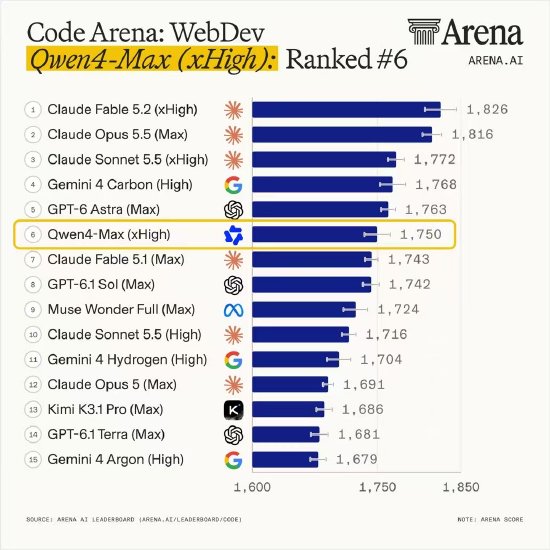
On third-party evaluations, Qwen4 ranks sixth on the global blind frontend-coding test CodeArena and sits in the leading tier on Agents' Last Exam (ALE) and Vals Index, which probe agent-level and specialized task capability. Alibaba positions the series for real workloads — orchestrating specialized tools across long-cycle jobs in automotive manufacturing, game development, financial investment research and scientific research.
Two caveats before you extrapolate. A blind-leaderboard rank is a ranking claim, not a fit claim for your stack. And the "leading tier" language on ALE and Vals Index comes from the vendor's launch materials, so treat it as directional until you replicate it on your own tasks.
Why the architecture change moves your bill
Conclusion first: the cost story is the strongest reason to re-test, and it is evidenced. In Terminal-Bench 4.0 — an open-source benchmark that, per the vals.ai methodology, measures how well an agent completes long, realistic pieces of work in a sandboxed terminal — Qwen4-Max, at the same Xhigh thinking tier as Qwen3.8-Max, cut average token consumption per attempt from 289K to 151K, close to 50%, while lifting the score from 38.9 to 48.5 points, roughly 25%. Evaluation data cited with the launch put the average cost per task 58% below Qwen3.8-Max.
The second lever is cache pricing. With cache hits priced as low as ¥0.5 per million Tokens on the Qwen AI platform, the platform-side claim is that the average cost to complete a single task fell about 60% versus the previous generation. The mechanism is not Alibaba-specific: across providers, prompt caching discounts repeated context prefixes at read time, and Flexera's cost analysis puts input-cost reductions at up to 90% for workloads that reuse long, stable context.
The practical implication is unglamorous: to collect the discount, your prompts must be cacheable. Put static system prompts, long reference documents and fixed tool schemas up front; keep per-request variance at the tail. Agents that interleave fresh state mid-context re-pay for the whole prefix on every call. Audit prompt ordering before you migrate, or the headline number will never appear on your invoice.
How do you switch in practice?
The migration path is deliberately boring, which is the right design:
- Create an API key on the Qwen AI platform; Qwen4-Max is already live there with API service.
- Point your existing OpenAI SDK at the compatible endpoint. Per the platform's OpenAI-compatible documentation, switching takes exactly three changes: base_url, api_key and the model identifier.
- If you consume through Alibaba Token Plan, the new model is reachable under the same plan.
- Before touching production, run interactive evals inside Qwen Office, Qoder and the Qwen App — the fastest way to sanity-check vision and tool behavior without harness code.
One documented trap: compatibility layers process the parameters they document and silently ignore the rest, as Aliyun Model Studio's compatibility notes state. A configuration that "works" may be dropping your temperature, tool-choice or thinking-tier settings without raising a single error. Smoke-test three things on day one: streaming behavior, tool-call schema fidelity, and whether the thinking tier you set is the tier actually applied. Model Studio also documents an opt-in session-cache switch via a request header, worth enabling for multi-turn agents once validated. If your pilot discipline needs a template, the same access-price-failure-mode checklist we applied to Gemini 4 Carbon transfers directly.
What breaks in long-horizon runs?
"Long-cycle capability" is a claim about the ceiling, not about reliability. A 2026 arXiv study on long-horizon agents derived a seven-category failure taxonomy — recurring patterns such as goal drift, specification drift, tool-call errors and state collapse that show up across tasks regardless of which frontier model runs the loop. A model upgrade changes failure rates, not failure categories, so budget for guardrails either way:
- Goal drift: long jobs wander. Insert milestone checkpoints the model must echo back before continuing.
- Hallucinated tool calls: validate arguments against schemas before execution; reject rather than retry blindly.
- State collapse in long sessions: re-inject authoritative state periodically, at the context tail, so cached prefixes stay intact.
- Runaway cost: set per-task token budgets and alerts. Xhigh thinking is the score lever — the 38.9-to-48.5 gain was bought with thinking tokens — and even the improved 151K per attempt is a large unit of spend the moment a loop starts retrying.
Adopt now, or wait for open weights?
The flagship is API-only today; Alibaba has said smaller models in the Qwen4 series will follow as open-source releases over time. That splits the decision by workload:
- Agentic coding and tool orchestration: pilot the flagship now — the Terminal-Bench 4.0 token-efficiency delta is exactly the profile that compounds inside loops.
- High-volume, cost-capped workloads: a mid-size open-weight Qwen4 may cover you at a flat rate. The market already votes this way: per Menlo Ventures' 2026 enterprise survey, 89% of US enterprises' open-source LLM spend went to Chinese models, as we covered in our analysis of the 89% figure.
- Vision-heavy pipelines: native visual understanding can retire upstream OCR pre-processing; fold those savings into the comparison.
FAQ: what readers ask about Qwen4-Max
How much does Qwen4-Max cost?
On the Qwen AI platform, cached hits price as low as ¥0.5 per million Tokens. Against Qwen3.8-Max, the average cost to complete a single task is down about 60% per the launch materials, with evaluation data pinning the measured reduction at 58%.
Is Qwen4-Max open source?
Not at launch. Alibaba has indicated that smaller models in the Qwen4 series will be released as open source over time; until then, the flagship is API-only.
Do I need to rewrite my integration?
No, if you already call OpenAI-compatible endpoints: change base_url, api_key and the model ID. Do re-verify your parameters — undocumented ones are silently ignored — and re-test streaming, tool calling and vision payloads.
What is QSA, and why should a buyer care?
Qwen Sparse Attention (QSA) is the mechanism under the new MoE architecture. It is why 2.4T total parameters collapse to 71B active per token — 25% fewer than the previous generation — and that structural efficiency is what funds both the token savings and the price cuts.
Adoption checklist
- Classify the workload first: token-bound or cache-bound? The savings land differently.
- Audit prompt ordering for cacheability: static prefix first, per-request variance last.
- Replicate one real task on Qwen3.8-Max and Qwen4-Max at the same Xhigh tier; compare tokens per attempt, not just scores.
- Smoke-test streaming, tool-call schemas and thinking-tier application on day one of the switch.
- Set per-task token budgets and cost alerts before the first agentic loop reaches production.
- Price the open-weight alternative if your workload tolerates mid-size models; smaller Qwen4 releases are on the roadmap.
- Re-run your own evals quarterly; vendor "leading tier" language on ALE and Vals Index is directional, not a fit guarantee.
References
- Terminal-Bench 4.0 leaderboard and methodology (vals.ai): https://www.vals.ai/benchmarks/terminal-bench-4
- Long-horizon agent failure taxonomy (arXiv, 2026): https://arxiv.org/html/2604.11978v1
- Prompt caching cost breakdown (Flexera): https://www.flexera.com/blog/ai/prompt-caching-breakdown/
- Qwen AI platform — OpenAI-compatible API documentation: https://platform.qianwenai.com/docs/api-reference/toolkitframework/openai-compatible/overview
- Aliyun Model Studio — OpenAI-compatible Responses API and session-cache notes: https://help.aliyun.com/zh/model-studio/qwen-api-via-openai-responses
- Alibaba Cloud — Qwen model product page: https://www.aliyun.com/product/tongyi