
AIdataNews Global General Report: Alphabet Slips About 12% as Nearly $500 Billion Market Value Vanishes, Ranking Second in U.S. One-Day Losses
By David Nakamura / AI & Data News
Alphabet (GOOGL) faced a repricing event on Thursday, when shares fell about 12% and nearly $500 billion of market value disappeared. The decline was not only the company's worst single-day move since it listed in 2004; it also moved into the second-largest one-day market-value loss ever recorded among U.S. listed companies. For General readers, the story is now less about a single earnings line and more about how AI is changing the arithmetic of search, cloud, and capital spending.
How the loss compares with prior record-setting declines
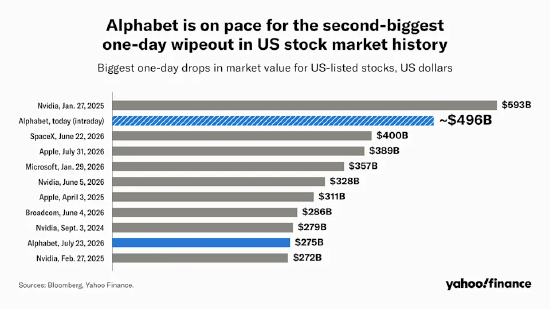
The number-one case remains Nvidia. On January 27, 2025, the emergence of China-based DeepSeek unsettled AI investors, and Nvidia lost about $593 billion in market value in a single day. Yahoo Finance calculated that Alphabet could have matched that top position only if it closed at about $274.75, implying a decline approaching 15%.
The record Alphabet has already surpassed is SpaceX's June 22 episode, which wiped out $400 billion and had stood as the second-largest on record. The fact that a single report could push Alphabet past that benchmark shows how large the expected market-value adjustment had become before Thursday's close.
Why this was the most expensive day in Alphabet's own trading history
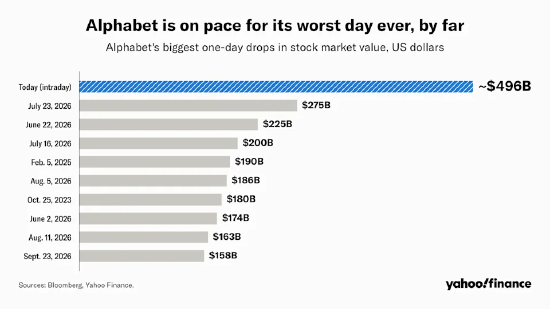
Measured against Alphabet's past, this was its most costly trading day in dollar terms. The company's earlier largest single-day market-value loss happened on July 23, when about $275 billion was erased. Bespoke Investment data also pointed to the same conclusion from another angle: the reaction to the earnings report was the worst post-earnings decline in Alphabet's market history, exceeding the almost 10% drop recorded in July 2008.
The earnings split: cloud growth, AI adoption, and a search shortfall
The report contained arguments for both optimists and skeptics. The bullish side can point to Google Cloud revenue, which doubled to about $31 billion, and to Gemini, whose app user base surpassed 1 billion. Those figures support the view that Alphabet's AI products and cloud platform are gaining scale.
The bearish side focuses on Google's search business. Search revenue grew 12% to about $63 billion, below Wall Street's forecast of $65 billion. At the same time, the company's free cash flow, meaning the cash remaining after data-center and other capital expenditures, swung to a loss of about $9 billion. Heavy AI investment therefore changed the way investors value Alphabet's future profitability.
| Positive sign | Pressure point |
|---|---|
| Google Cloud doubled to about $31 billion | Search grew 12% to about $63 billion, under Wall Street's $65 billion |
| Gemini app users surpassed 1 billion | Free cash flow moved to a loss of about $9 billion |
Analyst views captured both sides of the debate
Jeffrey Wlodarczak, chief executive of Pivotal Research, put the negative interpretation plainly: “Bearish investors would see this as the first quarter in which AI began to materially erode the core search business.” Angelo Zino, an analyst at CFRA, gave a more constructive take, telling Yahoo Finance that the decline “may be a buying opportunity.”
Thursday's drop fits a broader pattern of enormous one-day losses
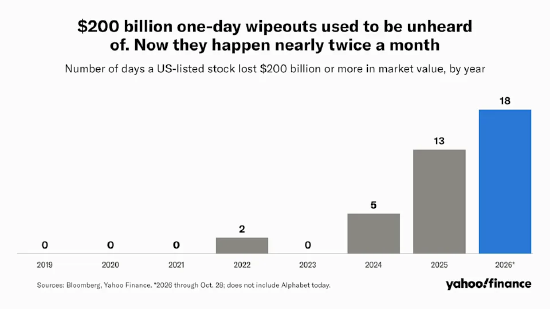
What once looked exceptional has become a recurring market pattern. Bloomberg data cited by Yahoo Finance showed that, as of this Wednesday, U.S. stocks had already recorded 18 single-day market-value declines of $200 billion or more this year. By comparison, the full year 2025 had 13 such cases, and before 2022 there had not been even one.
The broader loss curve around Alphabet also shows sustained pressure. Since the company reached a share-price high in May this year, its market value has shrunk by about $1.4 trillion. This means Thursday's event is not an isolated headline; it is one visible point in a longer adjustment.
What comes next: Amazon's earnings test the AI investment thesis
The next reference point is Amazon, scheduled to report as the last of the three major cloud vendors after Thursday's close. The logic is straightforward. If Amazon's AWS delivers fast growth while cash flow remains intact, that outcome strengthens the argument that Alphabet's problem is more specific to Google's search business and its own cost structure. If Amazon also shows quarterly cash consumption, the market may conclude that the AI investment trade is under broader financial strain.
Checklist for General readers
- Alphabet fell about 12% on Thursday.
- The decline erased nearly $500 billion in market value.
- The loss ranked second-largest in U.S. listed-company history.
- Nvidia remains first after losing about $593 billion on January 27, 2025 amid the China-based DeepSeek shock.
- A Yahoo Finance calculation put Alphabet's possible record-matching close at about $274.75, requiring a decline approaching 15%.
- SpaceX's June 22 loss of $400 billion had previously stood as the second-largest on record.
- Alphabet's own prior worst one-day dollar loss was about $275 billion on July 23.
- Bespoke Investment also framed the event as the company's largest post-earnings drop, topping an almost 10% decline in July 2008.
- Google Cloud doubled to about $31 billion, and Gemini app users surpassed 1 billion.
- Search grew 12% to about $63 billion, below Wall Street's $65 billion expectation.
- Free cash flow turned to a loss of about $9 billion because of heavy AI investment.
- Bloomberg data showed 18 U.S. one-day declines of $200 billion or more this year, 13 in the full year 2025, and none before 2022.
- Alphabet has lost about $1.4 trillion in market value since its May this year high.
- Amazon reports after Thursday's close as the last of the three major cloud vendors.
FAQ
Why did Alphabet fall so much if Google Cloud and Gemini are growing?
Because the market focused on the shortfall in the profit engine that still dominates expectations. Search revenue grew 12% to about $63 billion, below Wall Street's $65 billion projection, while AI spending turned free cash flow into a loss of about $9 billion. Those two facts outweighed Google Cloud doubling to about $31 billion and Gemini surpassing 1 billion users.
Does the second-largest loss ranking change the investment debate?
It does, because the ranking shows that the problem was priced by the market as systemic to Alphabet's AI transition, not as a minor revision. A drop large enough to enter U.S. history means investors are re-evaluating how much search profitability can tolerate the cost of building AI infrastructure.
Why is Amazon's report mentioned in the same story?
Because Alphabet is part of a set of three major cloud vendors. The market is testing whether AI-heavy spending is causing losses for the group, or whether the cash pressure is concentrated in Google's own search and capex mix. Amazon's AWS results after Thursday's close provide the next comparable data point.
What should readers watch beyond the headline percentage?
Three details matter most: the $500 billion scale of the loss, the gap between search results and Wall Street expectations, and the shift of free cash flow to a loss. Each explains a different layer of the move: historical market significance, business-model pressure, and financial consequence.
Editorial takeaway
The central signal from this episode is that Alphabet's AI story is no longer judged only by adoption milestones. The company has demonstrated that Google Cloud can double and that Gemini can cross a billion-user threshold. Yet the same report forced a harder question: if AI growth requires spending large enough to turn free cash flow negative, while search misses expectations, how should investors price the transition?
For global AI and data readers, the lesson is to keep three frames connected. First, the market-value scale, nearly $500 billion, shows how quickly sentiment can reprice a megacap. Second, the analyst split, from Pivotal Research's erosion warning to CFRA's buying-opportunity view, shows that the same facts can support different theses. Third, the Amazon follow-up will indicate whether the market is seeing a Google-specific correction or a broader AI infrastructure challenge.