
AMD's Q3 2026 Ledger: Record $13.4 Billion Revenue, a 40% Gaming Decline and the Cost of Data-Center-First
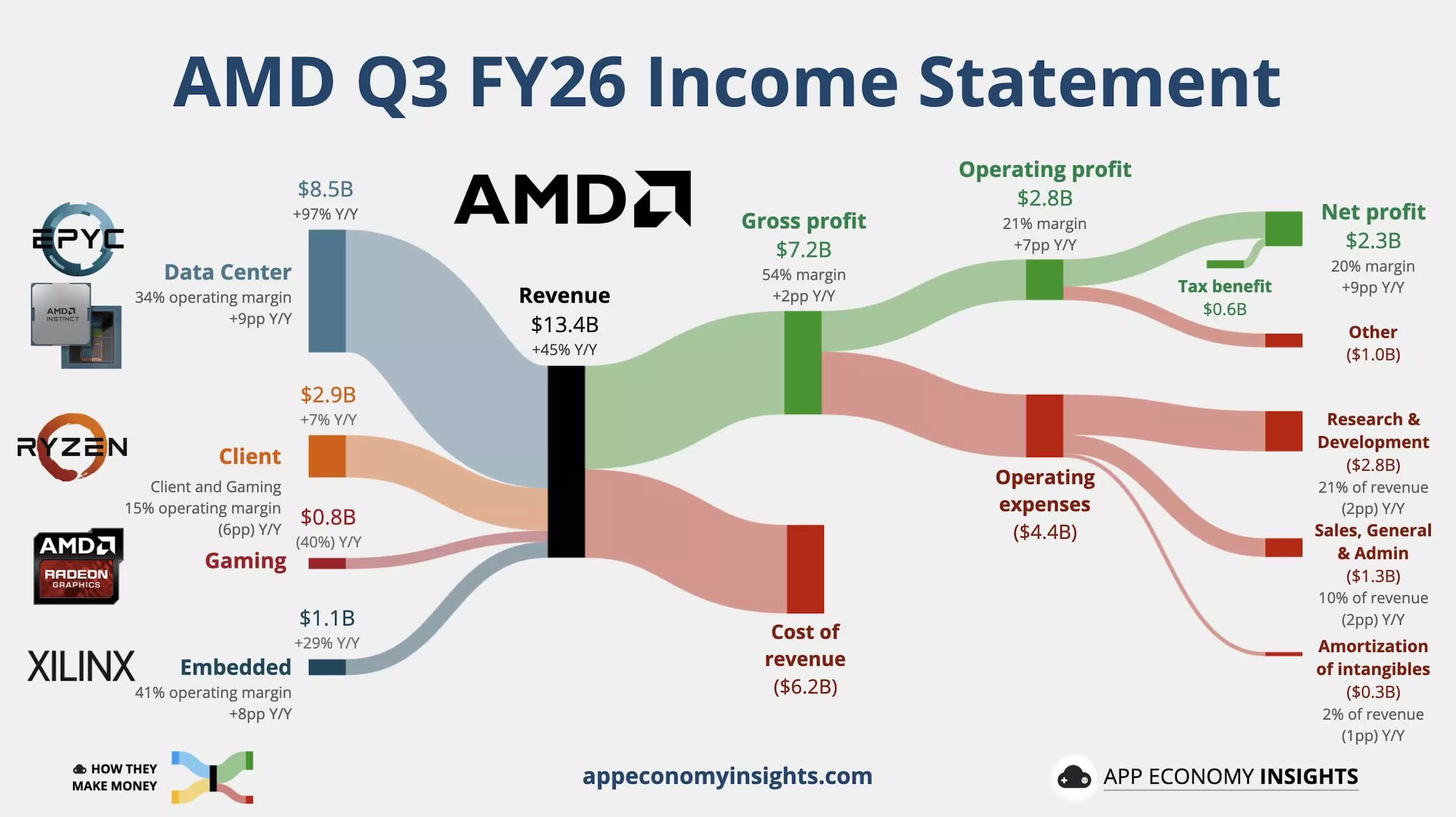
AMD's third quarter of 2026 reads less like a chip earnings report than like a decision about where a company's wafers, engineers and margin will go next. Revenue reached a record US$13.4 billion, up 97% year over year, while gaming revenue fell 40% to US$773 million. CEO Lisa Su's one-line explanation — AMD is a "data-center-first" company — is now visible in every line of the income statement.
What do AMD's Q3 2026 numbers actually say?
Conclusion first: growth, profitability and revenue mix all shifted in the same direction in a single quarter, and the mix shift is the part that outlives the headline.
| Metric, Q3 2026 | Reported value | Why it matters |
|---|---|---|
| Total revenue | US$13.4 billion, up 97% year over year | A record quarter that beat the company's own guidance range |
| Data Center segment | A record US$8.5 billion, roughly 63% of total revenue | Up from under half of the business a year earlier |
| Gaming | US$773 million, down 40% year over year | AMD attributes the fall to weaker semi-custom and graphics revenue |
| Gross margin | 54% GAAP; 56% on a non-GAAP basis | Higher-margin data center products now set the average |
| Adjusted earnings per share | US$2.09, versus roughly US$1.95 expected | Operating leverage, not just volume, per CNBC's coverage |
| Q4 2026 outlook | About US$17.0 billion, plus or minus 3% | Well above the US$162–163 billion-level consensus discussed in earnings coverage |
Two figures deserve more attention than the headline. The company's own release put the Data Center segment at a record US$8.5 billion, which works out to about 63% of AMD's revenue for the third quarter — a structural, not cyclical, change in who pays AMD. And the profit line moved faster than the sales line, which is what convinced investors rather than the beat itself: shares jumped on the results, as CNBC reported.
How did AMD become a data-center-first company?
"We are a data-center-first company, that is our positioning. People need more computing power to support all kinds of applications," Su said in an interview with Yahoo Finance.
The statement reframes a business that spent years fighting Intel on Ryzen processors and Nvidia on Radeon graphics cards, where personal computers and consoles were the base. Generative AI moved the center of gravity: the growth in the third quarter came from Instinct AI accelerators, used for model training and inference, and EPYC server processors, which supply the CPU layer of large data centers. Both ride the same tailwind — cloud providers and large technology firms are still building out AI infrastructure.
The product shape is changing, too. AMD's newer systems push beyond single chips toward rack-scale delivery: the Helios rack design packages 72 Instinct MI455X accelerators with EPYC CPUs and networking into one unit, a model that pulls more revenue per customer but also more manufacturing and integration cost per dollar of revenue. AMD's published partnership with OpenAI, covering up to 6 gigawatts of AMD GPUs with an initial 1 gigawatt deployment starting in 2026, shows how the pipeline is being built years ahead of shipment.
Su added in the same interview that the data center business is expected to grow 50% quarter over quarter in the fourth quarter, and that AMD wants the unit to be more than double its current size once it is into 2027. She described AMD as having enough technology resources and supply-chain expansion capacity to be the most important partner for the world's largest computing buyers.
Why did gaming fall 40% while AI set records?
The short answer is that the same memory and packaging capacity that feeds AI factories is being taken out of consumer products, and the price move is measurable.
TechSpot's reading of the quarter is that heavy buying of memory chips and other key components for AI data centers squeezed the supply available for consumer hardware and pushed graphics card production costs up, with higher prices then damping PC gaming demand. Market trackers put numbers on that mechanism. TrendForce reported that conventional DRAM contract prices rose roughly 93–98% quarter over quarter in the first quarter of 2026 and a further 58–63% in the second, before moderating to a 13–18% increase in the third quarter — deceleration because buyers reached the limit of what they could pass on, not because supply improved. IDC has likewise warned that rising DRAM and NAND costs threaten pricing, specifications and shipment growth across the smartphone and PC markets in 2026.
On the demand side, Gartner expected in February 2026 that surging memory costs would cut worldwide PC shipments by 10.4% for the year. A shrinking, repriced consumer market is the backdrop against which AMD's gaming line declined 40%, and it is not a problem AMD controls: the company supplies consoles and graphics cards into a market whose customers are being asked to pay more for less.
How does AMD's mix compare with Nvidia's?
Nvidia has already completed the transition AMD is now describing. In its fiscal second quarter of 2027, Nvidia booked US$89.02 billion of data center revenue, 92.5% of its total, and no longer breaks out a traditional gaming business, folding those products into a broader edge computing category.
| Dimension | AMD, Q3 2026 | Nvidia, fiscal Q2 2027 |
|---|---|---|
| Data center share of revenue | About 63% | 92.5% |
| Data center revenue level | Record US$8.5 billion segment | US$89.02 billion |
| Consumer gaming reporting | Still disclosed separately; US$773 million, down 40% | No longer reported as a standalone segment |
| Direction stated by management | Data center +50% QoQ in Q4; more than double after 2027 | Already an AI infrastructure company |
For players and PC buyers, the transition carries an uncomfortable implication. Competition between AMD and Nvidia is what produced aggressive value in consumer graphics, with Radeon long positioned as the lower-price route to strong gaming performance. If AI accelerators and server CPUs absorb the demand and the revenue, R&D budgets, wafer and memory allocation, and product refresh cadence follow them. AMD has not announced any exit from Radeon or any halt to consumer graphics; Su's point was about the company's overall positioning, not the end of the consumer GPU business. The trend, though, is converging: both companies are moving from PC and gaming hardware suppliers to AI compute infrastructure companies.
Is AMD's AI spending exposed to the "bubble" debate?
Answer: management's own framing is that the debate is a measurement error, not a demand signal. Asked about concerns that AI infrastructure investment has outrun its returns, Su argued that some investors judge AI capex by short payback windows and understate the growth in compute demand over the following years. AMD invests on a long view and typically plans its business three to five years ahead, she said, so the technology and supply-chain capacity being built now is meant to serve demand several years out rather than orders on the books today.
That horizon is also where the risk sits, and AIdataNewsGlobal treats the following as analysis rather than reported fact: a strategy timed on a three-to-five-year plan is a bet that today's anchor customers keep funding it. A revenue base concentrated in a small number of hyperscale and frontier-model buyers is more sensitive to one chief-executive budget decision than a business spread across millions of PC and console purchasers. Margin is the second pressure point — AMD's own outlook for roughly 55% non-GAAP gross margin in the fourth quarter sits a point below the 56% it just delivered, consistent with the cost of ramping rack-scale systems.
What should analysts watch next?
- The Q4 data center step. Su's guidance of 50% sequential growth in the data center business is the number that either validates or undermines the 2027 target of more than double today's scale.
- Mix dilution. Tracking whether racks and full systems lift revenue faster than they compress gross margin as MI455X and Helios ship in volume.
- Customer concentration. The share of bookings tied to a handful of large deployments, including publicly announced capacity agreements such as the 6-gigawatt OpenAI arrangement.
- Memory cost pass-through. If DRAM contract price increases stay in double digits, consumer GPU and console economics stay under pressure into 2027.
- Radeon roadmap cadence. AMD has not walked away from consumer graphics; the observable question is whether it keeps launching on its old rhythm.
FAQ
Did AMD really grow 97% in the third quarter of 2026?
AMD reported third-quarter revenue of US$13.4 billion, up 97% year over year, with the Data Center segment alone reaching a record US$8.5 billion, about 63% of the total.
Why did AMD's gaming business fall 40%?
AMD cited lower semi-custom and graphics revenue for the drop to US$773 million. Coverage by TechSpot and market trackers TrendForce and Gartner point to a common cause: AI data centers absorbing memory and packaging supply, driving component costs up and consumer PC demand down.
What does "data-center-first" mean for Radeon graphics cards?
It is a statement about resource priority, not a product cancellation. AMD continues to sell Radeon GPUs and console silicon, but R&D, supply allocation and refresh timing now follow a business whose growth and profit are concentrated in Instinct accelerators and EPYC server CPUs.
How big is the gap between AMD and Nvidia in AI?
By revenue mix, Nvidia's data center business is 92.5% of its total, versus about 63% for AMD in the latest quarter. In absolute terms the difference is larger still: US$89.02 billion versus a record US$8.5 billion segment.
When will AMD report the fourth quarter of 2026?
AMD guided to about US$17.0 billion, plus or minus 3%, for the fourth quarter, and has historically released fourth-quarter results in early February.
Where the numbers come from
- AMD, "AMD Reports Third Quarter 2026 Financial Results" — https://ir.amd.com/news-events/press-releases/detail/1303/amd-reports-third-quarter-2026-financial-results
- CNBC coverage of AMD's Q3 2026 earnings and guidance — https://www.cnbc.com/2026/11/03/amd-amd-q3-earnings-report-2026-.html
- TrendForce on conventional DRAM contract price movements in 2026 — https://www.trendforce.com/presscenter/news/20260601-13070.html and https://www.trendforce.com/presscenter/news/20260709-13140.html
- Gartner on surging memory costs and 2026 PC and smartphone shipments — https://www.gartner.com/en/newsroom/press-releases/2026-02-26-gartner-says-surging-memory-costs-will-reduce-global-pc-and-smartphone-shipments-in-2026
- IDC, "Global Memory Shortage Crisis" market analysis — https://www.idc.com/resource-center/blog/global-memory-shortage-crisis-market-analysis-and-the-potential-impact-on-the-smartphone-and-pc-markets-in-2026/
- AMD and OpenAI strategic partnership for 6 gigawatts of AMD GPUs — https://ir.amd.com/news-events/press-releases/detail/1260/amd-and-openai-announce-strategic-partnership-to-deploy-6-gigawatts-of-amd-gpus
- AMD Helios rackscale product documentation — https://www.amd.com/en/products/rackscale-solutions/helios.html