
AIdataNewsGlobal General: An Open Rack-Scale View of AMD Helion for Agentic AI Infrastructure
By David Nakamura | AI & Data News
Agentic AI infrastructure is being framed at a systems level rather than as a single component. In the description covered here, AMD Helion is presented as a rack-scale reference design that combines open-source hardware and software. The design supports two broad paths: a CPU-only path for hyperscale deployments and a CPU/GPU path for enterprises. The rack form factor uses a 21-in. architecture aligned with Open Compute Project, or OCP, specifications, with the stated aim of balancing CPU and GPU performance, core density, and power consumption for application requirements.
Open-Source Rack Architecture as the Starting Point
The architectural emphasis is not simply processor selection. It is the integration of compute, accelerator capacity, power budget, core density, and deployment model into one rack-scale reference. The phrase open-source is central because the Helion design is described as a combination of open-source hardware and software. That gives the reference design a dual identity: it is both a configuration framework for AMD platforms and a contribution intended for broader community development and adoption.
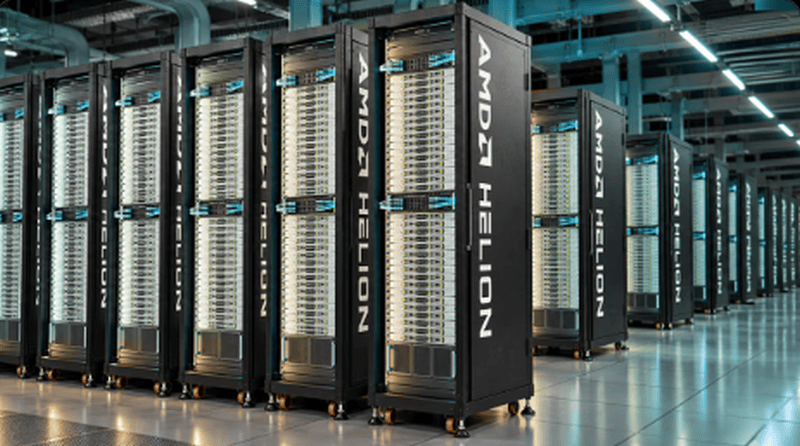
Key Configuration Data at a Glance
- Rack architecture: 21-in. design following Open Compute Project, also referred to as OCP.
- CPU-only option: can be powered by AMD EPYC processors that support up to 32,768 Zen 6 x86 CPU cores.
- CPU/GPU option: integrates general-purpose compute, AMD EPYC CPU nodes, and up to 16 AMD Instinct MI350 GPU nodes.
- Target profiles: hyperscale deployments for the CPU-only configuration and enterprises for the CPU/GPU configuration.
- Planned availability: November 2026.
CPU-Only Path and Enterprise CPU/GPU Path
The first path separates general-purpose compute density from accelerator capacity. A CPU-only rack can be powered by AMD EPYC processors that support up to 32,768 Zen 6 x86 CPU cores. In the provided framing, this path is associated with hyperscale deployments, where the configuration focus is described around broad general-purpose compute scale rather than locally embedded accelerator nodes.
The second path is described as an all-in-one rack that integrates general-purpose compute, AMD EPYC CPU nodes, and up to 16 AMD Instinct MI350 GPU nodes. In that structure, the AMD Instinct MI350 GPU nodes coexist with the CPU resources in the same rack architecture. The enterprise profile is the deployment context named for the CPU/GPU configuration.
How the Token Router Connects Local and Cloud Models
The reference design includes an inference routing concept. Inference requests are directed by a token router to frontier models in the cloud or to open-source models running locally in the rack. This detail adds a software-control dimension to the hardware description: the rack is not only a place for processors and accelerators, but also a decision point for where a model inference request is executed.
Community Contribution and Timeline
AMD intends to contribute the Helion specification to OCP so the community can develop and adopt it. With ecosystem partners, rack configurations are under development, and availability is planned for November 2026. The contribution plan means the specification is framed as a community-facing reference rather than a closed vendor-only description.
FAQ: AMD Helion Rack Design Questions
What is AMD Helion?
AMD Helion is an open-source rack-scale reference design for agentic AI infrastructure. It combines open-source hardware and software and can be configured as CPU-only for hyperscale deployments or as CPU/GPU for enterprises.
Which OCP specification detail is named?
The Helion 21-in. rack architecture follows Open Compute Project, or OCP, specifications.
What CPU capacity is listed for the CPU-only path?
A CPU-only rack can be powered by AMD EPYC processors that support up to 32,768 Zen 6 x86 CPU cores.
What accelerator capacity is listed for the CPU/GPU path?
The CPU/GPU path integrates general-purpose compute, AMD EPYC CPU nodes, and up to 16 AMD Instinct MI350 GPU nodes.
How are inference requests handled?
Inference requests are directed by a token router to frontier models in the cloud or to open-source models running locally in the rack.
When is availability planned?
Availability is planned for November 2026, while rack configurations are under development with ecosystem partners.
Reader Checklist: What to Watch in the Next Release Phase
- Whether the Helion specification is formally contributed to OCP for community development and adoption.
- Whether ecosystem partners publish concrete rack configurations based on the described CPU-only and CPU/GPU paths.
- Whether the November 2026 availability window is met for the configurations under development.
- How the described token-router behavior connects frontier models in the cloud with open-source models running locally in the rack.
Why This Rack-Level Summary Matters for General Readers
For readers tracking AI models, infrastructure, and enterprise deployment options, the AMD Helion summary connects several moving parts: an OCP-based rack form factor, Zen 6 CPU capacity, AMD Instinct MI350 accelerator nodes, cloud/local inference routing, and a planned availability date. The value of the summary is that it presents these elements as one reference-design picture rather than as isolated hardware specifications.
Contact editorial@aidatanews.com for editorial questions.