
AIdataNewsGlobal General: How Anthropic Handles Feedback Data for Claude for Work, Anthropic API and Claude Gov
This AIdataNewsGlobal General briefing summarizes published rules for feedback handling across business-facing Claude services. The reviewed material is centered on commercial products such as Claude for Work, Anthropic API, and Claude Gov. It is distinct from consumer-facing use, including Claude Free, Pro, Max, and consumer accounts that run Claude Code.
The stated default is narrow: inputs and outputs from Claude for Work, Anthropic API, and Claude Gov are not used for model training under the ordinary commercial configuration. That posture changes when a user chooses to report feedback, flag a bug, or otherwise grant data use. In that circumstance, the service says it may use the chat thread and coding session as training material.
The notice also points readers to the Trust Center and Commercial Terms for broader guidance about using Anthropic commercial offerings and about privacy-related inquiries.
How a rating action can become a data event
Feedback submitted through a thumbs up or thumbs down control can create a stored conversation record. The published rule says the full related conversation may be kept in a secure backend for up to 5 years. The retained set may include the visible content, custom styles, conversation preferences, and model settings.
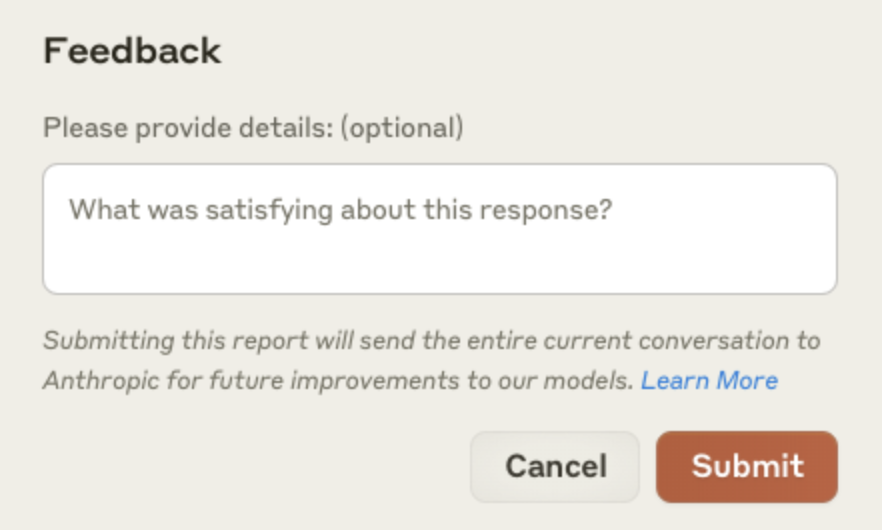
On claude.ai, that control is the same kind of surface where users can rate an answer and, in doing so, create a feedback record. The interface matters because it turns a quick usability action into a compliance-relevant data step.
The scope of a connector is one of the clearest limits in the notice. Feedback data does not include raw content from connectors such as Google Drive, including remote and local MCP servers. But if a user copies material directly into the Claude conversation, that copied material can fall inside the feedback record.
Before the stored feedback is used, the notice says it is separated from the user identifier and the customer identifier. Allowed uses include analyzing service effectiveness, conducting research, studying user behavior, and training models when applicable law permits it. It also says feedback is not merged with other conversations involving Claude.
What organization owners can restrict
The notice gives a team-level control for business plans. If someone is a Primary Owner or Owner of a Team plan or an Enterprise plan, that person can turn off the ability for members to send feedback through the thumbs up or thumbs down button. The control appears as Rate chats inside Organization settings > Data and Privacy.

That makes the thumbs up or thumbs down action not only a user-facing feature. For managed accounts, it can be a setting that administrators can switch.
Data points and practice notes at a glance
| Practice area | Published data point | Reader takeaway |
|---|---|---|
| Default training use | Ordinary commercial inputs and outputs for Claude for Work, Anthropic API, and Claude Gov do not feed model training by default. | Training requires a different trigger, such as feedback or explicit data-use permission. |
| Retention | A feedback-linked conversation can be retained for up to 5 years. | A brief rating action may create a longer-lived record. |
| Connector boundary | Raw connector content such as Google Drive, including remote and local MCP servers, is excluded from feedback data. | Copied text inside a Claude thread may still be captured. |
| Identifier separation | Feedback is de-linked from user and customer identifiers before use. | The policy describes a separation step before analysis or training. |
| Organization control | Team plan and Enterprise plan Primary Owners or Owners can disable thumbs up/down feedback through Rate chats. | Administrators can close a common feedback channel for members. |
Reading checklist for the notice
- Separate commercial use from consumer use: Claude for Work, Anthropic API, and Claude Gov are the focus; Claude Free, Pro, Max, and consumer Claude Code use are outside this notice.
- Read the default first: ordinary inputs and outputs are not used to train models.
- Then read the exception: explicit feedback, bug reporting, or another permission can make chats and coding sessions available for training.
- Note the retention figure: the feedback conversation may be kept for up to 5 years.
- Note the connector limit: raw content from connectors such as Google Drive, including remote and local MCP servers, is not included unless copied into the Claude conversation.
- Note the admin control: a Primary Owner or Owner can disable member feedback for a Team plan or Enterprise plan through the Rate chats setting.
Frequently asked questions
Does the thumbs down button automatically place a chat into training data?
No. The published rule says commercial product inputs and outputs are not used to train models by default. It says explicit feedback, bug reports, or another permission can create a training-use path.
Can feedback data contain material copied from a connector?
The rule says raw connector content from services such as Google Drive, including remote and local MCP servers, is not included. If a user copies that material into the Claude conversation, it can become part of the feedback record.
Is feedback kept identifiable?
The notice says it is de-linked from the user ID and customer ID before Anthropic uses it.
What can a Team or Enterprise owner change?
A Primary Owner or Owner can disable the thumbs up/down feedback route by changing Rate chats under Organization settings > Data and Privacy.
Does this notice cover Claude Free, Pro, Max, or Claude Code?
No. Those consumer references are separated from the commercial scope, which covers Claude for Work, Anthropic API, and Claude Gov, plus the Trust Center and Commercial Terms guidance.
For AIdataNewsGlobal General readers, the practical signal is the difference between product use and feedback use. The rating interface is small, but the policy behind it covers storage duration, training permission, connector boundaries, identifier separation, and administrative limits.
The notice does not treat every Claude interaction as a training event. It treats voluntary feedback as a governed data route, and it gives managed Team and Enterprise owners a way to limit that route inside the organization.