
AIdataNewsGlobal Explainer: Anthropic Tightens Claude's Boundaries Around Game Clones and Reverse-Engineering Tasks
Across the AI sector, a practical fault line has moved into view: not model capability alone, but the point where assistance stops becoming general creative support and starts becoming reproduction of someone else's interactive product. The latest episode involves Anthropic and Claude. Reports from users describe a narrower posture around requests that would clone game mechanics, reproduce an existing title, or activate reverse-engineering assistance. For AIdataNewsGlobal's General column, the event is less about a single refusal than about how model policy boundaries can reshape hobbyist workflows, developer troubleshooting, and platform risk management.
The reported shift: original work remains allowed, targeted cloning does not
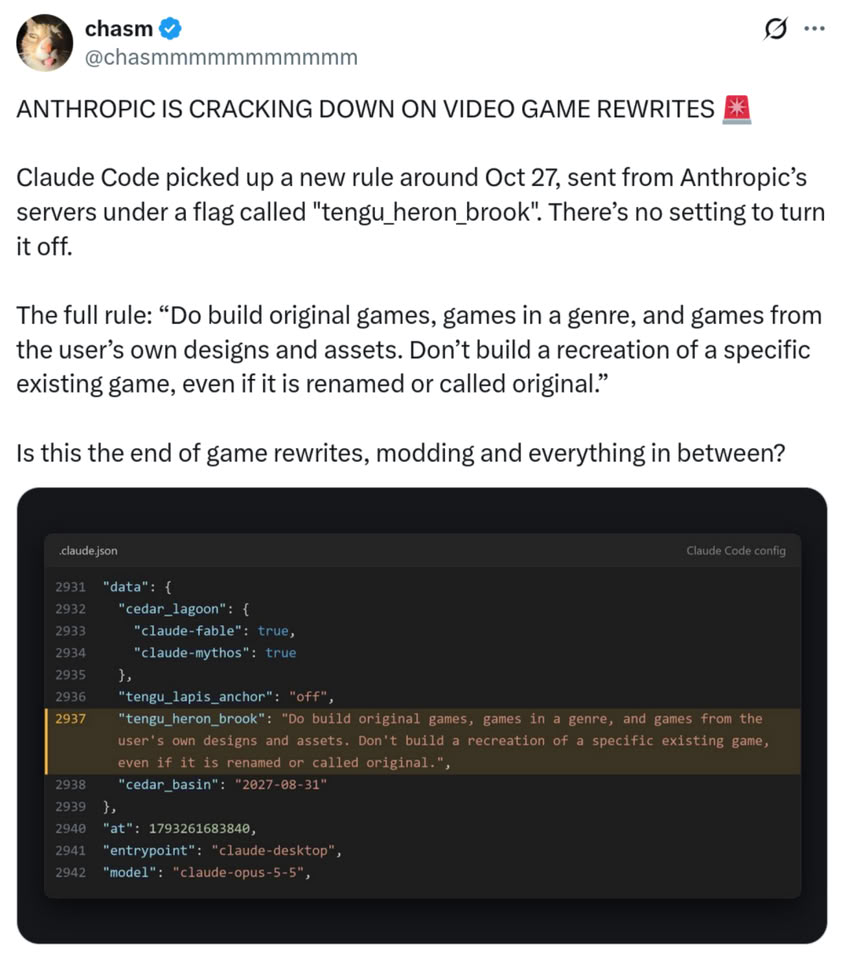
According to the user accounts discussed in the coverage, Claude is now being described as unwilling to replicate specific existing games or rebuild their mechanics. The change is being read as part of a new rule clause. The clause, as reported, draws the line between permitted work and prohibited work by focusing on design source: original games, genre-based games, and games built from a user's own designs and materials are allowed, but a clone of a particular existing game is not allowed even if the copy is renamed or labeled original.
That distinction matters for professional and semi-professional builders. A request framed as "make me something like X but not called X" may no longer clear the policy boundary if X is a specific existing title. The reported position treats naming and self-described originality as insufficient when the underlying reproduction targets an identifiable game.
The discussion also connects the rule change to a broader pattern. In recent months, AI-assisted game cloning, reverse engineering, and decompilation have become more common, producing a wave of small projects that can appear quickly. The coverage describes this activity as having become a small-scale home-workshop-style industry: many projects are made by individuals or very small teams rather than established studios. The reported examples include disputed attempts associated with Fortnite and Fallout, alongside player-created console ports.
Why the change may have arrived: legal exposure, public pressure, or both
One X platform user pointed to a new clause in Claude rules as a possible source of the limitation. The clause is reported as follows: "You can build original games, games in a genre, and games based on the user's own designs and materials. Do not build a clone of a specific existing game, even if it is renamed or called original." The initial report identifying the shift in Claude's game-replication behavior was published by Tom's Hardware.
The reported rationale is risk management. By refusing to reconstruct a specific existing game, Claude may avoid facilitating copyright infringement and reduce legal exposure for Anthropic. The accounts also suggest reputational pressure: the company may have become weary of adverse public attention, or may be responding to concerns raised by major gaming companies. The precise motivation is not established in the material, but the direction is clear: the boundary around game replication has tightened.
One consequence is noise. Users have reported a surge of new issues on Claude's GitHub page. The pattern is not only that problems are filed, but that the boundary cases are contested: what counts as "original enough"? What counts as a clone? When is a mechanic generic and when is it signature? The reported behavior suggests that ambiguous requests are being resolved conservatively.
A particularly notable reported edge case involves a developer's own earlier work. Even when the starting point is material created by the requester, the assistant is said to refuse reconstruction if later development requires mechanics that are similar to those of an existing game. This would turn the rule from a simple copyright shortcut into a workflow constraint: prior ownership may not be enough if the generated result looks like prohibited reproduction.
The reverse-engineering spillover: from consoles to smart TVs and cars
Reddit users have reported that the limitation is not confined to game projects. Some accounts say Claude is refusing to invoke a widely used capability known as Reverse Engineer Anything. Before that restriction, the capability was described as useful in several practical tasks: removing smart TV vendor lock-in, adding features to car infotainment systems, and recompiling video games so they could run on other platforms.
Those examples illustrate the cross-domain nature of the issue. The same underlying model behavior that blocks a game clone may also block a debugging, porting, or repair task. The line becomes difficult because game cloning and legitimate reverse engineering share techniques: understanding mechanics, reconstructing logic, and adapting binaries or code.
Citation table: the key reported elements
| Element | Reported statement | Editorial interpretation |
|---|---|---|
| Claude policy boundary | Original games, games in a genre, and games based on the user's own designs and materials are permitted; cloning a specific existing game is prohibited even if renamed or called original. | Policy appears to look through labels and focus on reproduction of an identifiable title. |
| Reverse Engineer Anything | Users report Claude refuses to invoke Reverse Engineer Anything. | Restriction may affect non-game tasks because the capability has cross-domain uses. |
| Developer-owned work | Even a developer's own early work may be refused when later development requires similar mechanics. | Ownership may not be decisive if the output still resembles a prohibited clone. |
| Issue volume | Claude's GitHub page has seen a surge of new issues as users contest refusals. | The boundary creates friction for hobbyist and indie workflows. |
| First reported source | Tom's Hardware first reported the shift in Claude's behavior around game cloning. | The story then spread through user reports on X platform and Reddit. |
Checklist: how readers can evaluate the reported change
- Identify whether the request targets a specific existing game, not merely a genre or mechanic pattern.
- Check if the design source is original: user-created concept art, mechanics documents, assets, or code.
- Treat renaming as insufficient if the result still reproduces a particular title.
- Expect refusals around Reverse Engineer Anything even when the target is not a game clone.
- Look at reports from Claude's GitHub page as examples of contested boundary cases, not as proof of policy intent.
- Separate repair, porting, and learning objectives from publishing a competing copy.
FAQ: common questions about the Anthropic Claude restriction
What exactly has Claude reportedly stopped doing?
It has reportedly stopped helping build clones of a specific existing game, including cases where the copy is renamed or presented as original. The reported rule still allows original games, genre games, and games based on user-owned designs and materials.
Is the change limited to video games?
No. Reddit user reports indicate the boundary can affect reverse-engineering tasks, including the Reverse Engineer Anything capability. Those tasks were previously used in projects involving smart TVs, car infotainment systems, and game recompilation for other platforms.
Why does this matter beyond hobbyists?
Because AI platforms are used by individuals and small teams described as a small-scale home-workshop-style layer. A policy change in a leading model can quickly affect prototypes, debugging, port experiments, and educational projects. The reported issue volume on Claude's GitHub page shows that practitioners are probing the boundary.
Does owning earlier work guarantee approval?
Not according to the reported edge cases. Some accounts say Claude may still refuse when later development requires similar mechanics, even if the developer completed the earlier work themselves.
What should readers watch next?
The key items to monitor are clarification of the rule language, whether Anthropic distinguishes copyright-sensitive cloning from repair or learning-oriented reverse engineering, and how users adapt their prompts and project designs.
The Anthropic episode shows that model policy boundaries can be as operationally significant as raw capability. For AIdataNewsGlobal readers, the takeaway is to watch how assistants negotiate originality, reproduction, and reverse engineering, because those decisions shape what small teams and individual developers can safely build.