
AIdataNewsGlobal General Desk: How Four Centers Split Control in Anthropic Before an IPO
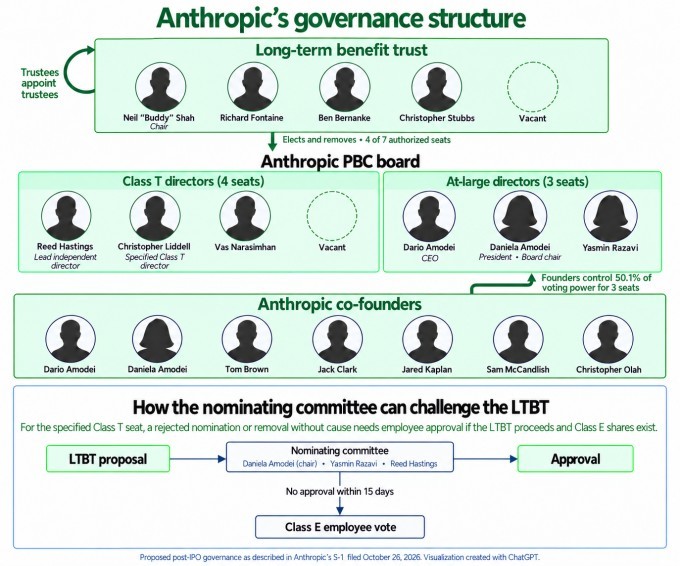
The question that matters most in Anthropic's pre-IPO governance architecture is not merely whether it lists shares, but how power is separated among four centers: a board, an independent trust, seven founders with special voting stock, and the employees who can be called on when a designated board seat is disputed. The result is a layered control map, where each actor can move, block, or reopen a question about who ultimately governs the company.
Data citation: the numbers that define the control map
Before examining each layer, the key quantitative anchors are straightforward: seven founders control a special class of stock carrying 50.1% of shareholder voting rights; those founders elect three board members; the Long-Term Benefit Trust, or LTBT, holds one class of stock connected to Class T directors; the LTBT has four directors in the described mechanism and one designated director can be subject to a review-and-vote path; there is one vacancy on the board and one vacancy in the LTBT; founder control can end ten years after an IPO, and the LTBT can be ended by 85% of ordinary shareholders or by its own approved exit; two special shareholder classes stand between present governance and final ordinary shareholder control.
| Control center | Instrument | Anchor |
|---|---|---|
| Board | Current composition | One vacancy |
| LTBT | One class of stock; Class T directors | Elects and removes majority Class T directors; four directors; one designated; one vacancy |
| Founders | Special class of stock | Seven founders; 50.1% of shareholder voting rights; elect three board members |
| Exit conditions | Time and share-count triggers | Ten years after an IPO; fewer than three founders; 85% of ordinary shareholders |
Board layer: Daniela Amodei chairs a board with one vacancy
- Chair: President Daniela Amodei, who serves as board chair.
- CEO seat: Dario Amodei, Daniela Amodei's brother, is CEO and a board member.
- Outside members: Netflix co-founder Reed Hastings; former Microsoft and General Motors CFO Christopher Liddell; Novartis CEO Vas Narasimhan; Spark Capital partner Yasmin Razavi.
- Status: one vacancy.
The board therefore combines operating leadership, outside technology-industry and finance experience, and a vacancy that remains unfilled. It is also the forum where the LTBT's Class T powers meet a procedural check: when the trust tries to install or remove a designated director, the nomination committee can escalate the dispute beyond itself.
Trust layer: LTBT as an independent group with Class T powers
The Long-Term Benefit Trust (LTBT) is described as an independent group whose purpose is to keep the company focused on benefiting humanity. It holds one class of stock, and that stock gives it the power to elect and remove the majority of directors, meaning the Class T directors. The LTBT is chaired by Neil Shah, a global health expert and former managing director of GiveWell, the charitable-evaluation nonprofit. Its members include Ben Bernanke, former chair of the Federal Reserve; Richard Fontaine, a national security expert; and Christopher Stubbs, a Harvard physicist. The trust currently has one vacancy, and existing members will choose the replacement themselves.
This layer matters because it gives a non-founder, non-management body influence over the composition of the board. The trust is not merely advisory in the arrangement described: its Class T stock carries election and removal power over the majority of directors, subject to the board-side procedural check discussed below.
Founder layer: seven founders keep 50.1% of shareholder votes
Anthropic's seven founders together hold a special class of stock. The arrangement means the majority of those founders have 50.1% of shareholder voting rights and can elect three board members. If the founders cannot form a majority, the special shares would instead vote in proportion to ordinary shareholders. The key point is that founder control is concentrated, but the concentration is contingent on unity.
The founder block therefore has a dual nature. When the seven act as a cohesive group, their special class creates an effective shareholder majority and a guaranteed set of three board seats. When the bloc fractures, the governance effect changes: the same stock does not automatically speak with one founder voice, and ordinary-shareholder influence can expand.
Employee counterweight: nomination committee can send a designated director dispute to staff
The board checks the trust. If the LTBT nominates one of its four directors as a designated director, or removes that director without cause, meaning no misconduct allegation, the board's nomination committee can refuse the move. When it does so, the decision is sent to an employee vote. In this limited but important route, staff become a decisive third party in a board-seat conflict.
Why the structure may produce unpredictable outcomes
Complex control systems can be more dynamic than their written terms. A prior episode shows the risk: OpenAI's board briefly removed CEO Sam Altman after concerns that he had not been candid. Because employees remained loyal to Altman, the board stepped back, restored his position, and established a new governance structure. Anthropic's design appears to institutionalize that kind of employee power rather than leave it to ad hoc pressure.
Two stress tests follow from that. If the founders' united front cracks, ordinary shareholders may gain more influence than expected. If employees side with the board rather than the trust, they can overwhelm the LTBT on board-seat questions. The result is that the formal control map and the real power balance may diverge when coalitions shift.
Sunset conditions: special classes do not last forever
Founder control is built to end. Ten years after an IPO, founders may choose to terminate control. It also ends automatically when there are fewer than three founders. The LTBT, by contrast, persists longer: it continues until 85% of ordinary shareholders vote to end it, or until it decides to exit with board approval. If two special shareholder classes cease to exist, a scenario the report hopes will not be caused by an AI-caused disaster, ordinary shareholders finally obtain control.
Those sunset rules create a sequence rather than a single endpoint. Founder power has a time trigger and a head-count trigger. Trust power has a supermajority trigger and a board-approved exit path. Only after both special shareholder classes stop functioning can ordinary shareholders become the final controlling group.
FAQ: the governance questions readers will ask
Q: Is Anthropic's board the primary source of governance power?
A: No. The board is chaired by Daniela Amodei, but the LTBT can elect and remove majority Class T directors, and the founders hold special voting stock. The board can, however, block some LTBT actions and send them to an employee vote.
Q: What does the LTBT hold?
A: The LTBT is an independent group holding one class of stock. That stock lets it elect and remove the majority of Class T directors.
Q: How much power do the founders have?
A: Seven founders jointly hold a special class of stock. The majority of them have 50.1% of shareholder voting rights and can elect three board members, unless they cannot form a majority, in which case the shares vote proportionally with ordinary shareholders.
Q: When could ordinary shareholders gain final control?
A: Only after both special shareholder groups cease to exist. Founder control can end ten years after an IPO or when founders are fewer than three; the LTBT can end through an 85% ordinary-shareholder vote or an approved self-exit. Then ordinary shareholders finally obtain control.
Bottom line: control is shared now, but future competition is already scheduled
For readers watching the company from the General desk, the most useful takeaway is not that one actor owns Anthropic. It is that four centers can each force a different outcome: the LTBT controls a class of board seats, the founders control a voting bloc and three directors, the board can contest a designated director decision, and ordinary shareholders may eventually inherit control only after the trust and founder special classes exit. That makes the pre-IPO governance story less about stability and more about sequenced, conditional authority.