
AIdataNewsGlobal | General: Flash Memory Prices Turn Against Apple as AI Hyperscalers Rebalance Supply Chains
Flash-memory suppliers that once had little leverage against Apple now hold a new weapon: artificial-intelligence demand. Scott Nelson, a sales executive at Kioxia, a manufacturer based in Japan, spent years selling flash chips to Apple and believed the deals hurt him. Kioxia had almost no bargaining power. Apple, the world’s largest flash buyer, used the chips in iPhone to store photos, music and applications, squeezed every cent from suppliers and forced them to open their accounts so it could monitor sales and confirm no other customer received a better price.
Nelson and his industry colleagues long resented Apple’s approach: it purchased flash memory at extremely low prices and sold storage capacity to consumers at far higher levels. Nelson’s anger was so vivid that he used an Android phone to signal his protest. He keeps the wreckage of an old iPod — shot with a rifle during a ride through a Southern California desert — on his desk as a reminder of Apple’s first flash-memory device and of how the relationship once looked. Now that wreckage carries special meaning because the market has changed.
AI demand rewrote the price curve
TechInsights said demand from AI hyperscale data-center operators has pushed flash prices to five times the original level over the past year, opening a new era for Kioxia and other suppliers. The research firm estimates that two years ago Apple purchased nearly twice the flash capacity of the four companies Microsoft, Amazon, Meta and Google combined; now hyperscale cloud providers buy twice the volume Apple buys.
From supplier grievance to supplier leverage
At the industry’s largest conference in Santa Clara, California, this summer, flash suppliers and their sales teams did not hide their satisfaction with Apple’s reversal during private conversations, treating it as karma. AI transactions have given Kioxia sales executives and other flash suppliers new bargaining chips, allowing them to seek higher prices from Apple. This year, Meta, Microsoft and Amazon signed contracts with Kioxia, agreeing to pay more to secure long-term flash supply. The contracts also protect Kioxia’s profits if market conditions reverse; the company declined to comment.
Why hyperscale buyers can absorb more cost
Hyperscale cloud providers can pay more because flash memory accounts for a smaller share of building a data center than it does in manufacturing a single iPhone. Accounting rules also allow companies to spread that expense over future years.
Apple’s storage-cost shock
TechInsights estimates Apple’s flash-storage spending this year will reach $25 billion, compared with $6 billion in 2025 to buy roughly the same amount. Apple executive chairman Tim Cook has compared rising storage-chip prices to a once-in-a-century flood.
People familiar with the matter said Apple ignored analysts’ warnings and was caught by surprise. Those people said Apple executives believed they understood the market better than anyone. Flash memory sold for $68 per GB in 2005, fell to 5 cents in 2023, and has now been pushed above 30 cents per GB by AI demand, a 550% increase that threatens the high profit margin Apple earns from selling additional storage.
| Time | Flash price |
|---|---|
| 2005 | $68 per GB |
| 2023 | 5 cents |
| Now | over 30 cents per GB |
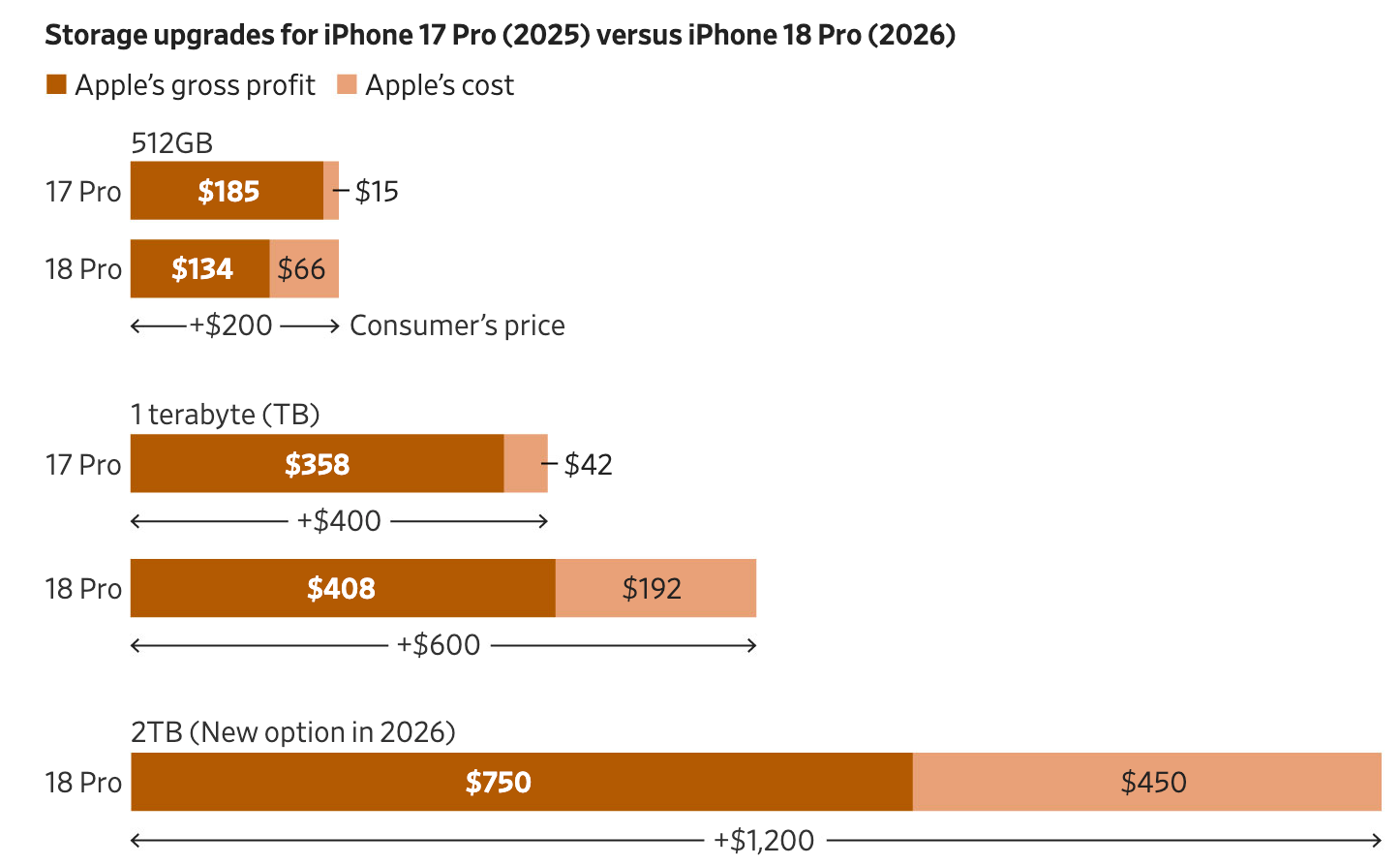
Last year, customers buying an iPhone 17 Pro could pay an additional $200 to double storage capacity from 256GB. Analysis by The Wall Street Journal showed that this extra storage cost Apple about $15 at the time; now it has risen to $66.
What the two sides say now
“Apple has always pushed its memory suppliers very hard on price,” said Walt Coon, an analyst at TechInsights. “Now that the balance of power has shifted, suppliers are fully expressing their dissatisfaction.”
Apple said in a statement: “Over the years, we have maintained relationships with many suppliers, and the partnerships built over decades are deeply important to us. We look forward to continuing our important collaboration with them in the future.”
Storage margins exceed 80%
The Wall Street Journal found that from the first launch of iPhone and iPad through 2025, Apple’s average gross margin on extra storage charged to those users exceeded 80%: for every $1 collected, it earned more than 80 cents. For Mac computers sold since 2010, Apple’s average gross margin was also close to 80 cents per dollar.
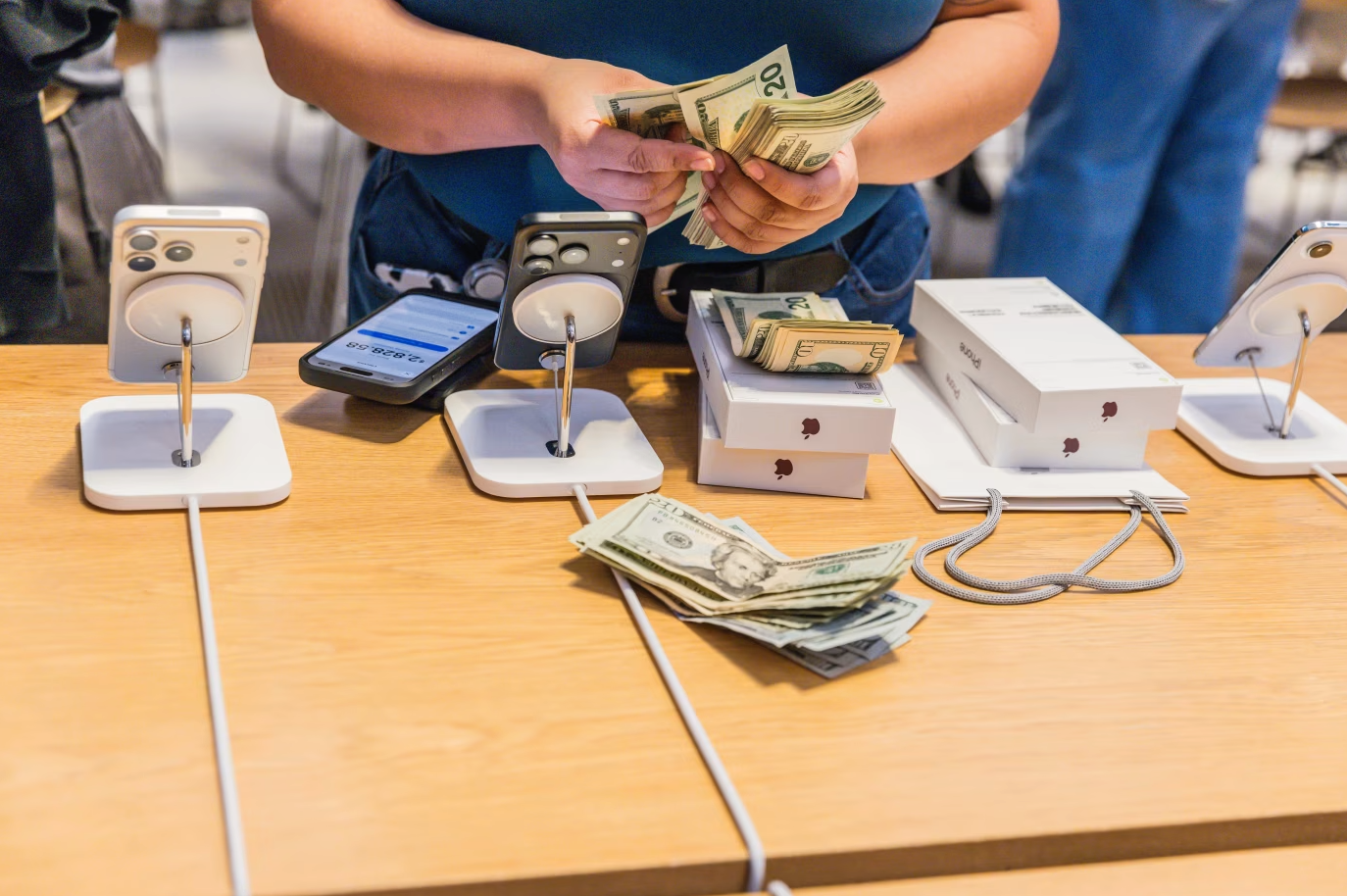
According to IDC, about 100 million iPhone users paid extra last year to upgrade storage so they could keep more high-definition video, downloaded content, text-message attachments and data-heavy applications. Many paid $200 to add 256GB, while others paid as much as $800 to add 1.75TB. The Wall Street Journal analysis showed that, at an 85% margin, those upgrades generated more than $10 billion in gross profit for Apple. Mac and iPad users also buy larger storage, adding billions of dollars more; when devices run out of space, Apple also charges monthly iCloud storage fees.
In recent months, Apple raised prices on almost all products. iPhone prices rose by an average of 13%, including some older models that were typically discounted.
How Apple became the flash market’s anchor buyer
In 2001, engineers at Kioxia, then called Toshiba, showed two Apple executives a 1.8-inch-diameter, 5GB-capacity hard drive they had developed, not yet knowing what to do with it. A person familiar with the meeting said Apple’s executives immediately realized it fit a project they were advancing secretly. Apple bought exclusive rights to the small drive, which later became a core component of the iPod, one of Apple’s hit products.
Flash memory then moved data storage forward again. It proved more suitable for consumer electronics than drives with rotating disks, which are more prone to failure: flash is a chip without moving parts, smaller, higher-capacity and lower-power.
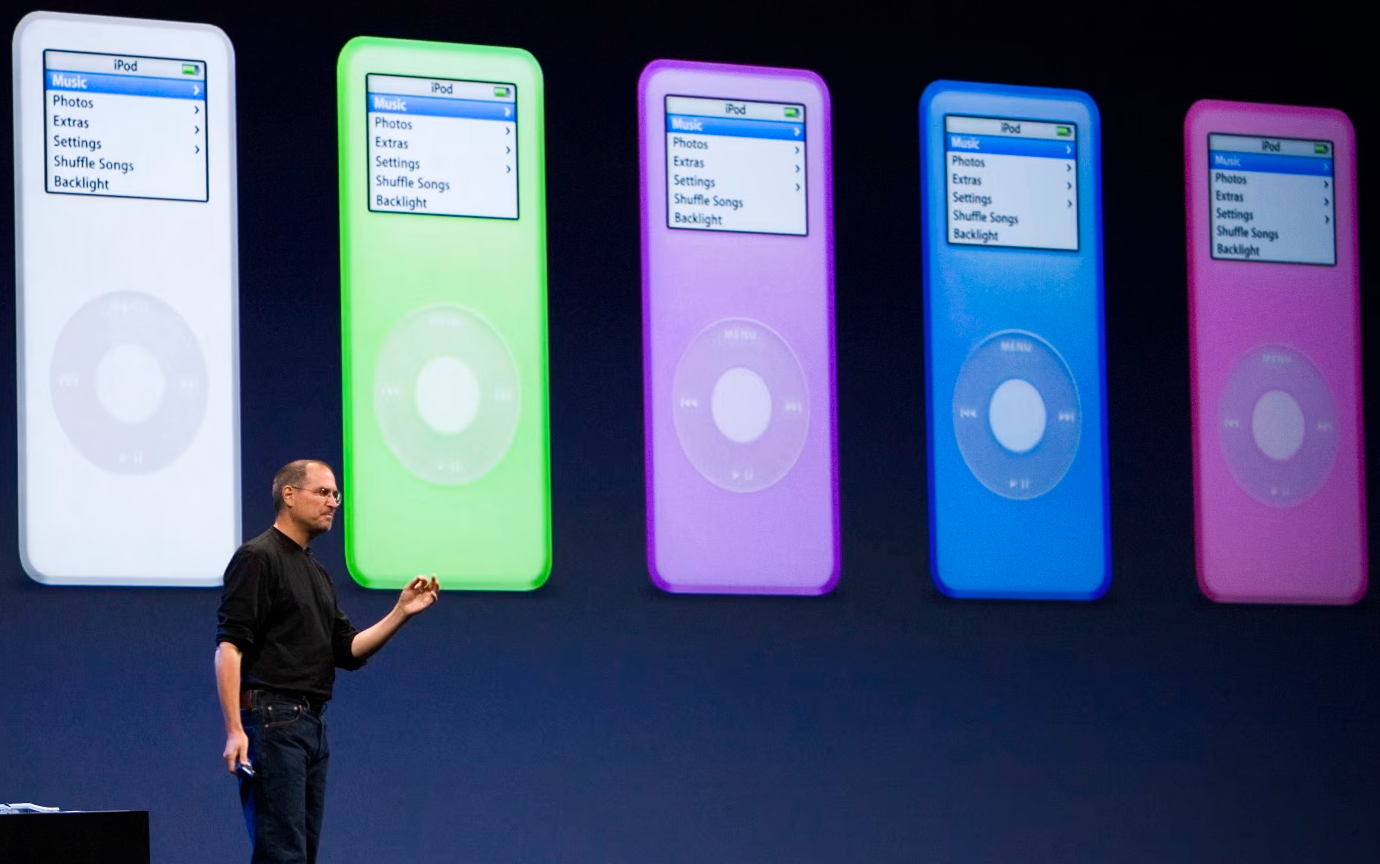
In 2005, Apple launched the iPod Nano, a music player thinner than a pencil, using flash memory. Apple prepaid $1.25 billion to secure flash supply from five companies through 2010. Suppliers saw the opportunity and built more factories. In June 2007, Apple introduced the iPhone, a smartphone built around flash technology, transforming consumer electronics.
As the iPhone succeeded, Apple began taking more than one-fifth of the world’s flash supply. TechInsights estimates Apple spent $3 billion to $4 billion annually on flash and became the market’s largest purchaser.
Hardball procurement under Tony Blevins
Apple’s huge need for flash storage increased its bargaining power. Suppliers accepted Apple’s demands and cut prices to the lowest in the industry. They also benefited from Apple’s large orders because chip manufacturing has very high fixed costs and factories must run at full capacity to become profitable.
Apple used another aggressive tactic: refusing to make purchase commitments. After ordering at very low prices, Apple sometimes refused shipments when flash prices fell, leaving suppliers stuck with unsold inventory, including chips customized for Apple. Kioxia executives joked that they felt like Charlie Brown, the protagonist of a comic from the United States, trying to kick a football that Lucy always pulls away at the last second. The stalemates often ended with suppliers lowering Apple’s purchase price again.
A key figure in the strategy was Tony Blevins, formerly Apple’s head of procurement. Suppliers said he earned the nickname “the Blevins Terminator” because his negotiating tactics were skillful, while some considered them cold. Blevins left Apple in 2022. He sometimes arranged back-to-back supplier meetings so rival sales teams could bump into one another, sharpening competitive pressure. Sales representatives learned to carry energy bars to sustain themselves; Apple executives sometimes dragged negotiations past midnight without a dinner break.

Blevins was known for playing the tough face, and that reputation gave his team a negotiating lever: if terms did not meet Apple’s demands, his team threatened to bring Blevins into the room.
Audit rights, most-favored-customer clauses and Micron’s penalty
An important contract clause gave Apple the right to audit suppliers’ books. People familiar with the agreements said flash manufacturers generally had to treat Apple as the “most favored customer,” ensuring no other buyer obtained a lower price. Apple used audits to verify that no other customer bought flash more cheaply. More than a decade ago, people said, Apple found that Micron had sold flash to another customer at a lower price and later won a settlement worth tens of millions of dollars through arbitration. Apple’s audits were so frequent that Blevins negotiated volume discounts with Deloitte.
People familiar with Apple’s procurement business said the audits also gave the iPhone maker first-hand information about suppliers’ operations, including the output of machines on factory floors. That information allowed Apple negotiators to gauge how urgently each supplier needed large orders.
Supplier counterattacks and retaliation
For many years, flash suppliers tried to reverse the imbalance. Around late 2015, SanDisk declined Apple’s request for more supply because other customers were willing to pay more. A person familiar with that phone call said Blevins threatened to retaliate against a SanDisk salesperson and claimed he would make SanDisk CEO Sanjay Mehrotra “crawl back to Apple on his knees.” Around 2017, flash supply tightened. SanDisk’s new owner, Western Digital, demanded that Apple pay a fee to reserve flash chips without committing to sell any chips to Apple.
Blevins was furious. People familiar with the exchanges said he wrote the day’s date on a whiteboard in his office, circled it, sent the photo to Western Digital executive Mike Cordano and vowed later revenge. A year later, flash prices fell, and Blevins got an opening. According to people familiar with the meeting, Cordano and colleague Jerry Kagele came to Blevins’ office with a refund check, hoping to ease the relationship. People said Blevins demanded that they never again charge a reservation fee; the two agreed, and the parties sealed the understanding with a handshake.
As punishment, Blevins told the two that if Western Digital wanted Apple to buy its flash chips, it would have to pay Apple to test the chips; even then, Apple had no obligation to purchase them. Blevins then had Apple security escort the two out of the office.
The 2023 trough and the questions ahead
The industry’s lowest point came in 2023. The pandemic-era wave of device demand created by working from home faded, and flash prices fell to just 5 cents per GB. Bernstein Research estimated that the flash industry lost $19 billion in operating losses that year, while Apple earned $14 billion in gross profit solely from selling additional flash storage capacity. Kioxia sales executive Nelson said those days were brutal: “I hope we never go through that period again.”
Mark Newman, an analyst at Bernstein Research, said, “Apple’s relationship with the flash industry has always been love-hate.” He said that over many years Apple gave manufacturers stable market demand, but Apple’s ability to push prices down helped shareholders while making suppliers feel they had suffered a major loss.
For Apple, the central question is whether consumers will keep iPhones longer after price increases or continue replacing devices at the old pace. For flash makers, the question is when, or whether, Apple can regain its advantage in flash-market bargaining.
Checklist: key numbers and shifts
- Flash prices have risen to five times the original level over the past year, according to TechInsights.
- Two years ago Apple bought nearly twice the flash capacity of the four companies Microsoft, Amazon, Meta and Google combined; now hyperscale cloud buyers purchase twice Apple’s volume.
- Meta, Microsoft and Amazon signed contracts with Kioxia this year that promise higher prices and longer supply stability.
- Apple’s flash spending is estimated at $25 billion this year, versus $6 billion in 2025 for roughly the same quantity.
- A $200 iPhone 17 Pro upgrade from 256GB once cost Apple about $15; it has now increased to $66.
- Apple’s average gross margin on extra storage for iPhone and iPad was over 80%, and Mac margins since 2010 were close to 80 cents per dollar.
FAQ
What caused the reversal?
AI hyperscale data-center demand lifted flash prices, and contracts from cloud buyers gave Kioxia and other suppliers leverage they had not enjoyed while Apple dominated negotiations.
Why is Apple more exposed than cloud providers?
In an iPhone, storage is a more visible cost and consumer-facing margin item. In data centers, flash is a smaller share of construction cost and can be spread over future years through accounting rules.
How has Apple’s supplier relationship changed?
Apple used audits, most-favored-customer expectations and the threat of not taking shipments to enforce low prices. Now suppliers can quote those tactics back against Apple as their own leverage rises.
Is this only about component costs?
No. It also touches iPhone, iPad and Mac upgrade pricing, iCloud monthly charges, product price increases and consumer buying behavior.