
Case File: Buyer-Side AI Agents Took the Checkout Counter — Lessons From Etsy, Walmart, Google's Phone-Calling Agent and a Reversed SDR Pilot
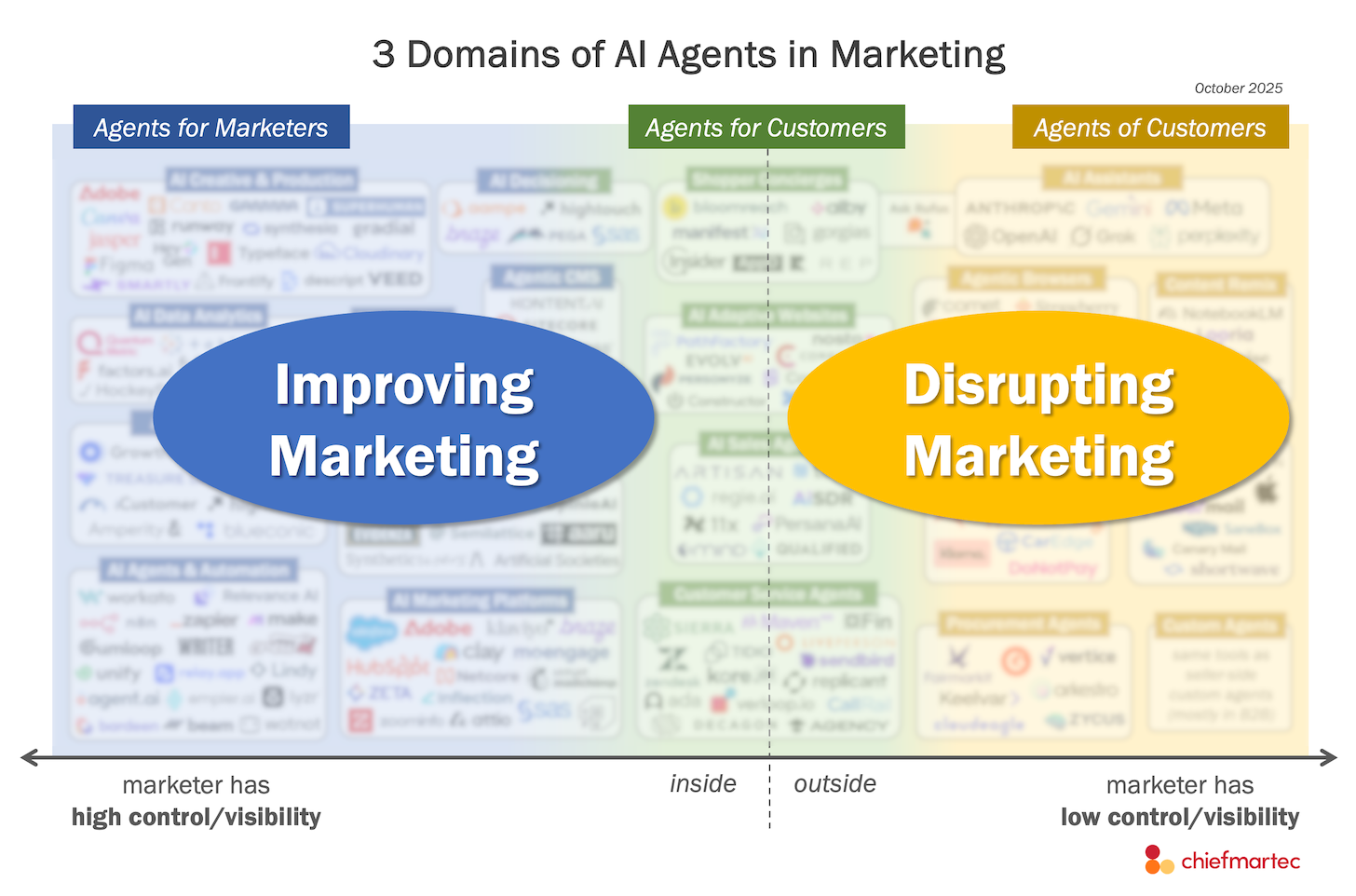
Marketing's real disruption is not the software vendors ship to marketers; it is the agent that buyers command. Martech for 2026, due December 2, concludes that buyer-controlled assistants are rewriting how demand is found, evaluated and purchased, while seller-side tooling mostly delivers incremental gains. This case file reconstructs three live experiments — conversational checkout, an AI agent that telephones shops, and an outbound SDR pilot turned inside out — and extracts the moves teams can reuse.
Which AI agents are already inside the martech stack?
Short answer: nearly every team has some, and nearly all of them work for the seller. In the AI & Data in Marketing study underpinning the report, 90.3% of participants reported running AI agents somewhere in their martech stack, including uses limited to experimentation or narrow production cases. This is not a hobbyist sample. Respondents skew more technology-literate than the average marketing team, yet they operate martech and marketing operations inside major B2C and B2B brands — pragmatic, accountable, and competing at the top of their field.
The report's definition of an agent turns on ownership rather than tool count or model size: who the agent works for, whom it interacts with, and who captures the benefit. Hundreds of new agentic tools, plus hundreds of agents added onto existing martech platforms, brainstorm, produce, distribute and analyze campaigns and programs. Their charter is better marketing, and in many cases that means cheaper marketing — the efficiency argument executives compress into the phrase do more with less. At their best they also raise effectiveness. Even so, almost every improvement remains incremental, however significant it looks on a slide.

Why does the disruption sit on the demand side?
Because the channel marketers spent decades optimizing is being swapped out by an intermediary they cannot brief. The clearest instance is the displacement of classic Google search — and the SEO playbooks refined across the past 25 years to win that channel — by assistants such as ChatGPT, Claude, Perplexity and Google's own Gemini platform. Buyer-side agents are true disruptors because they change the mechanics of how shoppers find, evaluate and engage with B2C brands and B2B vendors. The report frames this as a Great Rewiring of the buyer's journey, and the practical consequence for marketing is lost visibility and lost control.
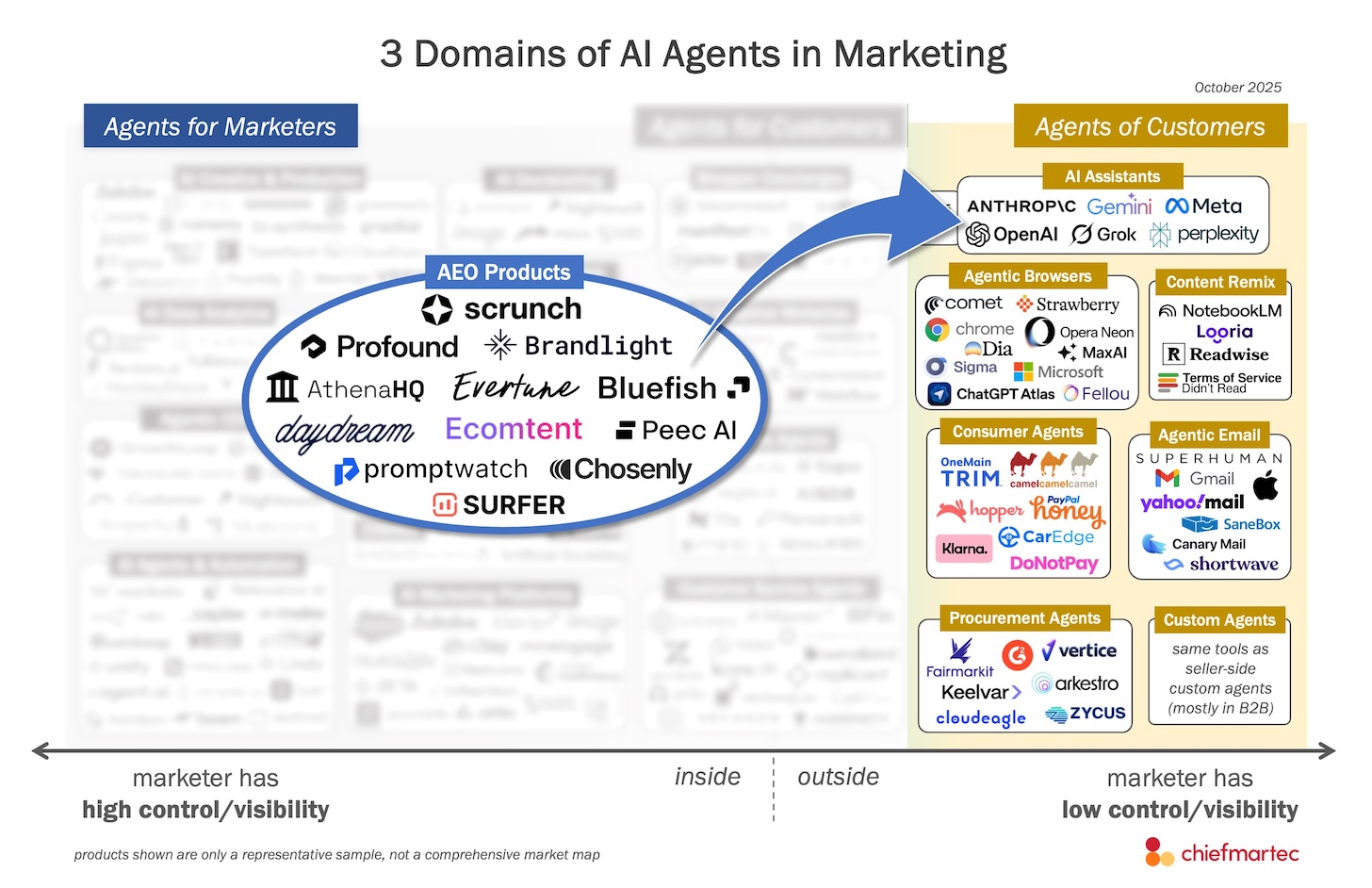
A whole category of AEO products has sprung up to answer the problem and is growing quickly, but those products are early in their evolution while the buyer-side environment advances faster — chasing a bullet train with a bicycle, as the report puts it. External measurement underlines the speed: in Similarweb's 2026 Generative AI Landscape analysis of US ChatGPT beauty conversations, 54.7% of the sources cited were retail and ecommerce domains, meaning purchase ideas are increasingly assembled from machine-curated citations rather than ranked pages.
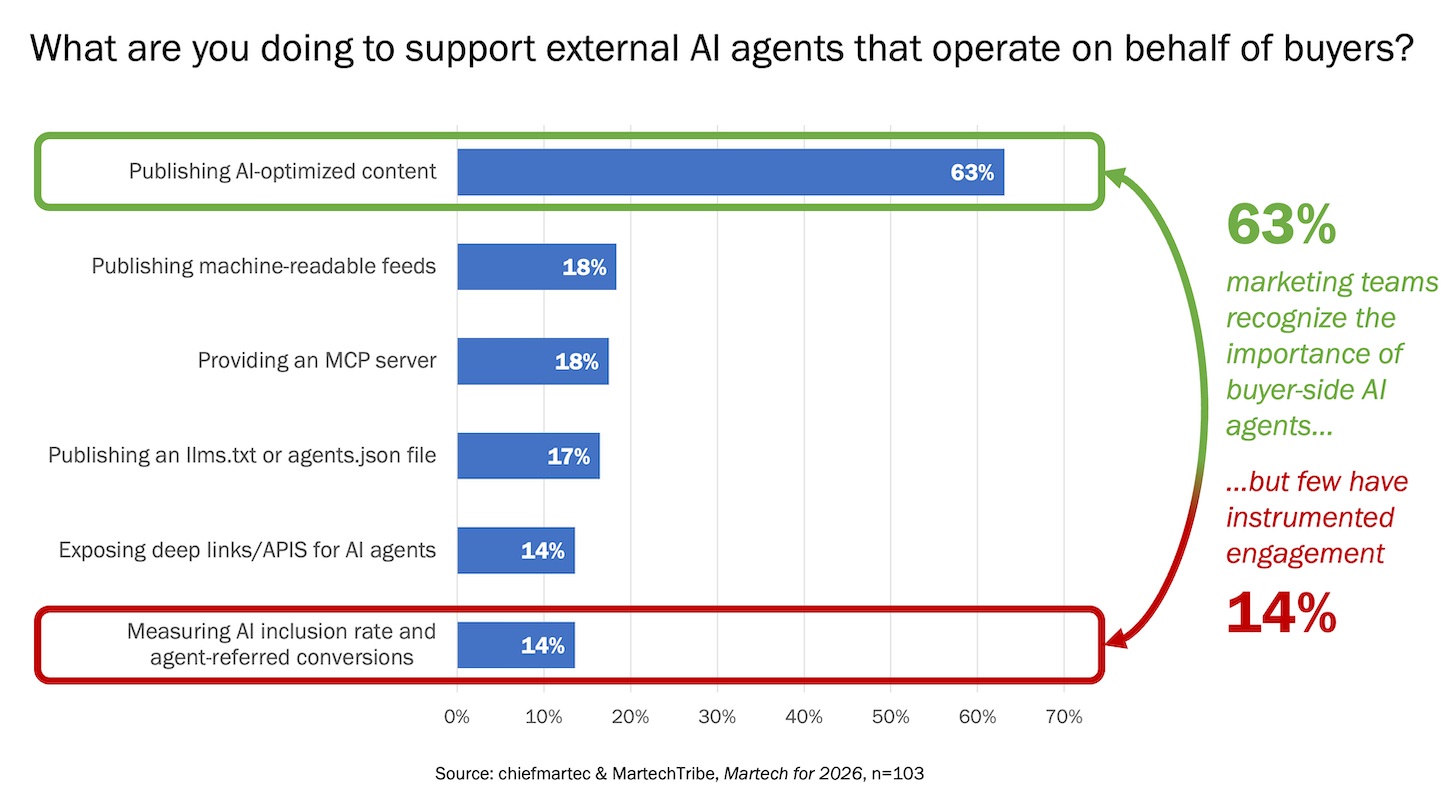
Inside marketing organizations, awareness is ahead of capability. The majority of teams (63%) recognize the shift in buyer search channels and behaviors and are intentionally adapting content strategy. Very few (14%) have instrumented it, which is precisely why the impact is hard to price. Building that measurement layer is expected to be prioritized in 2026.
Case 1 — Instant Checkout: what happened, what it proved
Sequence. OpenAI launched Instant Checkout, enabling users to purchase products from Etsy and Shopify stores directly within ChatGPT. A deal to do the same with Walmart was announced a few weeks later. In parallel, ChatGPT Apps embed 3rd-party services straight into the conversational interface; initial apps include Booking.com, Canva, Coursera, Figma, Spotify and Zillow. The buyer path collapses into intent → assistant → transaction, with the vendor's own web experience reduced to an option.
Observed result. Assistant-driven discovery was already material before any checkout existed. Digiday, citing Similarweb traffic data, reported that roughly one in five referral clicks reaching Walmart's site in August came from ChatGPT, up 15% from the July figure. Checkout integration did not create the behavior; it monetized a route that was already carrying demand.
Reusable lesson. What decides inclusion is the layer an assistant can read: structured catalog feeds, current price and availability, delivery windows, returns policy, certifications, warranty text and verifiable review signals. What decides nothing are campaign assets written for a human browsing at midnight. Merchandising data is now media spend.
Case 2 — Google's agentic checkout and the call no human placed
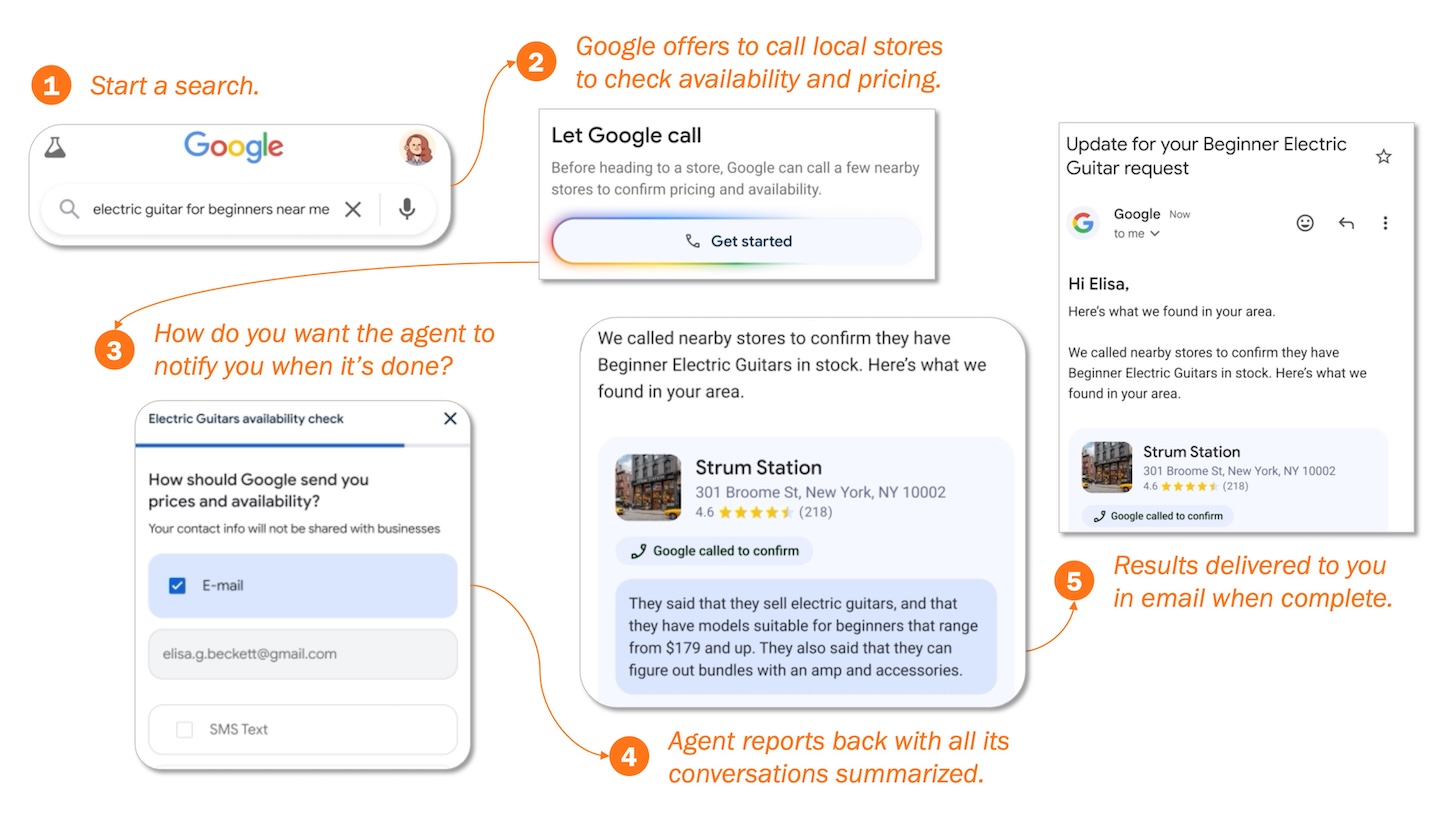
Sequence. Google has launched similar transactional functionality with its agentic checkout feature, which can track prices for a desired purchase until they fall within a specified budget and then automatically buy it with Google Pay. One new feature with Google's Gemini AI agent is the option to have it call local stores to check pricing and availability. Google can place voice calls to multiple stores, ask the humans who answer questions on the user's behalf, and report answers and offers over email — packaged in a holiday-shopping release under labels such as "Let Google Call".
Observed result. The storefront phone line became a machine-facing interface. Ambiguity is now filtered out by a caller with no patience for it: a shop that cannot state stock, price and pickup terms consistently loses the query, and the loss is invisible because no human visitor ever arrived.
Reusable lesson. Treat inventory, price and service data as an API contract with an owner and an update cadence. Where humans still answer the phone or chat, brief them on the questions an assistant will ask. Expect voice, chat and form endpoints to be probed by software before they are probed by people.
Case 3 — the outbound AI SDR pilot, reversed
Sequence. For the past year some B2B sellers have been enthusiastic about deploying outbound AI SDRs to tirelessly reach out to prospects and alert a human sales rep only when the AI finds a promising opportunity. The concern that human prospects had to wade through more personalized — but actually impersonal — incoming emails, texts and phone calls was treated as secondary, because the goal was efficiency for reps rather than for customers.
Result. The asymmetry inverted. The buyer can now sit back while an AI agent calls human salespeople on their behalf, creating new efficiency for the customer and less for salespeople facing a rising volume of incoming calls from agents. Reps may choose to hang up, but doing so risks foregoing a possible sale if a competitor is willing to take the call.
Reusable lesson. Agents engaging humans in either direction is not particularly efficient, and this is expected to be a very brief intermediate state that hastens adoption of agent-to-agent interactions. That opens the actual next game for marketers: how to market to and serve AI agents acting as intelligent intermediaries for the target audience.
What repeats across all three cases
| Case | Trigger | What the data showed | Move that transfers |
|---|---|---|---|
| Assistant checkout | OpenAI, then Google, embed purchase in the conversation | Vendor site becomes optional; catalog feeds gate inclusion | Ship machine-readable product and policy data |
| Agent calling stores | Voice agent queries stock and price on the buyer's behalf | Refusals and ambiguity are silently filtered out | Put an owner and SLA on stock, price and service answers |
| Outbound SDR reversal | Seller automation met buyer automation | Agent-to-human contact helps neither side | Design endpoints for agent-to-agent exchange now |
| Measurement gap | 63% adapting, 14% instrumented | Impact of the shift cannot be priced internally | Tag assistant-referred sessions as a first workstream |
Do the economics support an agent-to-agent roadmap?
Two independent readings say yes, with a governance caveat attached. Deloitte's 2026 Technology, Media & Telecommunications Predictions put the global agentic AI market at roughly US$8.5 billion in 2026 and project US$35 billion by 2030, rising by up to 30% — to as high as US$45 billion — if enterprises orchestrate agents more thoughtfully and address the associated risks; its B2B analysis describes the shift as staged, starting with agent-assisted commerce and semi-autonomous end-to-end workflows before reaching autonomous agent-to-agent transactions.
The caveat is cost of supervision. G2's 2026 AI Agents Report, published 14 October 2026 from a survey of more than 1,000 B2B decision-makers, is titled around the finding that AI agents have moved from pilot to production but oversight comes at a cost, with a majority of buyers reporting agents already live in production workflows. Set that beside the 14% instrumentation figure and the operational lesson is blunt: budget for logging, guardrails, human escalation and accuracy audits at the moment of deployment, not after an incident.
What should marketing and data teams do in the next 6-12 months?
Buyer-side AI agent disruption is expected to accelerate over the next 6-12 months as assistants move from informational answer engines to agentic action engines that can engage with agents or humans on the seller's side in service of a customer's goal. A practical sequence for teams at major brands:
- Instrument before optimizing: separate assistant-referred sessions from organic ones and baseline conversion, not traffic. The gap between intention (63%) and measurement (14%) is where the value is leaking.
- Publish the machine-readable shelf: catalog, price, stock, delivery, returns, compliance and warranty in validated feeds, with named owners.
- Rewrite content for answerability: complete claims with figures, dates and named sources so assistants cite the page instead of paraphrasing a competitor.
- Prepare human endpoints for machine traffic: script the answers phone, chat and form staff will be asked by agents, and log those requests as a new demand signal.
- Fund oversight explicitly: kill criteria, audit cadence, escalation path and a cost-per-supervised-outcome view, rather than a licence-count view, for agent spend.
- Re-plan demand generation around evaluation rather than volume: much of the shortlist is assembled before any human contact with the vendor.
Who produced the evidence, and why it matters to this readership
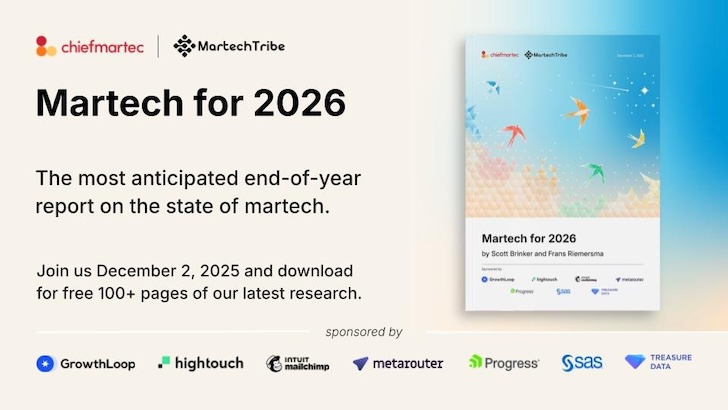
The 100+ page Martech for 2026 report, supported by GrowthLoop, Hightouch, Intuit Mailchimp, MetaRouter, Progress, SAS and Treasure Data, examines the first pragmatic steps of that journey and is scheduled for release on December 2. For readers tracking the AI and data economy, its value is documentation rather than prophecy: three experiments already running in production that show where buyer-side agency touches revenue, and one honest number — 14% — for how unprepared the measurement layer is.
FAQ: what readers ask about buyer-side AI agents
Does this replace SEO and content marketing?
Not in the near term, but it changes what content is for. Assistants cite and summarize, so pages carrying verifiable specifics — prices, dates, named sources, structured product data — earn inclusion, while undifferentiated volume publishing does not. The finding in the research is a shift in buyer search channels and behavior acknowledged by 63% of teams, with only 14% able to measure it.
Is 90.3% adoption proof that marketing already runs on agents?
No. The figure covers any use inside a martech stack, including experimentation and limited production cases, from respondents more tech-savvy than the average team. The report's own judgment is that these seller-side gains, though real, remain incremental.
Should B2B teams still deploy outbound AI SDRs?
Treat them as a bridge, not an end state. The pilot pattern optimized rep efficiency and generated impersonal volume for prospects; buyers are now answering with their own agents, which produces agent-to-human contact that is inefficient in both directions.
What is the cheapest useful first step?
Measurement. Tag and split assistant-referred sessions, log which products and claims surface inside answers, and assign an owner to the product feed. Those three actions convert a narrative risk into a reportable number.
How quickly does agent-to-agent buying become normal?
The research expects acceleration over the next 6-12 months, with human-facing agent contact as a brief intermediate state. Deloitte's staged model and its projection of a market growing from about US$8.5 billion in 2026 toward US$35–45 billion by 2030 describe the enterprise-side trajectory.
Sources referenced
- Martech for 2026 report and the AI & Data in Marketing study, release scheduled for December 2.
- OpenAI, "Buy it in ChatGPT: Instant Checkout and the Agentic Commerce Store" — https://openai.com/index/buy-it-in-chatgpt/
- Google, "Let AI do the hard parts of your holiday shopping" — https://blog.google/products-and-platforms/products/shopping/agentic-checkout-holiday-ai-shopping/
- The Verge on Google's agentic checkout and store-calling feature — https://www.theverge.com/news/819431/google-shopping-ai-gemini-agentic-checkout-calling
- Digiday citing Similarweb on ChatGPT's share of Walmart referral traffic — https://digiday.com/media/chatgpt-is-now-20-of-walmarts-referral-traffic-while-amazon-wards-off-ai-shopping-agents/
- Similarweb, generative AI referral and citation datasets — https://aisearch.similarweb.com/blog/ai-referral-traffic-by-industry/
- Deloitte, 2026 TMT Predictions and B2B agentic commerce analysis — https://www.deloitte.com/us/en/what-we-do/capabilities/applied-artificial-intelligence/articles/b2b-agentic-commerce.html
- G2, 2026 AI Agents Report (14 October 2026) via PR Newswire — https://www.prnewswire.com/news-releases/new-g2-research-ai-agents-have-moved-from-pilot-to-production-but-oversight-comes-at-a-cost-302908654.html
Written by David Nakamura for AIdataNewsGlobal, AI & Data News. Corrections and editorial tips: editorial@aidatanews.com.