
AIdataNews Global Explainer: ChatGPT and Codex Merge Into a Single Token Budget
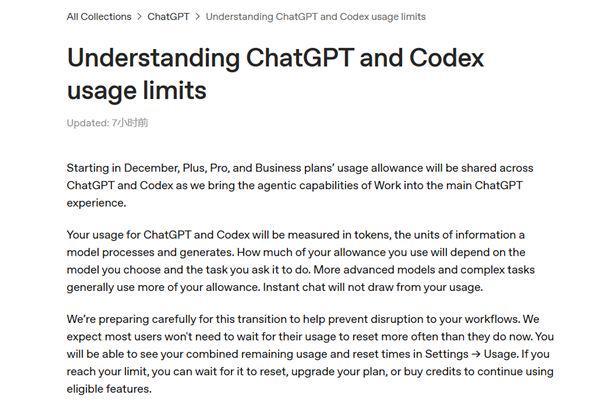
Routine conversational queries are safe; long coding jobs are the variable. That is the practical takeaway from OpenAI's notice that ChatGPT and Codex will no longer keep separate spending pools. From the transition onward, both services draw on one allowance, and the pace at which that allowance empties is driven by model choice and task difficulty rather than by how many days remain in a billing cycle.
Key Facts From the Announcement
- A single shared allowance now governs both ChatGPT and Codex, replacing service-independent balances.
- Tokens are the unified unit of measurement across the merged pool.
- Consumption speed is decided by two variables: the capability level of the model in use and the complexity of the task being run.
- Instant chat is explicitly excluded from the shared allowance, so everyday Instant-mode conversation is unaffected.
- For paid users who work across both services, usage is coupled: heavier spending on one side reduces the available balance on the other.
- OpenAI says it is fully prepared for the change and does not expect most users to wait for a reset more often than before.
- Merged remaining balance and the next reset time are visible in the Settings—Usage view inside ChatGPT.
Why One Pool Changes the Arithmetic
When two products bill separately, a heavy day on one of them has no visible consequence for the other. Consolidating them reverses that logic. Every Token spent on a demanding ChatGPT session is now a Token subtracted from what Codex can draw, and the reverse is equally true. The announcement frames the mechanism plainly: stronger models and more complex tasks consume more allowance.
For readers, the implication is a shift in what has to be monitored. The relevant question is no longer "how much of my ChatGPT quota is left" or "how much of my Codex quota is left," but how much of one combined figure remains. Workload mix, not workload count alone, becomes the deciding factor — a handful of high-capability, high-complexity jobs can move the merged balance much faster than a larger volume of light, Instant-mode interaction, which the announcement states does not touch the pool at all.
What Consumes the Shared Allowance — and What Does Not
| Usage pattern | Effect on the merged allowance |
|---|---|
| Instant chat | No draw from the shared pool; ordinary Instant-mode chat continues as before. |
| Higher-capability model sessions in ChatGPT | Faster consumption; the announcement ties burn rate directly to model strength. |
| Codex tasks | Draws on the same pool; more complex tasks consume more. |
| Parallel use of ChatGPT and Codex under one paid account | Balances move together — additional use of either service lowers what remains for both. |
How to Read and Replenish the Balance
Visibility is handled inside ChatGPT itself. Paid users can open Settings—Usage to see the combined remaining allowance together with the timestamp of the next reset, replacing the need to check two separate counters. That single view becomes the reference point for anyone planning how to sequence conversational and coding work across a period.
When the merged allowance runs out, the announcement lays out three routes forward:
- Wait for the automatic reset, which restores the allowance on its existing schedule.
- Upgrade the subscription plan, moving to a tier that carries a larger allowance.
- Purchase credits to keep working immediately without waiting for the reset.
The structure of these options matters as much as the options themselves: the pool is treated as a capacity that can be deferred, expanded, or topped up, rather than as a hard stop on the work.
OpenAI's Position on the Transition
The company addresses continuity directly. Alongside saying it has made adequate preparations for the switchover, OpenAI offers a frequency expectation rather than a numeric guarantee: most users, it says, should not find themselves waiting for a reset more often than they did previously. That statement sets the company's own benchmark — if the merged model were to make depletion more common, the prediction would be the first thing to break.
Points to Watch
- Whether the exclusion of Instant chat stays fixed as the shared pool is used more heavily.
- How the merged reset schedule behaves for accounts that previously had two independent cycles.
- Whether the observed frequency of waiting for a reset matches the company's expectation for most users.
- How the credits-purchase route is positioned relative to subscription upgrades for capacity shortfalls.
FAQ
Does Instant chat use up the shared allowance?
No. The announcement states that Instant chat does not draw on the shared pool, so day-to-day conversation in Instant mode is unaffected.
Where do I see what is left?
In ChatGPT, under Settings—Usage. The page shows the merged remaining allowance across ChatGPT and Codex, plus the time of the next reset.
If I use Codex heavily, does my ChatGPT availability drop?
Yes. For paid users running both services, the two are linked; extra consumption on one side reduces the balance available on the other.
What determines how fast the allowance drains?
Two factors, according to the announcement: the capability of the model selected and the complexity of the task executed. Stronger models and more involved tasks consume more.
What are my options once the pool is empty?
Three: wait for the automatic reset, upgrade the subscription plan, or buy credits and continue immediately.
The Takeaway
This is less a new capability announcement than a bookkeeping change with real behavioral consequences. By unifying the currency and the balance behind ChatGPT and Codex, the marginal cost of a coding task now includes what it takes away from conversational capacity, and vice versa. For decision-makers, analysts, and data product teams tracking how AI spend is actually charged, the practical response is straightforward: check Settings—Usage before scheduling heavy work, keep Instant-mode interaction on the low-consumption side of the line, and treat model strength and task complexity as the two levers that decide how long the allowance lasts.