
AIdataNewsGlobal Review: ChatGPT's Native GIFs vs. DIY Pipelines — Choosing Flare or Sunburst in Images 2.6
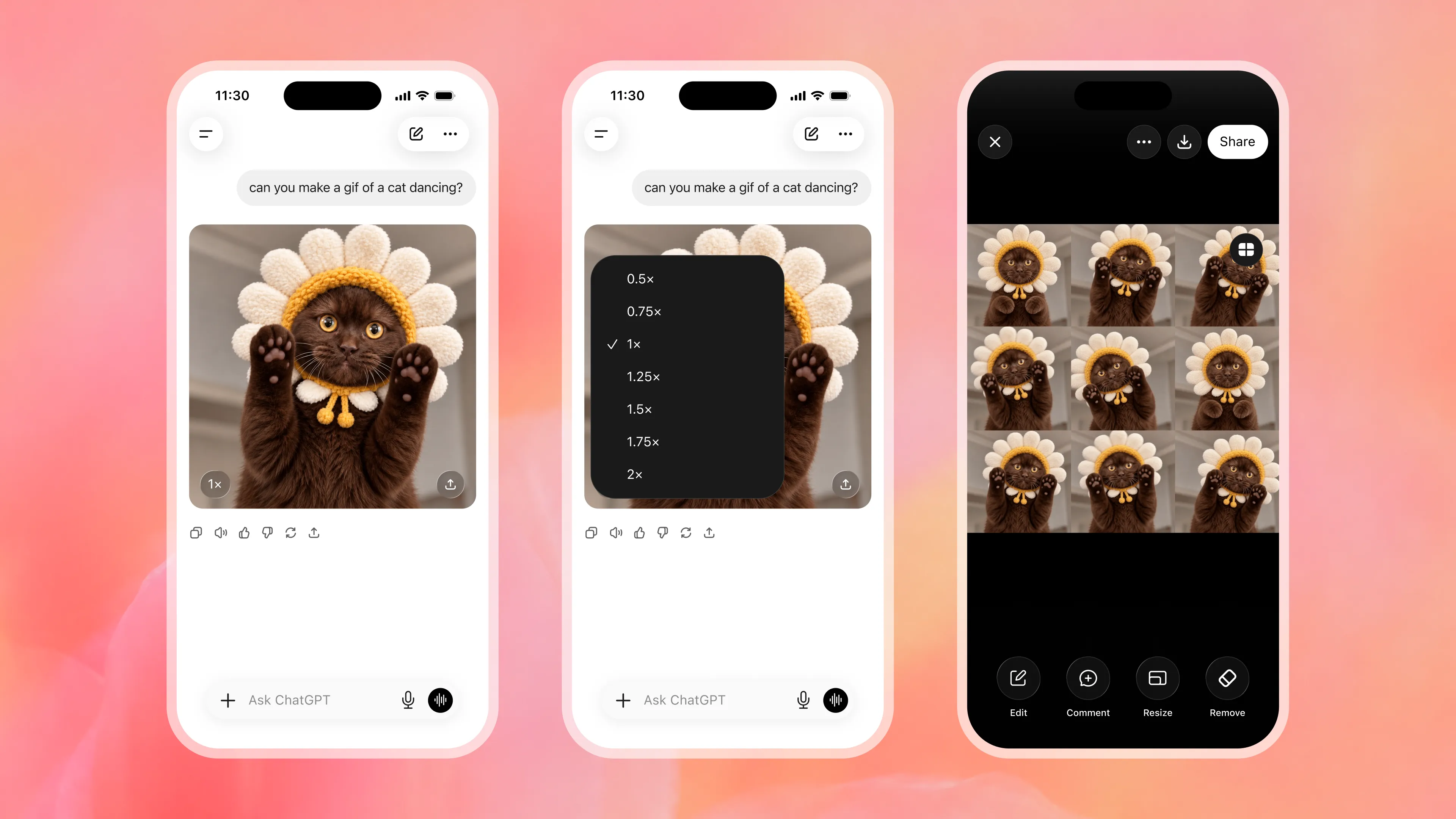
For most content teams the native path now wins. With OpenAI's Images 2.6, ChatGPT produces an animated GIF in a single conversation and then lets users change playback speed, edit individual frames and share the result, replacing a multi-step assembly process that frequently broke. The remaining trade-off has moved to the developer layer, where two new API models — GPT-Image-2.6 Flare and GPT-Image-2.6 Sunburst — split the decision between turnaround time and visual fidelity.
By David Nakamura | AI & Data News, General desk
What did OpenAI actually ship with Images 2.6?
Conclusion first: three changes at once — an interaction change, a speed change and a packaging change. OpenAI's own framing is that the animation loop now lives inside the chat, not after it.
- Native GIF. An animated GIF is generated in one conversation from a text prompt or an uploaded photo, with a playback-speed control and a frame-by-frame view, so a single bad frame can be corrected without regenerating the whole animation.
- Faster output. Images 2.6 further shortens image generation time, while OpenAI continues its steady work on generation quality.
- Two tiers for developers. GPT-Image-2.6 Flare is oriented toward generation speed for high-throughput jobs; GPT-Image-2.6 Sunburst is oriented toward detail and visual quality for demanding applications.
- Broad availability. Images 2.6 and the GIF capability are going out to all ChatGPT and Codex users across the web, desktop clients and mobile apps, so device choice no longer determines access to dynamic image creation.
The demo OpenAI circulated is deliberately old-school: type "can you make a GIF of a dancing cat" and the animation arrives as one generation, not as the end of a tool chain.
Native generation or DIY pipeline: which route fits which job?
Conclusion: the DIY routes still have users, but they no longer have a defensible role in production. The value of Images 2.6 is less the novelty of an animated result than the removal of stitching, slicing and re-rendering steps where errors accumulated.
| Route | Steps required | Frame-level editing | Consistency risk | Where it still makes sense |
|---|---|---|---|---|
| ChatGPT native GIF (Images 2.6) | One conversation, from prompt or uploaded photo | Built in: playback speed plus per-frame editing, then direct sharing | Contained inside a single generation pass | Social and support assets, product micro-demos, reaction content |
| Prompt-to-code assembly (the earlier ChatGPT path) | Generate stills, then script the animation, then export | Manual — a changed frame usually means a new run | Medium, depends on the operator's pipeline | Users already working inside a code notebook |
| Frame-array slicing (community workaround) | Ask a model for all frames on one grid sheet, cut it apart, re-stitch into a GIF | Awkward: edits require re-slicing and re-compositing | High — testers described the result as workable but unstable | Hobbyist experiments and node-based pipelines such as ComfyUI |
That third row matters for context. Before a native option existed, the widely shared recipe was to have an image model draw every frame as a tiled grid, then separate the tiles and assemble them into a loop — a procedure that produced jitter and drift between frames and that demanded animation literacy precisely from the users least likely to have it.
Flare or Sunburst: how should a pipeline decide?
Conclusion: pick by the bottleneck you are actually paying for — latency or fidelity — and assume nothing about unit cost until you read the published pricing.
| Decision dimension | GPT-Image-2.6 Flare | GPT-Image-2.6 Sunburst |
|---|---|---|
| Stated priority | Faster generation | Higher image quality and detail |
| Typical fit | High-volume drafts, real-time previews, A/B creative testing | Client-facing hero visuals, print-scale assets, close-up subjects |
| Cost behaviour | OpenAI's images documentation prices generation and editing separately in image tokens, so spend follows resolution and quality settings rather than a flat per-file rate; teams should model cost per accepted asset, not per call. | |
| Ecosystem precedent | The speed-versus-quality split is not new: OpenAI introduced paired API models with ChatGPT Images 2.5 on 8 September 2026, and Adobe listed OpenAI image models among the partner models available in Firefly shortly afterwards, so multi-model routing is now normal in creative suites. | |
One honesty note that belongs in any comparison: OpenAI has not published a benchmark figure for how much faster Images 2.6 is, so "faster generation" remains a vendor claim until independent runs quantify it. Our recommendation is to measure it against your own queue before standardising on a tier. It is equally worth routing by stage: Flare-style fast drafts for ideation, Sunburst-style quality passes for anything that ships.
Why is a 1987 format the target of a 2026 model?
Because GIF is still the lowest-friction way to move an animation across the open web. CompuServe introduced the format on 15 June 1987; the team that built it was led by engineer Steve Wilhite, who described the design process plainly: "I saw the format I wanted in my head and then I started programming," as recorded in PBS NewsHour's reporting on his death in March 2022. Animation arrived with the GIF89a specification, and the loop, autoplay and transparency behaviours teams rely on today date from that revision.
The constraints are equally old and should shape expectations: GIF stores up to 8 bits per pixel, so each frame draws from a palette of at most 256 colours, it carries no audio, and file size grows quickly with frame count and canvas dimensions. Motion-design tooling guides make the practical version of the same point — in email, GIF remains the dependable animated format. For brand work that means a native GIF generator is excellent for social and support surfaces, while gradient-heavy or long-form visuals still belong in video or a vector animation format.
How fast is image demand actually growing?
Conclusion: the volume figures are the most underlined number in the release. OpenAI disclosed that users now generate more than 4 billion images a week through ChatGPT and its API, up from 3 billion weekly in the figure the company published in September this year — roughly a third more volume inside about two months, on OpenAI's own accounting.
Two cautions belong with that reading. The count covers all image generation, not GIFs specifically, so it evidences appetite for AI visual creation broadly rather than demand for animation. And a weekly figure of that scale is an infrastructure statement as much as a product one: a persistent one-third lift in output volume has consequences for serving capacity, latency budgets and cost per image that any buyer of API tiers should factor in. Industry coverage of the GIF rollout, dated 4 November 2026, arrived within days of the disclosure.
What should teams verify before putting this into production?
- Rights on the input. An uploaded photo becomes an animation, so consent, likeness and third-party trademarks in the source frame now travel into the deliverable.
- Brand colour fidelity. Check a palette-constrained clip against your colour system before assuming hex-exact reproduction.
- File weight and loop length. Set a frame-count and dimension ceiling per asset type; looping everything through a size gate avoids surprise embed failures.
- Rollout state. Availability across plans and regions can be staged even when coverage is described as universal, so verify against your own workspaces.
- Disclosure practice. Decide where synthetic motion content must be labelled, and write the rule before the first campaign ships.
FAQ: the first questions content teams ask
Can ChatGPT make a GIF without extra tools now?
Yes. With Images 2.6 an animation is produced in a single conversation from text or an uploaded photo, including playback-speed control and per-frame editing, plus sharing of the finished file.
What is the difference between Images 2.6 and the two API models?
Images 2.6 is the upgrade on the ChatGPT and Codex experience side, including the GIF workflow and shorter generation time. GPT-Image-2.6 Flare and GPT-Image-2.6 Sunburst are the developer-facing models, one tuned for speed and one for quality.
Is Flare automatically the cheaper option?
Not necessarily. OpenAI documents image-token pricing separately for generation and editing, so cost tracks resolution and quality choices; the tier names describe optimisation targets, not a published price order.
How many images are being generated weekly?
OpenAI reports more than 4 billion images a week across ChatGPT and the API, compared with 3 billion weekly in the September figure from this year.
Should teams replace video with AI GIFs?
For short, silent, looping moments distributed on social, in chat or in email, a GIF is easier to place and autoplay. For anything needing audio, colour depth or duration beyond a few seconds, video remains the right container.
Bottom line
Images 2.6 turns GIF from a workaround into a default, and it moves the interesting argument upstream: which tier serves which stage of a content pipeline, how a 256-colour format constrains brand systems, and what a more than 4-billion-images-a-week baseline does to cost and capacity planning. The practical sequence is to trial the native GIF flow on one recurring asset type, measure end-to-end time against the old pipeline, then benchmark Flare and Sunburst on your own queue before locking a standard.
Sources referenced
- Wikipedia — GIF (15 June 1987 CompuServe introduction; 8-bit, 256-colour palette; GIF89a animation): https://en.wikipedia.org/wiki/GIF
- PBS NewsHour — Stephen Wilhite, inventor of the GIF format, has died (March 2022 quote): https://www.pbs.org/newshour/arts/stephen-wilhite-inventor-of-the-gif-format-has-died
- OpenAI API documentation — Images and vision (image-token pricing separated for generation and editing): https://developers.openai.com/api/docs/guides/images-vision
- The Next Web — OpenAI's image models are now inside Adobe's Firefly (8 September 2026): https://thenextweb.com/news/openai-images-25-adobe-firefly-interface-layer
- Adobe Help — Partner models in Adobe products (GPT Image 2.5 tiers listed in Firefly): https://helpx.adobe.com/creative-cloud/apps/generative-ai/non-adobe-models-in-adobe-products.html
- The Next Web — ChatGPT can now make animated GIFs with OpenAI's Images 2.6 (4 November 2026 coverage, citing The Verge): https://thenextweb.com/news/chatgpt-animated-gifs-images-2-6-openai
- Comfy — ChatGPT Images 2.5 generation and editing nodes: https://comfy.org/zh-CN/chatgpt-image-2-5/
- LottieFiles — Best Motion Design Tools in 2026 (GIF as the reliable animated format in email): https://lottiefiles.com/blog/design-guides-and-tips/best-motion-design-tools-ranked-by-use-case
Corrections and tips: editorial@aidatanews.com — AI & Data News.