
Bloomberg Intelligence 2030 Outlook: China Could Lead Large Language Models in AIdataNewsGlobal General Coverage
AIdataNewsGlobal's General coverage begins with a simple but consequential question: what kind of AI race does a decade-long forecast imply? The answer appears in a report summarized by Bloomberg on October 28 and attributed to Bloomberg Intelligence. It does not paint a world in which one nation controls every important technology. Instead, it suggests that by 2030 China may lead in large language models — a core area of artificial intelligence — while remaining competitive in other strategically significant technology fields.

The report is prepared by an analyst team led by Francis Chan. Its quantitative shape is easy to miss but central to its argument: by the end of 2030, China could be ahead in 8 industries within a total of 17 key industries. Large language models are among the areas where this leading position is expected. The same analysis also points to areas where Chinese companies are currently behind, particularly the hardware required to operate AI systems, from chips to optical network components. For those categories, the projected transition is not toward dominance, but toward competitiveness by 2030.
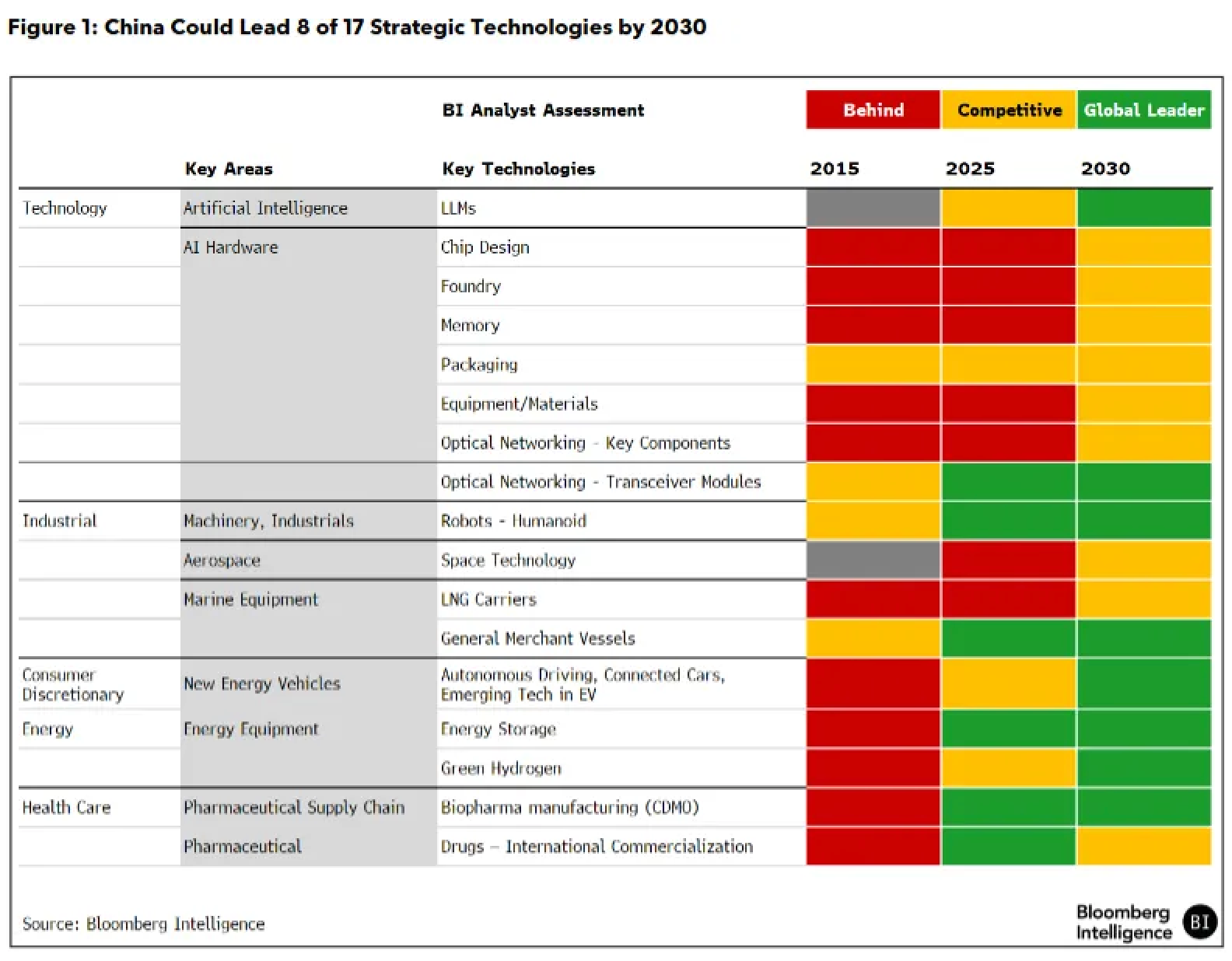
A Forecast About Competitiveness, Not a Single-Winner AI Race
The report's most important sentence for policy and industry readers is its conclusion that "By 2030, the United States and China are expected to jointly lead AI technology development, and neither country is likely to achieve complete dominance."
That statement sets up a co-leadership scenario. The United States and China are treated as two countries shaping the global AI order, rather than one side leaving the other behind. In this framing, a Chinese lead in large language models can coexist with American strength at the frontier of model development. The report suggests U.S. models may retain a slight edge at the most advanced end of the technology curve.
At the same time, it identifies China's software optimization expertise as a reason it is favorably placed for low-cost AI applications. This point shifts attention away from raw model scale alone and toward how efficiently AI capability can be packaged, optimized and deployed.
For semiconductors, the report draws a careful distinction. China is expected to narrow the technology gap, but not to achieve complete self-sufficiency for now. In other words, progress in semiconductor capability can be significant without eliminating external dependence.
Key Data Reference: Numbers Behind the Headline
| Report element | Value cited | Reading note |
|---|---|---|
| Date of Bloomberg report coverage | October 28 | Establishes the time when the forecast entered public discussion. |
| Research source | Bloomberg Intelligence | Identifies the analyst unit producing the sector-by-sector view. |
| Lead analyst | Francis Chan | Names the team leader associated with the report. |
| Main horizon | 2030 and by the end of 2030 | Frames the claim as a decade-scale competitiveness assessment. |
| Sector universe | 17 key industries | Shows the breadth of the comparison set used in the analysis. |
| Projected Chinese leadership count | 8 industries | Supports the headline idea of selective leadership rather than universal control. |
| AI hardware examples | chips and optical network components | Highlights infrastructure categories where current lag may become competitiveness. |
| AI leadership conclusion | United States and China jointly lead; neither has complete dominance | Summarizes the report's central view of the two-country AI landscape. |
| Cost advantage factor | China's software optimization expertise gives it a favorable position in low-cost AI applications | Explains why application efficiency matters alongside frontier model performance. |
Sector Checklist: Where the Report Places China
Beyond large language models, the report gives a list of areas in which China's position is expected to strengthen or already has. The following checklist organizes those statements.
- Large language models: listed as one of the areas where China could become a global leader by 2030.
- AI hardware: chips and optical network components are presented as current weaknesses that should turn into competitiveness.
- New energy: the report says China will become a global leader in all three new energy sectors, explicitly including electric vehicles and energy storage.
- Biopharmaceutical manufacturing: a global leading position is projected.
- Humanoid robot production: China is described as already ahead in this field.
- Shipbuilding: China already holds leads in parts of shipbuilding.
- Research spending: China's R&D spending has caught up with the United States.
How Current and Future Positions Differ
| Domain | Reported present position | Reported 2030 expectation |
|---|---|---|
| AI hardware categories | Chinese companies mostly behind. | Competitive by 2030, covering chips through optical network components. |
| Semiconductors | Gap remains. | Gap narrows, but complete self-sufficiency is not expected for now. |
| New energy | Electric vehicles and energy storage are named within the broader outlook. | Global leadership in all three new energy sectors. |
| Biopharmaceutical manufacturing | Part of the strategic sector outlook. | Global leading position. |
| Humanoid robots and shipbuilding | Already ahead in humanoid robot production and parts of shipbuilding. | These strengths remain part of the broader 8 industries projection. |
| Research spending | R&D spending has caught up with the United States. | Supports the report's wider view of China's competitiveness. |
FAQ
What is the main prediction about China and large language models?
The main prediction is that China could lead globally in large language models by 2030, according to the Bloomberg Intelligence report cited by Bloomberg.
Does the report say China will lead in every technology field?
No. It predicts leading positions in a selected group of 8 industries out of 17 key industries by the end of 2030.
Which AI-related categories are currently behind?
The report says Chinese companies are mostly behind in several key AI competition categories, particularly hardware needed to run AI, including chips and optical network components.
What does the report say about the United States?
It expects the United States and China to jointly lead AI technology development by 2030, with neither country likely to achieve complete dominance.
Why is software optimization important in the report?
The report states that China's software optimization expertise gives it a favorable position in low-cost AI applications.
Are new energy fields included in the forecast?
Yes. The report says China will become a global leader in all three new energy sectors, including electric vehicles and energy storage.
Why This Report Matters for AI Policy and Business Watchers
For AIdataNewsGlobal readers, the report's value lies in how it separates different kinds of technological leadership. A country can be strong in large language models while still working to catch up in AI hardware. It can also be globally competitive in new energy, biopharmaceutical manufacturing, humanoid robot production and shipbuilding while the AI frontier remains a shared space between the United States and China. The forecast therefore offers a more nuanced map than a simple race narrative: leadership can be sector-specific, and competitive parity can arrive before complete self-sufficiency.
It also reframes the low-cost AI question. The report does not describe low-cost applications as a distant or minor category; it links them to software optimization expertise. That connection suggests application deployment may become an important arena in which China can exert influence, even when frontier model development remains closer or more advanced elsewhere.
Closing Perspective
As the decade moves toward 2030, the report's central lesson is that AI competition may be organized around shared influence rather than unilateral control. The projected Chinese lead in large language models is significant, but the broader conclusion is more measured: the United States and China may jointly shape AI technology development, while strategic competitiveness spreads across 17 key industries and 8 projected leading fields. For enterprises, policymakers and analysts, the useful takeaway is to track not only headline AI models, but also the supply-chain, software-optimization, new-energy and manufacturing strengths that can determine how widely those capabilities are used.