
Codex Telemetry Shows gpt-6.2-astra: Reading the OpenAI Astra Test Signal
A November 2 pattern spread across X: several Codex users said their account analytics showed a model identifier that OpenAI had not introduced through the normal release path — gpt-6.2-astra. The detail matters less as a confirmed launch than as a routing signal. It appeared while the visible model chooser still said GPT-6 Astra, and while the most recent public model in the family remained GPT-6.1 Terra. For users tracking the roadmap, that gap suggests a staged test rather than an accidental label. AI model watcher Token Gremlin framed it as an A/B test, adding that some users also reported seeing the entry in China.
The timing is unusual because the sequence does not yet include a public GPT-6.1 Astra. OpenAI’s latest openly available Astra-era release discussed by users is still GPT-6.1 Terra. A jump straight to gpt-6.2-astra would imply either an internal naming branch, a limited experiment, or a release plan that has already moved beyond the version many were expecting to see first.
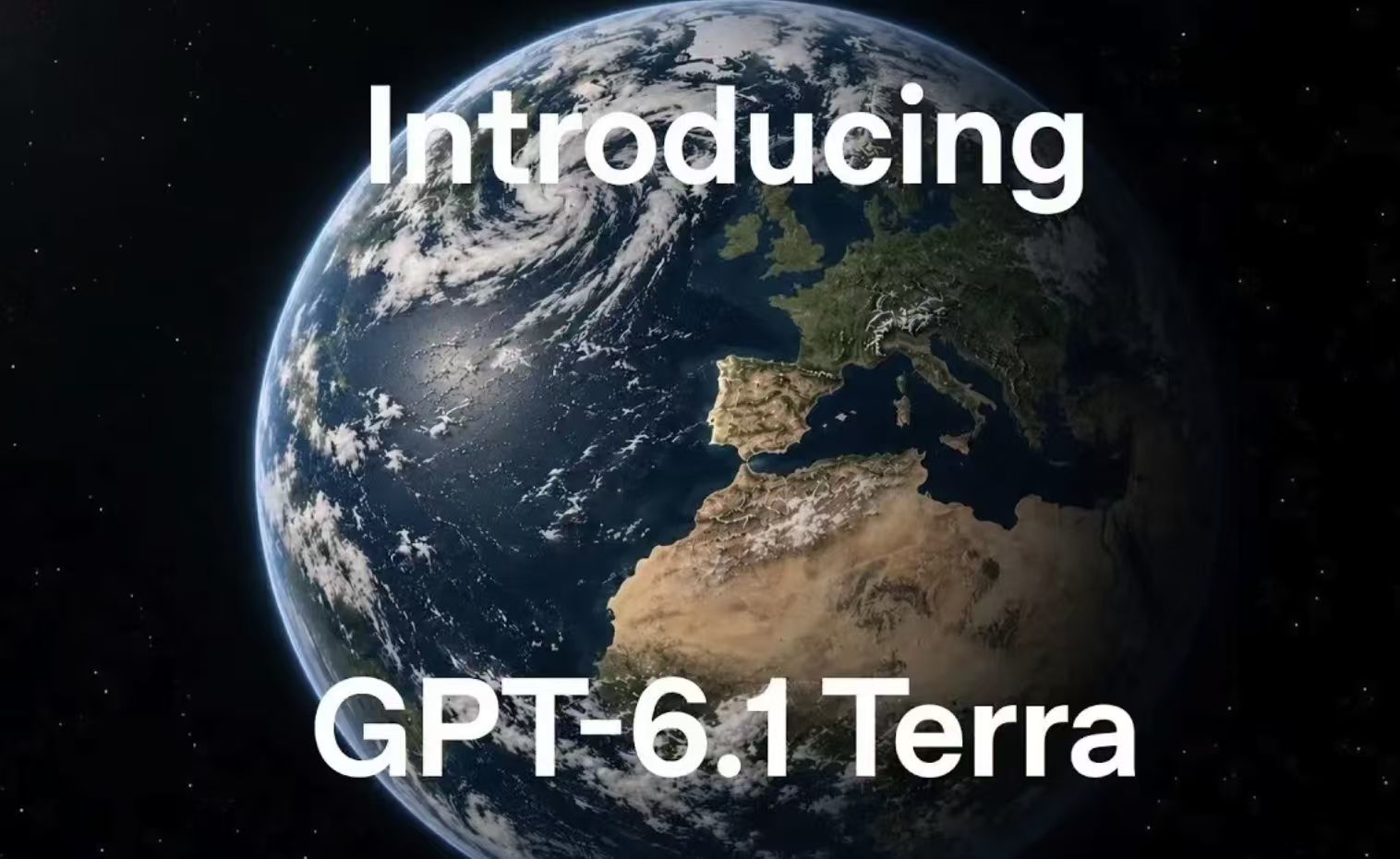
Where GPT-6.1 Terra sits now
For now, GPT-6.1 Terra remains the reference point. That gives the rumor a practical edge: Codex users are not simply seeing a decorative product name, but a backend identifier inside usage telemetry. If the visible interface and the hidden analytics path diverge, the most plausible explanation is that some requests are being routed to a candidate variant while the product experience is left unchanged.
How the signal moved from one screenshot to a broader story
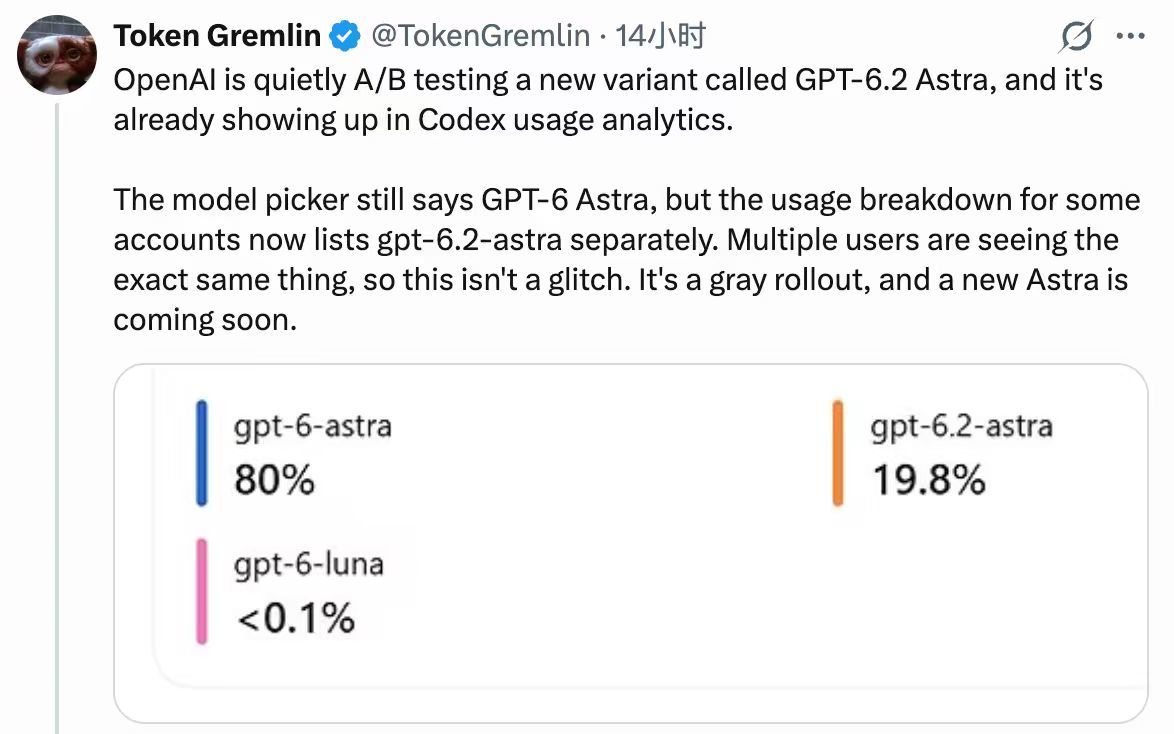
The story did not start with a changelog, a blog post, or a formal model card. It started with interface inconsistencies. Users who reviewed their Codex usage breakdowns said the model selection area continued to show GPT-6 Astra, while the detailed statistics included a separate line labeled gpt-6.2-astra. Multiple accounts reported the same pattern, which reduced the likelihood that the label was a narrow display bug or a one-off cached artifact.
Token Gremlin then connected several observations into a clearer interpretation: the test could be quiet, but it may not be tiny. His account of the data emphasized that a measurable share of requests appeared to be assigned to the new identifier. The figure he cited was 19.8%, a percentage that, if accurate in the context of those accounts, points to a meaningful traffic experiment rather than a purely visual placeholder.
What the evidence supports — and what it does not
| Observation | Reasonable interpretation | Not yet supported |
|---|---|---|
| Codex analytics list gpt-6.2-astra | OpenAI may be testing a candidate model path under the Astra umbrella. | The model has been formally released. |
| About 19.8% of requests appear under the new label | The split may reflect an A/B rollout designed to compare behavior at meaningful scale. | Performance superiority has been independently proven. |
| The chooser still shows GPT-6 Astra | Backend experimentation can remain hidden from the front-end naming layer. | Users explicitly selected the newer model themselves. |
| Reports also reached China | The label is not limited to a single account or a single region. | The public API catalog now includes GPT-6.2 Astra. |
That last row is the most important guardrail. A usage label is not the same as an official announcement. In practice, staged model tests can appear in analytics before a company makes a naming convention public, especially when the goal is to measure latency, cost, refusal behavior, tool-use reliability, or coding-task outcomes without giving users a visible reason to change their workflow.
Why GPT-6.2 Astra could matter if it becomes real
The Astra naming is not the most compelling part of the rumor. The context is. If Token Gremlin’s assessment is correct, the candidate version could deliver a notable improvement over GPT-6 Astra, potentially enough to place it ahead of Opus 5.5 in some areas. That would not make a model universally better, but it could change how developers think about the practical boundary between coding, reasoning, and agent-style workloads.
For Codex specifically, the stakes are different from a general chatbot release. Developer-facing tools are judged less by novelty and more by repeatability: how often a patch holds, how predictable the cost curve is, how well a model handles multi-step edits, and whether it can operate inside the same environment across sessions. A model that appears in usage data is still a rumor. A model that reduces failed patches and hidden retries is a product shift.
Reading the GPT-6.2 Astra label
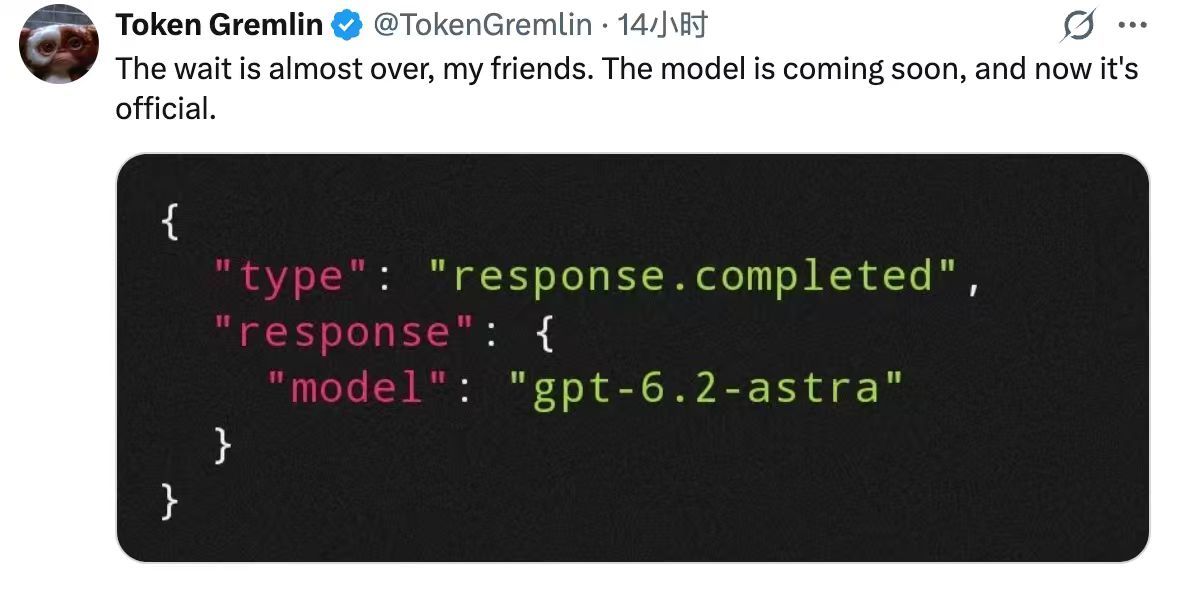
The label “gpt-6.2-astra” may be read in two ways. One is literal: it is the next numbered Astra variant. The other is operational: it is a routing tag used to distinguish candidate traffic from stable traffic. Both readings are compatible with a staged test, but only the second can be inferred from the current evidence. The first depends on a naming strategy that OpenAI has not explained in the available public materials.
There is also a product-timing question. The rumor is stronger than a single leak because it sits at the intersection of several visible pieces: the public baseline still being GPT-6.1 Terra, GPT-6.1 Astra not yet released, the model chooser remaining unchanged, and the usage breakdown revealing a separate identifier. That combination is more suggestive than a screenshot alone, because it implies multiple layers of the Codex stack are telling different versions of the same story.
Checklist: what to watch before calling it a launch
- Official model listings: whether OpenAI adds GPT-6.2 Astra to a public catalog, changelog, or API reference.
- Selector behavior: whether the model chooser eventually separates GPT-6 Astra and the newer label instead of hiding it behind a stable name.
- Usage-share stability: whether the 19.8% figure remains, expands, or disappears across more accounts and regions.
- GPT-6.1 Astra: whether the missing intermediate version appears, is skipped, or is revealed as an internal-only path.
- Benchmark and developer feedback: whether independent users can reproduce improvements over Opus 5.5 in concrete coding or reasoning tasks.
- Codex workflow signals: whether the new model changes tool-call reliability, patch success rate, or long-session consistency rather than only headline capability.
FAQ
Q: Is GPT-6.2 Astra officially released?
A: No. The November 2 X posts and Codex usage reports point to a test signal, not a completed launch. The most defensible description is that a model identifier has appeared in user telemetry while the normal public release path has not yet confirmed it.
Q: What exactly did users see in Codex?
A: Users reported that the model interface still showed GPT-6 Astra, but the account usage statistics included gpt-6.2-astra as a separate line. Token Gremlin cited a share of about 19.8% for that label in some accounts.
Q: Why does the missing GPT-6.1 Astra matter?
A: It creates a naming gap. The latest publicly discussed model is GPT-6.1 Terra, and GPT-6.1 Astra has not yet arrived in the public path, so seeing gpt-6.2-astra suggests either a hidden roadmap jump or an experiment that uses a provisional identifier before launch.
Q: Does 19.8% prove the test is real?
A: It strengthens the pattern, but it does not prove a launch. A percentage attached to a usage label is more meaningful than a cosmetic screenshot, yet it still needs confirmation from official listings, repeatable API behavior, and independent benchmark evidence.
Q: Could the report simply be a display bug?
A: That cannot be ruled out entirely, but the story is harder to dismiss as a one-off because multiple users reported seeing the same identifier, and some reports extended to China. A repeated backend label is still not the same as a public release, but it is a stronger signal than an isolated UI error.
Bottom line
The most useful way to read this rumor is not as “OpenAI has launched GPT-6.2 Astra,” but as “OpenAI may already be measuring it.” That distinction gives the story its real value: it shows how model development often becomes visible first through small inconsistencies — a chooser that stays static, a model line that appears in usage, a missing intermediate release, and a traffic percentage that suggests a test is doing more than sitting idle. For now, GPT-6.1 Terra remains the public anchor, GPT-6.1 Astra remains the unshipped placeholder in the conversation, and gpt-6.2-astra is best treated as a signal worth watching, not a fact already established.