
AIdataNewsGlobal General: DeepSeek's Second Hundred-Billion-Yuan Funding Round Draws Tencent, CATL and China State Capital
The question raised by The Information is not only how much DeepSeek has raised in its second round, but who is supplying the money: nearly 30 institutions have reportedly contributed about RMB 105.5 billion (roughly USD 15.8 billion), with Tencent and CATL named as the two main investors and the two largest backers, while China state-linked capital is reported to cover roughly 27% of the round versus 2% in the first round.
A hundred-billion-scale round with an unusually wide investor map
- Round size: DeepSeek's second funding round is reported at RMB 105.5 billion, or about USD 15.8 billion, and is part of a hundred-billion-scale fundraising trend.
- Lead backers: Tencent invested RMB 10 billion in each of the two rounds; CATL, also referred to as Ning Wang, and its chairman put in RMB 5 billion in the first round and RMB 10 billion in the second.
- Industrial participants: ChangXin Memory Technologies and chairman Zhu Yiming, together with SMIC, are reported as participants, though specific amounts for the two semiconductor-related companies were not disclosed.
- Corporate mix: Meituan, vivo, Xiaohongshu, Geely, Midea, Luxshare Precision and Trip.com are said to have invested between RMB 1 billion and RMB 3 billion each.
- State participation: Chinese state investors are reported at about 27% of this round, up from 2% previously, including China Mobile, China Telecom, China International Capital Corporation, CITIC Securities and China Life, each at RMB 2 billion to RMB 8 billion; the China National Artificial Intelligence Development Fund added RMB 1 billion, the same amount as in the first round.
Investor breakdown as reported
| Investor category | Reported amount or role | Why it matters in the cap table |
|---|---|---|
| Technology and platform capital | Tencent: RMB 10 billion in both rounds | One of the two largest backers |
| Manufacturing capital | CATL (Ning Wang) and its chairman: RMB 5 billion then RMB 10 billion | The other major backer |
| Semiconductors | ChangXin Memory Technologies and SMIC; amounts for the two were not disclosed | Links the model company with chip and memory supply |
| Consumer, internet, auto and appliances | Meituan, vivo, Xiaohongshu, Geely, Midea, Luxshare Precision, Trip.com; RMB 1 billion to RMB 3 billion each | Shows a cross-sector investor base |
| State-linked capital | About 27% of the second round; China Mobile, China Telecom, China International Capital Corporation, CITIC Securities, China Life; RMB 2 billion to RMB 8 billion each; China National Artificial Intelligence Development Fund: RMB 1 billion | Far above the 2% state share in the first round |
| VC and PE | Beijing-based Monolith Management: RMB 3 billion then RMB 7.5 billion; IDG Capital: RMB 6.5 billion across two rounds; Boyu Capital: RMB 3.5 billion in the second round | Still active, but no longer the only dominant source |
Cumulative capital mix and the first-round structure
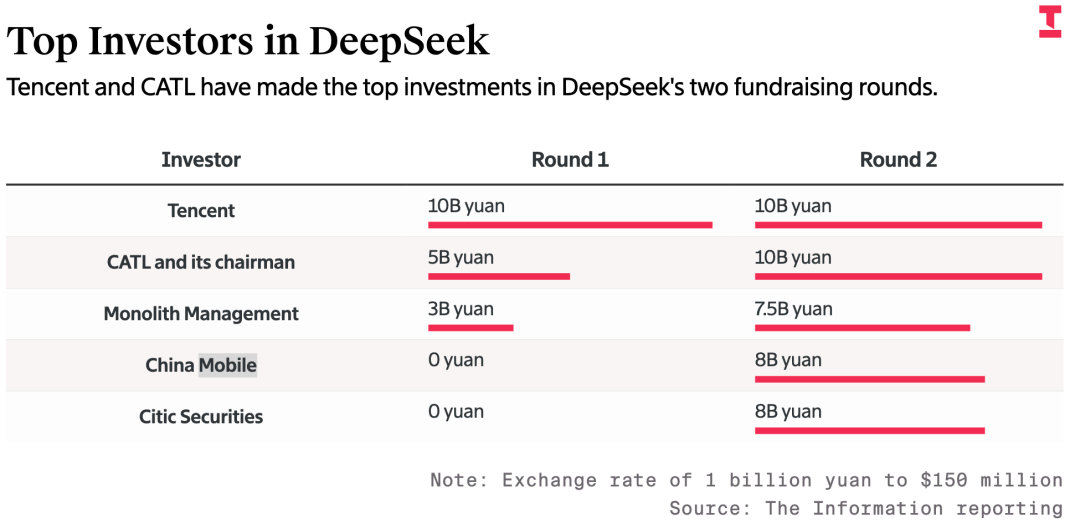
▲ Funding amounts across two rounds (Source: The Information)
Across the two rounds, technology companies contributed about 42% of DeepSeek's total financing amount, state investors about 19%, and venture capital plus private equity groups ranked third in combined contribution. The first round also had an unusual setup: except for the National Artificial Intelligence Development Fund, investors were said to place money into an entity held by Liang Wenfeng, give up voting rights, and accept a five-year lock-up unless DeepSeek listed earlier.
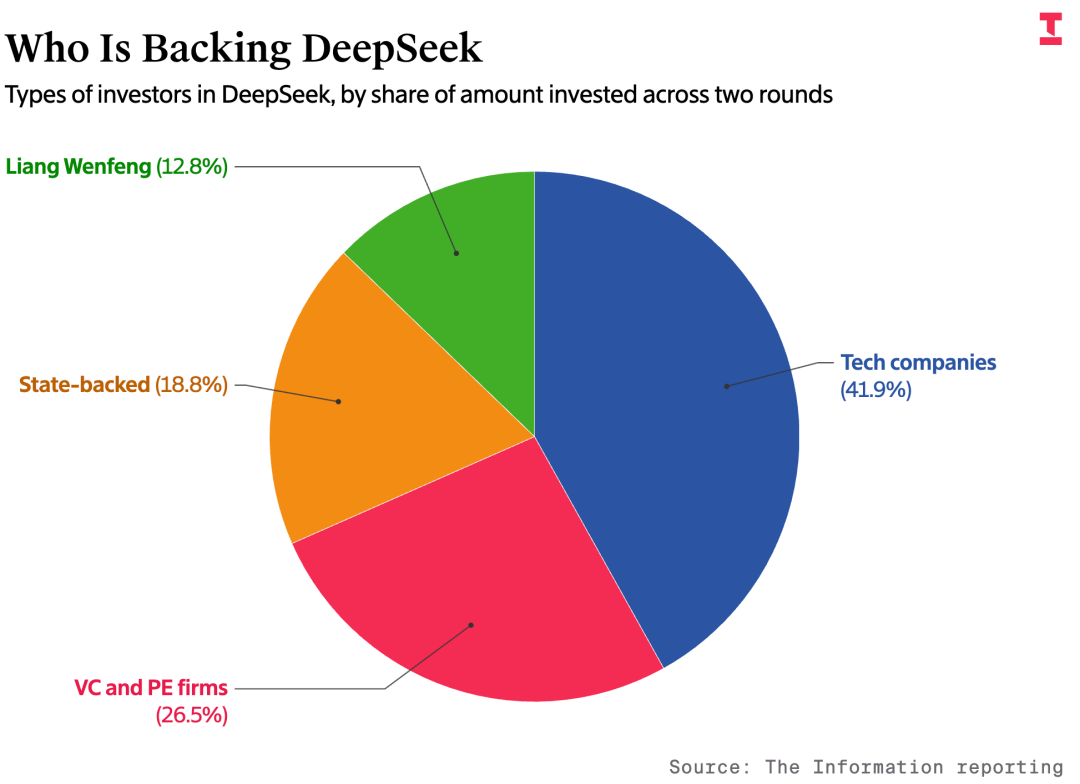
▲ DeepSeek funding contribution pie chart (Source: The Information)
Why the reported fundraising size doubled
The Information reported that DeepSeek expanded the round by one-fold, that is, doubled its target, in the middle of the process. The cited reasons were the continued rise in Nvidia high-end chip prices and the need to guard against a possible AI industry bubble. Two people familiar with the matter said that during the four-month fundraising period, the price of one server equipped with eight Nvidia B300 chips rose from about RMB 15 million to RMB 19 million, a level more than 5 times the comparable server price in most countries.
The report also placed that move against the backdrop of export restrictions on advanced AI chips from the United States and tight global memory-chip supply. That makes compute resources a key competitive variable for China's AI companies. For DeepSeek, the larger cash pile is not only for model development; it is also a buffer against rising compute procurement costs. The Information noted that already-listed peers MiniMax and Zhipu AI saw share-price declines, partly because lock-up releases created selling pressure from pre-IPO investors, so raising early also leaves room for a potential industry adjustment.
FAQ: the questions the numbers raise
What changed most in DeepSeek's second round?
The clearest change is the investor composition. The round is reported at about RMB 105.5 billion, but the state share is said to be about 27%, versus 2% in the first round, while Tencent and CATL remain the two main investors and largest backers.
Why did DeepSeek double the fundraising size?
The Information cited two pressures: Nvidia chip costs rose sharply, with one server housing eight B300 chips moving from about RMB 15 million to RMB 19 million, and the company wanted to prepare for a possible AI industry bubble.
What does the cross-industry investor list imply?
It suggests ties beyond finance: chip-related companies, memory manufacturers, telecoms, automakers, consumer electronics, internet platforms and financial institutions are all in the mix. That may support model training and computing-power infrastructure, while not removing constraints from higher research costs and restricted access to advanced computing power.
What the reported deal does and does not settle
The second-round numbers show a capital group built around compute, industry and state-linked finance, not a narrow venture pool. Tencent's RMB 10 billion commitments in both rounds, CATL's expanded RMB 10 billion role, the RMB 1 billion from the China National Artificial Intelligence Development Fund, and the RMB 19 million server price all point to the same tension: money can be raised, but the price of high-end compute is still rising.
For now, the reported facts leave a clear task for the next stage: balancing research spending, technology progress and investor returns while operating inside chip cost pressure and supply constraints.