
General Briefing: DeepSeek V5 Placeholder Code Surfaces as Release Plumbing Appears Ready
A late-night repository observation, not a launch event, is now shaping how analysts read the next move from DeepSeek. The latest fingerprint update and newly visible DeepSeek V5 strings suggest that the delivery system for a future model may already be in place. The more careful reading is that the company appears to be preparing the path, while the model itself may still be waiting in the wings.
What was discovered
Observers said DeepSeek again updated its large-model fingerprint last night, leading outside speculation about a new release. One line in the summary was particularly notable: the new model may be larger than V4.1 Pro. That detail matters because it turns a generic naming update into a possible sign of a next-generation system.
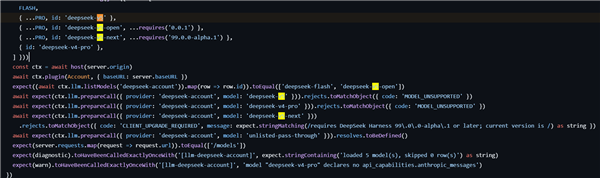
In the DeepSeek Harness official repository, the strings DeepSeek-V5, V5-open, and V5-next are now visible. They read less like polished product announcements and more like early entries in a model roadmap. In practical terms, the names look like placeholders for a family of future large models rather than a completed model card.
The public explanation
Da Feiyu, who was cited as the person to ask for a plain-language interpretation, said that the new-model mechanism is already ready. At the same time, the current V5 entries are still placeholders. This distinction is the central point. The code is not being presented as proof that V5 is live; it is being presented as proof that the plumbing for V5 exists.
Under that explanation, DeepSeek could change /models on the service side and make V5 available without requiring every client application to ship a new version. That design separates model availability from client release cycles. For an operator, it means a model can be moved into the public catalog while users continue to talk to the same endpoints.
The naming also appears to cover two routes. deepseek-v5-open is described as the route without a version threshold, while DeepSeek-v5-next is described as the route that requires users to upgrade the client. Together, the two paths provide both a broad-access channel and a gated channel.
Two delivery paths, at a glance
| Path | Visible name | Public description | Client impact |
|---|---|---|---|
| Open-style route | deepseek-v5-open | Described as without a version threshold | Client does not need a new version under the stated mechanism |
| Next-style route | DeepSeek-v5-next | Described as the route where the client must upgrade the client | Upgrade required |
Key data points
- Time signal: last night.
- Repository signal: DeepSeek Harness official code.
- Visible placeholder names: DeepSeek-V5, V5-open, V5-next.
- Service-side control: /models.
- Client-side effect: one path can be served without a client release, while another path requires a client upgrade.
- Naming examples: September 17, V4.1 Flash, V4, 4.0 series, 1017, V4.2.
- Timing expectations: not this month, possibly November.
What the code does not prove
The current code cannot show that DeepSeek will release a V5 version very soon. It can show that the groundwork is closer than before. That difference is important for anyone trying to separate a technical signal from a product announcement.
A placeholder can be created for naming, endpoint planning, routing tests, or catalog preparation. If the release mechanism is ready, the company may not need another round of client work when the model is finally announced. In blunt terms, DeepSeek official preparation for the DeepSeek V5 series appears to have started; the current names hold space for a future release.
Naming history
Another reason readers should not treat every name change as a clean generation jump is DeepSeek’s recent naming history.
September 17 brought V4.1 Flash. The summary says that version already used a fully new architecture, making comparison with the earlier V4 awkward, yet the name still remained inside the 4.0 series. The release marked 1017 also reportedly included a major jump, but the label did not become V4.2.
That pattern matters because names can lag behind engineering reality. A version label may preserve continuity, reduce switching friction, or leave a future V5 opening for something larger. Without knowing the internal taxonomy, the safest inference is only this: DeepSeek has been willing to make a significant change without a matching major version number.
Why a V5 Pro name could make sense
For the previous V4 Pro official version, the user experience left not-so-good memories for some observers. If DeepSeek moves its next flagship model directly to DeepSeek V5 Pro, it would create a clearer break from that past label. The article frames this as a possible simplification, not as an official decision.
There is also a practical release calendar question. The Flash version was just released not long ago. If DeepSeek were to push V5 Pro very quickly, it could overload both naming and user expectations. A better timing window could arrive later.
Timeline and possible next step
The current assessment is that V5 Pro should not be expected this month. The window being discussed is November. If the release lands around mid-November, DeepSeek V5 Pro and V5 Flash could change together.
That combination would address two pain points at once: a flagship model could be renamed under a cleaner V5 banner, and the Flash line could move in step with it. The result, in plain language, would be less naming confusion and a more readable public release story.
FAQ
- Is DeepSeek V5 already launched? No. The public explanation says the current V5 entries are placeholders.
- What is the strongest fact in the update? That the DeepSeek V5 names appeared in official code and the delivery mechanism was described as ready.
- Why is /models mentioned? It is the service-side setting that could make V5 available without a client release, according to the public explanation.
- What does V4.1 Flash have to do with this? It shows the naming history: September 17 brought V4.1 Flash with a large architecture change, but the name stayed in the 4.0 series.
- What does 1017 show? It is another example where a major version uplift did not become V4.2.
- When could a V5 flagship appear? The public discussion says not this month, with November as the likely window.
- What would mid-November enable? It could allow V5 Pro and V5 Flash to update together, reducing naming confusion.
For readers following the General briefing, the event is best treated as a preparation signal rather than a confirmed launch. The visible code, the placeholder explanation, the two delivery routes, and the November window together form the factual spine. The rest is inference from naming history and release mechanics.