
AIdataNewsGlobal General: Early Leak Detection Becomes a Core Control for Liquid-Cooled AI Data Centers
In AIdataNewsGlobal General's view, the liquid-cooling conversation in AI halls has moved beyond heat removal alone. Facilities that run Nvidia GB200-class and GB300-based racks also face leak detection gaps. Cooling failures remain second-leading drivers of outages, and when availability is scarce, the lost compute time may cost more than the damaged component. The practical need is telemetry that identifies fluid at its origin, spans paths where coolant can travel, and separates coolant from condensation. Commissioned rooms add urgency because designs that predate dense rack generations may not match today’s liquid-cooling realities.
Why small leaks now carry outsized consequences
At lower densities, a leak could often be handled as a localized maintenance item. Modern AI rooms make that model fragile. A GB200-based NVL72-class rack contains between 125 and 270 fluid connection pairs, while GB300-based racks double the count. Good individual fitting reliability still leaves a rising fleet-level burden because liquid joints are being deployed faster than leak probabilities are being lowered.
For a Nvidia GB200-class cluster, the business arithmetic is similar: stopping operation over a benign flow or pressure anomaly consumes compute time, while missing a real leak exposes hardware and service. A false-alarm-heavy design does not eliminate expense; it shifts the bill from repair to downtime.
The better control avoids that forced choice. It lets operators shut down only when needed, rather than raising thresholds so far that meaningful events disappear. Fluid identity matters as much as volume: coolant deserves an alarm, condensation generally does not.
Legacy sensing methods collide with high-density cooling
Historically, leak detection was often built around a drip pan under a computer room air handler. Today’s cooling loops place fluid closer to processors, trays, manifolds, and rack paths, so detection assets that depend on a single catch basin or a narrow sensor line become incomplete.
| Legacy method | Constraint exposed by dense AI racks | Operational consequence |
|---|---|---|
| Conductive cable | Fluid must travel to the cable, form a sufficient puddle, and conduct electricity. | Vendor documentation indicates these cables will not detect DI water or a DI water/glycol mixture, even though such fluids are recommended coolants for current rack designs. |
| Point and optical sensing | Placement must anticipate where liquid will appear. | Human guesswork can leave gaps, especially when paths are irregular. |
| Flow and pressure monitoring | Minor events can hide within normal operating variation. | Gross failures may be found, but early-stage leaks may remain concealed. |
The window that matters: seconds versus days
Slow leaks are the hardest to catch. A manifold seal can release microliters per hour, evaporating almost as quickly as it appears, and persist for days before a conventional sensor registers a pool. The Open Compute Project white paper on leak detection states that slow leaks often leave residue, and a detection rope may not catch them.
Timing determines the operator’s choices. If the event is seen in seconds or minutes, a rack can be isolated according to the center’s schedule. If discovery takes hours or days, a cluster may drop offline at a bad moment, and the lost compute revenue can exceed hardware loss.
 Figure 1: Early real-time sensing can reveal leaks in AI data centers before minor anomalies grow into catastrophic infrastructure failures.
Wide-area printed sensing gives continuous visibility
Flexible, conformal, wide-area sensing built from low-cost printed electronics has emerged as a different approach. Rather than sampling isolated points, an electrochemical sensing stack printed onto a thin film provides continuous two-dimensional coverage. Wireless mesh nodes paired with the transducer can pass information to the BMS and DCIM platforms already used in the facility. The stated capability is detection under five microliters, roughly a tenth of a droplet, in under one second across the coolant chemistries used in data centers: water, glycols, natural/synthetic oils, and dielectric cooling fluids.
The benefit is especially clear where rooms are tight or already built. The film can conform to floors, trays, piping routes, rack areas, manifolds, and irregular geometry instead of requiring elaborate plumbing that routes leaks toward a fixed sensor.
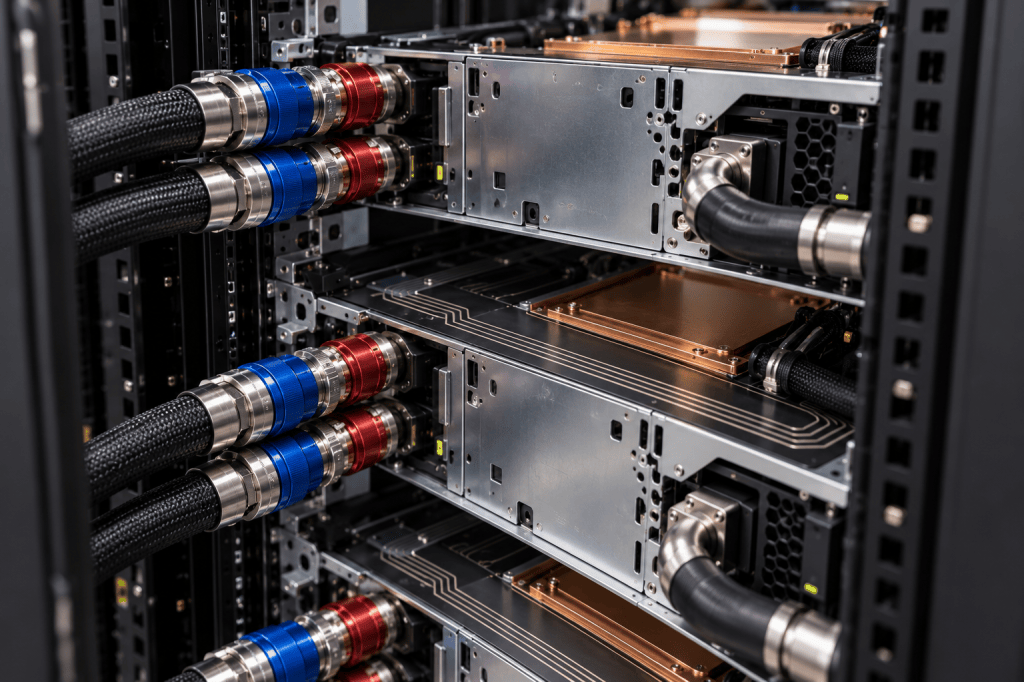 Figure 2: Flexible sensing technology can be integrated into high-density server environments to detect small coolant leaks near critical components and support early intervention.
Operational value of continuous coverage
- Surface coverage: A flexible film can trace floors, trays, pipe runs, rack zones, manifolds, and awkward geometries, narrowing gaps left by point devices.
- Earlier warning: Continuous coverage can reveal small coolant quantities before they become a damaging pool.
- Localization: Distributed sensing can indicate where along the protected surface liquid appears, helping crews respond faster.
- Adaptability: Flexible sensing can move around racks, bends, connectors, and mechanical piping as layouts change.
- High-density protection: AI racks hold substantial liquid-cooling hardware and valuable electronics; wider coverage watches more possible leak paths.
- Retrofit speed: Battery-operated, wireless, distributed sensing can be added when racks, loops, or infrastructure expand, or when vintage rooms switch from air to liquid cooling, without new hardware or utilities.
- Placement tolerance: Continuous coverage is less dependent on exact sensor placement than a single point detector.
- Control-system tie-in: Alarm and location data can be matched with coolant distribution unit (CDU) pressure and flow readings, aiding isolation and root-cause review.
Putting rack counts against field-derived leak rates
Process-safety QRA databases offer per-fitting leak frequencies compiled from decades of field experience. The IOGP RADD 434-01 and Norway’s PLOFAM materials publish rates such as 5.0E-6 to 1.3E-5 per joint-year for small leaks from flanged joints and 2.0E-4 for small-bore instrument connections. Applied to a GB200 rack with 252 individual couplings plus cold plates, manifolds, and hoses, the base case produces 0.38% per rack-year, with a range from 0.14% to 6.00%. A GB300 rack with more than 500 couplings produces about 0.76%, and couplings represent 80–85% of rack leak risk.
Standards, insurance, and machine learning converge
Leak detection is becoming part of design rather than an afterthought. Three distinct detection tiers appear in Nvidia GB200 and GB300 documentation, and OCP guidance extends from cold plates through CDUs. GB300 rack systems list 544 fluid couplings across 18 compute trays, underscoring how many origins a single rack can contain.
Insurance practice may accelerate controls. Allianz’s 2026 claims analysis places water damage at the top of reported data center claim causes, and underwriters are beginning to include liquid-cooling risk controls in new policies. Direct printed sensing and ML are likely to converge rather than compete. ML can change sampling rates or sensitivity when conditions warrant, but it sits several steps away from the physical appearance of a weep and cannot replace the first detection event.
San Diego-based Serinity represents the decentralized direction: its printed electronics sensing installations are intended to provide a more timely and complete view of liquid inside a protected area.
FAQ: What the shift means for AI infrastructure teams
- Why care about microliter leaks? They can evaporate or leave residue, slipping past point detectors for days. Late detection narrows isolation options and can turn a small seal issue into cluster downtime.
- Why are traditional cables not enough? They rely on fluid reaching a cable and conducting. That creates problems with DI coolants described in vendor documentation.
- What changes with wide-area sensing? It adds two-dimensional coverage, can react to tiny volumes within one second, and feeds alarms through wireless mesh nodes to BMS and DCIM systems.
- How does rack density raise exposure? GB200-based NVL72-class racks use 125 to 270 fluid connection pairs, GB300-based designs double that, and GB300 systems list 544 couplings across 18 compute trays.
- What should analysts watch? Three distinct detection tiers in Nvidia documents, OCP guidance across CDUs, Allianz’s 2026 water-damage claim data, and retrofit-friendly printed sensing from San Diego-based Serinity.
As AIdataNewsGlobal General sees it, the real test for liquid-cooled halls is not whether sensors exist, but whether they can find tiny events early, identify fluid types, follow irregular paths, and deliver useful location data into the systems that already manage facilities.