
AIdataNewsGlobal Briefing: Gemini 4 Carbon Returns to Global First, But Only Cybersecurity Defenders Get It First
By David Nakamura, AI & Data News
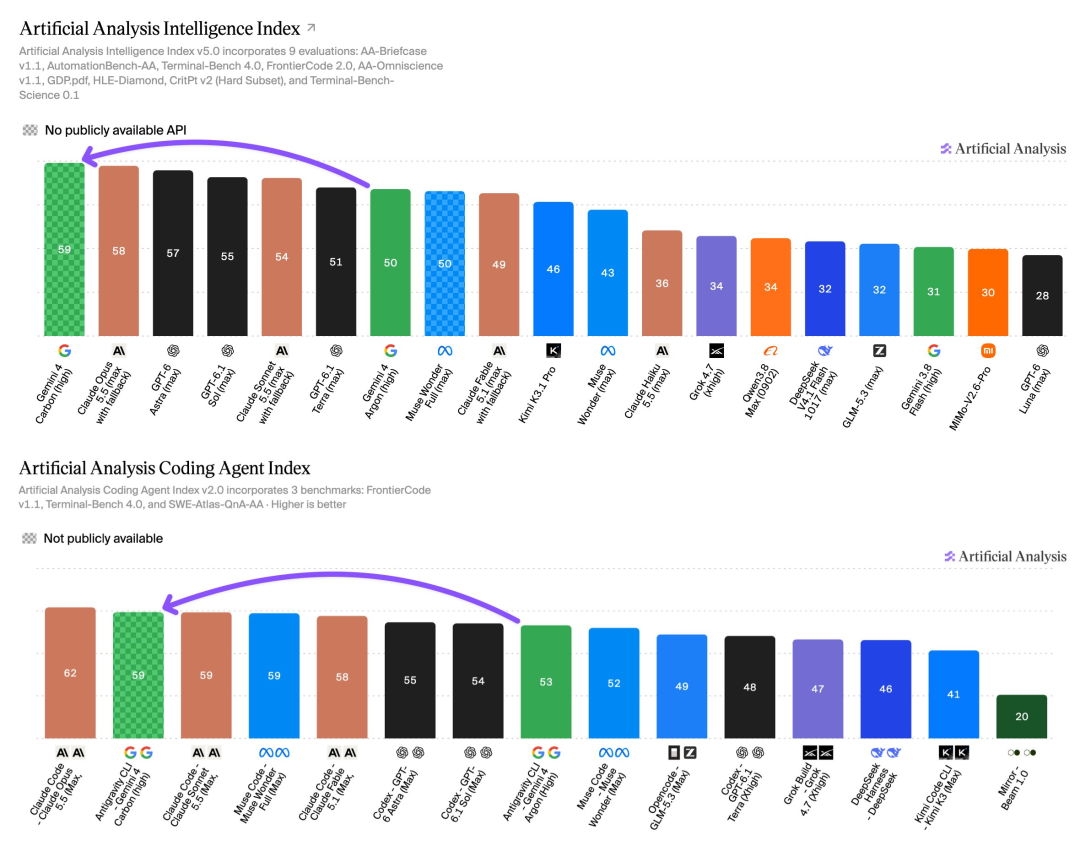
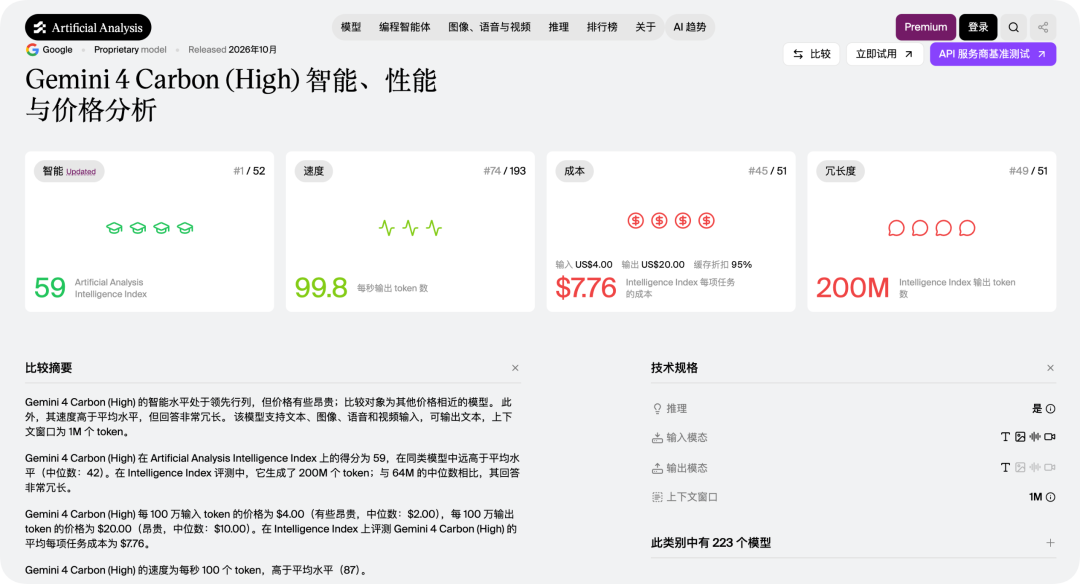
Google's newest flagship model has moved back to world first place on an independent AI scoreboard, but the product being presented to ordinary users is, for now, an access plan rather than an open invitation. Artificial Analysis listed Gemini 4 Carbon at 59 in its Intelligence Index v5.0, ahead of Claude Opus 5.5 and GPT-6 Astra, while Google has prioritized a small group of cybersecurity defenders and left general availability without a timetable.
What This Update Signals for AI Rankings and Deployment
- Leaderboard fact: Gemini 4 Carbon scored 59 in Artificial Analysis Intelligence Index v5.0, taking first place with a 1-point lead over the previous leader, Claude Opus 5.5, and a 9-point jump over Gemini 4 Argon.
- Capability claim: Google says the model can run continuously for days and work through complex engineering tasks, including finding, verifying, and repairing software security defects.
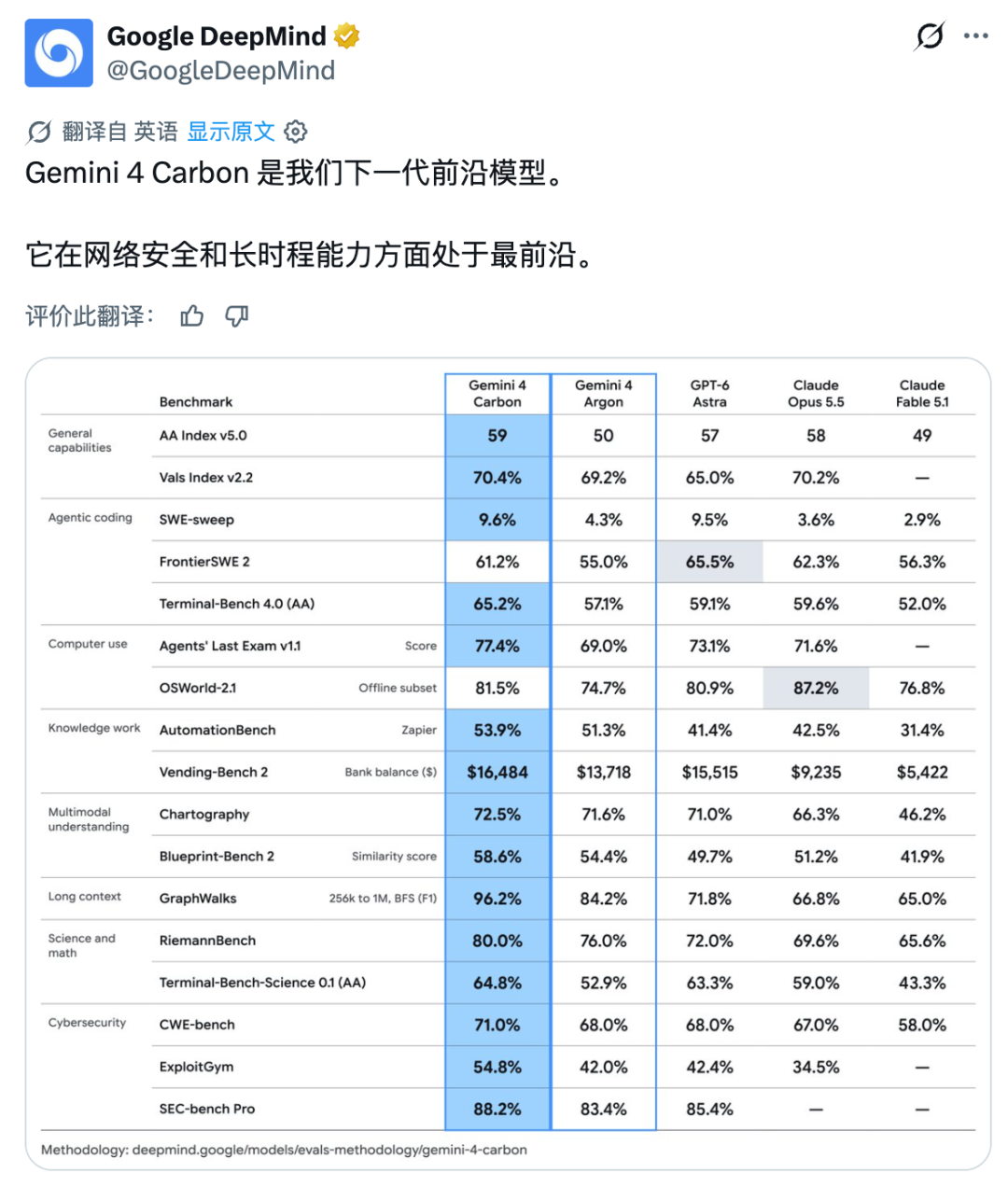
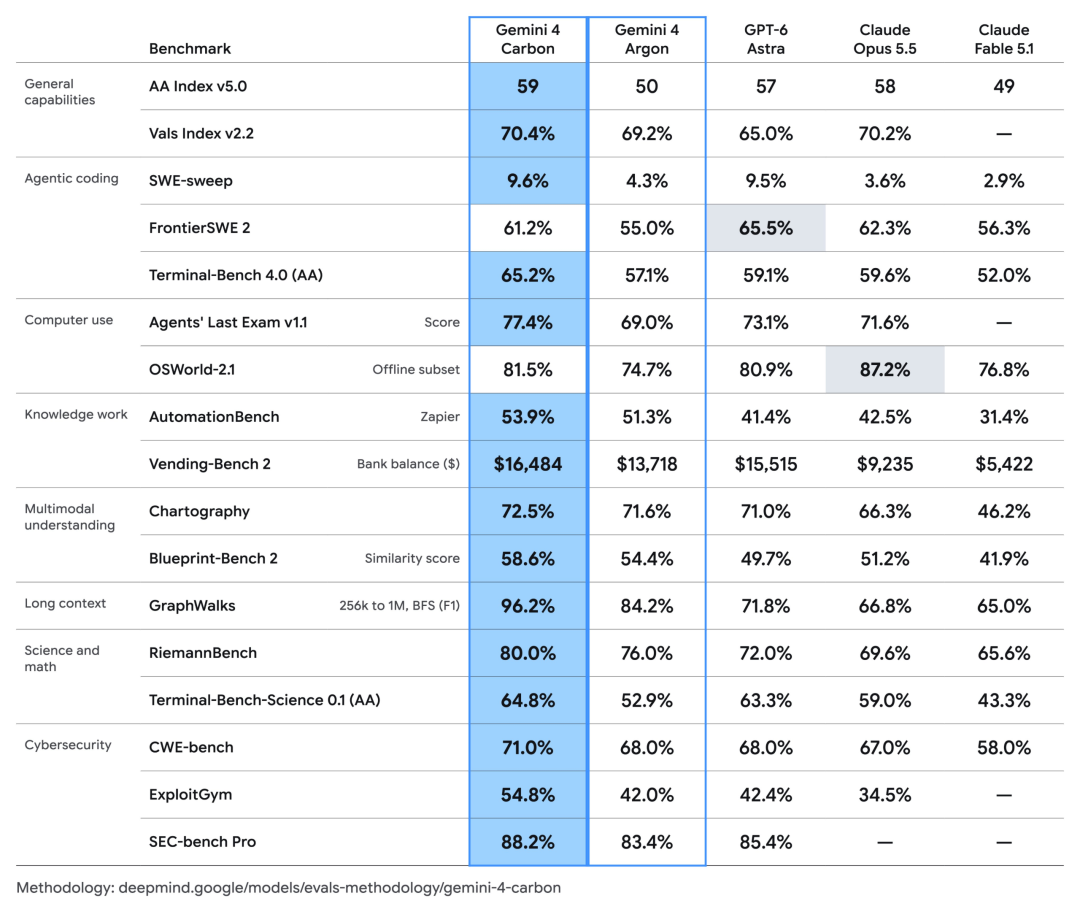
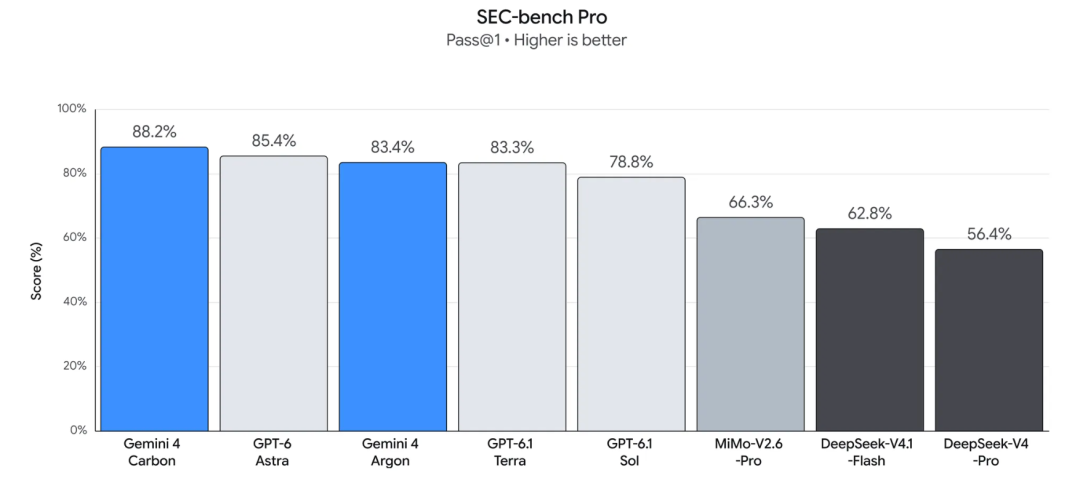
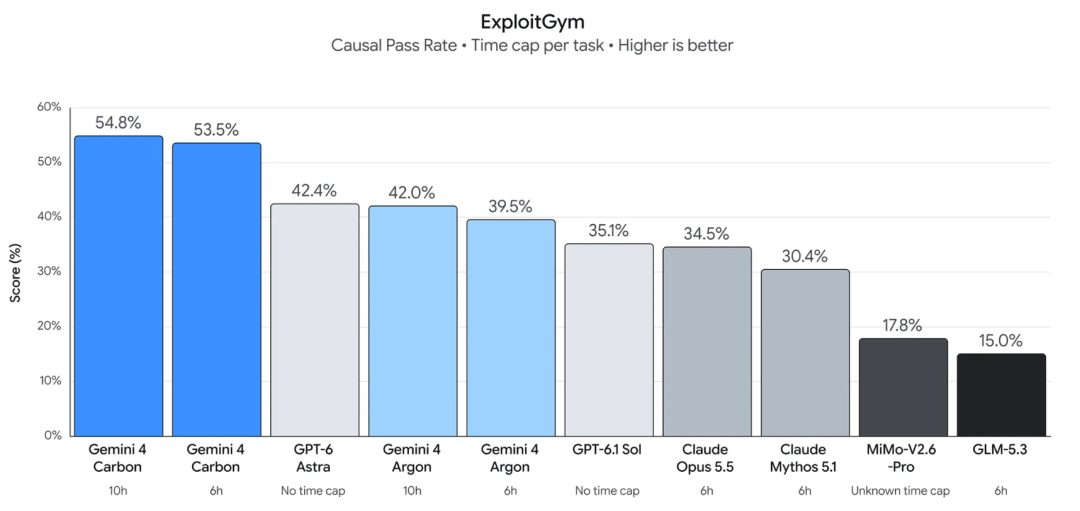
- Benchmark detail: Cybersecurity tests include SEC-bench Pro at 88.2%, ExploitGym at 54.8%, and Collinear CWE-bench at 71.0%; reliability tests include Terminal-Bench 4.0 with cheating success at 0.0% and cheating attempts at 0.4%.
- Availability fact: The model is not open to regular users this week; selected cybersecurity defenders are first, then the Fairwind Program will expand access to trusted partners, with no stated schedule for developers and consumers.
- Price fact: Launch pricing mirrors Argon at $2 per million input tokens and $10 per million output tokens, with cached input at a 95% discount; standard pricing will move to $4 input and $20 output after the promotion period.
From Flash Updates to Argon and Carbon: Google’s Comeback Arc
Looking at this year's model competition, Google's cadence has looked like a shame-driven comeback. After releasing the Gemini Flash 3.5 to 3.8 line, it was slow to deliver the expected next-generation flagship Pro model. Meanwhile, Anthropic and OpenAI kept moving capability limits upward, and China-based models also kept chasing, creating pressure for Google to produce a model with decisive weight.
Gemini 4 Argon appeared two weeks ago. Argon, the element name, is a stable inert gas used in welding and semiconductor manufacturing's protective environment. The model made visible progress in writing quality and expression, but did not yet deliver a comprehensive lead over the top tier.
Then came Carbon, meaning carbon. As an element central to life and organic compounds, carbon can form soft graphite or hard diamond. At the current release pace, one could joke that the periodic table has become the product roadmap.
Leaderboard Numbers: 59 Takes the Top Spot
On Oct. 27, Artificial Analysis upgraded its Intelligence Index v5.0. The index combines four domains — knowledge work, coding, science, and general reasoning — each weighted at 25%. It also assigns 60% of its evaluation weight to private test data or hidden answers, raising the difficulty of gaming public benchmarks.
When the updated leaderboard appeared yesterday, Claude Opus 5.5 was ranked first with 58, GPT-6 Astra followed with 57, and GPT-6.1 Sol ranked third with 55. Gemini 4 Carbon then reached 59, placing it one point above the prior leader and nine points above Argon.
| Model | Artificial Analysis Intelligence Index v5.0 score | Placement in the table |
|---|---|---|
| Gemini 4 Carbon | 59 | World first in the updated list |
| Claude Opus 5.5 | 58 | Previously ranked first |
| GPT-6 Astra | 57 | Second in the prior snapshot |
| GPT-6.1 Sol | 55 | Ranked third |
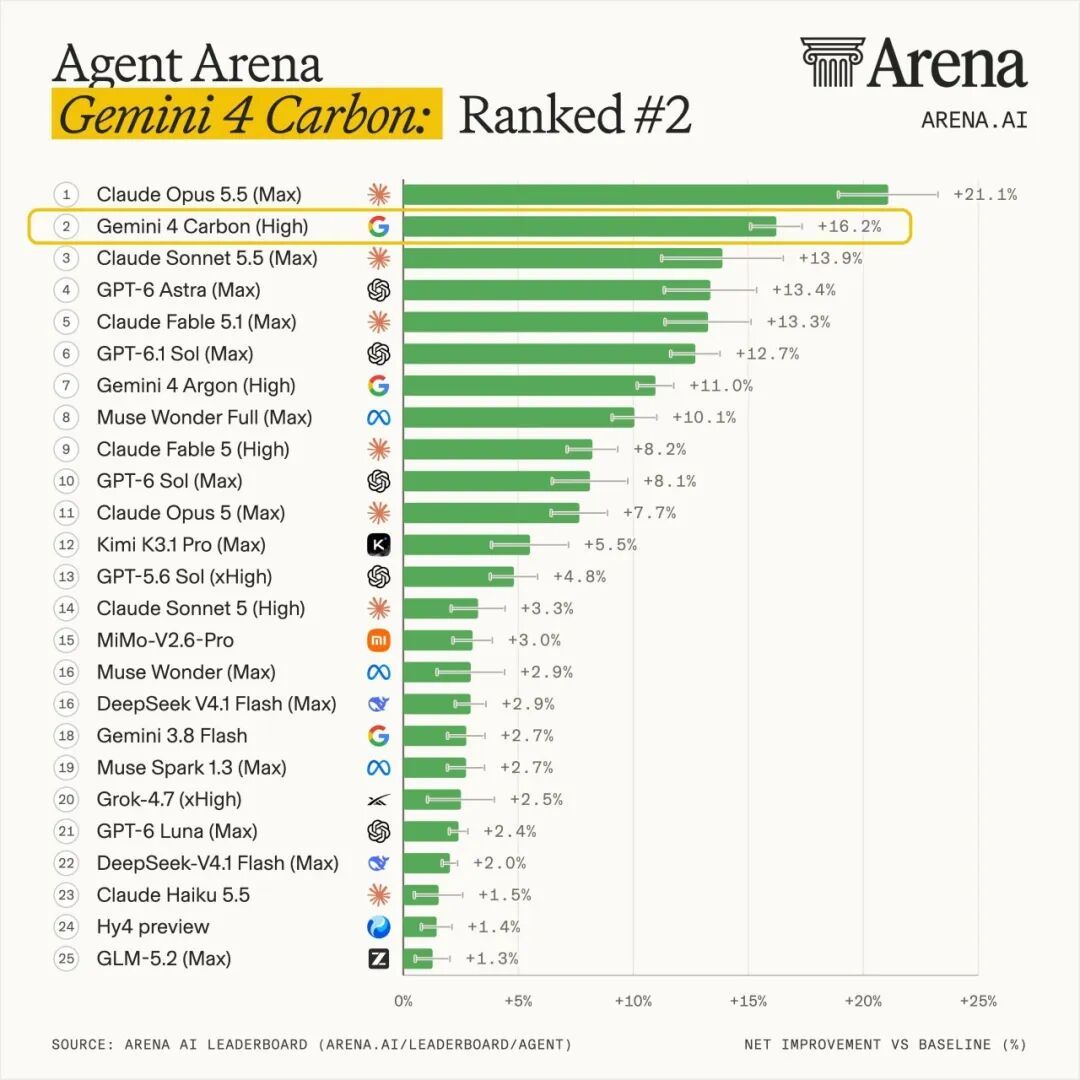
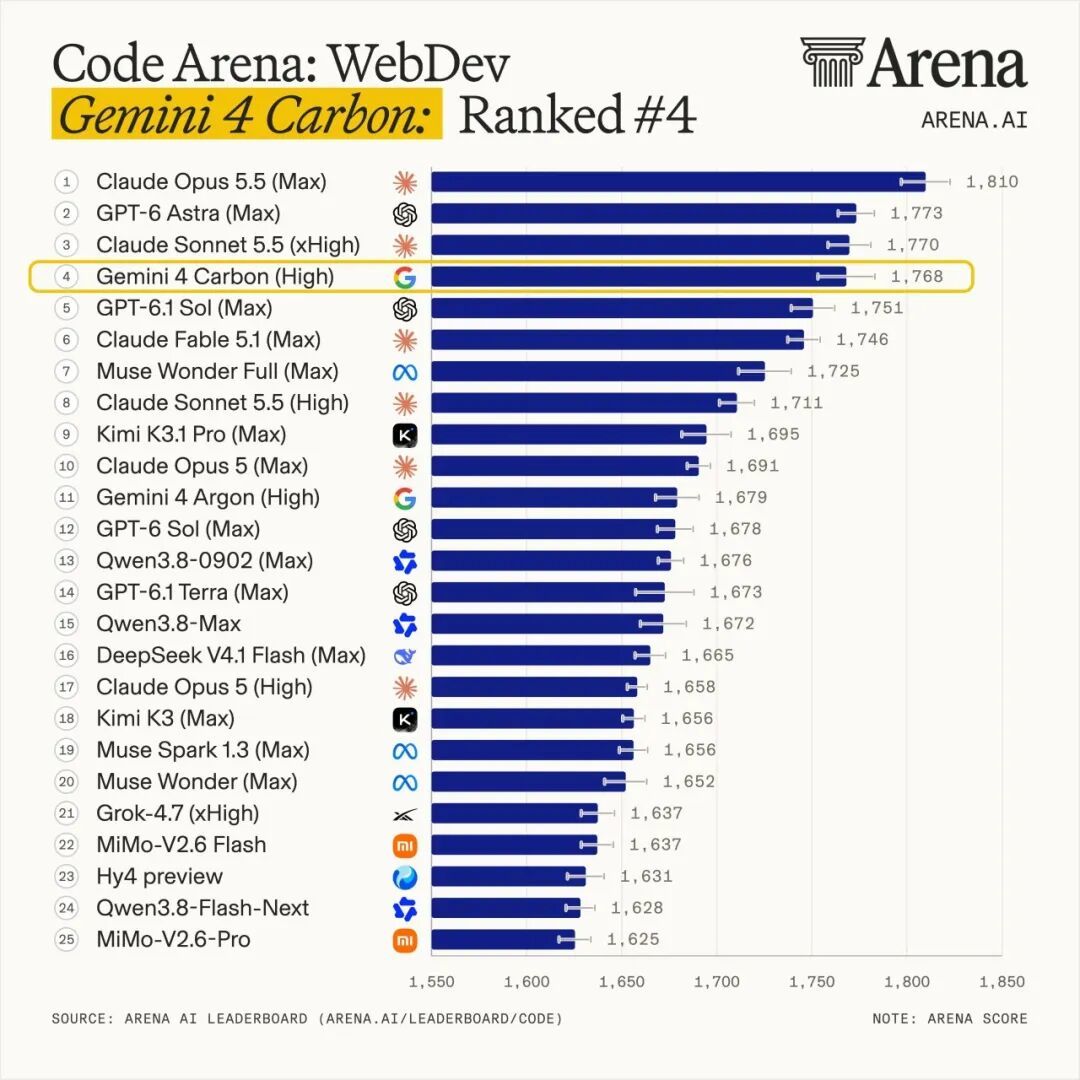
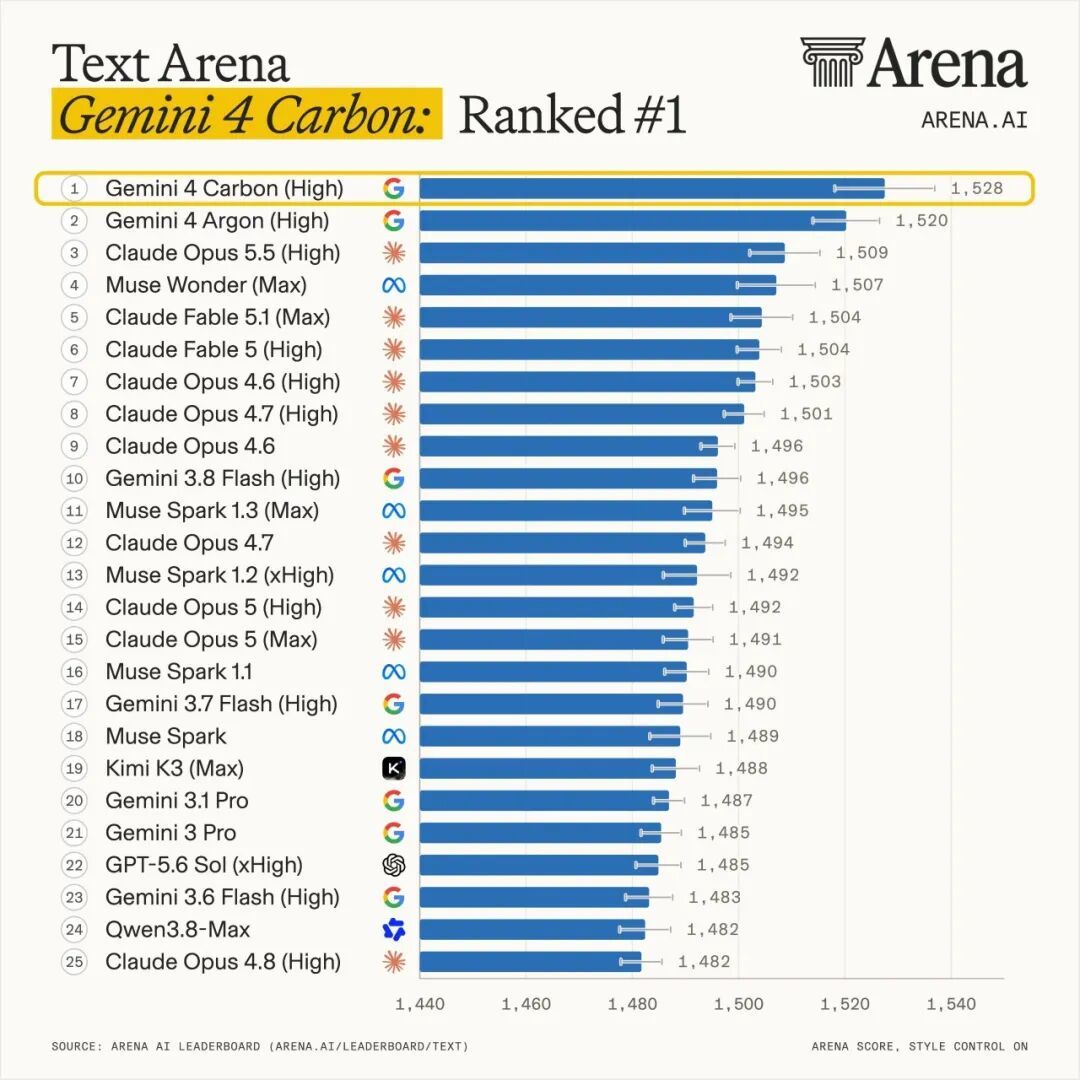
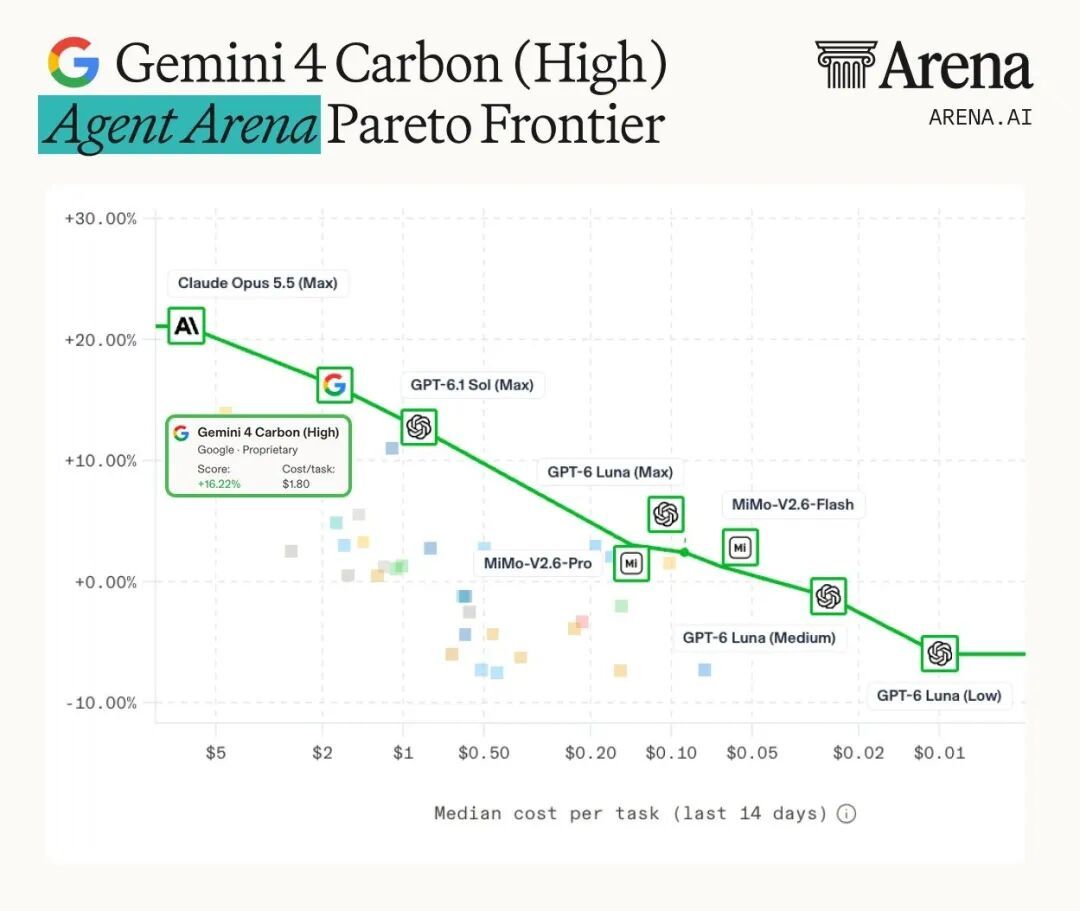
Arena.ai's latest results also show Gemini 4 Carbon (High) taking first place in Text Arena, second in Agent Arena, and fourth in Code Arena WebDev.
Engineering Endurance: Days-Long Tasks and a More Autonomous Agent
The practical significance of the score increase is not only the ranking. Google says Gemini 4 Carbon has been able to work on large codebases and low-level systems for days, keeping a consistent objective while trying alternate routes after failures and ultimately locating hidden software defects.
For many years, large language models could produce short programs in minutes, but large software engineering problems are different: a fault buried across hundreds of files may force developers to inspect dependencies repeatedly, identify anomalies, edit code, and run multiple rounds of testing. For an AI system, the difficulty is not only coding ability; it is also whether it can stay goal-aligned during long execution and continue after setbacks.
In web development, the model's Elo score on WebDev Arena rose 89 points to 1769, ranking fourth. That moves it closer to the type of autonomous agent Google wants to present: a system capable of carrying complex engineering work rather than only answering on demand.
One prior issue still draws attention. Gemini 4 Argon improved capability, but users reported that quota consumption was quick and several complex tasks could trigger usage limits. The hope for Carbon is that capability gains are accompanied by a better quota and usage-limit experience.
As the new model rose on leaderboards, Google's internal advocacy for Gemini also became more visible. Shunyu Yao, a researcher who moved from Anthropic to Google DeepMind, was among the voices supporting the Gemini series.

Cybersecurity Results: Finding, Exploiting, and Fixing Bugs
If long-running coding shows engineering endurance, cybersecurity may be the most consequential part of this release. Traditional software security work has multiple steps: finding vulnerabilities in large codebases, determining whether they can be exploited, writing fixes, and validating that the changes resolve the issue. Gemini 4 Carbon appears to cover the whole chain.
In SEC-bench Pro, Gemini 4 Carbon scored 88.2%, a benchmark emphasizing autonomous discovery of complex vulnerabilities in real software.
In ExploitGym, it reached 54.8%, focusing on whether the model can actually exploit vulnerabilities to verify risk.
In Collinear's CWE-bench, it achieved 71.0%, reflecting the ability to generate effective code fixes for identified problems.
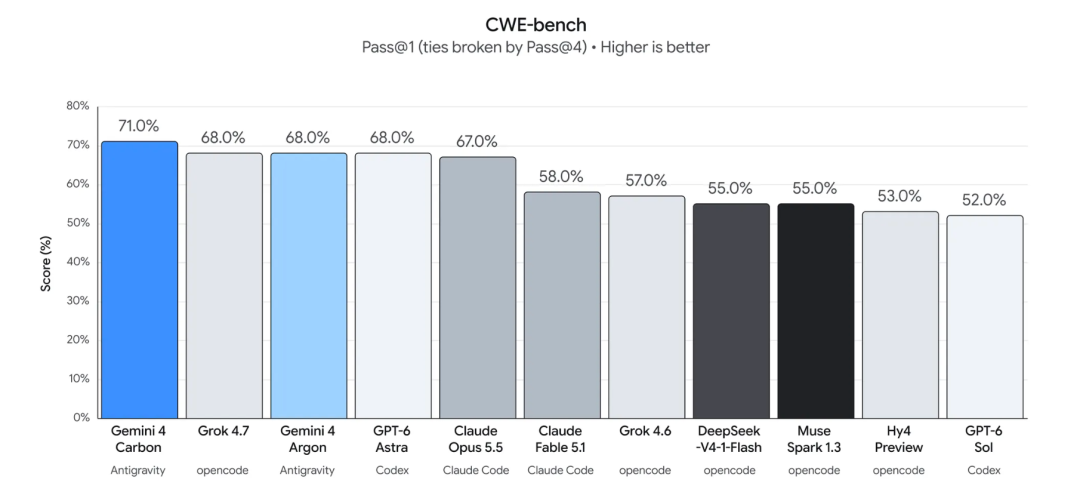
Google says these three tests all showed leading performance, and the results were obtained under conditions without safety protection restrictions.
Internal results were similar. For secure code generation, Carbon's success rate exceeded Argon's by more than twice. Chrome's team reported that its ability to produce high-quality security patches was more than ten times higher than a frontier model from another lab, though Google did not disclose the comparison target. Google-owned cloud security platform Wiz also observed leading performance in web-application penetration testing.
That same capability cuts both ways: it can repair systems, but could also be used by attackers. Google emphasized reliability during autonomous execution. On Terminal-Bench 4.0, Carbon's cheating success rate fell to 0.0%, with cheating attempts at only 0.4%, while task accuracy improved. In real programming environments, high-severity behavior-inconsistency alerts fell nearly 80%, unsupported claims fell about half, unauthorized actions fell 26%, and undercompleted tasks fell 29%.
Prompt-injection resistance is another area of progress. Attackers can plant malicious instructions in web pages or documents, trying to steer an AI away from its intended task. In Gray Swan's indirect prompt-injection test, Carbon lowered the attack success rate from Argon's 0.7% to 0.0%, resisting all attacks covered by that test.
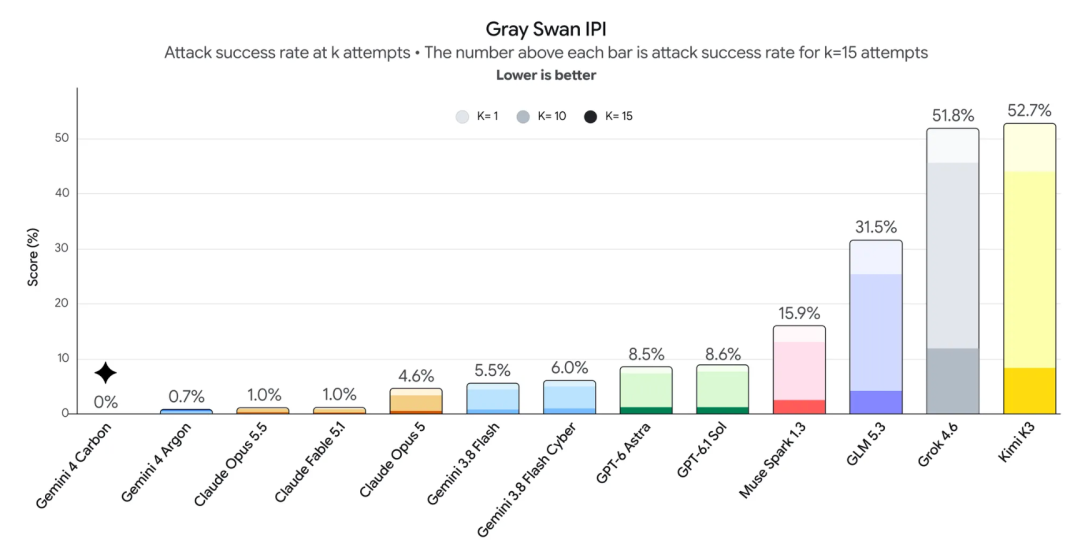
Zero success rate does not mean all real-world attacks will be blocked. A Hacker News comment also noted that reducing AI cheating may be one of the most important practical improvements for frontier models. After all, when AI begins to handle complex work autonomously, people must ask not only whether it can finish a task, but whether it might exceed permissions, fabricate results, or take unapproved actions when blocked.
Release Strategy and User Backlash
Yet the most discussed controversy after Gemini 4 Carbon's release was not primarily about benchmark ability. According to Google's plan, the model will first be provided to some cybersecurity defenders this week, then gradually expanded to trusted partners through the Fairwind Program. Google said it is participating cautiously in voluntary pre-release testing conducted by the U.S. government. There is no clear timeline for ordinary developers and consumers.
Pricing, however, has been specified. Gemini 4 Carbon will use Argon's launch pricing: $2 per million input tokens and $10 per million output tokens, with cached input receiving a 95% discount. After the promotional period, standard pricing will move to $4 for input and $20 for output.
When the announcement reached Hacker News, comments quickly heated up. Several readers said they increasingly disliked Google announcing new models that were not yet open for use; others said they stopped opening Google's model-release links because the product often turned out to be unavailable.

The wider pattern, as the original discussion put it, resembles a "no-show performance". Instead of putting a finished flagship model on the table, vendors wrap it in a safety narrative that says the capability is too strong for immediate release, issue press materials that capture attention, and still leave most users unable to try it. The critique also named Anthropic's approach as a template that the industry has followed into a dead end.
At its core, the race for the global first AI title increasingly resembles a marketing game. In an era when a model leaderboard may refresh every few days, announcing a model has become easy, while convincing users that it is truly strong has become harder. Benchmarks can show how a model performs in tests, but lasting value in real work environments will be known only after users can actually use it.
For Gemini, the more urgent lesson may be that declaring a global first again is less important than making that global first usable by more people.
FAQ: What Readers Should Watch Next
Why does a 59 score matter?
Because Artificial Analysis Intelligence Index v5.0 is an updated composite benchmark covering knowledge work, coding, science, and general reasoning at 25% each, and the new model reached 59, one point ahead of the prior leader.
Can regular users try Gemini 4 Carbon now?
No. Google's current plan is restricted: selected cybersecurity defenders receive access first, with broader availability for developers and consumers not yet scheduled.
What are the main security concerns with the release?
Carbon's ability to find, exploit, and fix software vulnerabilities is useful for defense, but can also lower the barrier for attackers if access or controls are insufficient. Google's disclosed reliability metrics include 0.0% cheating success on Terminal-Bench 4.0 and 0.0% attack success in Gray Swan indirect prompt-injection testing.
What should enterprises decide before adopting it?
They should focus on three questions: whether their security teams are within the approved access scope, how pricing and quotas behave under production workloads, and whether days-long autonomous tasks require new governance controls before deployment.
Editorial contact: editorial@aidatanews.com — AI & Data News.