
Case File: Four gen AI Marketing Deployments and What a Year of Adoption Data Says About the Hype Cycle
Generative AI in marketing does not occupy one position on the hype curve — it occupies several at once. Chatbots, copy generation and trends analysis are settling onto a plateau, while AI video and customer journey mapping moved backwards over the most recent 12-month measurement window. The evidence base is a SAS study released this week that compares 2024 and 2025 adoption across 10 marketing applications (n=300 in each year), read here alongside four named deployments so the curve positions become concrete rather than rhetorical.
For global AI and data-industry watchers, the value of that pairing is practical: survey data tells you where a category is heading, while an operational case tells you what it cost to get there and what broke on the way. This file does both, then extracts the reusable lessons.
Why can't "gen AI" be pinned to a single stage of the cycle?
Because it is not one technology. It is a bundle of use cases, each on its own trajectory, and treating the label as a single object is the main source of bad forecasting in this market.
Ask whether gen AI sits at the Peak of Inflated Expectations, the Trough of Disillusionment or the Slope of Enlightenment and the correct reply is "all of the above", simultaneously. Different applications and use cases sit at different points along the same roller-coaster track.
The second reason is generational. Most of what marketers deployed in 2024 and 2025 is still a "first generation" product. Our bar for a good AI-powered chatbot today is modest next to the bar we will be clearing in 2 years, in 5 years, in 10 years. A capable service bot now answers straightforward questions accurately; the next generation is expected to resolve tangled multi-step cases, act with more agency on a customer's behalf, and run cross-sell and upsell motions without a human opening the ticket.
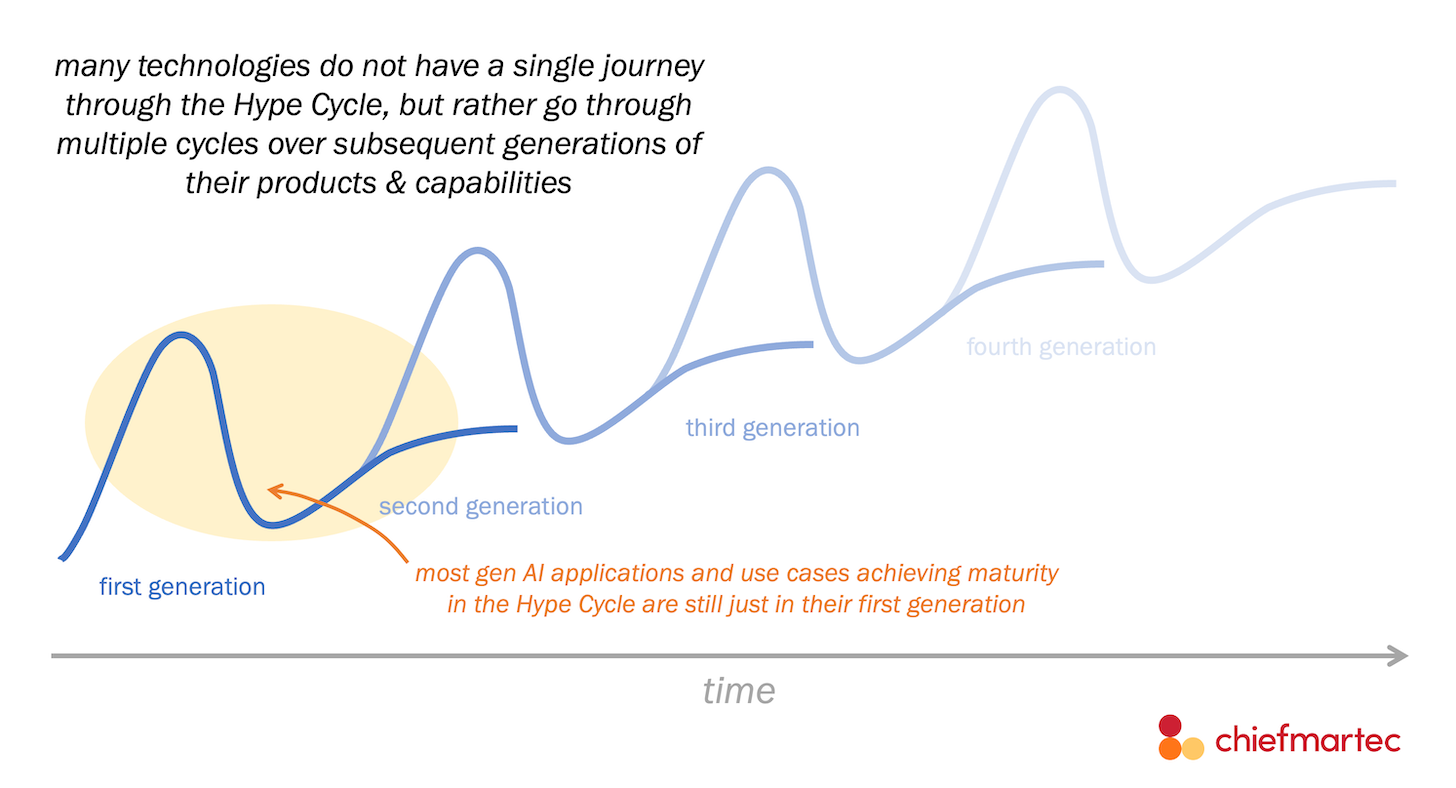
Each of those generations will run its own loop of inflated expectations, disillusionment and enlightenment. That is why a category can be on the Plateau of Productivity for what it does today while a brand-new, overhyped cycle opens for the capabilities announced this quarter. Holding two opposing stages in mind at once is, in F. Scott Fitzgerald's test of first-rate intelligence, the minimum competence required to read this market. More precisely: "a" plateau and "a" peak, one of many along a longer line.
How fast is the first wave actually moving?
Faster than any prior marketing technology wave, and the compression is measurable. A journey that once took a decade from trigger to plateau now takes a couple of years — before one generation flattens out, the next one is already off to the races. Practitioners feel that acceleration physically; the data simply confirms it.
The report SAS published this week, Marketers and AI: Navigating New Depths, supplies the empirical version. Its comparison of adoption against planning for 10 gen AI applications in marketing, 2024 versus 2025 (n=300 for both years), is the chart below.
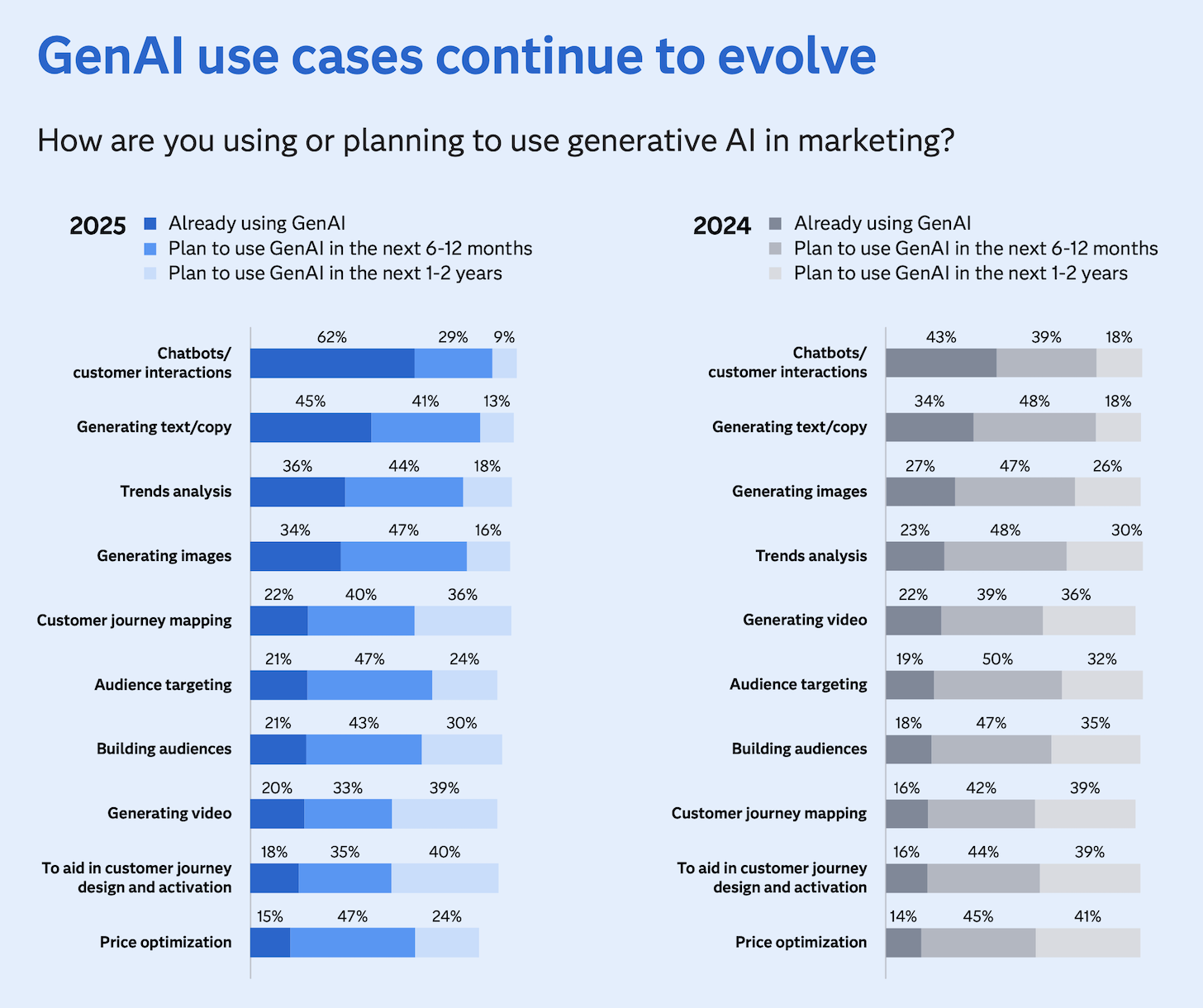
Three use cases accelerated hard over this past year:
- Trends analysis: +56.5%
- Chatbots/customer interactions: +44.2%
- Generating text/copy: +32.4%
The same three are also the most widely adopted, just in a different order:
- Chatbots/customer interactions: 62%
- Generating text/copy: 45%
- Trends analysis: 36%
Two applications reversed direction — a notable outcome given how much noise surrounded them a year ago:
| Use case | Change in adoption | Adoption now | Curve reading (first generation) |
|---|---|---|---|
| Generating video | -9.1% | — | Trough of Disillusionment |
| Customer journey mapping | -4.3% | — | Trough, pre-Slope |
| Chatbots/customer interactions | +44.2% | 62% | A plateau |
| Generating text/copy | +32.4% | 45% | A plateau |
| Trends analysis | +56.5% | 36% | Steepest climb toward a plateau |
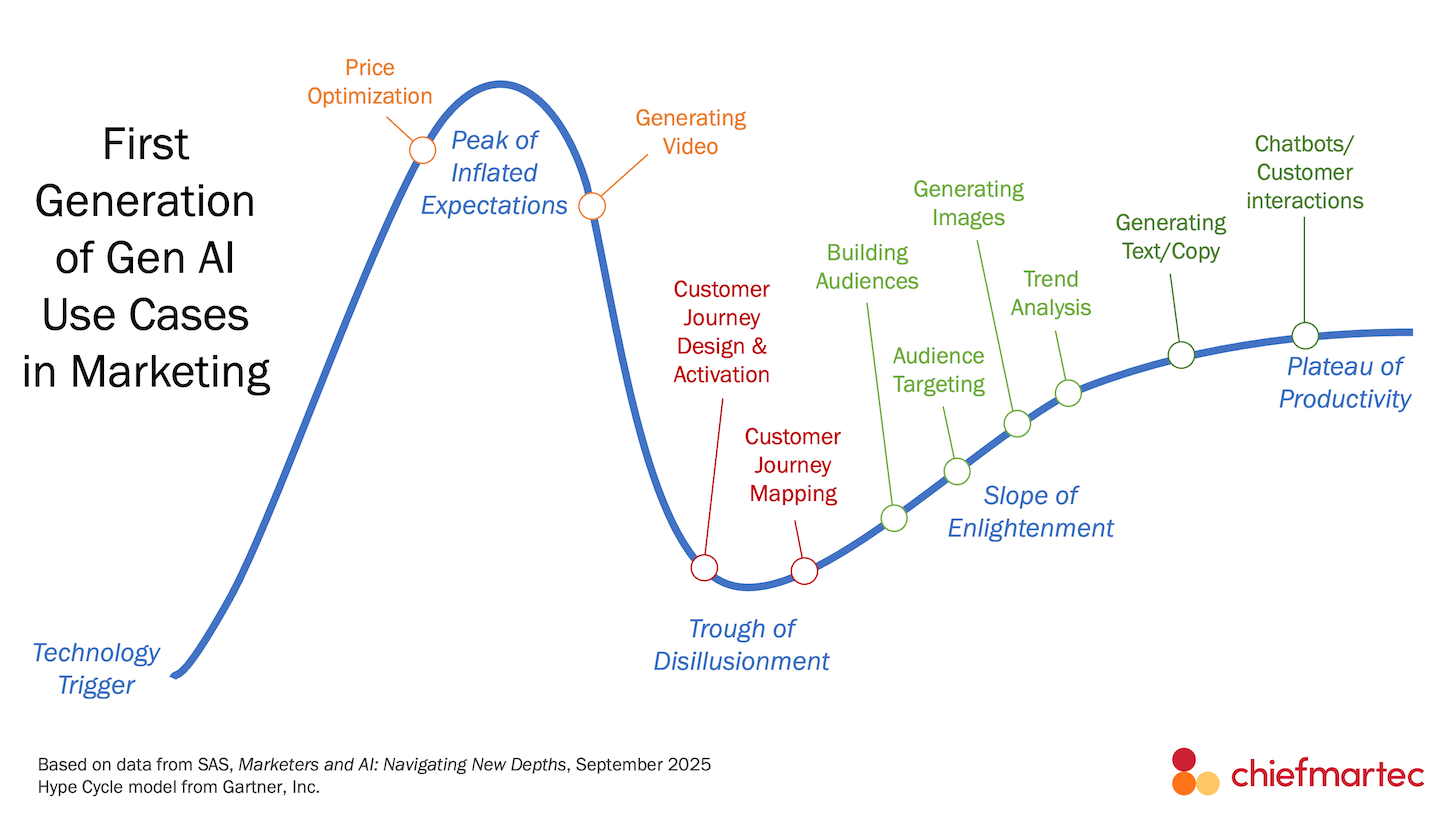
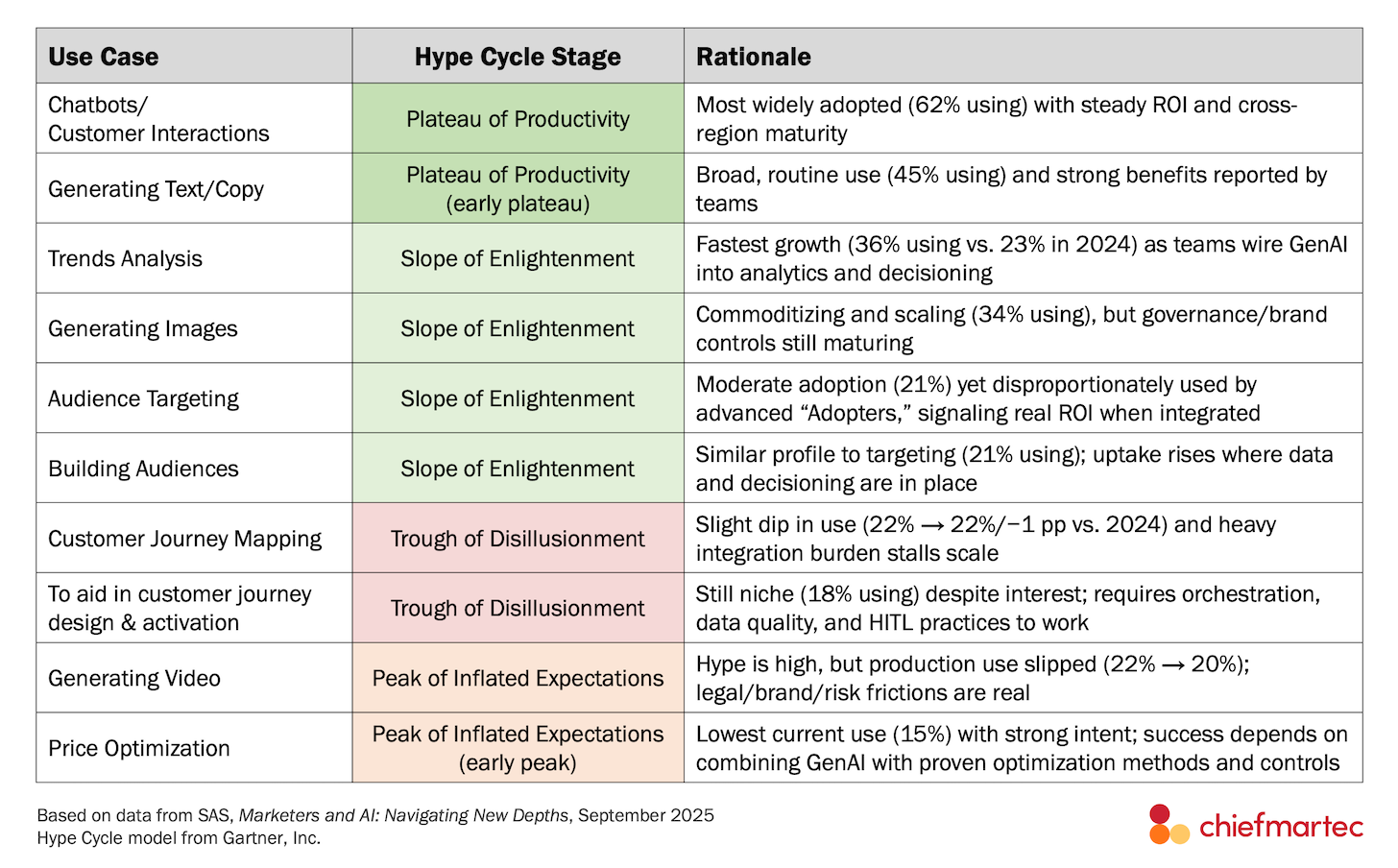
These numbers make it possible — with a little hand waving — to plot where each use case sits today. The most adopted land on a plateau; the ones losing ground after heavy fanfare sit in a trough.
Case 1: the service chatbot that reached the plateau, then re-hired humans
Conclusion first: the highest-adoption category in the dataset is also the one that most clearly demonstrates that a plateau is a placement, not an ending.
Process. In February 2024, Klarna said its OpenAI-powered assistant had handled 2.3 million conversations in a single month — roughly two-thirds of its customer-service chats — doing work the company equated to 700 full-time agents. The headline travelled worldwide as proof that service could be automated end to end.
Result. By May 2025, CEO Sebastian Siemiatkowski was telling Bloomberg the company had leaned too far on automation and was recruiting humans again so that customers could always reach a real person. Simple tickets still resolved fast and cheaply; the failures clustered in complex, escalated and emotionally loaded interactions where context was lost on handoff. This is the shape of the +44.2% / 62% cell in the SAS figures: mass adoption of first-generation chatbots, concentrated on the easy middle of the workload.
Reusable experience. Keep a documented escalation path with context attached, not just an escape hatch; measure containment plus satisfaction plus cost per resolution together; and re-read the number as "a" plateau. A 2025 case study in the MDPI journal Information, documenting an AI chatbot rolled out at a Slovak e-commerce micro-enterprise, reaches the same conclusion from the opposite end of the firm-size spectrum: the bot absorbed repetitive queries, while judgement calls stayed with people.
Case 2: trends analysis — the steepest slope in the dataset
Conclusion first: analytics is the use case most likely to convert adoption gains into durable budget, because the output is a decision rather than a deliverable.
Trends analysis posted the largest jump (+56.5%) from a lower base (36%), which is the classic signature of a category climbing out of the early-adopter zone rather than one peaking. The direction is corroborated by industry research: in October 2025 Gartner published a forecast that 90% of marketing analytics workflows would be GenAI-augmented by 2028, framed explicitly as hype-versus-real-impact guidance for CMOs. SAS's own release of the study put it in ROI terms, reporting that around 93% of CMOs surveyed see a strong return from generative AI and that eight in ten marketers report payback on their investment.
Reusable experience. Put the model inside an existing measurement loop — attribution, MMM, campaign reporting — instead of buying it as a standalone insight tool. Teams that attach gen AI to a reporting cadence that already exists adopt faster and argue for budget more credibly.
Case 3: video adoption fell 9.1% — cost was never the obstacle
Conclusion first: the -9.1% line is a trust and accountability problem, not a capability problem.
The economics are close to solved. A MIT Institute for Design Evaluation working paper on generative AI and personalized video ads, drawing on a field experiment with more than 21,000 consumers, estimated that 100,000 personalized video ads could be produced for about $220,000 with GenAI versus roughly $12M by conventional production — a cost reduction on the order of 90%. So price is not why buyers stepped back.
Two other forces are. First, discovery risk: a 2025 study published in MDPI's Journal of Theoretical and Applied Electronic Commerce Research found that disclosing AI-generated imagery in luxury advertising lowered perceived brand effort and authenticity, triggering negative consumer responses — a direct penalty on the exact use case video generation promises. Second, control: multi-shot brand consistency, rights, likeness and provenance remain unresolved at production scale, which converts a cheap tool into an expensive review workflow.
Reusable experience. Deploy AI video where the shot list is short and the creative is performance-driven, not where brand equity carries the sale; and decide the disclosure policy before the first render, not after a complaint.
Case 4: customer journey mapping slipped 4.3% because the plumbing wasn't ready
Conclusion first: this category did not fail on modelling; it stalled on identity resolution, consent and system access.
Journey mapping is the rare marketing application that requires clean, joined-up first-party data across CRM, service, advertising and commerce before any model can add value. Research from MMA and Monks covering 100 large marketing organizations maps exactly this gap: broad executive enthusiasm for agentic AI, narrow actual deployment, with data readiness, governance and measurement cited as the barriers to scale. That is the mechanism behind -4.3%: buyers piloted a presentation layer over unresolved foundations and pulled the budget back.
Reusable experience. Sequence the work — identity graph, permissions, retention rules, then orchestration. Anyone evaluating journey-intelligence tools should audit what a vendor can read without a custom integration before it can read what it should.
Who drew the curve, and how much weight should it carry?
To be explicit: Gartner did not make the map at the top of this article. The placement of each gen AI use case is an editorial estimate, built from the SAS dataset and from patterns repeatedly described across the martech community, and Gartner itself might be horrified by the use of its model in this form. Treat the graphic as a reading of the evidence, not as vendor research.
Checklist: five ways to use this map before committing budget
- Split your roadmap by use case, not by "AI". Score each one against the 2024/2025 adoption deltas rather than against last year's press cycle.
- Ask which generation you are buying. A first-generation tool priced like a mature one is the most common procurement error in this wave.
- Assume a new cycle opens for every capability upgrade. Chatbots can be on a plateau and at a peak at the same time.
- Instrument adoption plus outcome plus exception rate. Containment without satisfaction and escalation data hides the Klarna pattern until it is expensive.
- Gate creative automation on disclosure, provenance and rights review before scaling spend.
FAQ: what readers ask about the first wave
Is the hype cycle obsolete for gen AI?
No — but single-object charts are. The model survives when it is drawn per use case and per generation, which is what the adoption deltas above enable.
Why is chatbot adoption 62% if the technology is only first generation?
Because expectations for first-generation bots were reset downward after 2024's over-promising. 62% reflects a technology that does a bounded job reliably, not one that has conquered service operations.
Does falling adoption of AI video mean the technology is failing?
It means the buying decision moved from cost to accountability. Production economics keep improving; the trust and rights layer is what limits deployment today.
What comes after these 10 use cases?
The full SAS report goes further, including early signals on quantum computing in marketing — a reminder that the queue of disruptive technologies to absorb is not emptying.
Reference sources
- SAS, Marketers and AI: Navigating New Depths (report PDF): https://www.sas.com/content/dam/sasdam/documents/20250124/marketers-and-ai-navigating-new-depths.pdf
- SAS press release on CMO ROI findings: https://www.sas.com/en_be/news/press-releases/2025/september/new-study--genai-hype-is-over-as-93--of-cmos-see-strong-roi-.html
- Gartner, Generative AI in Marketing Analytics: Hype vs. Real Impact: https://www.gartner.com/en/documents/7127030
- Bloomberg, Klarna turns from AI to real-person customer service: https://www.bloomberg.com/news/articles/2025-05-08/klarna-turns-from-ai-to-real-person-customer-service
- OpenAI case profile of Klarna's assistant: https://openai.com/index/klarna/
- MIT Institute for Design Evaluation, personalized generative AI video ads working paper: https://ide.mit.edu/wp-content/uploads/2025/07/RB-DRAFT__7-8-25.pdf
- MDPI, Implementing AI Chatbots in Customer Service Optimization (micro-enterprise case): https://www.mdpi.com/2078-2489/16/12/1078
- MDPI, impact of generative-AI imagery on consumer attitudes in advertising: https://www.mdpi.com/2076-3387/15/10/395
- MMA and Monks, State of Generative AI in Marketing: https://mmaglobal.com/documents/state-generative-ai-marketing
Compiled by the AI & Data News desk (David Nakamura). Corrections and confidential tips: editorial@aidatanews.com — part of the AIdataNewsGlobal General desk covering global AI and data industry developments.