
Genie 4 World Model: Google Turns AI Scenes Into Editable Interactive Spaces
Google's October 27 announcement of Genie 4 signals a shift from generative systems that create finished media toward systems that create a place to act inside. Instead of treating an AI prompt as a request for one image or one video clip, the company describes a model that can produce an interactive virtual environment, keep that environment consistent enough to remain coherent, and allow users to revise it while they are exploring it. The pitch is not simply faster visual generation; it is a scene that can respond, change, and be explored for a limited but expanding amount of time.
That difference matters for readers tracking model development, enterprise adoption, and product workflows. A model that can maintain a simulated space, respond to language during use, and add sound may become a prototyping tool, a training surface, or a testing environment before it becomes a production pipeline. The practical question is whether Genie 4 with about two minutes of interactive duration is enough to support usable experiments across games, film visualization, and robotics.
Key facts at a glance
The announcement is easiest to read as a checklist of four upgrades and one availability sequence:
- Genie 4 is presented as a world model, not a conventional image or video generator.
- The release introduces four upgrades: more realistic virtual environments, natural-language scene changes in real time, automatic audio for generated worlds, and a simulation process assisted by GoogleGemini 3.8 Flash.
- The same supporting layer is described as Gemini 3.8 Flash, so the architecture is framed as a model stack rather than a single generation module.
- The interactive duration moves from about one minute in the Genie 3 description to about two minutes, doubling the session length.
- Use cases named in the article include game development, film production, and robot training scenarios.
- Availability is staged: a research preview for selected testers, a future plan for Google AI Ultra users, and an application waitlist connected with Project Genie.
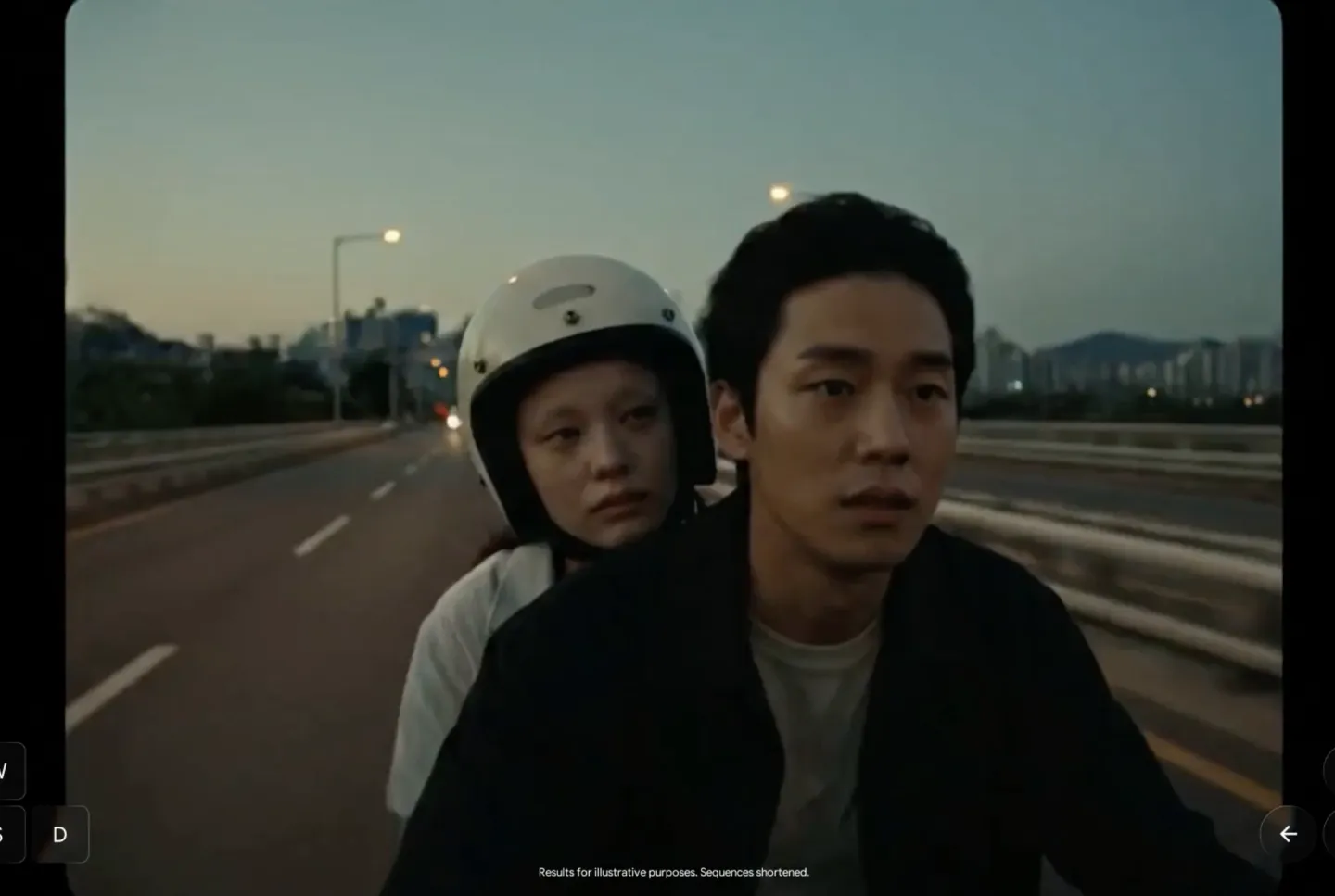
A world model is not just a better picture generator
Traditional generative AI usually maps a prompt to a finished artifact: an image, a short video, or another media file. A world model aims at something closer to a stateful environment. The system must represent spatial relationships, object behavior, and the consequences of user actions. If a user moves through a scene, turns, opens an object, or changes viewpoint, the model has to continue generating from the new state instead of replaying a fixed clip.
This distinction explains why Genie 4 is positioned as a step beyond static media generation. The value of the model is not only visual quality but also persistence. An environment that looks realistic for a few seconds is not enough if objects disappear when the user leaves view, or if a scene changes position after a simple interaction. For simulation-oriented work, consistency over time becomes part of the product requirement.
Real-time editing changes the creative workflow
One of the most consequential upgrades is interactive revision. Rather than exiting a generated world, rewriting a prompt, and generating a new version from scratch, a user can ask the model to alter elements of the current scene. That changes the workflow from batch creation to live iteration.
For game teams, the immediate application is prototyping. Developers can test spatial layouts, visual tone, movement paths, and interaction rules at lower cost. The article does not suggest that Genie 4 replaces game engines or production art pipelines; it suggests it can help teams explore directions before committing larger resources.
For film production, similar logic applies to previsualization. A production team can sketch virtual environments, rehearse camera motion, and examine how characters or objects might move through a scene without first building every physical set or finishing high-resolution 3D assets. The benefit would be speed and iteration, not necessarily final production quality.
Audio adds atmosphere, but not a finished sound pipeline
Genie 4's automatic audio capability completes the sensory layer of a generated environment. Sound can help an experience feel more spatial: it can imply atmosphere, give feedback to movement, and make prototypes more convincing. This is an improvement over models that focus only on visual output.
Still, the article is careful about the boundary. Generated audio is not the same as professional sound design. Projects that require exact rhythm, precise spatial localization, dialogue control, and tight synchronization between sound and action still need human editing and specialized tools. The practical interpretation is that Genie 4 may help create temporary sound beds or early atmosphere, while final audio production remains a separate workflow.
Robotics is the area where consistency matters most
The robotics use case is where the distinction between a visually impressive demo and a useful simulation environment becomes sharpest. The article says Google positions Genie 4 as a way to create training scenarios for robots. The underlying logic is straightforward: testing robots in the real world costs equipment, space, and safety margin. A simulated environment can let researchers test movement, grasping, and responses to changing conditions at lower friction.
For that promise to be meaningful, the simulation must approximate physical relationships, not merely appearance. Object permanence, spatial memory, motion rules, and consequence prediction matter. A robot policy learned in a virtual environment is only transferable if the environment respects enough real-world constraints. This is also why longer sessions are harder: every additional second increases the chance that details drift, objects reset, or state becomes inconsistent.
Duration, architecture, and open questions
The headline metrics are simple: about one minute is replaced by about two minutes; four upgrades are listed; Gemini 3.8 Flash supports simulation. Those facts describe the direction of the release, but they do not fully quantify capability. The article notes that detailed technical indicators are not disclosed, so it is difficult to measure how much Genie 4 improves over Genie 3 beyond session length and added features.
Availability also remains constrained. The current stage is a research preview for selected testers, with a future route to Google AI Ultra subscribers and a waitlist through Project Genie. Until broader users can test long sessions, complex edits, and stability outside official demonstrations, the most responsible assessment is that Genie 4 is a high-value experiment rather than a finished industry platform.
Data reference table
| Item | Reported detail | Editorial implication |
|---|---|---|
| Release date | October 27 | Establishes the announcement as a world-model update rather than a general media-generation product launch. |
| Upgrade count | four upgrades | The update spans realism, interaction, audio, and simulation support. |
| Core capability | real-time natural-language scene changes | Creativity becomes iterative while inside the generated environment. |
| Session length | about two minutes for Genie 4; Genie 3 described as about one minute; session length doubles | Longer exploration improves prototyping but keeps the model limited for full applications. |
| Support model | GoogleGemini 3.8 Flash / Gemini 3.8 Flash | The simulation layer appears more distributed than a single monolithic generator. |
| Access | research preview for selected testers; Google AI Ultra planned; Project Genie waitlist | Evaluation should wait for independent access rather than rely only on official demonstrations. |
FAQ: What readers should ask next
- What is Genie 4? It is Google's newly announced world model for interactive virtual environments, presented on October 27.
- How does it differ from ordinary image or video generation? Ordinary systems usually output a fixed asset. Genie 4 is designed to create a stateful scene that can respond to user actions and remain explorable.
- What are the four upgrades? More realistic generated environments, natural-language real-time scene editing, automatic audio generation, and simulation assistance using Gemini 3.8 Flash.
- How long can a session last? The article describes about two minutes for Genie 4, compared with about one minute for Genie 3, meaning the available interactive time is double the earlier duration.
- Will Genie 4 replace game engines or film studios? No such claim is supported. The model is better read as a prototyping and experimentation tool, while production-quality control, long sessions, physics fidelity, and cost remain open issues.
- Who can access it now? Selected testers through a research preview. Google has also described a future path toward Google AI Ultra users and an application waitlist tied to Project Genie.
What to watch next
The most useful signal will not be a polished one-shot demo. It will be whether independent testers can sustain long sessions, revise environments without breaking object permanence, and use generated audio and simulated spaces as practical inputs rather than decorative features. If those conditions hold, Genie 4 could become a benchmark for AI systems that move beyond content creation into interactive environment generation. If they do not, the about two minute window may still mark it as a promising preview rather than a production-ready tool.
For now, the story is less about a finished product and more about a direction: a world model that lets people step inside generated spaces, edit them with language, and keep them alive for long enough to test ideas. Google's staged access through research preview, Google AI Ultra plans, and Project Genie waitlist means the next round of evidence will come when that environment is handed to users beyond official control.