
When School Search Becomes an Opt-In: Decoding Google’s K-12 AI Policy Shift
Google’s new K-12 rule ties student search access to AI settings: if schools disable all Google AI tools, they may also lose Google Search, while Gemini, Gemini Notebook and search become school-managed defaults. This turns a feature toggle into a data-governance decision, forcing United States schools to weigh classroom control, vendor dependence and search access.
What changed for Google student accounts?
The policy was announced on Tuesday, Nov. 3, 2026, and is described as taking effect for K-12 student accounts early next year, according to AP News. Under the framework, school administrators can individually enable or disable Gemini, Gemini Notebook and Google Search, with each starting in an off position. The catch is that Google still treats core search and AI capabilities as bundled products: if a school chooses to keep all AI experiences disabled, students may be blocked from Google Search and see a message from the school that access is not available.
Google’s explanation is that search and artificial intelligence are now deeply integrated, so it cannot provide a school version of search that is completely stripped of AI features. For districts, that means the new default-off model does more than move a switch; it creates a dependency map. A school may want Gemini for lesson planning, Gemini Notebook for source organization, and plain search for library research, but the product architecture asks whether those choices can be separated without changing the platform itself.
Why the policy looks like a trade-off rather than a simple control panel
The controversy is not only about whether students should use artificial intelligence in class. It is also about the design of school accounts: administrators get more formal control, yet they may have to choose between AI-enabled services and basic search access. Teachers and school leaders who oppose forced AI say students still need classic web search to locate primary sources, compare claims and learn how to navigate result pages. Critics also warn that AI summaries can weaken independent research habits if learners copy an answer instead of evaluating evidence.
Two features show why Google’s positioning is contested:
- Guided Learning: Google’s student-facing mode, described in reporting as a way to prompt reasoning and support rather than hand over complete answers.
- Default-off tools: Gemini, Gemini Notebook and search are presented as individually controllable, but the practical question remains whether search can be turned on while all AI layers are turned off.
That distinction matters because schools often make decisions by grade level, subject and device type. A middle school may allow Gemini Notebook for teacher preparation while blocking student chat; a high school may want search-only accounts for exam practice. The policy invites districts to ask their students, parents and legal teams what they mean by “opt out of AI”: opt out of chat, opt out of summaries, opt out of agents, or opt out of the entire generative layer.
DuckDuckGo’s pitch: make AI a switch, not a gate
DuckDuckGo has moved quickly to court schools upset by Google’s bundled design. Founder and chief executive Gabriel Weinberg published social media guidance telling educators how to set DuckDuckGo as the default search engine and offering help with migration. Kamal Bazbaz, the company’s chief public affairs officer, framed the debate in starker terms: forcing AI onto students is a manifestation of market power, and schools should have the ability to demonstrate that a non-AI option still exists.
DuckDuckGo’s broader argument is that Google could build an education search version without AI tools if it chose to do so. The company also notes that students need links, source pages and citation trails for research work; they do not necessarily need generated summaries, chat assistants or synthetic images. That framing helps the company present itself not as anti-AI, but as a provider of selectable interfaces.
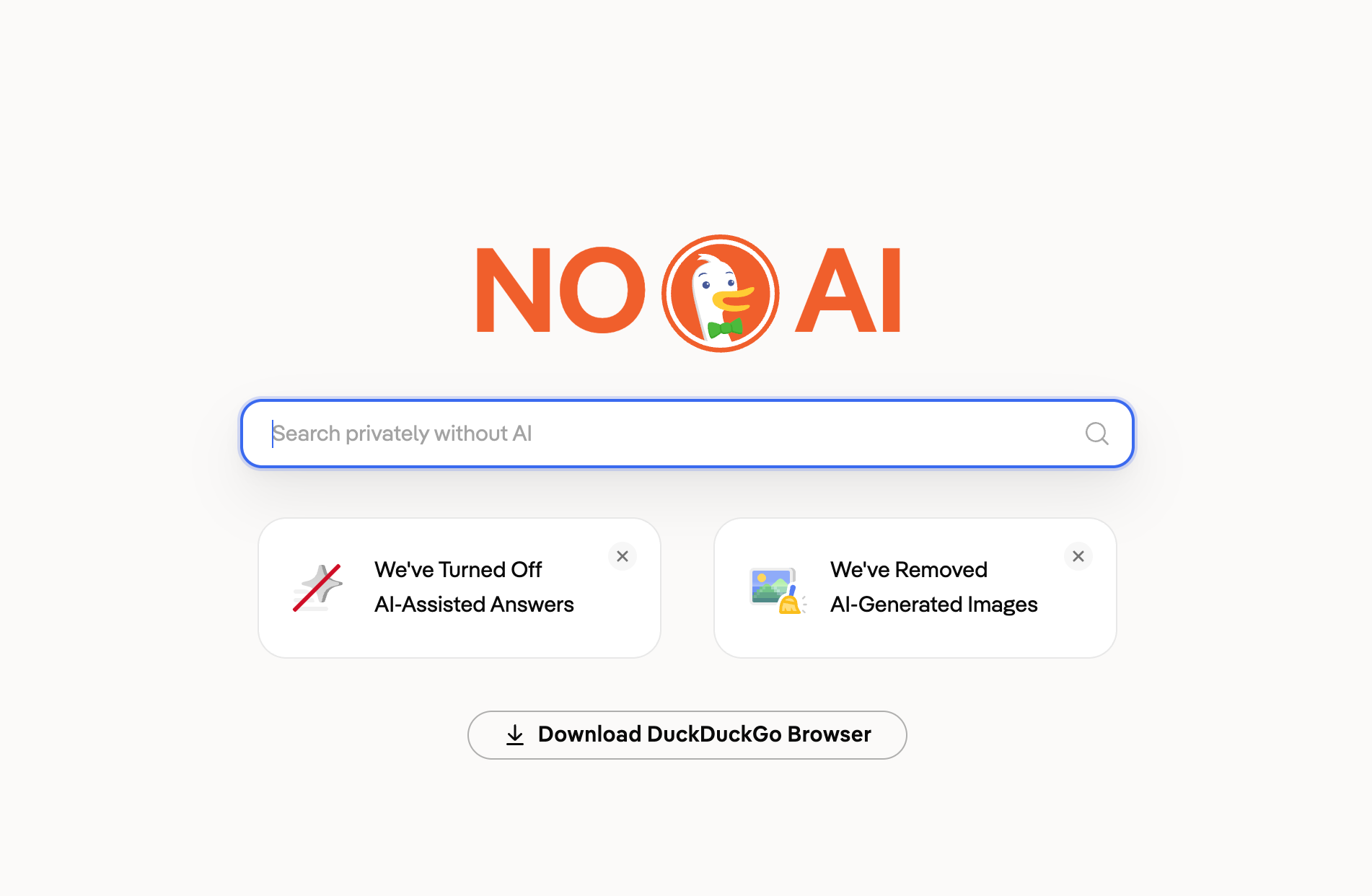
The company has a concrete mechanism to support that claim. Its dedicated page at noai.duckduckgo.com turns off AI features and filters out AI-generated images, according to DuckDuckGo help documentation. The company’s earlier response to user backlash was measurable too: after Google’s I/O 2026 search redesign moved more results toward AI agents, TechCrunch reported a 30% spike in DuckDuckGo app installs, evidence that a portion of users value an AI-free path even in a mature search market.
How Google’s K-12 plan and DuckDuckGo’s school pitch differ
| Issue for schools | Google’s current approach | DuckDuckGo’s offer |
|---|---|---|
| AI access model | Schools enable or disable Gemini, Gemini Notebook and search by default-off settings, but search may remain tied to AI experiences. | Users can choose noai.duckduckgo.com or toggle AI features while retaining search. |
| Learning tools | Google highlights Guided Learning as a way to guide students instead of giving answers. | DuckDuckGo emphasizes traditional search results and fewer generated interruptions. |
| Migration burden | Google remains embedded in Classroom, Chromebook and Workspace workflows. | DuckDuckGo positions itself as a default search engine, not a full workspace replacement. |
| Demand signal | Critics say schools need choice without surrendering basic search access. | DuckDuckGo cites a 30% install spike in a prior AI-search controversy. |
What schools should check before accepting either side
For district technology teams, the issue is now a governance project, not a helpdesk ticket. A useful review would cover four steps.
- Map dependencies. Count how much homework, library research, exam security, classroom search and teacher planning depend on Google Search, Chromebooks and Workspace accounts.
- Define “no AI.” Separate Gemini chat, Gemini Notebook, search summaries, AI-generated images and agents so procurement does not collapse into one vague category.
- Test a fallback. If the district wants non-AI search, test DuckDuckGo or another provider for reliability, adult content filtering, privacy rules and accessibility before changing defaults.
- Document the rationale. Board decisions should record why AI access is enabled for a grade, why search remains available and how incidents are reviewed.
Frequently asked questions
Do United States schools have to enable AI for students?
No. Under the announced policy, school administrators are expected to opt in. Gemini, Gemini Notebook and search are described as starting with default-off controls. The sharper question is whether a school can enable search while rejecting the bundled AI experiences.
Can a school keep Google Search but remove all AI features?
That is the core dispute. Google says search and AI are deeply integrated and cannot be completely separated for schools; critics and DuckDuckGo argue that a non-AI Google search version could be delivered if Google chose to build it.
Is DuckDuckGo fully free of AI?
DuckDuckGo offers a no-AI route through noai.duckduckgo.com, but the company also sells optional AI services. For schools, the practical distinction is that AI is not required to keep search access.
Why does this matter beyond classrooms?
Search defaults shape information literacy. If students only see synthesized answers, they may lose practice evaluating links, comparing sources and recognizing uncertainty. That effect reaches workplaces, public debate and AI adoption itself.
The bigger trend: platform defaults are becoming education policy
The lasting impact is that a platform’s architecture is doing policy work. School boards will still write acceptable-use rules, but the menu of choices is set by account-level toggles, integration assumptions and migration costs. A provider that makes AI part of search changes the default environment; a provider that makes AI optional shifts bargaining power to educators. For districts, the best response is to treat AI policy as procurement, data governance and pedagogy at once. For vendors, the reputational question is whether school trust is preserved by adding choice or by adding complexity. The next phase of the dispute will likely be measured less in headlines than in how smoothly a student can search, cite and learn when the generative layer is turned off.
Reference sources
- AP News: Google will cut off search access for students at schools that restrict AI - https://apnews.com/article/ai-schools-classroom-students-google-7ba4219e505db1c11d672f6eefe7155a
- TechCrunch: Google will let schools disable its AI tools, but not without sacrificing search - https://techcrunch.com/2026/11/03/google-will-let-schools-disable-its-ai-tools-but-not-without-sacrificing-search/
- TechCrunch: DuckDuckGo installs are up 30% as users reject Google’s AI Search - https://techcrunch.com/2026/05/26/duckduckgo-installs-are-up-30-as-users-reject-being-force-fed-googles-ai-search/
- DuckDuckGo Help: About noai.duckduckgo.com - https://duckduckgo.com/duckduckgo-help-pages/ai-features/about-noaiduckduckgocom