
AIdataNewsGlobal General Brief: Google’s First Data-Center Satellite Turns Live After a Three-Week Check as Gemma 4 Drafts a Space Poem
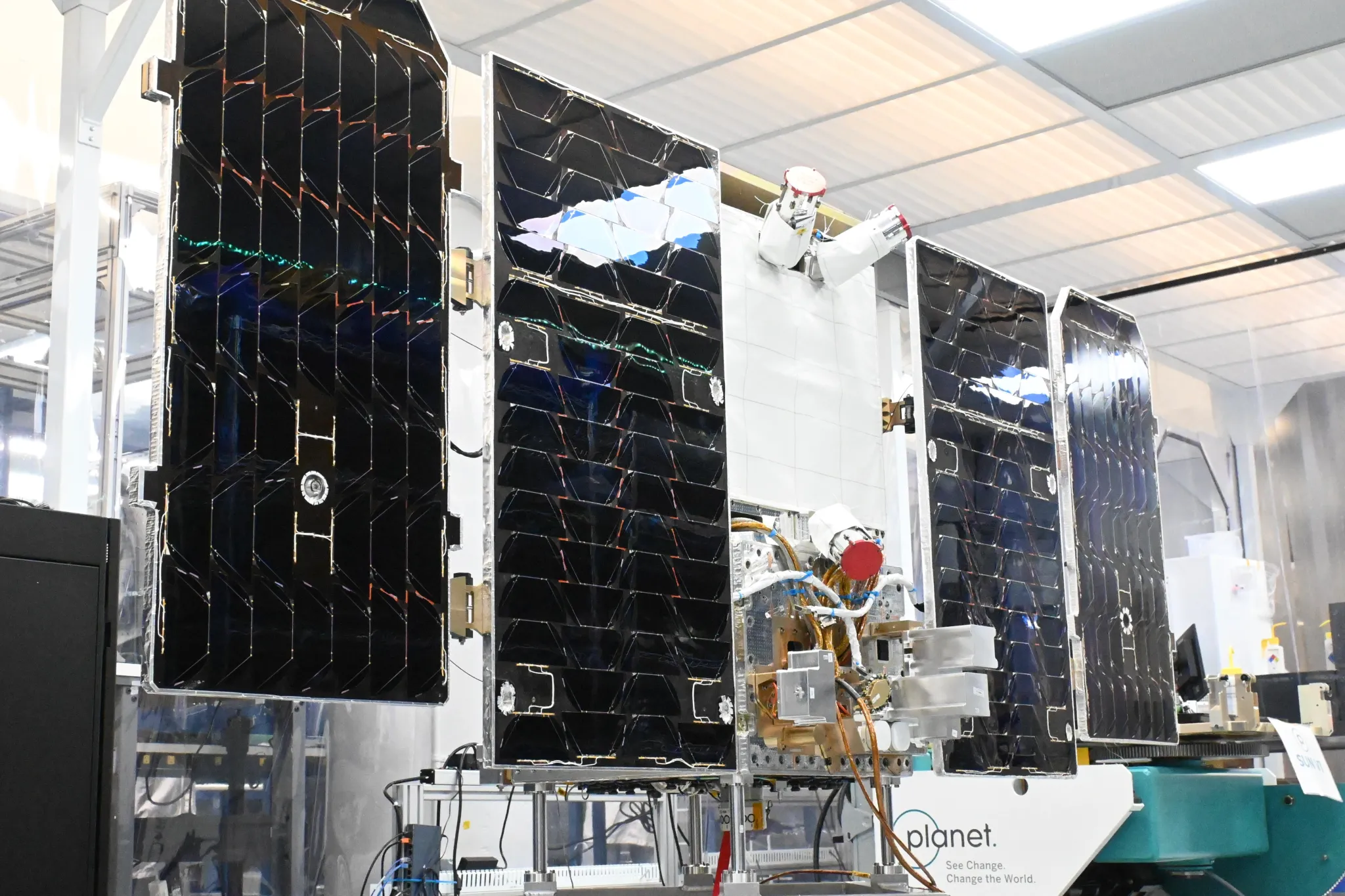
The milestone is less about a poem and more about proof: a spacecraft intended to function as an orbital compute node has moved from a roughly three-week period of on-orbit testing and calibration into routine operation. It is Google’s first data-center satellite, and the experiment asks a question that increasingly matters as AI infrastructure strains power, radiation and communication timing constraints: can a model serve large AI inference workloads while orbiting Earth?
The satellite carries Google’s Tensor Processing Unit, or TPU, an accelerator built for AI computation. The platform can produce up to about 1 kilowatt of electricity, a figure that frames the mission’s ambition while also exposing its limits. The larger objective is an “orbital data center network” made of multiple satellites working in close coordination. In that future architecture, demanding AI tasks would not have to return every piece of data to the ground before processing begins.
Why the calibration window mattered
The transition to formal operation was not immediate. The mission spent about three weeks checking timing, telemetry, thermal behavior and the interaction between the spacecraft and its onboard AI stack. That window mattered because the satellite is not merely a communications craft with a processor attached; it is a compute platform in an environment that can stress every part of a system before a single useful output is available.
The test period is short by aerospace standards, but it suggests the mission was built to answer a narrow set of questions quickly. The satellite’s first live output is not a product launch. It is a health check, and it gives operators a way to move from laboratory assumptions to real flight evidence.
A key bottleneck is power and duration. Because the TPU is relatively demanding for the satellite’s electrical design, the spacecraft can activate the chip for only about 20 minutes at a time. That limit complicates an already difficult satellite-to-ground communication chain, where operators must choose what work to run, when to run it and how to return results without turning a short compute burst into a scheduling problem.
The first poem from an AI model in orbit
This week, Google engineers sent a prompt to the satellite and asked its preinstalled Google DeepMind Gemma 4 model to compose one poem about space, in haiku form. The resulting work, rendered in English, reads: “The blue planet shines quietly below, data streams glide calmly, starlight nourishes my core.” The exercise was deliberately simple, but its value was operational: it tested whether a language model on the satellite could accept instructions, generate an output and return a readable response under real orbital conditions.
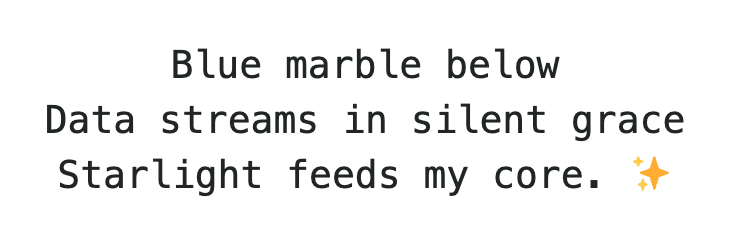
The poem was not intended as a literary milestone. It was a visible output of an invisible engineering test: can AI software remain usable while the hardware it depends on is exposed to orbital motion, thermal stress, radiation and intermittent links? The answer, for now, is that it can. The harder answer is whether it can do so repeatedly, predictably and without silent data damage.
Orbital awareness and system status
Beyond poetry, Google has used the model to gather and report information about the satellite’s orbital environment. The company has treated this as another way to confirm that the payload can do practical work in space, rather than merely demonstrate that it can turn on.
A Google spokesperson said the satellite is currently operating normally, with systems behaving as expected. That status update anchors the narrative: the experiment remains in early, cautious verification mode. The first public output is a poem; the next task is to prove the hardware can survive and support repeated AI workloads.
The durability questions that follow the TPU
The next phase is more demanding than a single haiku. Google plans to assess the reliability of the TPU in extreme space conditions, with particular attention to temperature swings that impose thermal stress and to cosmic radiation affecting hardware. The company has already run extensive ground-based tests using particle accelerators, but laboratory exposure cannot fully substitute for long-term flight data.
One concern is the “bit flip,” an unintended change to stored data bits caused when high-energy particles alter a memory location. If such an event damages a computation, the result could be corrupted without obvious symptoms; routine monitoring may not always detect it quickly. The risk is not hypothetical, and the satellite’s limited activation window makes it harder to separate a model’s output from the hardware event that produced it.
Earlier ground experiments pointed to a split in risk: inference tasks showed relatively limited effects, while training tasks could be more sensitive to radiation. The current mission lets Google examine those assumptions with actual on-orbit data, rather than relying only on simulated exposure.
These questions are central because AI systems can produce plausible outputs even when the underlying hardware has been disturbed. A corrupted memory event may not announce itself as an error; it may appear as text that still looks normal. That makes the poem useful as a visible marker, while the more consequential task is proving that longer or repeated runs remain stable.
From one satellite to a coordinated network
Google’s roadmap depends on the next hardware generation. If this mission confirms that a TPU can operate stably in space, the company plans to launch two follow-on satellites in 2027. The newer spacecraft are expected to use more advanced chips, provide stronger power generation and demonstrate optical communication links between satellites.
That change matters for the “orbital data center network” concept. A single satellite with a 20-minute compute window can produce a poem, a status update or a small inference job. A network of multiple satellites exchanging data optically could share workloads more effectively, but it also raises harder questions about synchronization, fault tolerance, routing and power allocation.
Key signals for infrastructure readers
| Signal | What it shows |
|---|---|
| About three weeks of calibration | The mission moved into routine operation only after a short, focused testing window, not after years of in-service experience. |
| Up to about 1 kilowatt | The satellite has meaningful but constrained electrical capacity for an onboard TPU workload. |
| About 20 minutes per activation | Compute windows are limited by the TPU’s power demands, making task selection important. |
| Two follow-on satellites planned for 2027 | The longer-term plan is a multiple-satellite network, not a single experimental node. |
How the network concept differs from rival approaches
| Approach | Communication and coordination profile |
|---|---|
| Google’s concept | Multiple satellites fly close enough to form a fast inter-satellite network, allowing several spacecraft to process the same workload together. |
| Some competing concepts | They may also use laser links, but wider separation between satellites makes efficient coordinated computing harder to achieve. |
What is still unknown
- Whether a TPU can remain reliable over repeated orbital activations rather than a single test period.
- How thermal stress and radiation alter performance over months rather than weeks.
- Whether short compute windows are sufficient for practical AI workloads.
- How quickly the system can detect memory corruption such as bit flips.
- What level of output quality and reproducibility is acceptable when a model runs in space.
- How much coordination a multiple-satellite network will need before it can behave like a distributed compute platform.
Frequently asked questions
What does “first data-center satellite” mean?
It refers to Google’s first satellite designed to carry AI computation in orbit rather than only collect, store or relay data. The project is framed as a path toward an orbital data center network composed of multiple satellites.
Why is the Gemma 4 poem important?
The poem is not the main objective. It is evidence that a model installed on the satellite could receive a prompt, generate one requested haiku and return a readable result during real mission conditions. For space AI, that makes the output a test signal, not a literary event.
Why does the 20-minute limit matter?
It restricts how long the TPU can be activated in a single run, which affects task planning, communication scheduling and the amount of AI work that can be completed during one window. For observers of AI infrastructure, the limit is a reminder that space compute is not simply a relocated data center.
What are bit flips?
They are unintended changes to stored data bits, sometimes caused by high-energy particles in space. They may corrupt results without being immediately visible through routine checks, which is why long-term onboard verification matters.
What comes after this satellite?
Google plans to assess TPU reliability in orbit. If results support the concept, it intends to launch two more satellites in 2027 with more advanced chips, stronger power capacity and optical inter-satellite links.
The larger infrastructure question
The Suncatcher satellite is small compared with a terrestrial data center, but it signals a larger shift: AI demand is pushing compute toward new places where power, heat, radiation and communication timing behave differently from Earth-based facilities. For now, the result is modest — about three weeks of calibration, a live satellite status, a first orbital poem and an open set of reliability questions. If the mission can answer those questions, the more consequential change may come after 2027, when a network of multiple satellites and optical links turns the experiment into something closer to a real space-based computing layer.