
AIdataNewsGlobal Deep Dive: The Depreciation Debate Behind the AI Infrastructure Boom
Ask anyone underwriting an AI data centre what keeps them awake, and the honest answer is rarely whether demand exists. It is the date printed in the depreciation schedule. How many years a GPU cluster is permitted to sit on a balance sheet has quietly become the hinge between an infrastructure boom that can be serviced and one that cannot. This analysis from the AI & Data News desk sets out where that assumption came from, what fresh pricing, accounting, financing and grid evidence adds, and the three separate clocks now running against one another.
The contested variable: how long a chip is assumed to earn
A couple of weeks ago, Gartner put numbers on the worry. AI providers, its analysts estimated, will spend close to $1 trillion on infrastructure in 2026 and another $6 trillion across 2027 to 2030. To fund that build-out, pay for borrowed money and still clear a 12% return, owners of AI data centres would need about $8.5 trillion in revenue by 2030. Gartner expects the AI revenue that actually lands inside those facilities to be $3.6 trillion at most. Two headlines came out of that arithmetic: more than $3.5 trillion of the spending could be exposed to write-downs by 2030, and more than 80% of neoclouds will no longer exist as independent companies. Read this as one scenario's risk estimate, not a verdict that every dollar disappears.
- Capex path: close to $1 trillion in 2026, then another $6 trillion through 2030 (Gartner).
- Revenue needed for a 12% return: about $8.5 trillion by 2030.
- Revenue likely to arrive: $3.6 trillion at most.
- Spending flagged as exposed: more than $3.5 trillion.
- Industry shape implied: more than 80% of neoclouds cease to exist as independents.
The rebuttal from economics: Jevons and the price of capability
That arithmetic holds only if buyers keep using AI roughly as they do today. The Jevons paradox argues the opposite: when a resource becomes more productive or more available, people do not conserve it, they discover new uses for it, so total consumption rises even while the unit price falls. Fuel-efficient engines and cheap petrol are the standard illustration — each kilometre costs less, so households drive farther and together buy more fuel.
The measured trend fits that pattern on the supply side. Epoch AI estimates that the price of reaching a given benchmark score has fallen by roughly 13 times a year since 2023, on the benchmarks it tracks, with the usual caveats about how those benchmarks are selected. Cheaper, more accessible capability should open work that was previously uneconomic, and aggregate usage should climb. No law guarantees that demand outruns the price decline, and that one unresolved question is what the entire write-down argument pivots on.
What the rental market has actually been paying
So far the so-called “old chips” are holding value better than the pessimists predicted. A chart circulated by a16z, assembled from Ornn rental data as of Oct. 19, placed each major Nvidia generation's current rent against a deliberately naive projected path: take the first rent ever observed for that part and let it slide in a straight line to zero over six years, roughly how the hyperscalers write these servers off. Because each series begins at its own first observed rent, the generations start at different points in their lives. Every one of them now rents above that line — A100 by 9%, H100 by 54%, B200 by 111% and H200 by 143%.
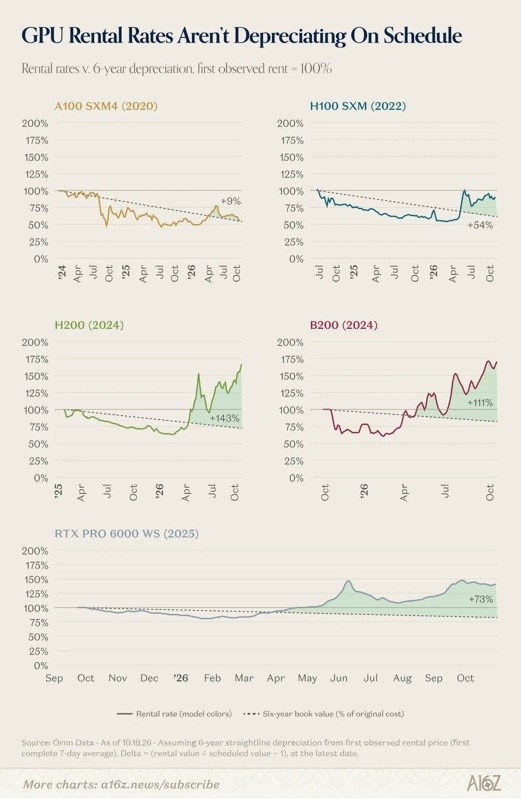
a16z notes that most of the gap opened after April, when token demand accelerated — behaviour consistent with Jevons at work, though a price chart alone cannot establish cause. Two qualifications belong on the record. Across most of their working lives these parts rented below the straight line, and rent is not margin: power, cooling, networking, facilities and interest must all be paid before an owner earns anything.
Compute as crude: a useful metaphor with a hard limit
The Economist recently described compute as the new oil, and the comparison carries more structure than it first appears. The token is the barrel — the “thing” the customer actually buys. Each GPU generation is a field: some wells pump cheap, high-quality crude, others expensive, low-grade crude. For silicon, the cost of producing a token tracks mainly the energy each generation consumes and whether it can take the job at all. When prices are high, every well runs; when prices fall, the costliest barrels are shut in first. Demand since April has been high enough that even A100 capacity is needed, which is exactly what the a16z series shows. When a new generation ships in volume it becomes the new cheap well, and the oldest machines are the first switched off. Microsoft's plan to scale its own Maia accelerators to multi-gigawatt deployments from 2027, claiming 40% more tokens per megawatt — a figure not yet independently verified — is what the arrival of a cheap field looks like in practice.
A barbell, not a ladder: which machines keep a job
The oil analogy still treats every barrel as identical, and that is where much of the debate oversimplifies. Tokens, and the chips that generate them, are not interchangeable. Interactive and agentic work needs low latency and the newest, fastest memory. Bulk work — overnight document processing, synthetic data generation, running evaluations — barely notices latency and cares only about cost. A chip whose capital has already been recovered, whose remaining burden is power, cooling and upkeep, can be the cheapest way to produce those tokens. There is not one market but several.
The complication is that Jevons-generated demand is inherently price-sensitive and consists largely of jobs that only became worthwhile once AI got cheap. Some of it is high value; much of it is bulk work, the ground where older silicon competes best. A recent example is Jev, from TypeSafe AI, a model that returns structured decisions rather than text and which its makers describe as hundreds of times cheaper than a large language model. Work like that plausibly migrates off expensive frontier systems and onto older hardware, although TypeSafe has not said what it runs on. At the opposite pole, frontier models keep growing and are increasingly sparse, activating only a fraction of the network per token, as in Mixture of Experts (MoE) designs. For the largest of them the binding constraint is memory capacity and fast inter-chip links rather than raw compute, which has made the rack, not the chip, the unit of frontier computing. An older GPU is less too slow for these models than too small and too isolated. Between the poles sit recommendation engines, image generation and scientific models, with different hardware appetites again. Our reading is a barbell: the giant models pull toward the newest rack-scale systems, small specialist models live happily on older silicon, and the squeeze falls on the middle — parts neither at the frontier nor already paid off, still carried at high book value. That is precisely where a lot of the 2024 and 2025 spending sits.
The mixed-silicon estate and who can afford it
Data centres have always run heterogeneous equipment, but a decade ago the menu was short: a handful of CPU types, memory, storage and networking, with workloads matched to a predictable list. Those servers aged gently, each CPU generation only modestly better than the last, much like a rental car fleet where last year's model still books customers. Today's menu is far richer: next to the CPUs sit GPUs, TPUs and other accelerators, and inference is splitting into stages that run best on different parts. Nvidia announced Rubin CPX, a chip dedicated to the prefill stage, in 2025, then put it on the back burner — possibly until a later generation — in favour of decode-focused racks built on technology licensed from Groq. Add HPC, which often still requires high-precision math that many AI chips deprioritise, and matching each workload to the right silicon gets harder while every generation ages faster.
Only the largest operators can afford that variety. At scale they keep many hardware classes busy and route each job to the cheapest chip able to do it. Smaller facilities cannot, so for them the general-purpose GPU remains the safest bet, because it can step down from training to inference to batch work as it ages. Specialised parts are cheaper per task but more fragile as assets, since they lose the ability to start a second and third career. Dedicated on-premises installations are a third case: a company running well-understood workloads can specify a tight configuration and skip generations, where state-of-the-art silicon matters mainly for training custom models and perhaps a few GPU-accelerated solvers.
The roadmap, not the ledger, sets the clock
Many big operators spread the cost of these servers over about six years in their accounts, but that is a bookkeeping convention and says little about how long a chip actually earns more than it costs to run. The economic life is decided upstream, by whoever designs the next part: Nvidia's annual cadence, the tokens-per-watt gains each generation brings, new memory standards and number formats, and the software that keeps old chips useful together. On this view, the silicon roadmap dictates the real depreciation timeline. Owning your own silicon gives you more say over your own clock. Microsoft with Maia, Google with TPU and Amazon with Trainium can shape when their fleets date themselves, even if demand and competitors still have a vote. A neocloud renting out Nvidia GPUs lives on a schedule set by its supplier and its customers.
Nvidia sits on both sides of that table. It sets the pace that erodes the value of its customers' fleets and has also agreed, according to a recent piece in The Economist, to cover up to $300 billion of customer debt used to buy its chips should those customers be unable to repay. A faster cadence sells more new parts and weakens the collateral behind those loans. When Jensen Huang posted in August that an A100 remains useful until 2029, he was making a technical point while holding a stake in the same trade-off.
Where the six-year assumption came from — and who is testing it
Accounting context sharpens all of this. Server and network gear used to be written off over three or four years at most cloud operators; across roughly 2022 to 2024 the big clouds lengthened those assigned lives toward five and six years, and as the accounting analysis site Footnotes Analyst has documented, the resulting reduction in depreciation charges was material. Investor Michael Burry has attacked exactly that drift, estimating that the largest AI clouds will understate depreciation by about $176 billion cumulatively between 2026 and 2028 (CNBC). Neoclouds have the same exposure in a purer form: CoreWeave has run six-year GPU depreciation since 2023 and says it is “incredibly comfortable” with the policy (Bloomberg). Regulators have so far applied limited pressure — SEC staff do probe useful-life determinations through the comment-letter process, yet critics such as Montclair State accounting lecturer Francine McKenna have described the agency as hands-off in this cycle.
Two practical consequences follow. Stretching a life defers the charge and flatters the near-term margins on which infrastructure lenders price risk; and if an assumption is later walked back, the correction arrives as catch-up expense rather than a gentle glide path.
Three clocks that rarely line up
| Clock | Who sets it | Typical horizon quoted today | What a mismatch looks like |
|---|---|---|---|
| Book life | The owner's accounting policy, reviewed with auditors | Five to six years | Shortening it produces a step-up in depreciation and weaker reported margins |
| Economic life | Chip designers and the software stack | Roughly one Nvidia generation per year | Fleets still carried at high value lose rental pricing long before they lose function |
| Delivery life | Grid operators and equipment supply chains | Multi-year interconnection queues | Capital is committed against one roadmap and energised against a later one |
An exit thinner than a used-car lot
Gartner's real question is distributional: who will own the chips when the market turns? Rental car fleets are the closest working model. They buy with borrowed money, pledge the vehicles against the loans, and make or lose money on what the fleet fetches at resale. In early 2024, Hertz sold about 20,000 electric vehicles and booked a loss of about $245 million. Hertz pointed mainly to high repair and collision costs, but soft resale values played a part, and Tesla's price cuts on new cars had dragged down used ones. A supplier's pricing decision eroded the value of its customer's fleet.
GPUs carry that risk in a stronger form: each generation is a far bigger step than a new model year, the second-hand pool is thin and specialised, and power, unlike parking space, is scarce. There is also no accepted benchmark price for a used cluster. Public resellers quote second-hand H100 cards changing hands between roughly $18,000 and $25,000 in 2026, against $25,000 to $40,000 for new units — a dispersion that is itself evidence of an illiquid market (Hash Rate Index; Mercatus AI). The financing has been restructured in response. In October 2025 Meta and private-credit firm Blue Owl Capital arranged some $27 billion for the Hyperion campus in Richland Parish, Louisiana, through a special-purpose vehicle that keeps the debt off Meta's balance sheet (Reuters; Bisnow). Residual-value risk is migrating toward private-credit lenders and structured investors rather than sitting inside a hyperscaler's own accounts.
Signals from the latest earnings cycle
Last week's calls added texture. Meta, which reported a week earlier, narrowed its 2026 capital spending to $135–$145 billion and cited rising infrastructure costs and payments to third parties for AI tokens. Then Microsoft, Alphabet and Amazon reported. All three said demand for AI computing still runs ahead of the capacity they can bring online, and Microsoft and Google are even renting third-party capacity to keep up. Between them these three plan to spend close to $600 billion in 2026, and Alphabet and Amazon both said they will spend significantly more in 2027.
Four details bear directly on depreciation. Microsoft credited part of Azure's growth to “continued efficiency gains across our CPU and GPU fleet,” a reminder that squeezing more from owned capacity is part of the business. Amazon said short-term capacity on its previous-generation Trainium chips now rents at a premium compared with the first half of the year — the a16z insight replicated on its own silicon — and that inference is now well over half of AWS's AI revenue, the varied, price-sensitive work where older and specialised chips compete. Google is selling complete TPU systems for customers to run in their own data centres, and Amazon plans to sell Trainium outside AWS from late 2027, so more of the market may age to a hyperscaler's roadmap rather than only Nvidia's. Investors were also reminded that usage is not revenue: Alphabet lost about $500 billion of market value in a day after admitting that answers from AI Mode in Google search earn less than traditional search ads, according to The Economist. Advertising pays for much of this build-out, so that gap matters to everyone buying chips. More of the money is now borrowed: Meta, Alphabet and Amazon all reported negative free cash flow, and Microsoft, still cash-positive, announced $25 billion of new bonds the day after its earnings call.
The clock most models leave out: electricity
Even accurate roadmap assumptions collide with physical delivery. Lawrence Berkeley National Laboratory's interconnection-queue research has found that the median project reaching commercial operation in the mid-2020s waited more than five years from its grid request. Because depreciation begins when an asset is placed in service, a queue that long pushes the book-life clock back — but it does not hold the roadmap still. Silicon ordered against one generation can be energised against a later one, compressing the window in which it earns a return. Wholesale power costs and grid constraints raise the operating hurdle that a fully depreciated chip must clear to stay switched on, and long-run demand projections point the same way: DNV estimates, as summarised by the World Economic Forum, that roughly 80% of data-centre electricity demand by 2060 will come from AI.
What we are watching from here
- Any change in disclosed useful life at the large clouds or listed neoclouds — the single most informative line in the next filing cycle.
- Rental spreads for A100, H100 and H200 against B200: persistence is evidence for Jevons, a simultaneous collapse is evidence for the roadmap.
- Inference's share of AI revenue, and whether price-sensitive bulk work keeps older silicon busy.
- Contract length and take-or-pay terms in neocloud deals, which reveal how lenders privately price residual value.
- Whether in-house parts (Maia, TPU, Trainium) get resold or leased onward, which would create the exit market that does not exist today.
- Whether usage growth keeps pace with a benchmark price falling roughly 13 times a year — the condition on which the whole build-out rests.
FAQ: the three questions this desk keeps getting
Is Gartner forecasting $3.5 trillion of losses?
No. Its published figure is an exposure estimate: more than $3.5 trillion of spending could be exposed to write-downs by 2030 if its own assumptions hold. The gap between about $8.5 trillion of required revenue and $3.6 trillion at most of expected revenue is what generates that exposure.
Does a six-year depreciation period mean a GPU stays competitive for six years?
It means the owner spreads cost over that period. A chip can function well beyond it and be uncompetitive well before it. The earning window is set by the roadmap — cadence, tokens per watt, memory formats — and, for older parts, by whether bulk work keeps them occupied.
Should rising demand reassure infrastructure owners?
Only partly. Jevons-style growth can sustain rental prices, as the post-April chart suggests, while that same growth is served by the next generation of chips. Britain's coal use rose for decades and the least efficient pits still failed: expansion and write-downs can be one event viewed from opposite sides of the balance sheet.
The 1865 lesson, restated for silicon
William Stanley Jevons framed the mechanism in 1865 in The Coal Question: more efficient steam engines did not cut Britain's coal consumption but raised it, because cheaper motive power found many more uses. The observation withstood the test of time — Britain burned more coal as its engines improved, even though efficiency was not the only reason. What it did not do was save every mine. The owners of the least productive pits went under while the industry grew.
AI infrastructure is showing the same shape. Demand will probably keep surprising on the upside, and a real share of the capital that built the first generations of this system will likely still be written down. Both outcomes flow from one roadmap, seen once from the buyer's side and once from the owner's. The variable worth tracking is not whether AI gets used; it is whose clock the machines are running on.
Compiled by the AI & Data News desk at AIdataNewsGlobal. Corrections and tips: editorial@aidatanews.com. Sources consulted beyond the primary reporting cited above include Gartner, Epoch AI, a16z with Ornn data, The Economist, Footnotes Analyst, CNBC, Bloomberg, Reuters, Lawrence Berkeley National Laboratory and the World Economic Forum.