
Meta Hyperion Review Due Early Next Year: Four Data Center Fights Compared, From Richland Parish, Louisiana to Lordstown, Ohio
By David Nakamura — AI & Data News. Tips, document requests and corrections: editorial@aidatanews.com.
Short answer: the fastest lever on the AI buildout is not federal court. Set side by side, the four contests resolved this week — a pipeline review for the Meta campus in Richland Parish, an election fight in South Carolina, a litigation settlement in Minnesota and a land-use ruling in Ohio — show that local moratoria and state-review commitments freeze projects within months, while National Environmental Policy Act litigation runs two to three years and increasingly turns on scope rather than substance.
The split matters for anyone underwriting AI infrastructure. Opponents now get leverage late and certainty never; developers get speed on paper and risk in practice. What follows is a comparison of the instruments themselves, not a recap of the incidents.
What did the Federal Energy Regulatory Commission just schedule for Meta's Hyperion?
On Wednesday the commission published the environmental assessment plan governing the Entergy pipeline that will serve the Meta data center, a review conducted under the National Environmental Policy Act, and said the document will be issued in early January 2027. Federal agencies were also told to finish any remaining authorization decisions by April.
Those two dates answer different questions. The January document becomes the evidentiary record every later challenge is measured against. The April deadline is what keeps turbines, interconnection queues and construction crews aligned.
For scale, the Hyperion campus is described by Meta and reported by CNBC as a 5-gigawatt project carrying more than $50 billion of announced investment — the largest single site of its kind, and the reason a paperwork choice about one pipeline now has national consequences.
EA versus EIS: the clock is the argument
Choosing an environmental assessment under NEPA is expected to draw objections. In comments to FERC, the Sierra Club asked instead for an environmental impact statement, arguing it should account for the environmental impacts of the data center fed by the pipeline and review the project's cumulative impacts, because those impacts are explicitly linked to the campus's operations. The comments read, "The power stations and data center are not remote or speculative developments unrelated to the proposed action," and pressed for the two to be assessed together.
Both sides are arguing inside a narrowed legal frame. In May 2025 the U.S. Supreme Court decided Seven County Infrastructure Coalition v. County of Eagle, holding that agencies need not analyze the effects of separate projects that differ in time and place and that courts owe agencies wide latitude in drawing NEPA's boundaries. That shifts the cumulative-impact request from routine objection to uphill climb.
The timing data explain the stakes. Federal quality-council figures reported by E&E News in May 2025 put the median environmental assessment at 1.2 years and the median impact statement at 2.8 years; the White House's October 2026 permitting analysis said agencies averaged 4.2 years for impact statements published in 2022. Winning the deeper study is therefore worth roughly a year and a half of delay before any court case begins.
Asked what could happen next, the Sierra Club said through managing attorney Eric Huber on Thursday, "I heard the EA is expected in January, but we are in wait and see mode and will decide on further steps when it comes out." Neither Meta nor Entergy responded to a request for comment.
Why the New Mexico Green Chile case sets Louisiana's ceiling
The same dispute is already staged in a parallel venue. The Green Chile pipeline fight in New Mexico, involving Oracle and OpenAI's Project Jupiter, could become litigation with high stakes for future gas pipelines linked to data centers. Twelve other state attorneys general have argued against a broader federal review there, contending the commission has no authority over the loads a pipeline serves — the mirror image of the Sierra Club position in Louisiana.
Meta's site carries the heavier immediate risk. Gas plants serving the campus have been under construction for almost a year after state regulators earlier blessed them, so any court-ordered redo now burns cash rather than schedule. A precedent that merely narrows scope would be survivable; one that voids the approval would not.
How do the four pathways compare?
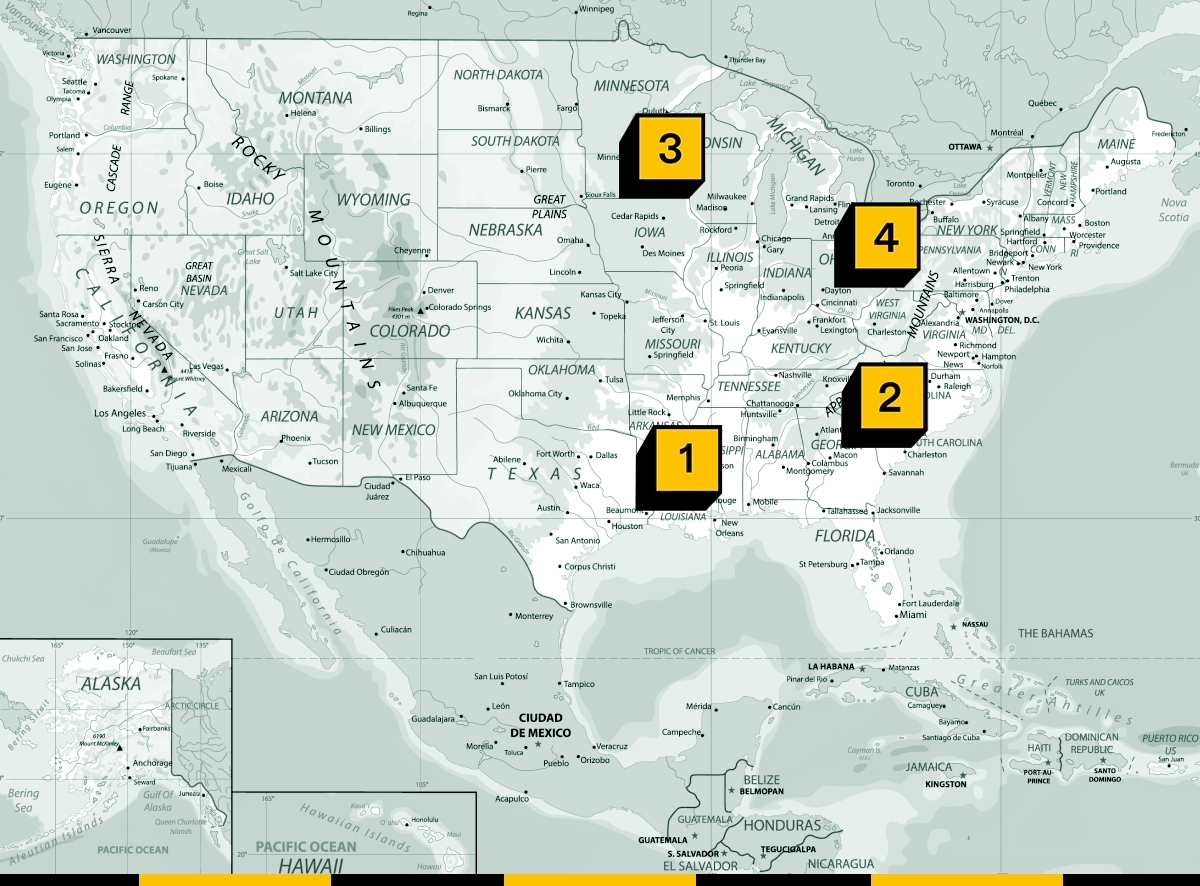
| Case | Instrument | Realistic clock | Who actually decides | What it can stop | Structural weakness |
|---|---|---|---|---|---|
| Richland Parish, Louisiana | Federal review of a gas line under the National Environmental Policy Act | 1.2 to 2.8 years, median | FERC staff, then federal courts | The pipeline's in-service date, not the campus concrete | Scope doctrine now favors the agency |
| Spartanburg County, South Carolina | Ballot-box pressure on top of a county ordinance | One election cycle, then years of amendments | Voters and county council | Future siting; already-permitted work keeps going | Symbolic, creates no precedent |
| Goodhue County, Minnesota | Litigation settlement converting a project into a state review | Weeks to sign; months of review | State pollution regulators | New construction until a mitigation plan is approved | Binding on the parties, not the industry |
| Trumbull County, Ohio | Local moratorium upheld by a state high court | Months | Village council, then Ohio Supreme Court | Site-plan review outright | Delays the question instead of answering it |
Can an anti-data-center candidate break the map in South Carolina?
The contest to watch on Tuesday is South Carolina's 4th district, along the northern rim of the state. In ordinary circumstances a safely Republican seat held by military servicemember William Timmons would attract little attention. It instead presents a first: an aggrieved neighbor of a data center project running against an incumbent member of Congress. Courtney McClain, a Democrat who says she lives in Spartanburg County one mile from a data center under development, also serves as executive chair of the NAACP's youth works program.
The county's rules explain why the fight is local before it is federal. After community opposition led to one project withdrawal, Spartanburg enacted a restrictive ordinance on new development. It was supposed to be a moratorium, but amendments let data centers proceed if they demand fewer than 65 megawatts and sit on current or former industrial-zoned land; applications outside those criteria are paused, and the pause does not apply to projects permitted within the previous year before enactment.
That carve-out is what allowed the most contentious build to move forward. NorthMark's Valara hyperscaler now faces aggressive environmental litigation at the state level, and McClain has personally testified against further development. Reporting from the Post and Courier and WSPA adds the practical limit of the courthouse route here: a Spartanburg County judge dismissed on Oct. 6, 2026 a lawsuit challenging the project's treatment as a minor land development, and the county's own moratorium language exempts previously permitted work like NorthMark's.
At the only candidate debate, McClain directly challenged Timmons to speak on data centers he previously supported and weigh in on those being built today. Timmons demurred, saying he has "no role whatsoever in how data centers are located," and added: "That’s just not how life works. My job as a member of Congress is to legislate in Washington, and the job of county council and city council is to address this issue. Simple as that."
Whether an anti-data-center activist can ride an election riddled with anxiety about artificial intelligence to Congress is doubtful. Cook Political Report continues to rank this as a safe Republican race despite a toss-up statewide U.S. Senate campaign in which Democrat Annie Andrews has specifically brought up Spartanburg County in her bid to oust Senator Darlene Graham, the sister of the late Lindsey Graham. As a policy instrument the ballot lever ranks last: a loss proves nothing, and a win repeals nothing.
Which did more to stop steel and concrete — a settlement in Minnesota or a moratorium in Ohio?
In Goodhue County, Google settled with an environmental group suing to stop its data center in Pine Island, a small southern Minnesota town, producing what local press describe as the Land of 10,000 Lakes first state-level environmental review of a data center project. The Minnesota Center for Environmental Advocacy had sued to block the build, saying it believed Google did not fully disclose the total impacts and scope of the facility, including total energy and water use. The settlement, also approved by the Pine Island government, halts development of Google's Project Skyway until the state proposes and approves a mitigation plan.
The mechanics, per the advocacy center's own Oct. 28, 2026 release, are the interesting part: the deal swaps a streamlined municipal approval for a state Environmental Assessment Worksheet handled by Minnesota's Pollution Control Agency, and the Pine Island council voted unanimously to accept it. That is a template, not just a truce — the first time a state environmental process has been pointed directly at one AI campus.
It is the second time in less than a month that environmental litigation has produced a settlement requiring state regulators to deeply scrutinize data center development for the first time. That is how Wisconsin wound up becoming one of the few states to launch a comprehensive review of the entire industry's impacts on ecology, the grid, and local communities, joining only New York and Maryland.
Ohio took the blunter route. After realtors seeking to develop filed a lawsuit against the village for enacting moratoria, the Ohio Supreme Court unanimously granted Lordstown the right to reject consideration of a data center project, finding the village adequately enacted the pause and had no "legal duty to proceed with a site-plan review" of their project. The disposition, State ex rel. Bristolville 25 Developer, L.L.C. v. Lordstown, was a per curiam ruling issued Oct. 20, 2026 and is now binding on every Ohio municipality drafting the same ordinance.
The verdict on effectiveness depends on the buyer. The Minnesota route buys disclosure and conditions but travels no further than the signatories; the Ohio route buys an immediate hard stop and answers nothing on the merits — which is precisely why state legislatures are the next battleground. The Brookings Institution counted at least 15 states weighing pauses and at least 100 localities adopting their own, while the National Conference of State Legislatures logged 14 states considering bans or restrictions as of September 2026. Data Center Watch recorded at least 75 projects worth roughly $130 billion blocked or delayed in the first quarter of 2026 alone.
Local wins, in other words, are now numerous enough to price in. At least one data center still appears to be in progress in the Lordstown area, at a former General Motors plant, as part of OpenAI, Oracle, and SoftBank's Project Stargate. It is also the same ex-auto work site where Trump promised he'd bring jobs back when he first ran for president in 2016.
What are the trade-offs and risks of each tool?
- Federal review challenges. Highest ceiling, lowest hit rate. Post-2025 case law rewards narrow scoping, and FERC said in its June 18, 2026 large-load order that it would no longer automatically weigh cumulative environmental impacts in its NEPA work, per Reuters. Expect procedural wins that projects absorb.
- State-level review commitments. Best information payoff: energy and water totals, mitigation plans, precedent for the next filing. Weakness is contractual — it binds parties, not states, until legislatures act.
- Local moratoria. Cheapest and fastest shield, and the Ohio ruling shows a state high court will sometimes sustain one outright. Risks: preemption bills, takings-style claims, and the reputational cost of deterring future investment in communities that want it.
- Electoral pressure. Useful for setting agendas and forcing disclosure of votes, useless for unwinding permits already issued.
- Developer exposure. The same permitting acceleration that shortens schedules concentrates risk: power plants contracted years before the load is certain, with interconnection reform shifting grid upgrade costs onto large loads.
Which pathway fits which goal? A decision guide
- Community groups wanting time to study a specific site: pursue local moratorium first, then a state review petition — the two together produced the Minnesota and Ohio outcomes.
- Groups wanting binding emissions or water data: target the state review track; federal scope rulings make cumulative-impact arguments expensive.
- Developers and investors: treat the federal review date, not the permit date, as the risk milestone; model an additional 1.2 to 2.8 years if the review level is successfully contested.
- Utilities and grid planners: assume large-load cost allocation changes faster than environmental review thresholds.
- Analysts: weight statehouse activity above single-project headlines, since Ohio and Minnesota are exporting templates.
How large is the power problem behind these legal fights?
The volume of disputes tracks a demand curve nobody in this week's rulings controls. EPRI's Powering Intelligence analysis estimates U.S. data centers at 4% to 5% of national electricity today and projects 9% to 17% by 2030; BloombergNEF puts the 2035 share near 20%, up from 5.9%. In Louisiana the pipeline question is what closes the gap between a 5-gigawatt ambition and a gas fleet that must exist before the campus can run.
FAQ: what readers ask next
Does the federal review cover Meta's Louisiana data center itself?
No. The federal action is the Entergy pipeline; the campus sits under state permits. That gap is the core of the Sierra Club's demand for a broader study, and the core of the developers' defense.
Why does an environmental assessment versus an impact statement matter so much?
Because duration is the practical remedy. Median completion runs 1.2 years for the shorter document and 2.8 years for the longer one, before any litigation clock starts.
Is the Ohio decision national precedent?
No. It is binding in Ohio, where the Supreme Court's per curiam ruling removes any duty to process a site plan during a valid pause. Other states reach this through legislation, not courts.
What dates should a watcher put on the calendar?
The environmental assessment in early January 2027, remaining federal authorization decisions by April, and the outcome of the South Carolina contest held on Tuesday in this cycle.
Reference sources
- Federal Energy Regulatory Commission, large-load interconnection docket RM26-4 — ferc.gov/rm26-4
- Reuters, "Top US energy regulator pushes grids to overhaul data center power rules," June 18, 2026 — reuters.com
- EPRI, Powering Intelligence load-growth scenarios — epri.com
- Ohio Supreme Court, State ex rel. Bristolville 25 Developer, L.L.C. v. Lordstown, 2026-Ohio-4073 — supremecourt.ohio.gov
- Minnesota Center for Environmental Advocacy, Pine Island settlement release, Oct. 28, 2026 — mncenter.org
- Brookings Institution, "Data center moratoriums are not a substitute for oversight," July 28, 2026 — brookings.edu
- NCSL, "Which States Are Banning Data Centers?" — ncsl.org
- CNBC, Meta Louisiana investment reaches $50 billion — cnbc.com
- Harvard Law School environmental and energy law tracker, FERC cumulative-impacts determination — law.harvard.edu