
Microsoft's $45.2 Billion Quarter: AIdataNewsGlobal Decodes the Capex Shortfall Behind the AI Build-Out
Every reader of this column has already seen the same three-word summary: "capex below estimates." Taken alone, that phrasing invites the wrong conclusion. The spending Microsoft recorded in its latest quarter did fall short of the Wall Street consensus, by roughly $6.5 billion, yet the company's own explanation, its signed capacity contracts and its revised full-year guide all point the same way: cash that was scheduled to leave the building in this quarter has been pushed into later fiscal quarters, because the data center capacity it was meant to buy has not arrived. The construction programme has not been cancelled. The briefing below separates the verified figures from the market's inference, and lists what will decide the next phase.
The disclosed figures, stated plainly
Before interpretation, the data Microsoft put on the record:
- Quarterly capital expenditure: $45.2 billion for the quarter ended September 2026, inclusive of finance lease-related spending, against the $51.7 billion analysts had modelled — a gap of about $6.5 billion.
- Year-over-year direction: still up roughly 30% versus the same quarter a year ago.
- Full-year 2026 outlook: revised to $170 billion from the $175 billion previously expected.
- New capacity: 24 data centers added during this quarter.
- Outside capacity: agreements signed since 2023 with CoreWeave, Nebius and Nscale, worth more than $80 billion in total.
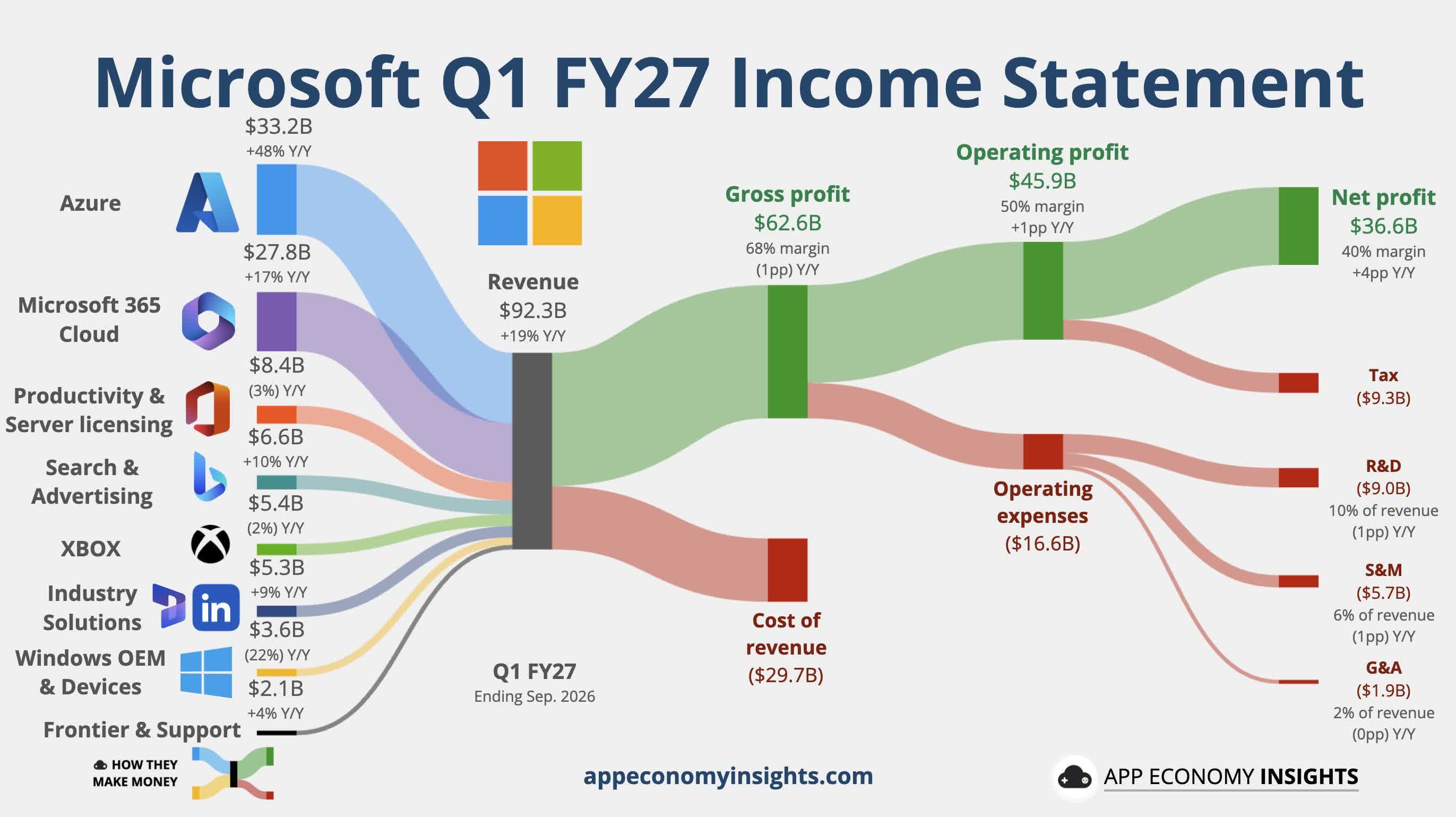
- Demand-side proof: Azure revenue up 48% year over year, to $33.2 billion.
- Cash position: free cash flow of positive $18.6 billion this quarter.
What actually slipped, in the company's own account
Chief financial officer Amy Hood framed the shortfall as a delivery problem rather than a change of appetite: a group of third-party suppliers did not hand over the required data center capacity on time, so the spending attached to those facilities moved to a later period. Microsoft's stated expectation is that these facilities will enter service over the second half of the fiscal year. Read that way, the trim to $170 billion for 2026 is a re-phasing of outlays, not a retreat from large-scale artificial intelligence investment, and the spending curve should steepen again once deliveries catch up.
Two cost pressures sit underneath that schedule. Memory and other hardware prices are rising, which inflates the cost of every unit of infrastructure still to be built. And the physical pace of construction, rather than the willingness to write cheques, is increasingly the binding constraint.
Who builds the capacity: 24 new sites and $80 billion of outside supply
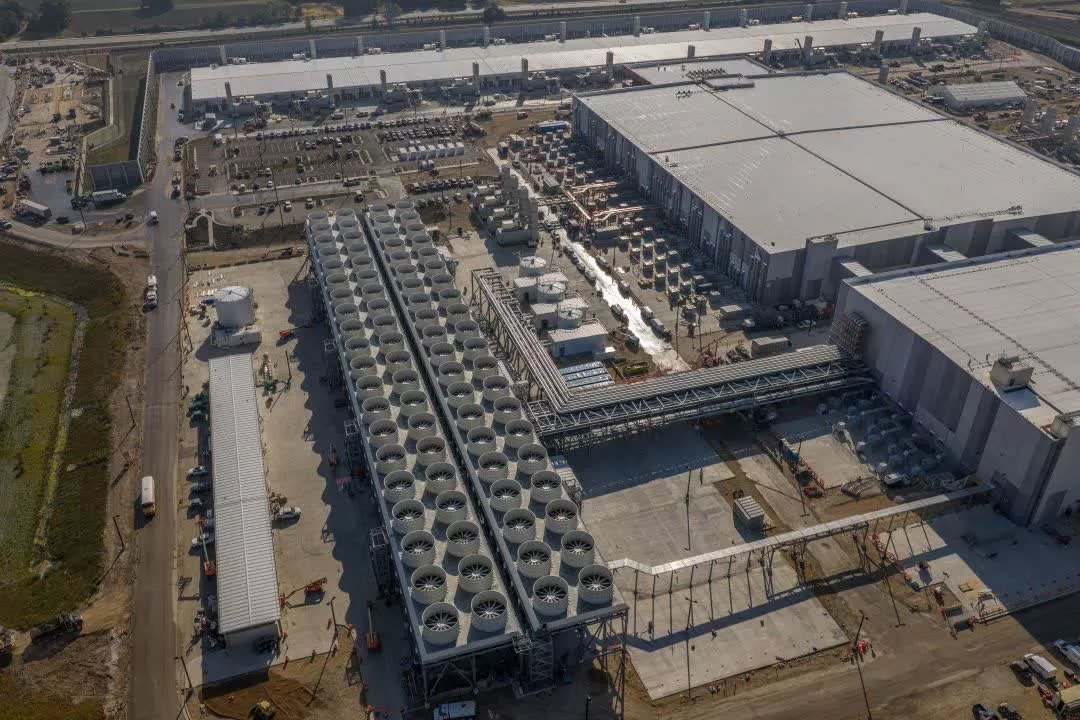
Microsoft brought 24 data centers online in the quarter, but it is not building or operating everything under its own banner. To scale cloud capacity faster than its own crews can, the company has turned to smaller cloud infrastructure operators: since 2023 it has contracted CoreWeave, Nebius and Nscale for additional data center capacity in deals exceeding $80 billion altogether.
The third-party route carries its own risk list:
- Microsoft recently abandoned a data center capacity arrangement tied to Nscale, citing inadequate power supply.
- Construction at one Nebius facility in New Jersey, United States, is progressing more slowly than planned.
Taken together, those items explain why capital cannot simply be converted into compute on demand. With AI compute demand accelerating, expansion is gated by electricity availability and construction progress as much as by funding and chip supply.
Three spending programmes, side by side
| Company | Full-year capital spending plan | Latest reported quarter | Constraint named in this reporting |
|---|---|---|---|
| Microsoft | $170 billion for 2026, cut from $175 billion | $45.2 billion, below the $51.7 billion expected; up about 30% from the year-ago period | Late delivery of third-party data center capacity; higher memory and hardware prices |
| Amazon | about $220 billion this year, roughly $50 billion above Microsoft's adjusted plan | Purchasing and stockpiling Nvidia GPU server racks | Some facilities lack the power needed to put those machines into operation |
| Alphabet (parent of Google) | $195 billion to $205 billion, with next year's spending expected to increase significantly | $51.4 billion in the September quarter, also below market expectations | Free cash flow of negative $9.1 billion, continuing prior pressure |
The comparison makes the industry picture clearer. Amazon's budget sits ahead of Microsoft's revised total, which is one sign that the AI infrastructure race among large technology companies is still running. Alphabet's case shows the other side of the ledger: enormous commitments can strain cash generation, a trend visible in its negative free cash flow. Microsoft, by contrast, still creates enough cash to leave room for continued investment.
The revenue line that underwrites the spending
The justification for the build-out sits in the cloud business itself:
- Azure revenue grew 48% year over year, reaching $33.2 billion in this quarter — direct evidence that demand is absorbing the capacity being constructed.
- Free cash flow remained positive at $18.6 billion, meaning the expansion is being financed alongside a core business that still generates substantial cash.
Where Microsoft is taking money out
Heavy infrastructure spending and a tighter workforce plan are running in parallel. The company has already acted on labour costs, including an optional voluntary separation package for employees that could involve as many as 60,000 people. The pattern suggests a reallocation of resources: more capital directed at artificial intelligence, cloud computing and the infrastructure behind them, with restraint applied elsewhere.
What to watch over the next several quarters
- Delivery catch-up. Capacity that missed this quarter is expected to come into use in the second half of the fiscal year, which should push capital expenditure back into faster growth in the next several quarters.
- Hardware inflation. Rising prices for memory and similar components lift the cost of infrastructure already in the pipeline.
- Power availability. The dropped Nscale arrangement and the idle Nvidia racks at some Amazon sites show electricity as a first-order constraint.
- Construction timelines. The delayed one-site Nebius project in New Jersey illustrates schedule risk in the third-party channel.
- Cash-flow divergence. Microsoft's positive free cash flow versus Alphabet's negative figure will shape who can keep scaling and who must ration.
- Contract counterparties. More than $80 billion of committed capacity with CoreWeave, Nebius and Nscale since 2023 means third-party execution risk stays on Microsoft's books.
FAQ: the questions this report raises
Is Microsoft's AI investment slowing?
Nothing in the disclosed facts supports that. Spending for the quarter ended September 2026 was $45.2 billion, still up about 30% compared with the same quarter a year ago, and 24 data centers were added in the period.
Why did the number miss Wall Street expectations?
According to Amy Hood, some third-party suppliers failed to deliver the needed data center capacity on time, so payments tied to those projects shifted into later fiscal quarters. The difference against the $51.7 billion consensus was roughly $6.5 billion.
Does cutting the full-year forecast to $170 billion from $175 billion change the story?
It reads as timing, not strategy. The delayed facilities are expected to enter service in the second half of the fiscal year, and upward pressure on memory and hardware costs points spending higher, not lower.
Is this a Microsoft-specific issue?
No. Alphabet's capital expenditure in the September quarter, $51.4 billion, also came in under market expectations, and Amazon holds Nvidia GPU racks it cannot yet energise at some data centers.
What is the real bottleneck for AI capacity today?
Power supply, construction lead times, hardware costs and vendor delivery performance. Money alone does not translate into compute.
How is Microsoft funding all of this?
Azure grew 48% year over year to $33.2 billion, and free cash flow stayed positive at $18.6 billion — financial headroom that peers under cash-flow pressure do not currently enjoy.
Bottom line
For AIdataNewsGlobal, the reading is straightforward: a missed consensus number describes a calendar, not a conviction. The $45.2 billion quarter, the $170 billion full-year plan for 2026 and the 24 new sites all sit inside an unchanged strategy, while power, hardware prices and vendor delivery have become the variables that decide how fast global AI capacity can grow. Our team will keep tracking each of the six watch items above as later fiscal quarters reveal whether the deferred spending arrives on schedule.