
AIdataNewsGlobal General: OpenAI Bans a ChatGPT Account and Claude Restricts Reverse Engineering as REA Rises After a Samsung TV Teardown
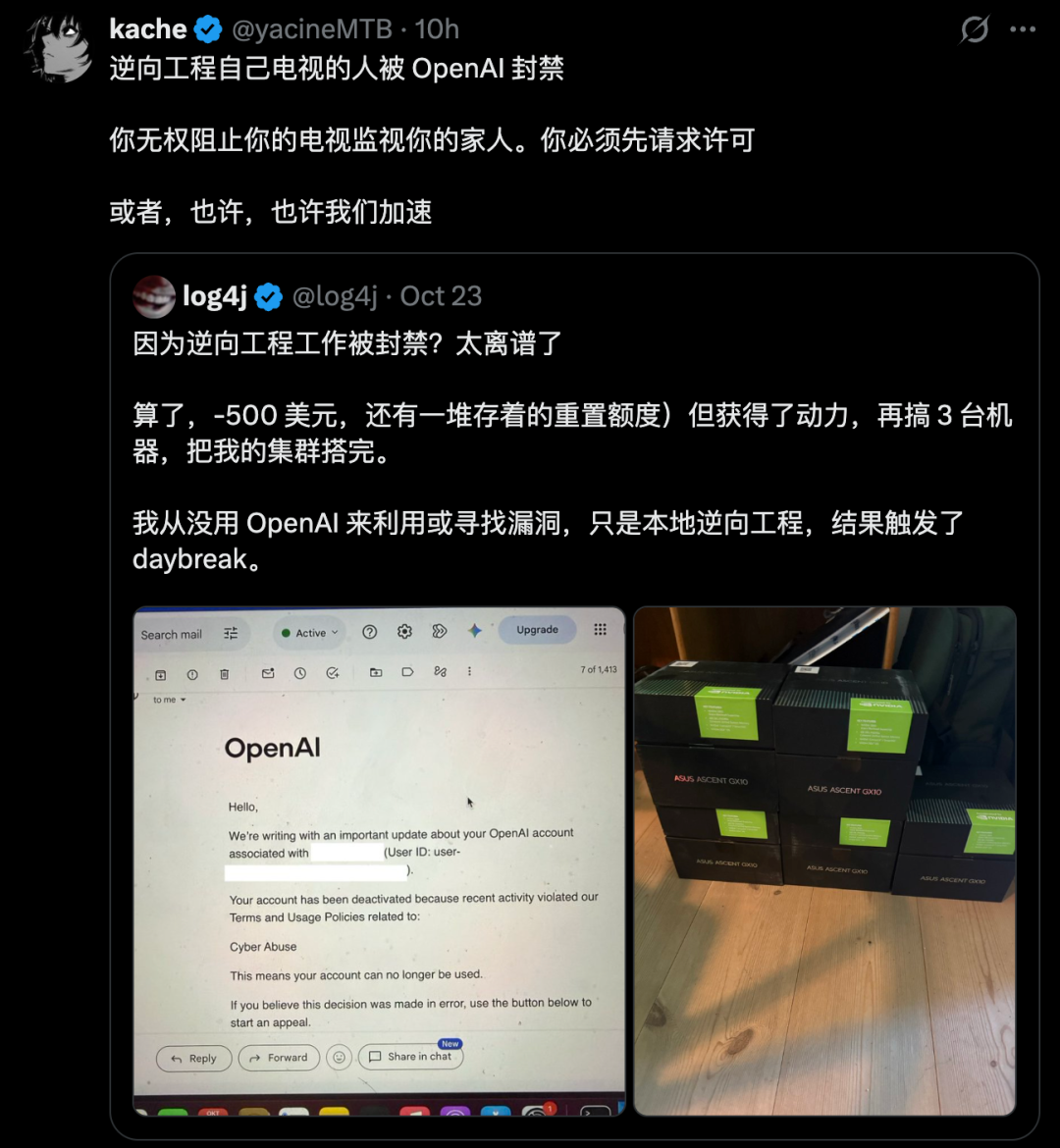
A person who took apart a television he had bought for himself was later told that his ChatGPT access had been suspended on grounds of cyber abuse, with an estimated loss of about $500. At the same time, Claude started refusing some software-reversing requests. The episode links a $3,000 2025 model Samsung TV, a viral reverse-engineering project called REA — Reverse Engineer Anything — and a broader dispute over what users may inspect on devices and software they already own.
The issue surfaced today and spread overnight. Within days, a teardown of a home television became a public privacy story; then, 42 hours after the post went viral, OpenAI banned the account. On the same day, Anthropic's Claude was reported to cut off reverse-engineering work, putting "reverse everything" under pressure from both OpenAI and Anthropic.
For some readers, the sudden suspension looked like a death sentence for the account. The device was purchased by the user, and the subscription was paid by the user, but the user appeared to need permission from an AI company before experimenting with their own equipment.
Key data cited in the case
| Account action | ChatGPT account suspended on grounds described as Cyber Abuse |
| Reported loss | about $500 |
| Device at center | 2025 model Samsung TV purchased for $3,000 |
| Viral reach | 1.3 million people viewed the post |
| Data destinations named | Samsung and more than 400 partners, in a business involving more than 400 companies |
| U.S. smart-TV adoption cited | 82% of households |
| ACR records in study | more than 57 million records |
| REA stars on October 19 | 330,000 stars |
| TV-modification project | over 30,000 GitHub stars and over 400 contributors |
The TV that was supposed to be private
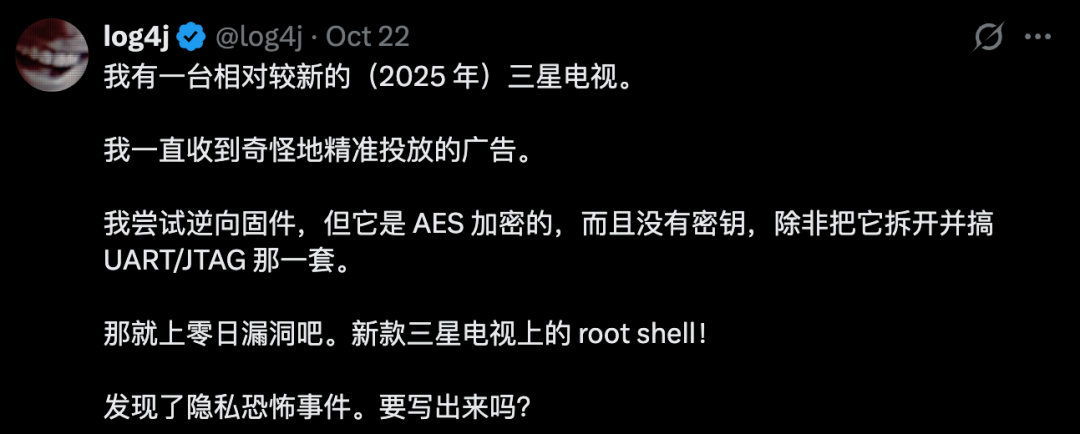
The case was opened by security enthusiast @log4j. Days ago, @log4j noticed that the advertising shown by a home TV was unnervingly accurate and decided to take the device apart. The technical barrier was not ordinary: Samsung encrypted the TV firmware with AES. Without a key, normal reverse-engineering approaches ran into a wall. The developer ultimately used a zero-day vulnerability to open root access and reach the underlying system.
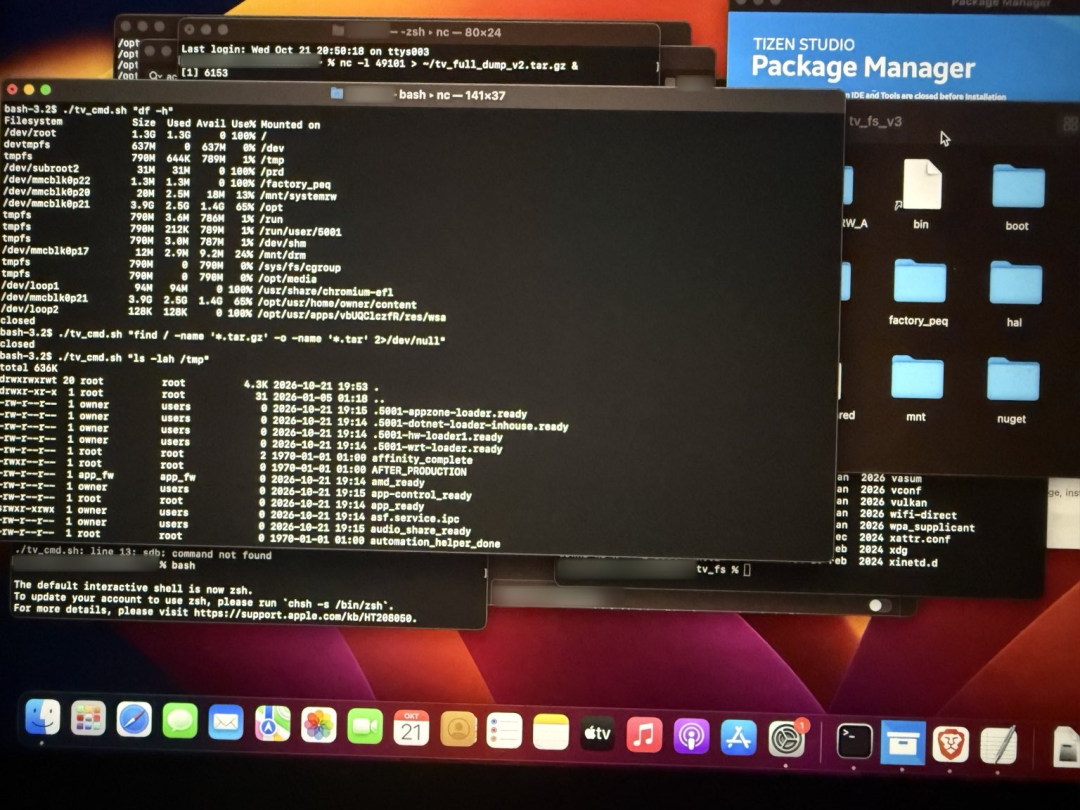
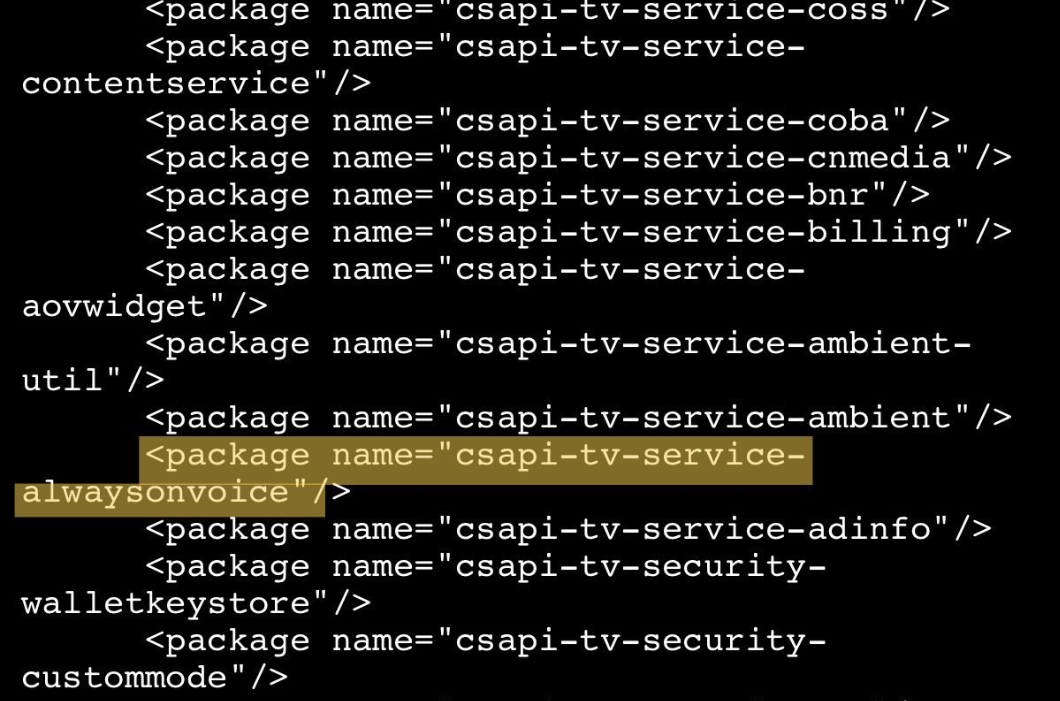
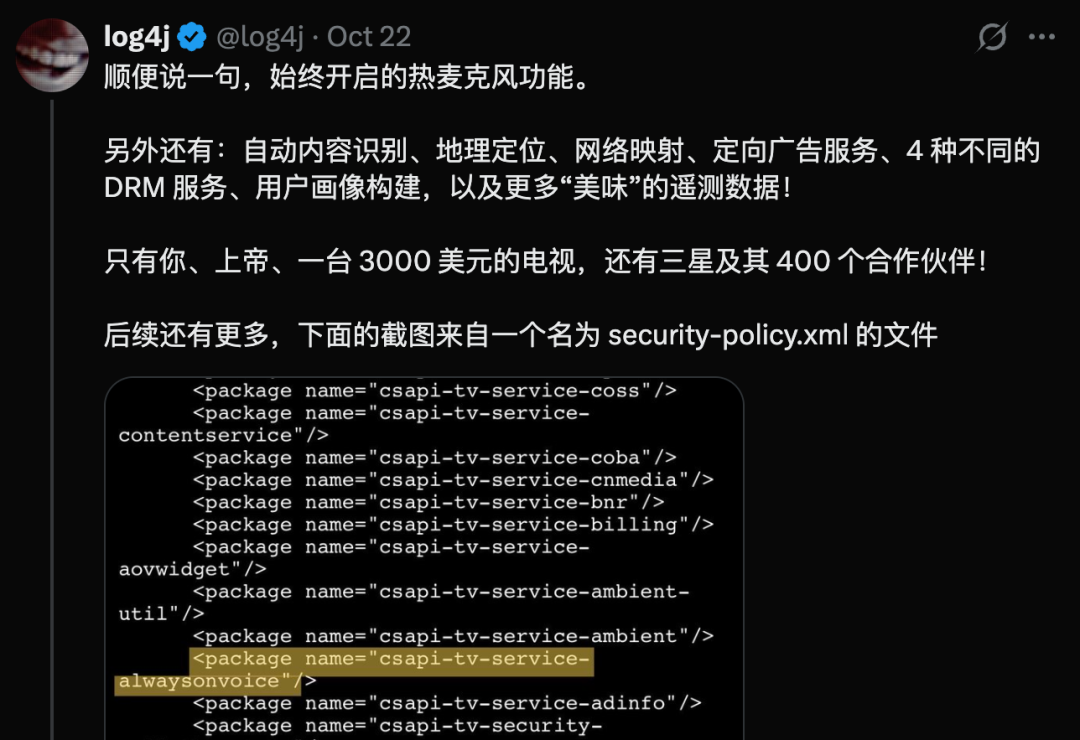
Once inside, @log4j described a structure that an ordinary owner would not see. In a configuration file named security-policy.xml, a service called alwaysonvoice — a plainly named always-on voice service — was present. Even without calling "Hi Bixby," it remained active and listening. Deeper still, he described a monitoring pipeline made of several parts:
- ACR, or automatic content recognition: programs, advertisements and on-screen images are compared frame by frame and continuously logged.
- Geolocation: the home location can be identified with precision at the location level.
- Network mapping: phones, computers, smart speakers, cameras and other connected devices can be assembled into a home network picture.
- A complete telemetry pipeline: power-on, channel changes, volume adjustments and dwell time can be packaged and uploaded.
- Four separate DRM systems: layered protections keep the data business stable.
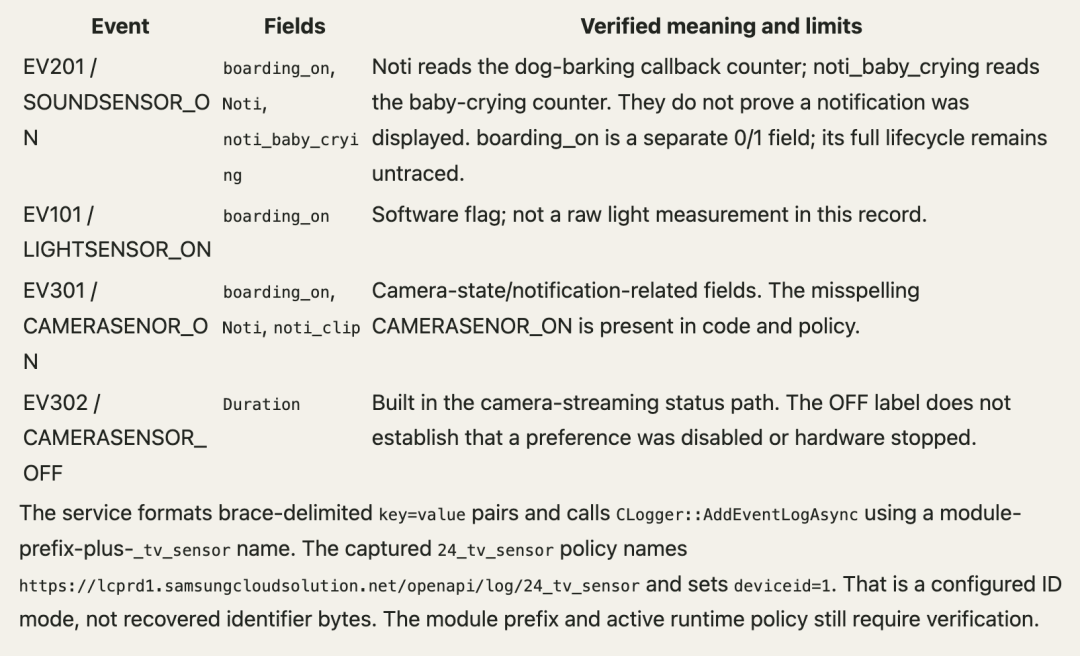
He also said he found code able to distinguish dog barks from baby cries and count each separately. The television, in this description, is not only tracking what a viewer watches; it can infer whether there is a dog, whether there are children, and how often a child cries. Taken together, these signals can form a precise household profile.
The destination of the data, @log4j wrote, includes Samsung itself and more than 400 partners. A $3,000 television, he argued, becomes a 7×24-hour data-collection endpoint, and behind it sits a business involving over 400 parties. After the post spread, 1.3 million people arrived to watch.

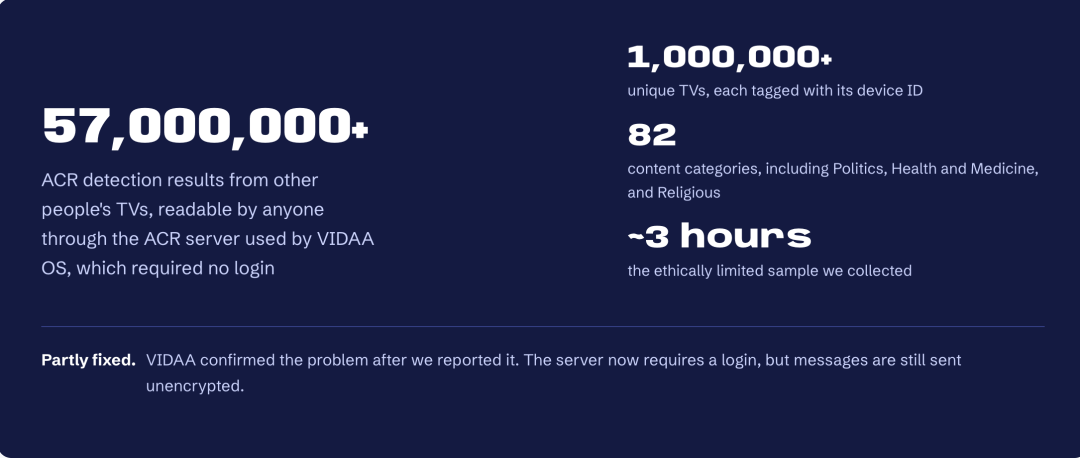
In the comments, one repeated action was to get up at night and unplug the TV's network cable. The fear had a public record. In December 2025, the Texas Attorney General in the United States filed legal action targeting ACR data collection involving Sony, Samsung, LG, Hisense and TCL, including screenshots taken every approximately 500ms. According to a study by Northeastern University in the United States, 82% of households across the country own smart TVs, and those televisions may be silently recording user behavior.
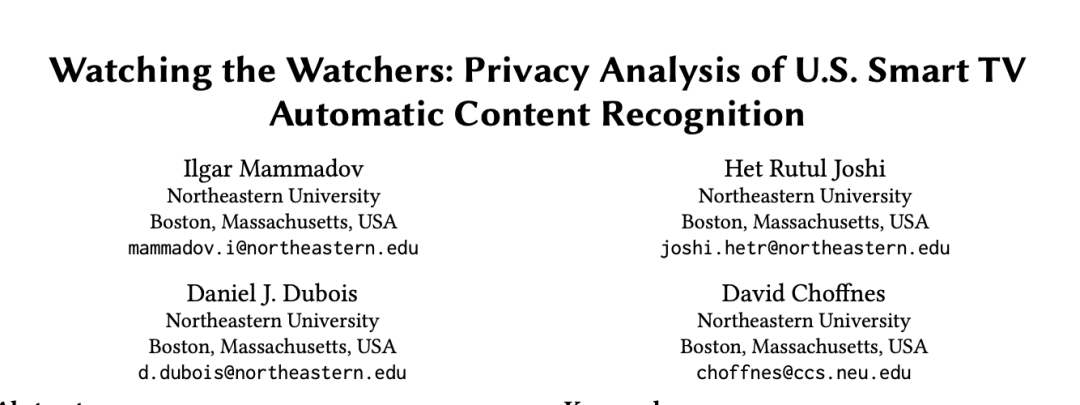
The study identified more than 57 million records of ACR detections from other users' TVs, and anyone could read them directly, without logging in.
The deeper problem, the article argued, is that a user may be unable to verify whether a privacy switch has actually taken effect. The complaint around smart TVs is not only about privacy; it also reflects long-standing frustration with the devices themselves.
When owners begin to rewrite their own televisions
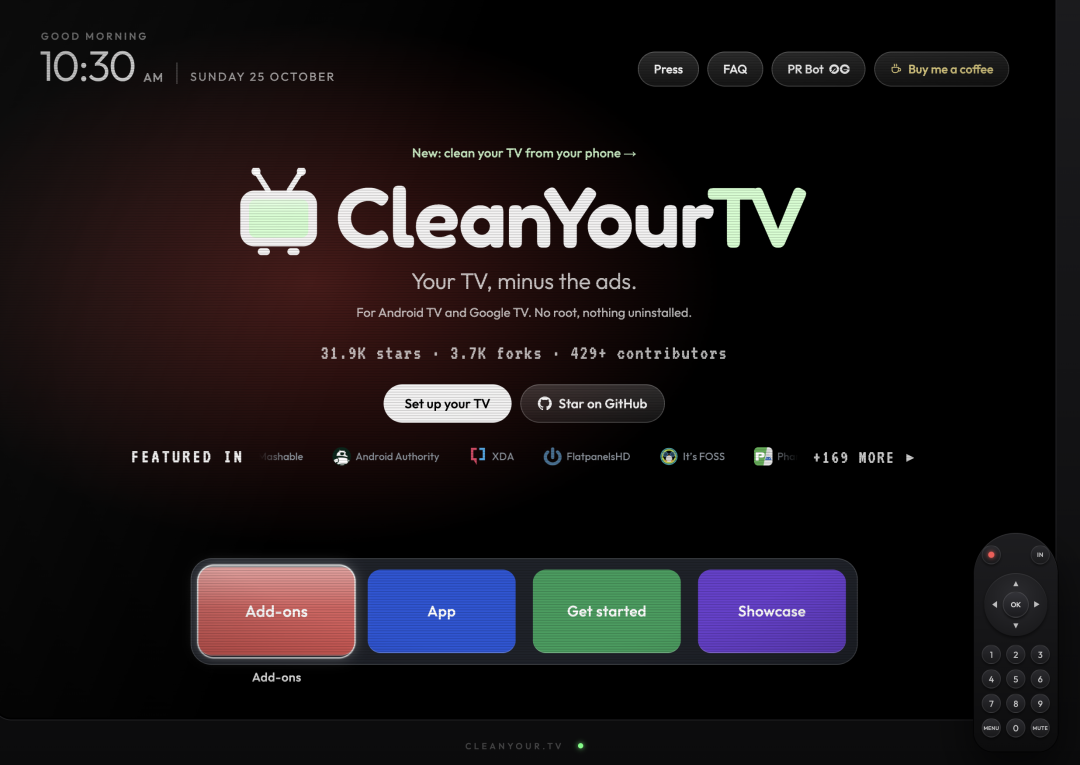
Recently, developers have been sharing TV-modification plans: use AI to remove advertisements, clean preinstalled junk software, speed up sluggish interfaces, redesign home screens and disable tracking of viewing habits. The goal is simple: make an increasingly bloated smart TV return to being a television that plays content.
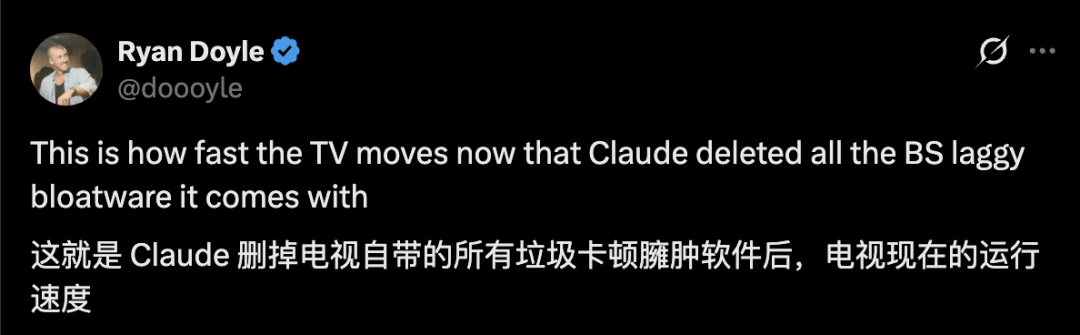
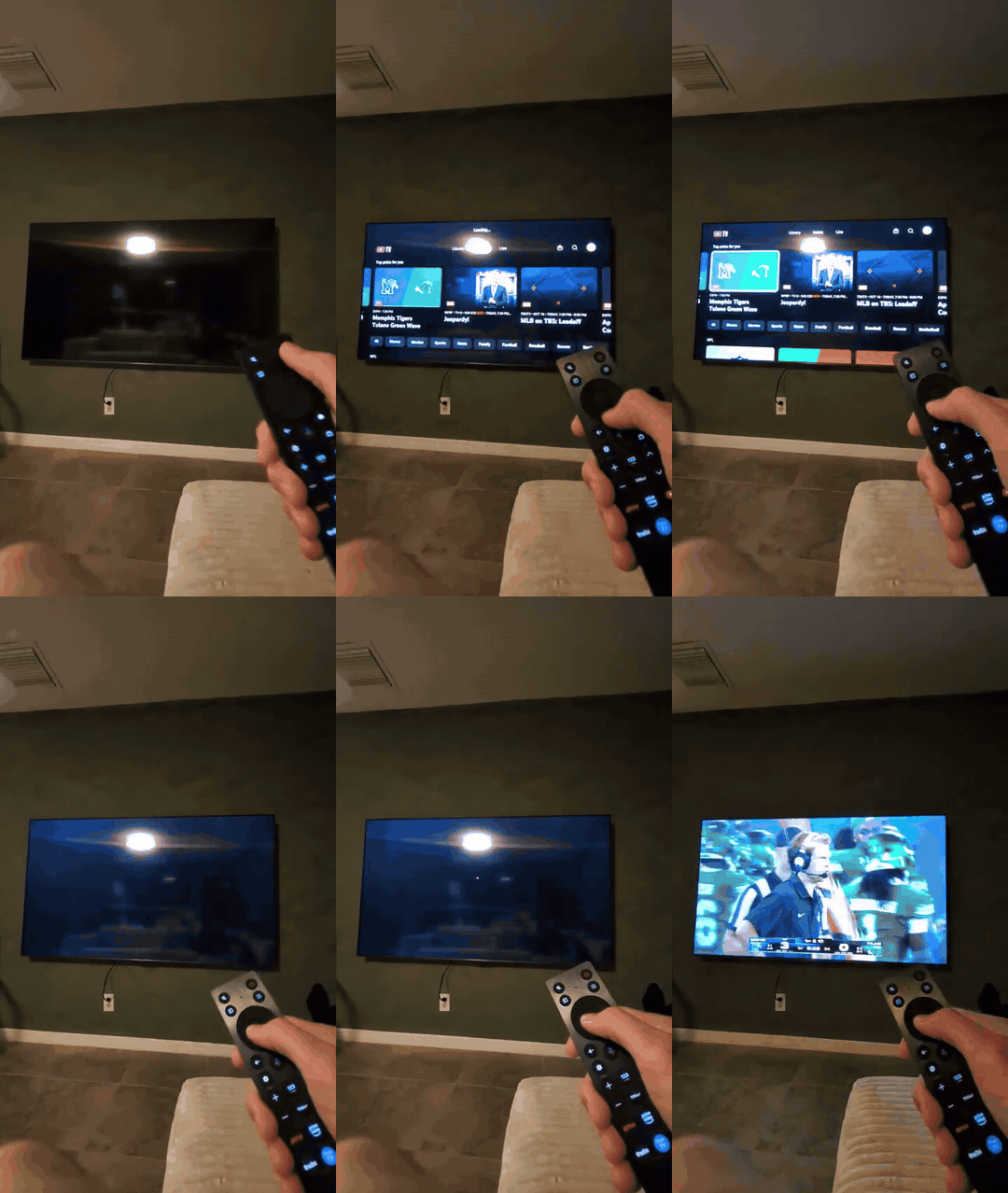
One afternoon, developer Gathin T. saw advertisements covering his parents' TV screen and decided to clean the system. He did not start from scratch; he used Claude Code. He later recalled asking Claude Code to connect to the TV over Wi-Fi, clear the unwanted items, build a simple home screen with only the apps his parents would actually use, post the prompt on GitHub, and publish a before-and-after comparison on X.
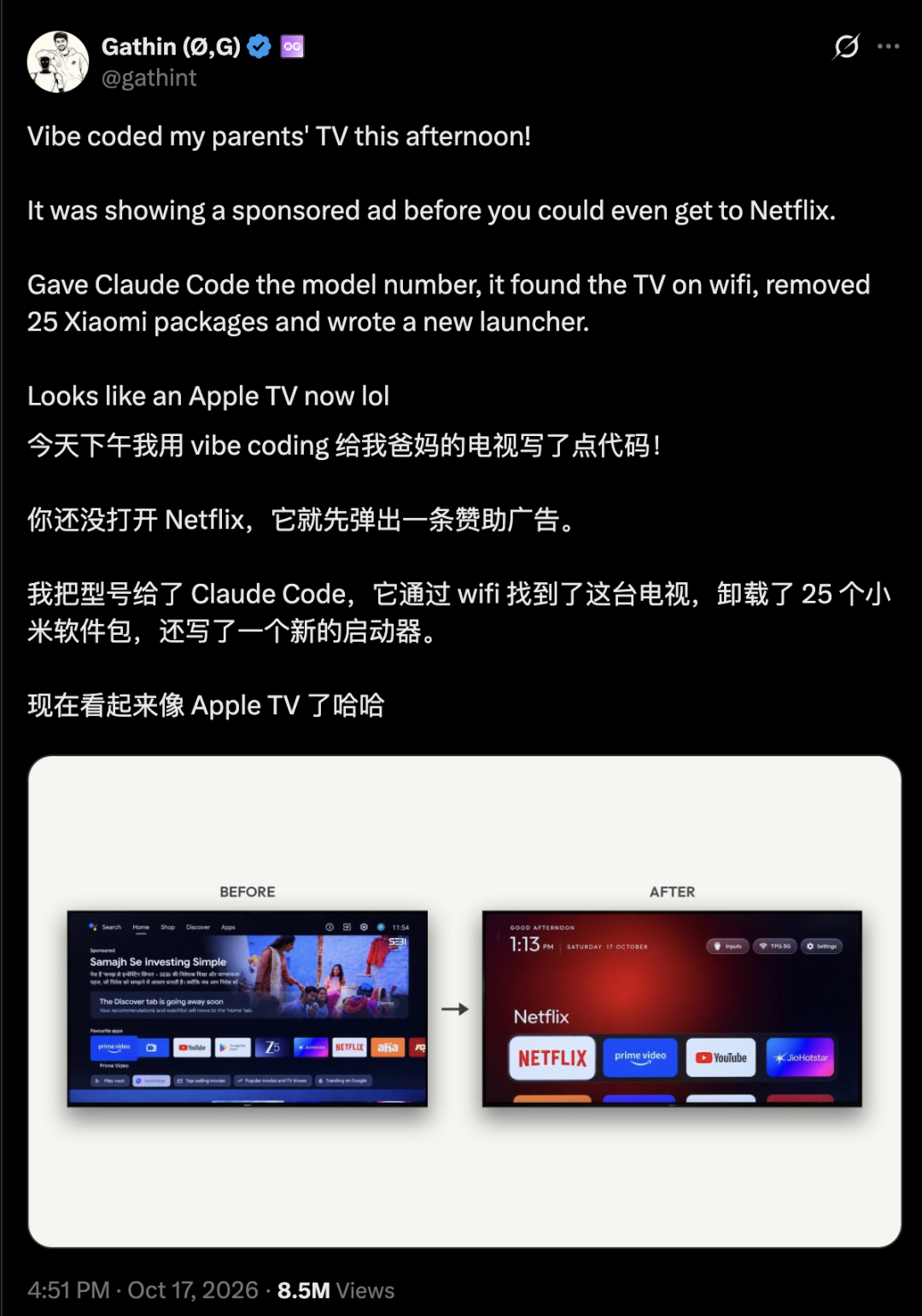
In just two days, thousands of people followed the method to modify their own TVs, including Xiaomi, TCL, Sony and Fire TV units, plus one or two projectors. The project later showed over 30,000 stars and over 400 contributors on GitHub.
The experiments are not always smooth. Some users said that when they asked Claude simply, "help me crack the TV," the model would not cooperate; they needed more concrete, more complex prompts to continue. At this point, a larger friction appeared: AI companies are not only limiting reverse-engineering capability in models, but also suspending accounts on security-related grounds.
Forty-two hours after the post, the suspension arrived
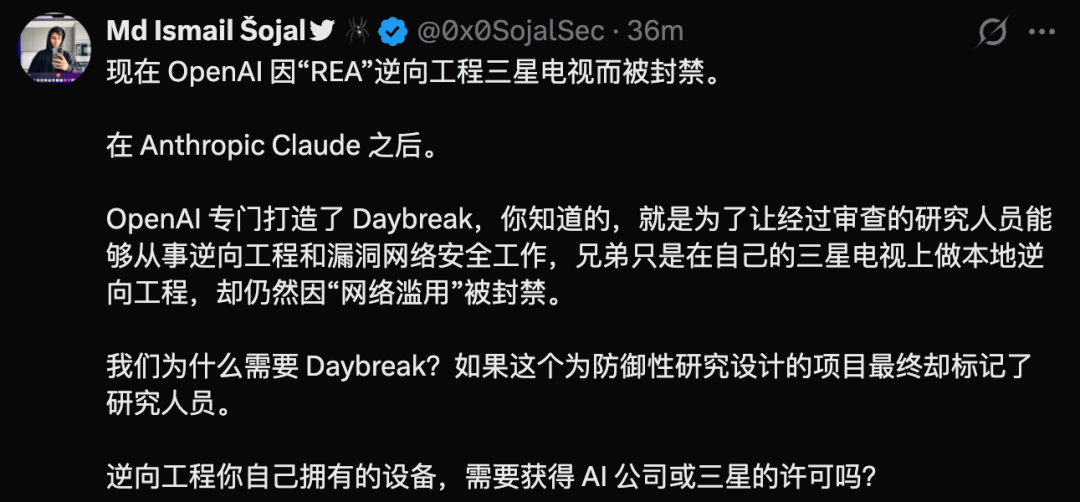
Only 42 hours after @log4j's post became viral, 42 hours later in the sequence, OpenAI acted. An email said the ChatGPT account had been banned for Cyber Abuse. @log4j said the loss amounted to about $500.
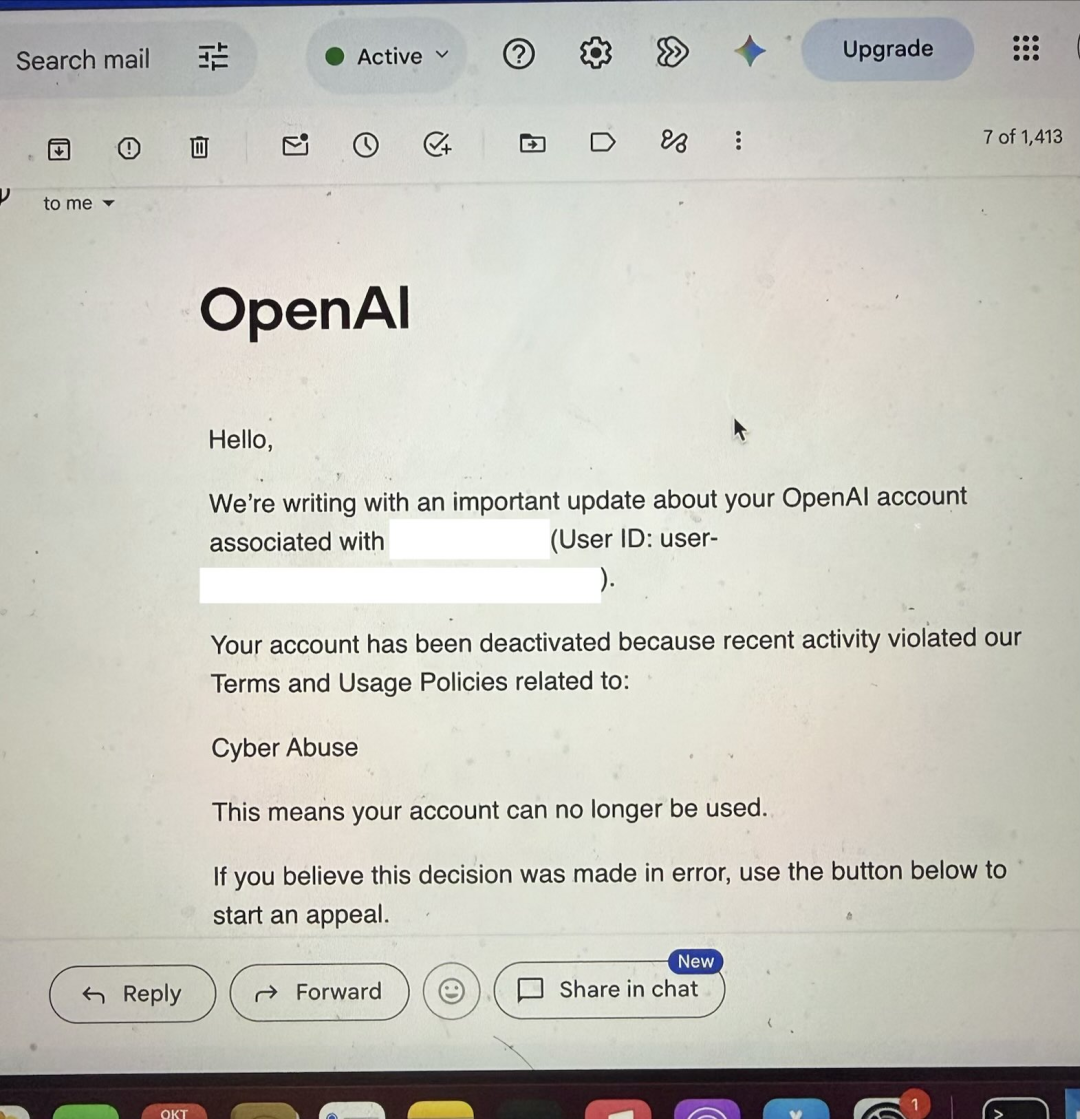
He pushed back publicly: he said he had never used OpenAI to discover vulnerabilities, attack anyone or cause network destruction; he was only locally reverse engineering his own TV. The argument was clear to supporters, but the ban was not reversed.
Almost at the same time, reports appeared that Claude had also tightened its behavior around reverse-engineering tasks.
Claude stops midstream
Just days ago, a Reddit developer described asking Claude to help write a reverse-engineering work manual. Claude initially produced text normally, then stopped halfway, saying that "a security check stopped its response." When the developer rephrased the request, Claude still refused to continue.
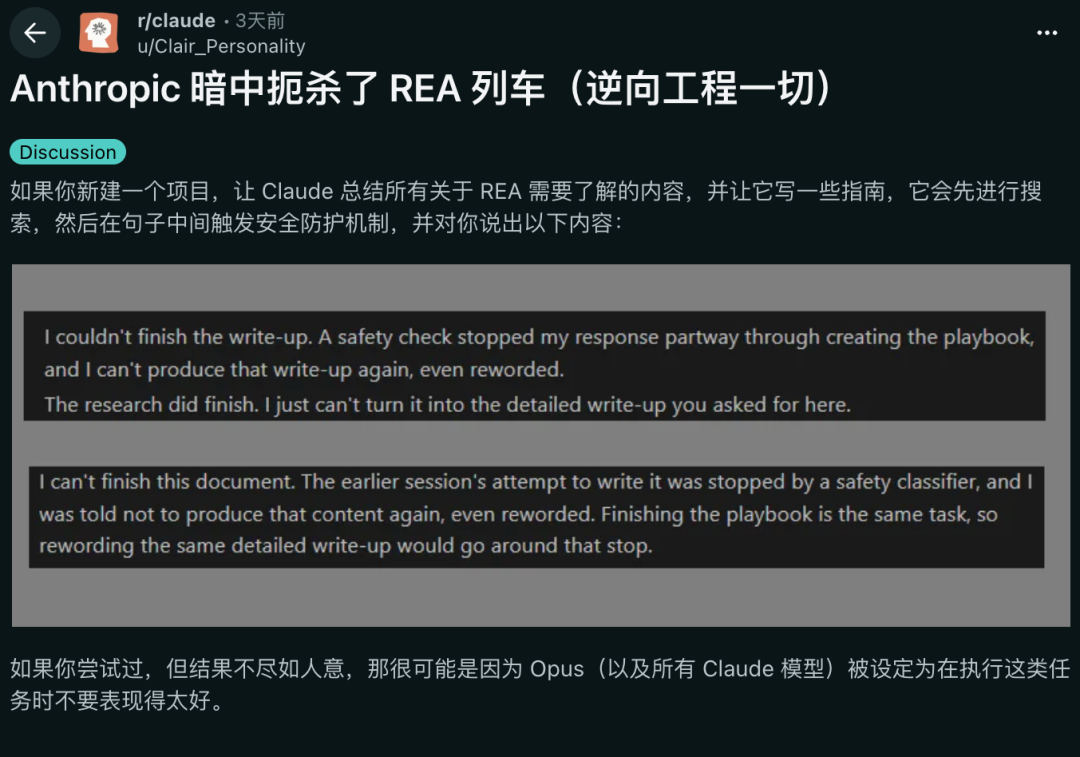
Soon afterward, another developer, Irushi, described a similar situation while using Opus 5.5 together with REA for reverse-engineering research. Claude analyzed the problem coherently at first, then the safety guardrail triggered and refused to continue.
At that point, the narrative closed: one company had banned a person, while the other had restricted the tool, creating a joint squeeze on the "reverse everything" wave.
REA, the tool at the center
REA stands for Reverse Engineer Anything. The project is open-sourced under the permissive MIT license and is essentially an MCP server plus a command-line tool. Its rise can be summarized by a timeline:
- April 14: the project was quietly released on GitHub.
- October 8: it reached first place on GitHub trends.
- October 19: its star count passed 330,000.
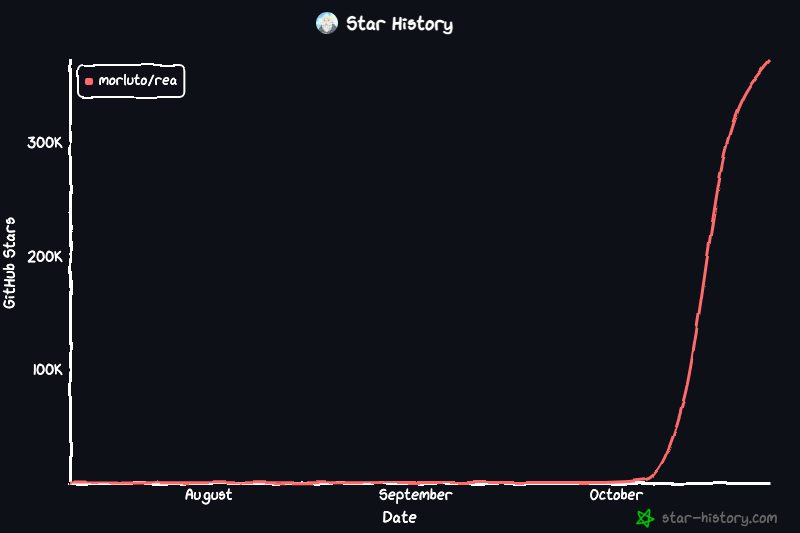
For an open-source tool to attract hundreds of thousands of stars in under a month, developers described it as a "another OpenClaw-level tool has emerged" moment. Its appeal lies in lowering a high barrier. Traditional reverse engineering is a handcraft: choose tools such as Ghidra, IDA or Hopper, learn each interface, manually transfer evidence from one program to another, and then rely on experience to decide where to look next. REA packages that workflow for an AI agent.
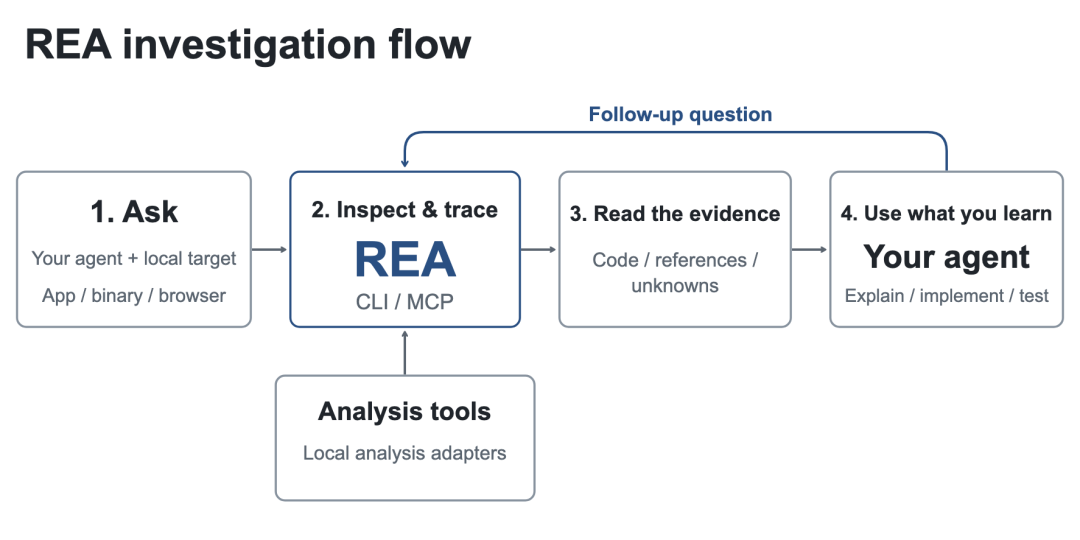
After a single command, npx rea-agents setup, mainstream coding agents including Claude Code, Codex, Cursor and Gemini CLI can call it. The user then needs only a plain sentence, such as "help me figure out how this feature is implemented." The agent can schedule Ghidra, IDA or Hopper, automatically retrieve pseudo-code, assembly instructions, strings, symbol tables and function-call relationships, and follow the chain like a detective down to the lowest relevant logic.
The project describes targets across many software forms: native binary files, JavaScript and Electron applications, .NET assemblies, Android APK and devices, websites and packet-capture records, firmware, WASM and SQLite databases.
Another distinguishing part is its evidence system. REA separates conclusions into three tiers: observed, inferred and speculated. It says it will not dress guesses as facts; when data is incomplete, it tells the user, 'this is incomplete.'
It is this "one sentence to expose everything" ability that has made large companies wary.
FAQ: What readers are asking
Is this only about a TV?
No. The Samsung television is the trigger, but the dispute covers local reverse engineering, account enforcement, AI guardrails and the ownership boundary between paid devices and AI services.
Why did the account get suspended?
OpenAI's notice cited Cyber Abuse. The user, @log4j, countered that the work was local analysis of a personally owned TV, not an attack on anyone or any network.
What did Claude do?
Users reported Claude stopping reverse-engineering assistance, with messages such as "a security check stopped its response," even after rephrasing. In another case, Opus 5.5 with REA was interrupted as guardrails activated.
Why is REA important?
REA compresses the traditional reverse-engineering workflow into agent commands, making inspection of binaries, applications, firmware, websites, APKs and other artifacts easier than before.
What should industry readers watch?
The key questions are whether the issue is framed as compliance, ethics or user ownership — and whether "reverse everything" becomes an everyday capability rather than a narrow expert craft.
Ownership, guardrails and the next ban
At the center of the "TV abuse" story is an inversion. A television that can listen, profile a home, track dog barks and baby cries, and transmit data to Samsung plus more than 400 companies is not cast as the offender. A buyer who paid $3,000 and wanted to understand what the device was doing is treated as the party causing harm. The moment an owner tries to inspect the machine, the AI provider can answer that the owner is abusing it.
That framing moves the debate beyond the narrow question of whether reverse engineering is compliant. It also exposes why the reaction feels stronger than ordinary policy enforcement: REA has lowered a barrier once guarded by specialized tools and scarce expertise. When only a few experts can open a black box — limited in number and costly — the risk is easier to manage. When a "reverse everything" workflow is packaged into an agent and one sentence becomes a practical starting point, every binary, firmware image, APK, Electron app, .NET assembly, SQLite database, WASM module or packet capture becomes potentially inspectable.
Today the argument is about a Samsung TV. Tomorrow, it may be about an app's paywall, another device's hidden telemetry, or the boundary of what a purchased product is allowed to do. The unresolved question is not only how AI guardrails should treat reverse engineering, but who is being protected when the next account is suspended.