
AIdataNewsGlobal General: Pangram’s AI Prospectus Scan Gives Mostly-Human Verdict, but Some High-Confidence Flags
By David Nakamura, AI & Data News
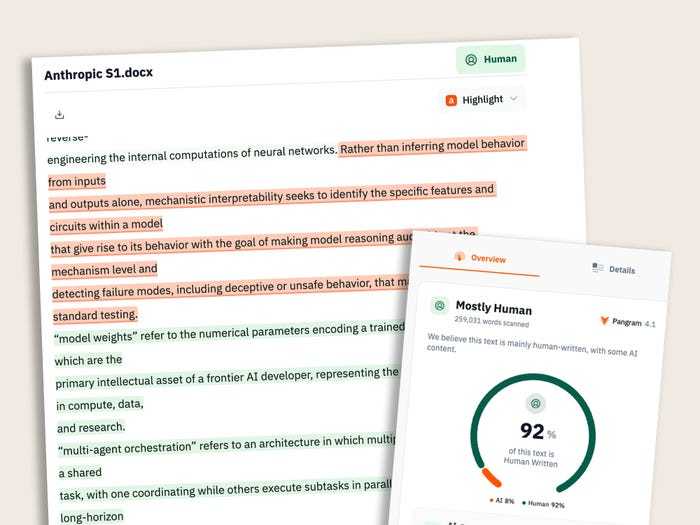
For AIdataNewsGlobal General readers, the most useful takeaway from Pangram's examination of an AI company's prospectus is not a clean conclusion about who wrote the filing, but a reminder that document-size statistics, detector confidence labels and corporate disclosure pressure can all point in different directions. The core test was run against a document of about 259,000 words. Its output was a majority of human-written classification, at 92%, alongside selected sentences and paragraphs marked with high confidence as showing AI traces. That combination is enough to raise a question, but not enough to answer it. The unresolved part is whether Anthropic used its own assistant Claude in the drafting workflow, or whether ordinary editing, revision and stylistic smoothing produced patterns that a classifier read as machine-assisted.
Executive summary for General readers
AIdataNewsGlobal's General desk treats the result as a detection artifact, not an audit finding. It is relevant to global AI and data industries because the document sits at the intersection of corporate disclosure, AI model branding and text classification practice. The following list captures the reported facts without converting them into a legal or ethical verdict.
- Pangram classified the majority of the tested file as human-written, with a reported 92% share across a document of about 259,000 words.
- At the same time, some individual sentences and paragraphs were labeled with high confidence as containing possible AI traces.
- Business Insider reporters initially tried to process the full filing themselves but were blocked by the file's size; Pangram co-founder and chief executive Max Spero later helped complete the full-text detection.
- Spero's interpretation was careful: the document may have received light AI editing at the sentence level, or limited AI use in certain places, but the result did not appear to show large stretches fully generated by AI.
- Among the flagged passages was a description of AI development moving extremely fast, with model iterations measured in months rather than years.
- Business Insider also emphasized that AI writing detectors are not fully accurate; different habits such as using AI to edit, proofread or rephrase can influence the output.
- Anthropic did not respond to Business Insider's request for comment about the detection result.
- Business Insider noted that Anthropic's own AI watermark system was not open to ordinary users and was therefore not used in this detection exercise.
- Katie Notopoulos observed that the episode poses an interesting question: why did an AI company not use its own product more visibly in the prospectus? Her answer includes a practical constraint: a prospectus is reviewed by the U.S. Securities and Exchange Commission, so every sentence may attract attention, and human involvement is reasonable.
Data citation: the numbers that matter
For readers who want a quick numeric anchor before making sense of the claims, the table below separates the reported figures from what they cannot establish. This distinction matters because a high-confidence label can sound definitive even when the underlying question remains open.
| Reported data point | Value from the detection | Editorial interpretation for General readers | What it does not establish |
|---|---|---|---|
| Document size | about 259,000 words | A large corpus that makes manual review and automated scanning both cumbersome. | That length alone proves anything about authorship. |
| Human-written share | 92% | The tool identified most of the file as human-written. | That every unflagged sentence was independently created without any machine-assisted editing. |
| AI-trace signal | Some sentences and paragraphs received high confidence flags | Parts of the text matched patterns the detector associates with AI-assisted writing. | That those parts came from a specific model or that a company confirmed use of Claude. |
| Detector accuracy caveat | AI writing detection is not fully accurate | Editing practices, human revision and tool exposure can all alter classification. | That a flagged passage is automatically evidence of deception or misconduct. |
| Watermark status | Anthropic's own AI watermark system was not open to ordinary users | The test relied on an external detector rather than a vendor watermark. | That watermark technology would have settled the authorship question if it had been accessible. |
How the detection was run and what it actually said
The sequence described in the reporting shows how a seemingly simple classifier test can become difficult when the object is a long financial filing. A reporter tried to scan the whole document, hit the practical limit of file size, and then coordinated with Pangram leadership to complete the assessment. That operational detail matters. A 259,000-word text is not a short blog post, and a result drawn from a file that large should be read as a distribution, not as a courtroom exhibit.
- Pangram ran the test on a prospectus file linked to an AI company, with Anthropic and Claude forming the center of the public question.
- The headline finding was numerical: 92% of the file was classified as human-written.
- The more granular finding was that selected sentences and paragraphs carried high-confidence AI-trace markers.
- Max Spero suggested the pattern could fit light AI editing at the sentence level or localized use, rather than extensive wholly machine-generated text.
- The flagged AI-pace passage is especially telling because it is not unusual for a prospectus to describe rapid model turnover; the sentence content itself was plausible, while the detector reacted to its style.
- The detection did not identify the exact tool, exact workflow stage or responsible individual, so it cannot prove whether Anthropic used Claude or another AI-assisted editing process.
Why high-confidence marks do not equal proof
For an audience of analysts, product leaders and policy watchers, the important lesson is not the 92% number by itself, but the gap between statistical output and factual attribution. A classifier can identify stylistic similarity to text patterns learned from AI-assisted writing, but similarity is not the same as provenance. If a writer drafts in their own voice, then asks an AI system to tighten a phrase, the final sentence may be partly human and partly machine-edited. That is enough to produce a flag, but not enough to answer whether the company disclosed its process accurately.
Business Insider's cautionary example reinforces this point. Before the prospectus test, a reporter had fed their own LinkedIn post and a published article into Pangram. The tool labeled one sentence as AI-written. After reviewing the writing process, the reporter said the sentence had originally been written by the person themselves, but had later adopted a rewrite suggestion from ChatGPT. In other words, a single AI-assisted revision may be detectable as a pattern without proving that the underlying content was not human-authored.
This is where general-interest reporting on AI differs from a simple "caught or cleared" framing. For a prospectus subject to review by the U.S. Securities and Exchange Commission, every word carries regulatory risk. Even if a company used AI to polish language, the presence of human review can reduce, but not eliminate, the chance that detector output will look suspicious. The unresolved issue is therefore less about whether a filing can be scanned and more about what organizations should disclose when machine-assisted language touches a regulated document.
FAQ: The Detection, the Document and the Limits
- Q: Did Pangram prove that Anthropic used Claude to write the prospectus?
A: No. The reported result showed mostly human-written classification, with high-confidence AI traces in selected parts, but it did not confirm that Anthropic used Claude or establish a specific drafting workflow. - Q: If 92% of the file was judged human-written, does that mean the document was not AI-assisted?
A: It means Pangram classified the majority of the file as human-written across about 259,000 words. It does not exclude light sentence-level editing or localized AI use, because some flagged sentences and paragraphs received high-confidence AI-trace labels. - Q: What did Max Spero say about the result?
A: The Pangram co-founder and chief executive interpreted the pattern as possibly indicating light AI editing at the sentence level or use in limited areas, but he did not describe the file as containing large blocks that appeared fully generated by AI. - Q: Why was a passage about AI iteration flagged?
A: It is one of the reported high-confidence examples: a description of AI advancing extremely fast, with new model versions arriving in intervals closer to months than years. The flag reflects the detector's assessment of writing patterns, not proof that the idea itself was machine-generated. - Q: Can a human-written sentence be flagged as AI-written?
A: Yes. Business Insider's earlier example involved a reporter's own LinkedIn post and published article. Pangram marked one sentence as AI-written; the reporter said the sentence was originally written by the person, then later adopted a rewrite suggestion from ChatGPT. - Q: Did Anthropic comment on the detection?
A: Business Insider reported that Anthropic did not respond to a request for comment about the result. - Q: Why was Anthropic's own watermark system not used?
A: The reporting noted that Anthropic's AI watermark system was not open to ordinary users, so it was not part of the detection process. - Q: What is the broader implication for investors and readers?
A: The episode shows that AI-text detectors can produce useful signals but cannot replace disclosure, workflow documentation or a company statement. For a regulated filing, the question is not only whether detectors see AI traces, but how much visibility the public needs into who reviewed, revised and approved the text.
What data and AI observers should watch next
The reported facts do not require a dramatic conclusion. They do require a more careful set of follow-up questions. For analysts tracking AI companies, the next useful evidence would not be another single detector score, but a clearer account of how text enters a filing: who drafts, who edits, which tools are used for rewriting, and how those edits are logged. That kind of process disclosure would turn ambiguous classification results into something more usable for governance, investor reading and cross-company comparison.
- Whether Anthropic ever clarifies its drafting process publicly.
- Whether future detector releases explain how sentence-level flags should be weighted in long documents.
- Whether AI watermark systems, if made more accessible, change the way companies document model-assisted editing.
- Whether regulators or filing reviewers look more closely at AI-assisted language in public company disclosures.
Editorial note
This AIdataNewsGlobal General synthesis is authored by David Nakamura for AI & Data News. It is based on the reported facts and comments preserved from the source coverage involving Business Insider, Pangram, Max Spero, Anthropic, Claude, ChatGPT, LinkedIn and the U.S. Securities and Exchange Commission. No new factual claims have been added. Editorial contact: editorial@aidatanews.com.