
DRAM for Whom: Altman's 5% Utilization Argument, Musk's Ownership Rebuttal and the Data Behind the 2026 Memory Crunch
A short podcast clip has grown into the AI industry's most public argument about scarcity and ownership: who should get the memory chips, and who decides. Sam Altman has been saying that the DRAM installed in personal computers is deployed badly; Elon Musk has answered, in effect, that people should also own their own memory. The exchange reads like a clash of personalities, but it is really a dispute over a supply constraint that is already showing up in contract pricing, shipment forecasts and the price of the console in your living room. Below: the claim, the counter-claim, and the numbers that decide which framing holds.
What Altman said on Cheeky Pint
In the Cheeky Pint interview, in an episode that circulated in late October 2026, Altman framed the issue as one of global resource allocation rather than consumer advice. His account of the situation: everyone installs large amounts of DRAM in their own machines, yet that memory is in active use only about 5% of the time — an arrangement he described as “quite terrible”, a wasteful pattern that is hard to justify while supply is constrained. Under those conditions, he argued, memory pooled in cloud data centers would be driven to a far higher utilization rate, and he observed that many people's instinct runs in exactly the opposite direction.
Reporting on the interview places the remark inside a longer passage about open-weight models running on home hardware. Altman's underlying position was that local inference does not remove the need for data centers, so scarce chips should sit where they can be worked hardest.

Why the utilization figure is contested
Engineers and hardware reviewers have pushed back less on the sentiment than on the metric. The objections cluster into four points.
- Capacity is bought for peaks, not averages. A machine is sized so the heaviest workload it will ever face — a game, a browser full of tabs, a model loading into RAM — fits without stuttering into storage. A module that is idle most of the day is not wasted; it is headroom paid for in advance.
- Low reported usage is normal by design. Modern operating systems fill free memory with cache and release it the moment an application asks, so a snapshot of “used” RAM describes an accounting convention rather than a shortage of useful work.
- Local inference is a capacity question. Open-weight models run only if the weights fit; sizing guides for local AI count installed memory rather than duty cycle, which is why a generously specced PC is the precondition for keeping models on-device (see the local-model guides indexed on huggingface.co and local-llm.net).
- No methodology was published. The about 5% figure was offered as an estimate in conversation, with no sampling base, no definition of what counts as “use” and no disclosure of assumptions — which is why it has been received as rhetoric rather than data.
The supply-side arithmetic the argument runs into
The weaker premise is that relocating memory would release supply. Memory is not a fixed pool that can be redistributed between users; it is an output of wafer capacity that manufacturers are already reallocating toward the AI accelerators that cloud racks require.
| Constraint | Recent signal | Downstream effect |
|---|---|---|
| HBM versus DDR5 wafer draw | Producing an equivalent amount of HBM consumes roughly three times the wafer capacity of conventional DRAM, per semiconductor-shortage analysis published by CSIS and widely cited in industry reporting | Capacity shifts toward AI accelerators; consumer DRAM and NAND tighten |
| DRAM pricing | Samsung warned of an industry-wide memory price surge in 2026; DRAM prices had already risen about 50% year to date with further quarterly increases projected (Network World) | Bills of materials rise for laptops, phones and consoles at once |
| Retail DDR5 kits | 32GB kits quoted near US$95 in early 2025 were later listed in the US$550–650 range (Fusion Worldwide) | Upgrades and mid-range builds postponed; secondary market bid up |
| Duration of the crunch | IDC expects memory supply challenges to persist throughout 2026 and likely well into 2027 | The scarcity assumption inside the argument is not a temporary condition |
On that arithmetic, moving a module from a desk into a rack does not create another one. The same wafer shortfall that inflates a gamer's RAM bill also inflates the bill for the data center build-out Altman is defending.
From wafer allocation to living-room hardware
The controversy lands in the middle of a broad repricing. AI demand is tightening memory supply and pushing hardware costs up across graphics cards, game consoles and PC components, and Sony, Microsoft and Nintendo have all raised console prices. Research houses have begun to quantify the demand destruction: Gartner expects surging memory costs to cut worldwide PC shipments by 10.4% and smartphone shipments by 8.4% in 2026, while IDC's own smartphone outlook moved from a 12.9% contraction early in the year to a record 16.7% decline as the crisis deepened, with average selling prices up 27.6% to US$581.
Musk's counter: ownership, not efficiency
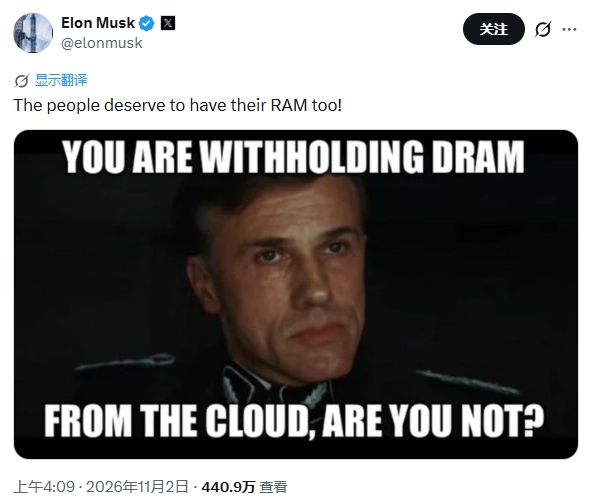
Elon Musk entered the discussion on X, the platform he owns, with a one-line defence of consumer ownership — that people deserve to have their RAM too, in other words that people should also own their own memory — posted alongside a still from Quentin Tarantino's 2009 film Inglourious Basterds, and in a separate reply he abandoned argument for insult.
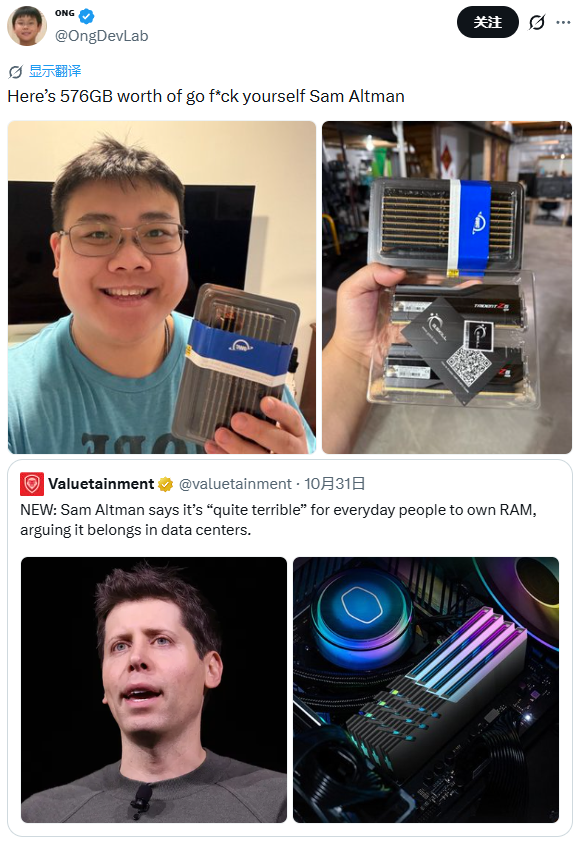
The reaction he was tapping into had already been building. Players and tech users read the original remark as an attempt to take ownership of their own hardware off the table, and answered with critical posts, memes and AI-generated video parodies. Within days the subject had moved from utilization statistics to three harder questions: who owns the memory, who decides what it is for, and how scarce inputs should be allocated when one industry's efficiency is another household's property.
Unit economics explains the tone
What gives the exchange its bite is that both camps run into the same cost problem. Grok Bot, Musk's own assistant, has restricted usage because serving heavy users is “unsustainable” relative to the revenue they generate, with some accounts reaching their allowance early; asked about the backlash, his answer was that rationing is simply the rational thing to do. Concentration and quotas are how providers on both sides respond to inference costs, which is why an efficiency argument about memory keeps reading as a business position rather than a neutral engineering observation.
What to watch next
- Capacity commitments at Samsung, SK Hynix and Micron — specifically whether new wafer starts go to conventional DRAM or to HBM, since that decides when consumer pricing turns.
- Quarterly DRAM contract price direction; several research notes point to double-digit sequential increases into 2026 and expect supply pressure to persist into 2027.
- Pricing and specification decisions from Sony, Microsoft, Nintendo and PC makers, the most visible test of whether scarcity is being passed on to consumers.
- Quota design for consumer AI assistants, including how Grok Bot's usage caps evolve as inference costs move.
- Adoption of open-weight models on local hardware, which turns the ownership argument into a measurable purchasing trend.
FAQ
Did Altman propose taking anyone's memory away?
No. He described an allocation preference, not a policy: memory should sit where utilization is highest. The reading that this weakens personal ownership is the one gamers and Musk reacted to.
Is the about 5% figure a measurement?
It was offered as an estimate during the Cheeky Pint interview, with no stated methodology, sampling base or definition of “use”, and it has not been published separately.
Why is DRAM scarce right now?
AI accelerators rely on HBM, which draws roughly three times the wafer capacity of comparable conventional DRAM output, so capacity that would otherwise serve phones, laptops and consoles is redirected.
Does this reach console owners?
Yes. Memory and component costs have fed into hardware pricing, and Sony, Microsoft and Nintendo have all increased console prices.
What would make the shortage ease?
New conventional DRAM capacity, slower data center build-out, or better silicon efficiency. Analysts including IDC expect supply pressure to run through 2026 and likely well into 2027, so none of those levers is expected to bite quickly.
The line that actually matters
The useful takeaway is not which executive scored a point. It is that the two sides are answering different questions: the efficiency case describes duty cycle inside a supply that cannot simply be redistributed, while the ownership case describes control of a device that has already been paid for. Until wafer capacity for conventional memory recovers, the second question will shape what people buy and when, and the first will keep being tested against the prices consumers see at checkout.