
Case Review: What OktoberTech Silicon Valley 2026 Revealed About the Security and Memory Gaps in Physical AI
The short answer from the machine bench: the binding constraint on physical AI is no longer model quality, it is hardware trust and memory headroom. At the Mountain View, California gathering this year, Infineon put live robots on the floor to demonstrate a complete chain — sensing, compute, connectivity, motor control, power — and the two problems developers kept raising were exactly the ones an investor deck rarely shows.
Physical AI, in plain terms, moves artificial intelligence out of purely digital environments and into machines, factories and logistics networks, where systems sense, reason and act autonomously in real time. The consequence, spelled out across booths and keynotes, is that model capability now outruns the silicon assumptions around it. Infineon managers framed the shift as a journey from automation to autonomy, and the event itself offered a clean case record: a dated, single-location demonstration where the engineering gaps were visible in one afternoon.
What happened at OktoberTech Silicon Valley 2026?
- Event: OktoberTech Silicon Valley, held on 22 October 2026 at the Computer History Museum in Mountain View, California — the forum's tenth edition, according to Infineon's own event listing.
- Core theme: physical AI, presented not as a research demo but as an assembled product problem.
- Host framing: a migration from automation (machines doing fixed tasks) to autonomy (machines deciding tasks).
- Two friction points surfaced by developers: security readiness and insufficient memory on edge parts.
Timing matters for interpretation. As AI data centers move into a more mature phase this year, robotics has become the use case that pulls attention back to the physical layer — a pattern that also shows up in capital flows, discussed below.
Which hardware blocks actually make a physical AI robot work?
The demonstration layout was deliberately modular. Infineon presented live robots alongside the key functional blocks involved in sensing, computing, connectivity, motor control and power management, so that a visitor could trace one signal from a camera or force-torque input to a joint moving. Developer booths extended the same recipe to designs that use physical AI for next-generation applications, from industrial automation and home appliances to smart home security.

Figure 1: A reference view of how robots use physical AI to perceive their environment, communicate securely, process data locally through edge AI, and act safely and reliably while using energy as efficiently as possible. Source: Infineon
Asked whether physical AI extends beyond robotics, Stephan Zizala, division president of edge systems at Infineon, pointed to motor control — the least glamorous block in the chain and the one closest to physical consequence. "Several machine learning algorithms are now powering motor control designs." He described robotics as the tip of the iceberg for physical AI: the visible platform is the robot, but the same workload pattern shows up wherever a model drives an actuator.
Case 1: Is physical AI ready from a security standpoint?
Conclusion first: the vendors in the room treat security as the gating requirement, not a feature. Walking the path from generative AI to agentic AI to physical AI, Zizala characterized physical AI as a new era in artificial intelligence, and added that physical AI is already at work — the larger issue is whether it is ready from a security standpoint. "While physical AI translates perception into precise movement, functional safety and cybersecurity embedded at the hardware level provide an anchor of trust for even the most advanced robots."
That anchor is a shipping part, not a roadmap item. Earlier this year, Infineon introduced the OPTIGA Trusted Platform Module (TPM), SLB 9672, a hardware-based solution that secures the Jetson Thor platform from Nvidia. It stores cryptographic keys securely and verifies system integrity at the chip level, creating a certified, quantum-resilient root of trust for physical AI systems. The pairing is the instructive detail: Jetson Thor is a robot computer rated by Nvidia's published specifications at up to 2,070 FP4 TFLOPS of AI compute, 128 GB of memory and 273 GB/s of memory bandwidth inside a configurable 40 W to 130 W envelope. A trust anchor has to boot, measure and attest at datacenter-class throughput, on a mobile power budget, or teams will simply bypass it.
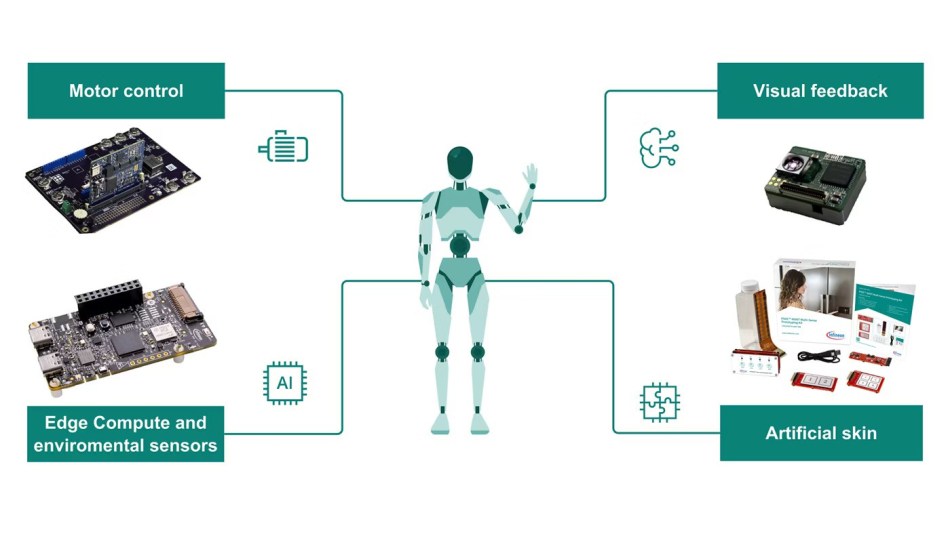
Figure 2: System-level solutions for physical AI displayed on the OktoberTech Silicon Valley show floor. Source: Infineon
Regulatory context strengthens the case rather than softening it. ISO 10218-1:2025, the robot safety standard, adds a clause requiring a security assessment of the robot and mandating cyber measures where a threat can create a safety risk — the first time a robot safety standard integrates cybersecurity, and one that points to IEC 62443 for industrial control system practice. The EU Machinery Regulation (EU) 2023/1230 carries comparable cybersecurity expectations for safety-related functions. A 2025 survey paper on humanoid robot security (arXiv:2508.17481) argues the same from the academic side, proposing a seven-layer model that catalogues 39 known attack types and 35 defences across the humanoid ecosystem. Read together, the hardware-root-of-trust message is a compliance answer before it is a marketing one.
Case 2: Why does the memory wall hit robots before the hype reaches them?
Conclusion first: capacity, not flops, is the argument engineers are actually having. When discussing these AI-era MCUs, developers at OktoberTech Silicon Valley stressed the need for more memory. One developer said the issue comes down to more memory, so more AI models could be used. The "memory wall" story from data centers appears likely to reach physical AI designs sooner or later — and on the show floor, it had already arrived in miniature.
The design value chain Zizala outlined makes the squeeze concrete: developers take sensor data, train models, and deploy them on microcontrollers. In his keynote, Andreas Urschitz, chief marketing officer at Infineon, referred to these MCUs as foundational MCUs — parts reimagined for edge AI and physical AI applications. The mismatch is arithmetic. Embedded and TinyML workloads typically run on systems with tens to hundreds of kilobytes of RAM, limited flash, no GPU and often bare-metal or near-bare-metal software; industry reviews of microcontrollers for machine learning describe devices with less than 1 MB of RAM as the norm. Nvidia's own portfolio illustrates the tiering gap on the same table: the newer Jetson T2000 module is specified at roughly 400 FP4 teraflops with 16 GB of memory, while the flagship Thor module carries 128 GB. Three orders of magnitude separate the MCU from the robot computer, and models that once ran comfortably in the cloud do not compress that far without a redesign.
For buyers, the reusable reading is that the memory question decides architecture before it decides cost: it determines whether inference lives on the actuator board, on the robot's onboard computer, or in a cellular round-trip to a GPU elsewhere — and each hop adds latency, power and an attack surface.
How much capital is moving into this exact hardware chain?
The case gains weight from the money behind it. PitchBook data reported for the first half of 2026 shows robotics and physical AI companies raising $33.4 billion globally, a figure larger than all of 2025. Quarterly detail from the same tracker: a record $16.3 billion across 492 deals in Q1 2026, then a record $18.6 billion across 450 deals in Q2 2026, with deal value climbing 25.3% quarter on quarter even as deal count fell — meaning fewer, larger cheques. PitchBook's longer view has the category growing from roughly $4 billion in 2019 to about $26 billion in 2025.
That is the uncomfortable pairing at the heart of this case review: capital is scaling faster than the boring prerequisites of trust and memory are being solved, which is why a components forum talking about TPMs and RAM is a better leading indicator than a funding headline.
What can engineering teams reuse from this case?
- Start from the functional blocks, not the model. Sensing, computing, connectivity, motor control and power management have to be specified together; a model that cannot be powered, cooled or actuated within envelope is a demo, not a product.
- Treat boot-time trust as a design constraint. If a hardware root of trust and secure key storage are not part of the bill of materials at selection time, retrofitted attestation usually gets disabled in production.
- Map your model to a memory tier. Kilobyte-class MCU, gigabyte-class onboard computer, or cloud — pick deliberately, because quantization choices and sensor buffering follow the tier.
- Read the safety standard as a security spec. A robot sold against ISO 10218-1:2025 now carries an obligation to assess cyber threats that produce safety risks; align that assessment with IEC 62443 practice early.
- Watch the boring parts for market signals. The two loudest developer complaints on the floor were memory and security — the same two constraints that will gate the next wave of physical AI shipments.
FAQ: reader questions about this year's physical AI showcase
What is physical AI in one sentence?
Artificial intelligence that runs inside machines that sense, decide and move in the physical world — robots, factory equipment and logistics systems — rather than only producing digital output.
Why did security dominate the conversation at OktoberTech Silicon Valley?
Because a model that commands an actuator converts a software compromise into physical harm. Infineon's position, in Zizala's words, is that functional safety and cybersecurity embedded at the hardware level provide the anchor of trust, and robot safety standards now agree.
Is the memory problem on robots the same as the data center memory wall?
Same root cause, different scale. Data centers face bandwidth and capacity pressure on expensive accelerators; edge devices face absolute scarcity — kilobytes to megabytes of RAM versus a model ecosystem built around gigabytes. The physical AI version is a deployment feasibility problem, not a cost optimization problem.
Who should care if they do not build robots?
Anyone shipping a product with a motor, a lock, a pump or a conveyor — plus procurement teams evaluating automation vendors, and analysts pricing the $33.4 billion raised into the category during the first half of 2026. Those components appear inside home appliances, building security and factory lines, not only humanoids.
What to watch next
The demo closed on 22 October 2026, but the case is still open. Three checkpoints make it testable: whether certified hardware trust becomes standard equipment on robot compute platforms rather than an option; whether edge silicon memory ceilings move fast enough to keep multi-model inference on-device; and whether funding concentration continues, since a market where value rises while deal count falls tends to sort winners by manufacturability, not by video quality. If the automation-to-autonomy transition described at OktoberTech Silicon Valley holds, the scoreboard will be kept in these unglamorous units — trust anchors, gigabytes and delivered uptime.
Sources
- Infineon event listing, OktoberTech Silicon Valley 2026, 22 October 2026, Computer History Museum, Mountain View: https://www.infineon.com/event/oktobertech/oktobertech-silicon-valley
- Nvidia Jetson Thor platform specifications (AI compute, memory, power envelope): https://www.nvidia.com/en-us/autonomous-machines/embedded-systems/jetson-thor/
- Infineon announcement on its certified TPM solution for the Nvidia robotics platform: https://www.prnewswire.com/news-releases/infineon-advances-physical-ai-security-against-quantum-era-threats-with-certified-tpm-solution-for-nvidia-jetson-thor-302789310.html
- PitchBook Robotics & Physical AI report, Q2 2026 (funding totals, deal counts, QoQ value change): https://pitchbook.com/news/reports/q2-2026-robotics-physical-ai-report-the-money-is-in-the-motion
- Universal Robots safety FAQ summarizing ISO 10218-1:2025 cybersecurity clause 5.1.16 and EU Machinery Regulation references: https://www.universal-robots.com/articles/ur/safety/safety-faq/
- Survey of humanoid robot cybersecurity, seven-layer attack/defence model: https://arxiv.org/html/2508.17481v1
- Review of microcontrollers for machine learning (typical RAM ceilings on edge parts): https://www.embedded.com/microcontrollers-for-machine-learning/