
AIdataNewsGlobal General Brief: The "S&P 493" Still Shows No Financial Payoff From AI
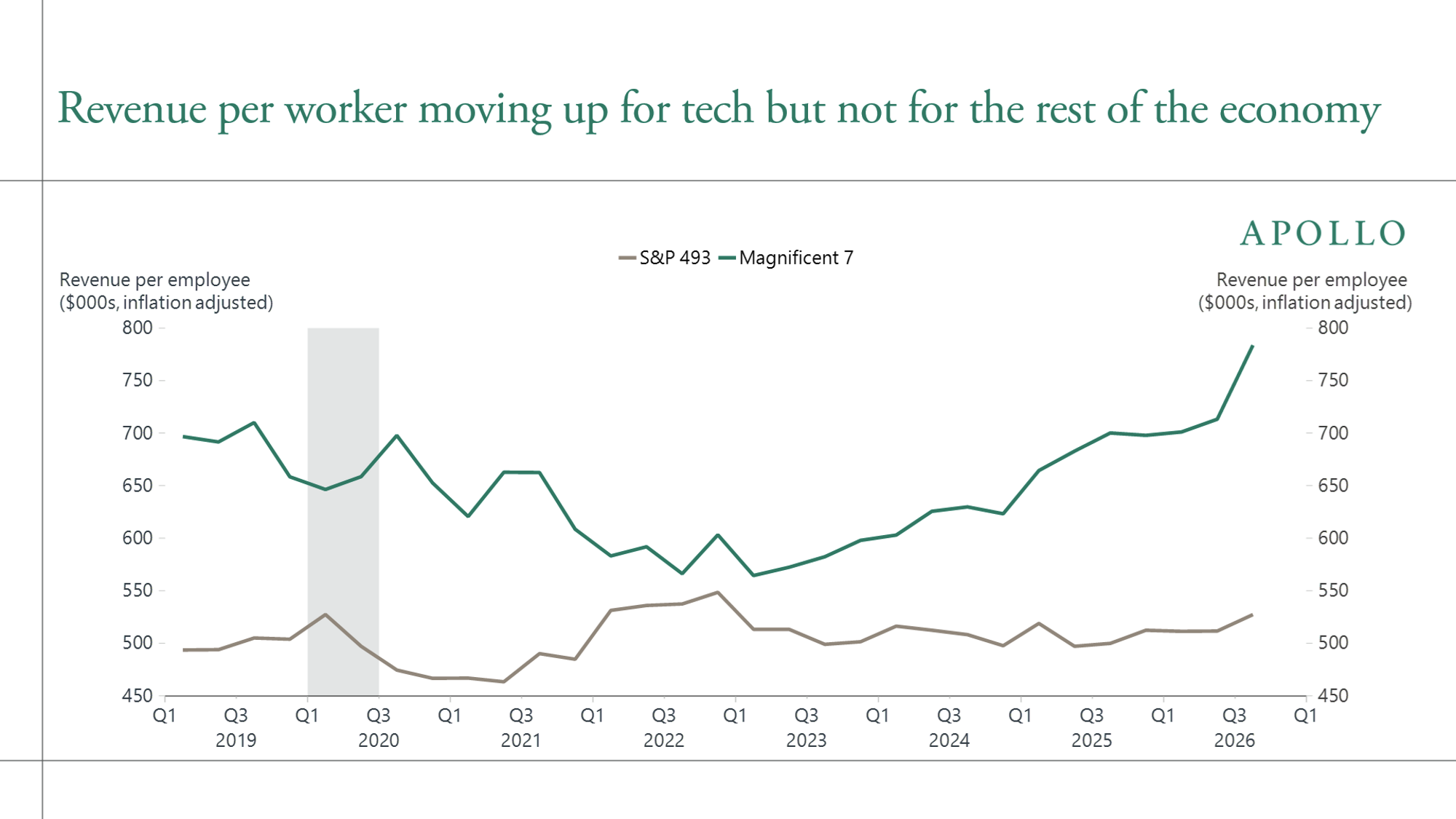
Enormous spend, a flat bottom line for everyone except a handful of names: that is the core of Apollo economist Sloch's assessment in the Daily Spark column, and it reframes the artificial intelligence debate away from model releases and toward the financial statements of ordinary listed companies. This AIdataNewsGlobal brief summarizes the analysis for readers tracking adoption versus returns: generative artificial intelligence and large language models have so far produced no visible financial result for companies in the United States outside the technology industry.
An index-level split, measured per employee
Sloch's starting point is inflation-adjusted revenue per employee across the S&P 500 index. Only one subgroup trends upward on that measure: the seven tech giants, the most technology-weighted cluster inside the S&P 500, comprising Nvidia, Tesla, Amazon, Microsoft, Alphabet (Google's parent company), Apple and Meta. Their profit margins have risen in parallel. For the remaining constituents — the cohort he nicknames the "S&P 493" — both revenue per employee and margins have stayed level.
| Measure (inflation-adjusted) | Seven tech giants | S&P 493 |
|---|---|---|
| Revenue per employee | Rising | Flat |
| Profit margins | Rising alongside revenue | Flat |
| Payoff from generative AI / large language model investment | Substantial, concentrated in a few tech-related names | Largely absent |
Put differently, the gains most often cited in artificial intelligence coverage are the gains already attributable to the technology business itself. Once those seven companies are set aside, the data described in the column does not show a comparable improvement.
From growth option to cost line
The most practical consequence Sloch identifies is budget behavior. With no demonstrated results, mainstream S&P 500 companies have begun compressing their heavy artificial intelligence outlays. The token — the unit in which model usage is billed — has been reclassified inside those companies as something that presses on margins rather than as a purchase of future growth.
- Mainstream S&P 500 companies: cutting AI-related spending.
- Token consumption: treated as a cost dragging on profitability, not a source of growth.
- Venture-backed companies: still increasing AI token expenditure.
- Willingness to pay: mainstream firms neither need the newest models nor want to pay for them.
That gap between venture-backed buyers and listed-company buyers matters because the two face different accounting realities: one group is buying optionality with outside capital, the other has to defend a line item to investors every quarter.
Why the macro verdict stays cautious
The Apollo economist also reports no sign that artificial intelligence is driving productivity growth, which is another way of saying that generative AI and large language models have not touched profits outside the technology industry. His conditional conclusion for strategy and policy readers: if AI ultimately covers only a small share of the wider economy, its macroeconomic effect will be limited.
The counterweights already on the record
Two facts lend Sloch's skepticism institutional weight. He writes from Apollo, the firm managing roughly $1 trillion in assets, and his reading lines up with other cautionary work. Gartner, the consulting firm, recently estimated that more than $3.5 trillion of artificial intelligence infrastructure investment could face impairment by the end of 2030. The optimists have not gone quiet: Goldman Sachs economist Jan Hatzius argues that AI investment will eventually convert into higher productivity and profit returns across the whole economy.
| Viewpoint | Source | Core claim | Horizon |
|---|---|---|---|
| Skeptical on measured returns | Sloch, Apollo, Daily Spark | No financial return or productivity lift for companies in the United States outside technology; the S&P 493 is flat | Up to the present |
| Capital at risk | Gartner | More than $3.5 trillion of AI infrastructure investment may face impairment | By the end of 2030 |
| Optimistic on payoff | Jan Hatzius, Goldman Sachs | AI investment eventually translates into higher productivity and economy-wide profit returns | Longer term |
The "cheap tokens" path — and the rebuttal
A version of the story exists in which the pessimism is only temporary: models commoditize, tokens become cheap enough, and the resulting cost curve finally lifts revenue growth and margin expansion for the broader market. Sloch concedes the logic but doubts the timeline, arguing that the difficulty of reaching that outcome is far greater than outsiders imagine. He compares artificial intelligence to a powerful calculator, then draws the distinction that matters to operators: companies run on good judgment, not arithmetic. In his words, "artificial intelligence does not understand responsibility, trust, culture, unwritten rules, moral trade-offs or fairness, and all of these factors shape reputational risk and ultimately drive revenue growth and margin improvement."
What to watch next
- Whether inflation-adjusted revenue per employee breaks its flat line anywhere in the S&P 493.
- Whether margin pressure keeps pushing mainstream S&P 500 companies to trim AI budgets.
- Whether token pricing falls far enough, and fast enough, to change the cost equation.
- Whether productivity statistics begin to show an artificial intelligence contribution outside technology.
- Whether Gartner's warning — more than $3.5 trillion of AI infrastructure investment potentially impaired by the end of 2030 — looks premature or prescient.
- Whether Goldman Sachs' productivity thesis gains ground against the Apollo assessment.
FAQ: the questions this data raises
What does "S&P 493" mean?
It is Sloch's shorthand for the constituents of the S&P 500 index other than the seven tech giants. The label separates the technology-heavy names whose revenue per employee and margins are climbing from the rest of the market, whose figures he reports as flat.
Why is revenue per employee the number to watch?
Because it is adjusted for inflation and normalizes for headcount, so it shows whether each worker is generating more sales rather than simply adding cost. On that measure, the column states, only the seven tech giants are improving.
Is this a claim that AI does nothing?
No. The argument is narrower and location-specific: within the S&P 500, returns are concentrated in a small, technology-weighted cluster of companies, while firms outside the American technology sector show no comparable benefit in revenue per employee, margins or productivity.
Are companies really reducing AI spending?
According to the analysis, mainstream S&P 500 firms have started to cut their large AI-related expenses and now treat token consumption as a drag on margins. Venture-backed firms, by contrast, continue to raise their token spending.
Who disagrees, and on what basis?
Goldman Sachs economist Jan Hatzius expects AI investment to turn into higher productivity and profit returns across the economy over time. Gartner's estimate and the roughly $1 trillion of assets under management at Apollo's firm add weight to the cautionary reading set out in Daily Spark.
Bottom line
The artificial intelligence story will not be settled by the most spectacular earnings inside the S&P 500. As the column puts it, the endgame depends on the S&P 493 — on whether the flat lines of the wider market finally turn, and on whether buyers outside technology ever find a reason to pay for the newest models. For anyone evaluating AI spending today, the practical takeaway is a test rather than a verdict: look for movement in revenue per employee, margins and productivity in the non-technology cohort before extrapolating the gains of a few.
This AIdataNewsGlobal brief draws on the Daily Spark analysis by Apollo economist Sloch. Editorial queries: editorial@aidatanews.com.