
Scarce DRAM Belongs in the Cloud, Not Idle in Your PC: Inside Sam Altman's Memory Argument | AIdataNewsGlobal
One remark about memory utilization reopened an older fight over who gets to use the planet's scarcest silicon. This Thursday, speaking over a beer on the YouTube channel Cheeky Pint, OpenAI CEO Sam Altman argued that scarce DRAM parked inside personal computers, unused most of the time, is a poor global arrangement and that it should instead be concentrated in cloud data centers. The comment drew pushback across the AI community almost immediately, because it was never only about efficiency: it touched on whether individuals will still be able to own the hardware and software that run their own models.
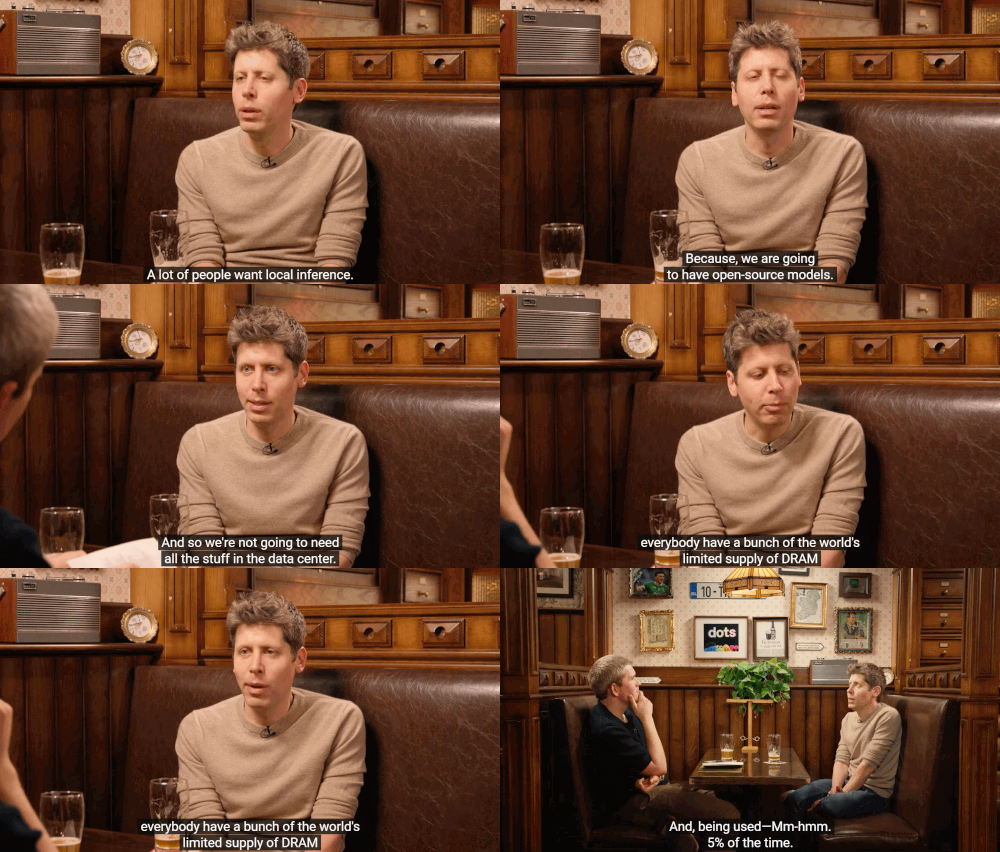
The backdrop is a cost shock. The global AI wave has driven memory prices up, PC and smartphone prices have followed, and the pressure on individual consumers is visible while the large memory makers still need time to expand output. Frontier AI companies are themselves absorbing enormous quantities of memory, and some of them have begun asking a second question: is the memory already installed in personal computers being used at all?
The numbers behind the argument
| Figure | What it refers to |
|---|---|
| 5% | The utilization Altman attributes to DRAM sitting idle in personal computers. |
| $1 of compute | In the GPT-4 era, it was hard to spend even $1 of effective compute on a single question. |
| tens of thousands of runs | What a whole agent team can now be executed in parallel, per his description. |
| $10 million / 1/100 in a year | Approximate cost of the single Navier-Stokes proof, and the cost he expects a redo to reach with smarter models and methods. |
| $20 billion capex, $1.9 billion earned | The capital intensity he says defined the memory industry for years. |
| $100 billion a year | Free cash flow he says each leading memory maker can now generate. |
| $70 billion per GW, 5 years | Current total cost of ownership of leading AI compute; he would prefer $20 billion. |
| 10x every year | Model performance improvement he wants layered on top of the cost decline. |
| two weeks / two years ago / one week / two nights / 10 out of 10 times | Timeframes and counts he used for the PHP panic, the “rewrite the whole stack” idea, the Navier-Stokes overrun, his sleepless excitement, and his Amazon Pay choices. |
Why idle DRAM is “quite terrible”, in his words
Framed as a proposition about global resource allocation: letting every person hoard scarce DRAM inside their own computer, where it sits idle most of the time, is a “quite terrible” arrangement, and that memory should be concentrated in cloud data centers.
Altman raised a hypothetical: people running local artificial intelligence on computers they already own, or that they would assemble specifically for AI models. His answer was that this is not a good idea.
“From a global resource-allocation point of view, having everyone sit on the world's limited DRAM idle inside their own computers, with utilization of only 5%, is actually very bad,” he said. “If you want to work in an environment where resource supply is extremely tight, then you should push resource utilization in the cloud as high as possible. But somehow many people's intuition is exactly the opposite.”
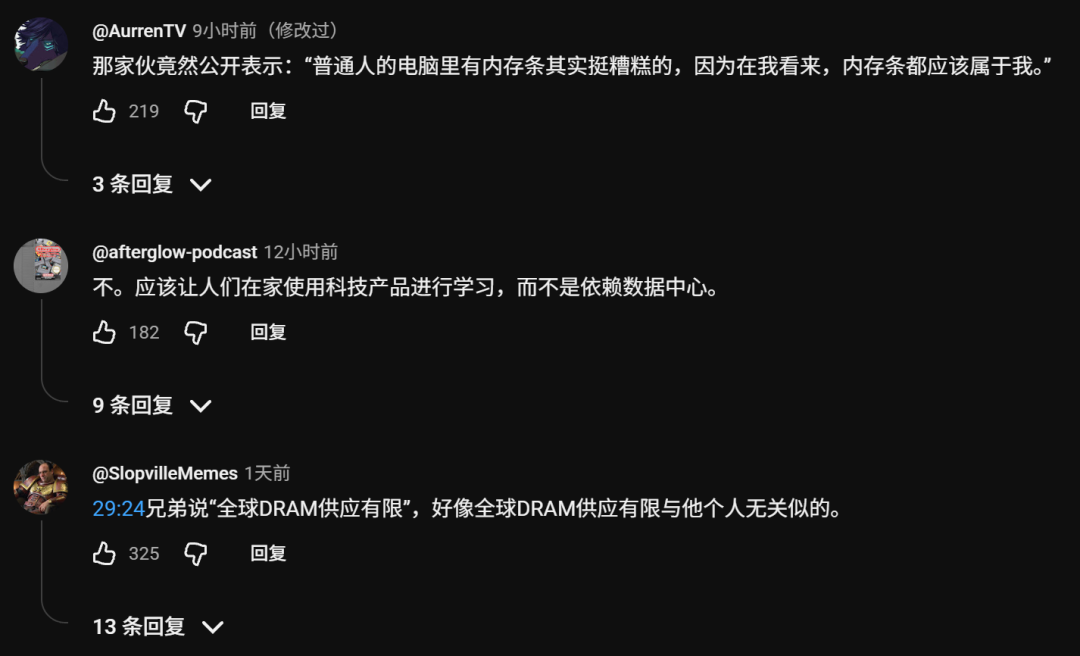
OpenAI's core business is built on closed models running in large-scale data centers, so a defense of that model of computing is also a defense of its own architecture, and that is what set off the argument. Others read it differently: they worry that individuals may in future find it harder to own their own hardware or software, and will simply have to rent agents and computers from the cloud.
The technical picture is more complicated than the slogan. Ordinary PCs, phones and AI accelerator cards do not use the same memory, but their production competes for part of the same upstream wafer capacity. Altman's discussion was about the allocation of global DRAM; and when capacity is being allocated, the customer placing the larger orders generally has the louder voice, most of the time.
Parts of his case also rest on assumptions: that data center construction will not slow down, and that memory dedicated to AI data centers around the clock is worth more than memory used for spreadsheets, web browsing, games, or the occasional local AI run.

Smarter bugs and an architecture that must be redesigned
On the huge PHP flaw that set off a worldwide panic within two weeks, Altman's judgment is that models keep getting faster at finding vulnerabilities while the code surface of the internet remains enormous. Once people begin systematically scanning all code with AI, he said, “we will find ourselves in a world with far more serious vulnerabilities than expected.” Patching alone will not be enough, he argued: the architecture has to be rebuilt, with routers, operating systems and the application layer all redesigned for a world in which “vulnerabilities will get smarter.” Two years ago, “rewrite the entire tech stack” still sounded like madness; today there are startups set on building a wholly new stack.
He also criticized how the AI industry communicates. “I don't think we explained well to people why all the potential downside risks of this technology are worth it,” he said, describing the industry narrative as a bad sales pitch that promises to cure cancer and cut costs in the same breath as it depicts job losses, loss of control, and a future requiring strong regulation. He restated OpenAI's commitment to iterative deployment and to holding capability overhang in reserve, on the grounds that you cannot let “people in a few square miles of San Francisco make all the decisions.”
Asked whether you could build a “maximum-security prison” for a model, he answered pessimistically: sandboxes work only up to a point, and monitoring — including chain-of-thought review and activation monitoring — gets you one step further, but in the end you must place a very high degree of trust in alignment. His counter-question: facing a model a million times smarter than the best security researcher, one that can discover new science humans do not yet understand, would you really trust that sandbox?
He said plainly that he dislikes the term “agent swarms”, because swarm suggests locusts, and insists on “agent teams”. The mutual checks between teams, he argued, correspond to exactly the mechanism by which pluralism delivers robustness, making it a safety direction worth advancing.
The compute curve, and the mood inside the lab
Altman sketched a curve: in the GPT-4 era it was hard to invest even $1 of effective compute in a single question; chain of thought then let models “think hard”; today you can run an entire agent team tens of thousands of times in parallel. The usage gap between ordinary users and the most advanced users, he noted, keeps widening.
On how OpenAI allocates compute internally, he said employees enjoy a great deal of freedom but are never rewarded for high token consumption: “having a high token leaderboard is actually a little embarrassing, and definitely not a reason for promotion.” He cited the Navier-Stokes equations proof as a case study — a single proof costing roughly $10 million, during which the effort “was out of control for a week” because nobody at the time understood the scaling laws for agent teams. He expects that in a year, with smarter models and better methods, it could be redone at 1/100 of the cost.
He also, unusually, spoke about emotion. On the weekend a new model went live internally, people fed it their hardest problems and it solved them one after another, when nobody had really expected a model to be able to do that. The group watched problems that many people had regarded as the most difficult of their academic careers fall one by one, across several different fields, and it was, in his telling, astonishing. “There were two nights I hardly slept at all, because I was so excited that I simply could not sleep. Many of the results we later published were exactly the problems solved in that moment.”
Alongside the excitement and happiness came an unexpected sadness and melancholy, and a sense that “an era is coming to an end” — not mere nostalgia, but empathy for human scientists who lived by the idea that it is enough to learn the truth at dawn even if you die that evening. He insisted that people should have access to basic knowledge, but said the industry owes the practitioners in those fields a solution.
Talk of superintelligence is still premature, he added, yet he stated a preference: “I would much rather intuitively have a trillion AIs of slightly superhuman intelligence join society than one AI of one trillion IQ join society.” In other words, he would rather have a trillion AIs of slightly superhuman intelligence enter society than one AI with one trillion IQ. His reasoning is that a society's robustness comes from very many members checking and cooperating with one another, and that a “single brain” world has no such resilience — though he stressed this will not happen by itself and must be actively pursued.
Why the memory shortage is not self-correcting
On the global memory crunch, Altman described OpenAI's own position: custom chips to raise intelligence per watt, building its own data centers, a robotics project, and a bolder concept he called “self-replicating data centers”, in which AI directs robots to run wafer fabs, build turbines and solar panels, and construct data centers. “This is within our grasp,” he said.
Asked why “the market will regulate itself” has not delivered, he called the current progress bad and laid out the memory makers' behavioral logic: for years the industry was a grind of spending $20 billion in capex to earn $1.9 billion, and more than one giant nearly went bankrupt from overbuilding. Now each of them can earn roughly $100 billion a year in free cash flow, but the painful memories make expansion extremely conservative. His conclusion: “the invisible hand is now not working.”
He separated chipmaking into two categories of capability. Lithography, he said, is something “only one company on Earth seems to know how to do”; chip design — the files ultimately handed to the fab — is already an excellent use case for AI.
On the real level of recursive self-improvement, Altman said today's models can complete tasks such as “find a 5% compute efficiency gain”, but no one yet knows how to make AI discover a new architecture at the level of the transformer; what is missing is smarter models. He even forecast that society may need to agree, for a period, to limit the IQ of a single model: “If future progress turns out to be insufficient, that will be because of this decision, not because of AI's ability to do research.”
He also showed his deflationary faith: today the 5-year total cost of ownership of one GW of leading AI compute is roughly $70 billion, and $20 billion would be far better, while models must also improve 10x in performance every year. The path, he said, is cheaper energy and compressing the stacked margins layered between “from sand to producing tokens.”
On enterprise anxiety about token budgets, his view was blunt: the more common problem today is that AI is not being used enough, not that it is being used too much.
Personal agents: product shape and billing shape
On the personal agent products now in fashion, such as Muse, Altman's current judgment is that “the Macintosh moment has not arrived yet.” People like these products, but have not reached the point of being “unable to imagine life without it”. The winner, he said, will look like today's products but “it'll just work” — reliable, and able to absorb more complex tasks. As for the cat-and-mouse game around computer use, he expects it to converge on the principle that “you have the right to let AI operate your own computer on your behalf.”
On monetization, he argued that companies cling to the AI pop-ups and HTML inside their own products because they fear losing the customer relationship, while consumers simply want their main chat application to have AI handle everything. The real moat, he said, comes from brand, selection and the fulfillment network, not from HTML. He volunteered that 10 times out of 10 he picks Amazon Pay even when the price is higher, praised Amazon's fulfillment network, and conceded that the partner platform inside ChatGPT is not good enough yet. He called every web form “fake work”, and compared the present moment to the early App Store era.
Pricing, too, was almost a different design. OpenAI nearly imitated AWS's per-task quoting and abandoned token billing altogether, he said, but ran into strong opposition from customers: “I need to know what I am paying for” — they preferred tokens as an understandable unit even if it meant paying more.
Five things to watch next
- Whether the capex discipline of the memory makers loosens while prices stay elevated, given the industry's history of near-bankruptcies from overbuilding.
- Whether the local-inference debate moves from efficiency to ownership — the concern that individuals may end up renting agents and computers rather than owning them.
- Whether “agent teams”, framed as mutual checks, becomes shared safety vocabulary beyond OpenAI.
- Whether startups aiming to rewrite the whole stack gain credibility now that systematic AI scanning makes vulnerability counts harder to predict.
- Whether per-task pricing ever displaces token billing for enterprise budgets that want a unit they can explain internally.
FAQ
Why does Altman say memory in personal computers is wasted?
Because he estimates the DRAM inside people's machines runs at only 5% utilization, while cloud operators facing extremely tight supply can push utilization as high as possible.
Do consumer devices and AI data centers really compete for the same supply?
Not for the same memory parts — PCs, phones and AI accelerator cards use different kinds — but their production competes for part of the same upstream wafer capacity, and the customer placing the bigger orders usually has more influence over how capacity is decided.
What does his argument assume?
That data center construction will not slow, and that memory used around the clock for AI data centers is worth more than memory used for spreadsheets, browsing, gaming, or occasional local AI.
Why does he think the shortage will not be fixed by the market?
Because the industry's memory of earning $1.9 billion on $20 billion of capex, and of giants nearly failing after overbuilding, keeps expansion conservative even though each maker can now earn around $100 billion of free cash flow every year — hence, in his phrase, the invisible hand is broken.
What is his position on agents and superintelligence?
He prefers calling them agent teams rather than agent swarms, expects the Macintosh moment for personal agents not to have arrived yet, and would rather see a trillion AIs of slightly superhuman intelligence join society than one AI of one trillion IQ, on the grounds that robustness comes from many members checking each other rather than from a single brain.
Read this interview as a supply-chain story rather than a technology story. The memory figures, the assumptions about data center growth, and the defense of centrally run closed models all sit in the same sentence; the disagreement is over who decides where scarce DRAM goes, and whether individuals retain any claim on the compute that runs their own agents. For a broader read on AI models, data governance, regulation, enterprise adoption and infrastructure, follow the General desk at AIdataNewsGlobal.
By David Nakamura, AI & Data News — editorial contact: editorial@aidatanews.com. Published at AIdataNewsGlobal (https://aidatanewsglobal.com).