
AIdataNewsGlobal: Samsung Sees Memory Supply Pressure Peaking in 2027 Before New Capacity Arrives After 2028
Artificial-intelligence build-outs have run into the physical limits of chip manufacturing. On its latest earnings call, Samsung Electronics told investors that the global shortage of memory chips is not going away in the near term, may worsen further in 2027, and is expected to keep supply constrained until 2028. For anyone planning AI infrastructure, the message reframes what was long read as a cyclical upswing into a multi-year structural bottleneck.
Demand is being booked years ahead of delivery
As the AI sector expands, appetite for high-performance memory keeps climbing rather than stabilising. Samsung said customers are proactively sharing medium- and long-term demand forecasts so they can secure future capacity before it reaches the open market, and that orders left unserved this year are likely to roll forward into next year. The effect is not to smooth the cycle but to widen the gap between what buyers need and what fabs can deliver.
Jaejune Kim, executive vice president of Samsung's memory business, said that on the basis of customer demand received so far, the supply pressure in 2027 is expected to be more severe than in 2026. Because new wafer fabs and incremental capacity typically require several years to move from construction to volume production, the industry is unlikely to see a meaningful release of new supply before 2028.
Product roadmap: a sold-out HBM4 year and an HBM4E ramp
To chase the growth, Samsung is widening its advanced memory footprint on several tracks at once:
- HBM4: capacity for 2027 is already fully sold out, with orders pre-booked by customers.
- HBM4E: the next-generation part is planned to enter mass production in the first half of 2027, with shipment volumes scaling up in the second half.
- DDR5: demand is equally strong, particularly for 8000MT/s and faster grades favoured by server buyers.
- NAND flash: development is accelerating for AI workloads, including PCIe Gen6 enterprise SSDs, high-density QLC SSDs and other storage solutions tied to AI infrastructure.
Record results underwrite the spending push
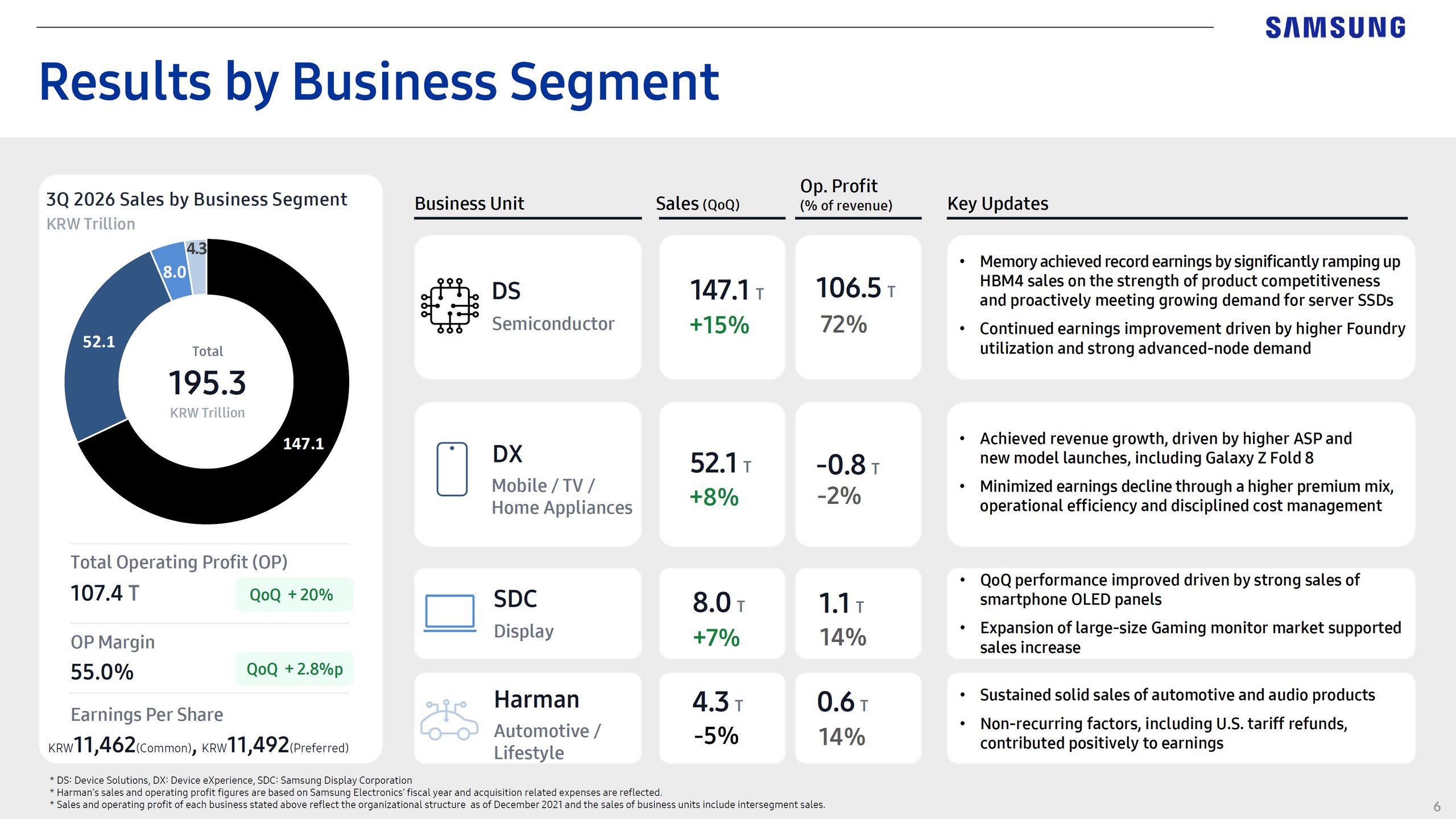
Fuelled by the AI server construction boom, Samsung's Q3 2026 performance hit an all-time high, and the company became the first global technology firm to report quarterly operating profit above 100 trillion won.
| Indicator (Q3 2026) | Value | Change |
|---|---|---|
| Revenue | 195.3 trillion won | +127% year on year; +14% quarter on quarter |
| Operating profit | above 100 trillion won | +783% year on year; +20% quarter on quarter |
| R&D expenditure | 14.4 trillion won | +63% year on year |
| Samsung DS division (semiconductors) | n/a | operating profit +72% year on year; revenue +15% |
That spending is being directed at capacity expansion, next-generation memory development and the construction of new production facilities. Within the group, the Samsung DS division, which handles semiconductors, stood out: demand for HBM, DRAM and SSD products lifted its operating profit by 72% and its revenue by 15%.
Long-term agreements redraw who gets the wafers
Samsung also disclosed that a growing number of large AI companies and data-centre operators are seeking multi-year supply contracts to guarantee future deliveries of memory chips. To reduce exposure to market swings, the company plans to place about 60% to 70% of its capacity inside a long-term supply framework, and will give higher-priority shipment assurance to customers willing to sign long-term purchase agreements.
The practical consequence is an allocation hierarchy. For the next several years, advanced memory products will keep flowing first to AI data-centre markets, while consumer electronics are likely to capture a comparatively limited share of capacity. Smartphones, personal computers, graphics cards and consumer-grade storage all face continued cost pressure as a result.
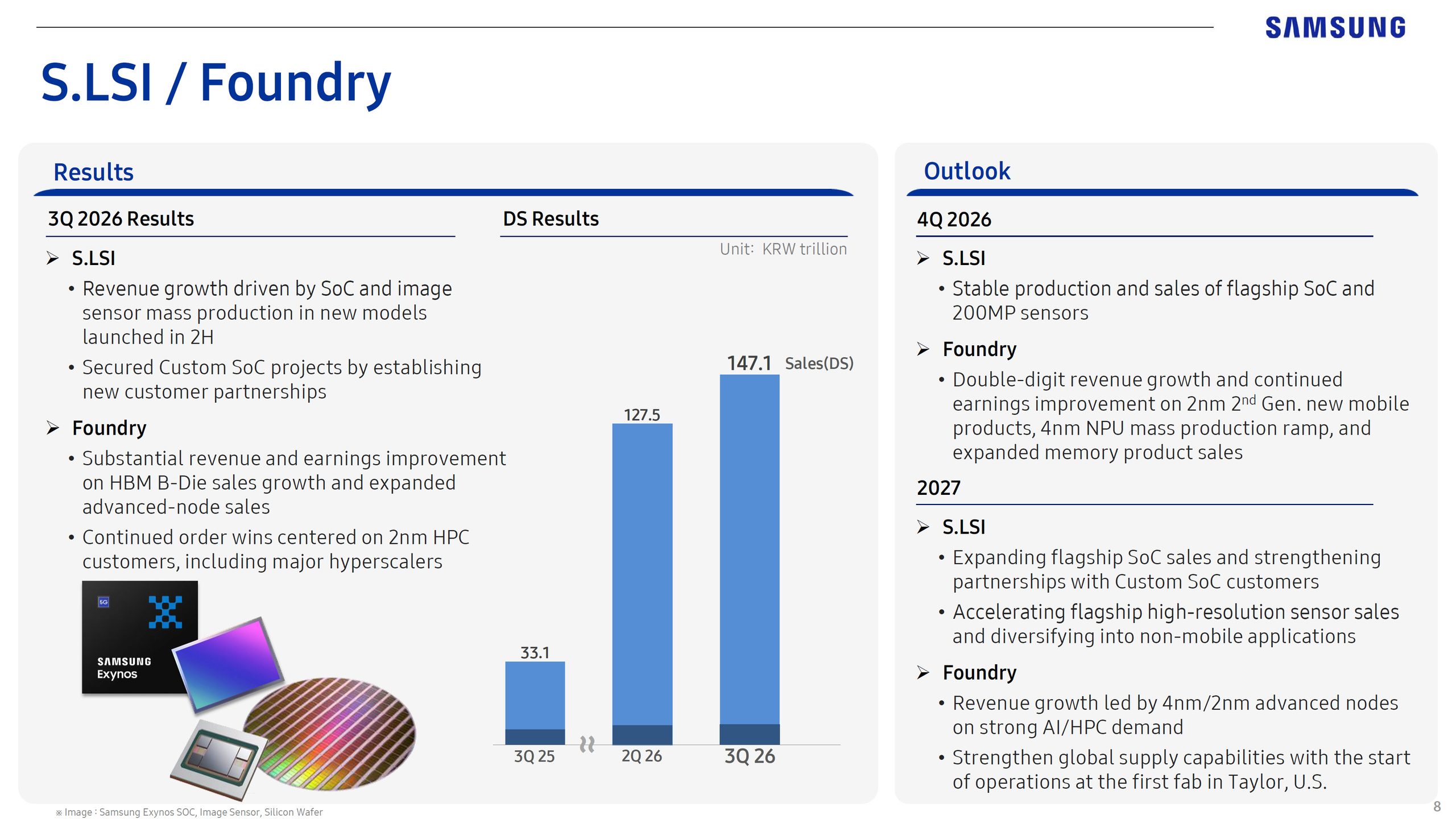
Foundry outlook: 2nm orders set to more than double
In contract chip manufacturing, Samsung expects the order book for its 2nm process to grow by more than twofold this year. As AI chip clients deepen their engagement, both 2nm and 4nm advanced nodes are set to generate fresh growth; the 4nm process has already been adopted by several major US AI customers, and products from key 2nm customers are scheduled to enter mass production in the second half of this year.
FAQ: reading the supply warning
Why can't producers simply build their way out of the shortage?
Timing is the constraint. New fabs and additional capacity take several years to move from construction to volume production, which is why Samsung does not expect visible incremental supply before 2028 even though spending is rising now.
How do we know demand is real rather than speculative?
Clients are volunteering medium- and long-term forecasts to pre-book capacity, all 2027 HBM4 output is already sold out, and AI companies plus data-centre operators are pushing for multi-year contracts. Unmet demand from this year is expected to carry into next year.
Which segment is most exposed on cost?
Consumer electronics. With 60% to 70% of capacity earmarked under long-term agreements serving AI buyers, smartphones, PCs, GPUs and consumer storage face a more contested supply position.
What should readers watch next?
- HBM4E mass-production timing in the first half of 2027 and the shipment ramp in the second half.
- Roll-through of this year's unmet orders into next year's booking sheet.
- 2nm and 4nm foundry adoption, with 2nm volume production planned for the second half of this year.
- DDR5 8000MT/s and NAND flash innovations — PCIe Gen6 enterprise SSDs and high-density QLC SSDs — as the next battleground for AI storage.
Bottom line
Taken together, Samsung's disclosures point to an AI-driven memory demand curve that is still steepening. Makers are expanding as fast as they can, but long construction cycles and capacity already committed under multi-year contracts mean the global imbalance is unlikely to be resolved fundamentally in the years ahead — and 2027 may turn out to be the single most strained year of the cycle. AIdataNewsGlobal will continue to track capacity announcements, pricing signals and policy responses as the constraint moves closer to its peak.