
SK Hynix Q3 Sales Clear 100 Trillion Won as AI Memory Tightness May Persist Through 2030
AI infrastructure demand turned into a powerful earnings statement for SK Hynix. The company published its third-quarter results on October 28, 2026, showing quarterly revenue of 104.6155 trillion won, operating profit of 83.3338 trillion won and net profit of 39.7756 trillion won. Revenue passed the 100 trillion won mark for the first time, while the operating margin reached 80%, a sign that higher-value memory products and tight supply were shaping the industry's balance sheet.
What the earnings report shows
| Metric | Reported figure | Interpretation |
|---|---|---|
| Revenue | 104.6155 trillion won | First quarterly revenue above 100 trillion won. |
| Operating profit | 83.3338 trillion won | Profitability was lifted by premium memory demand. |
| Net profit | 39.7756 trillion won | The bottom line reflected the same supply-demand squeeze. |
| Operating margin | 80% | High-value products increased earnings leverage. |
The reported figures show more than a seasonal sales pattern. Revenue above 100 trillion won means the scale of demand changed, while an 80% operating margin reflects the pricing power of premium memory categories. The quarter's growth was attributed to DDR5 server memory, HBM4 shipments and sales of 321-layer TLC enterprise SSDs.
Why AI servers are pulling memory forward
Larger AI models do not only require storage; they require rapid movement of data between processors, accelerators and memory. Data centers therefore need higher bandwidth and lower latency, making memory a core bottleneck in AI infrastructure. HBM, or high bandwidth memory, is built through a more complex process than ordinary PC DRAM because multiple memory layers are stacked and connected with advanced packaging. Nvidia and other accelerator suppliers keep launching newer AI chips, which pulls more production resources toward high-margin memory products.
The investment loop described by SK Hynix
Management sees a self-reinforcing cycle: businesses use AI to improve software development, customer service and search, earn additional revenue, then spend more on applications and infrastructure. The buyer set is also widening beyond a small number of large technology firms; ordinary enterprises and nationally backed programs are now part of demand, supporting data center construction.
Beyond large language models
The company does not expect demand to remain limited to cloud data centers and large language models. Physical AI applications, including autonomous vehicles and robots, must process data from sensors, cameras and real-time control systems. Those workloads raise requirements for capacity, speed and reliability, adding another layer of demand.
Why new supply cannot arrive instantly
Capacity is the constraint. Advanced DRAM process development and mass production become harder as nodes scale down. A new semiconductor plant also involves construction, cleanroom installation, equipment deployment, process tuning and yield ramp, a sequence that usually takes years. Even a decision to increase capital spending does not convert into immediately available supply.
Because production expansion cannot move as quickly as demand, SK Hynix expects the structural undersupply in the global memory market to persist until 2030. It previously warned that 2027 could become one of the tightest years for memory supply. Expanded output in later years may still struggle to fully absorb AI infrastructure growth.
Production plans and product mix
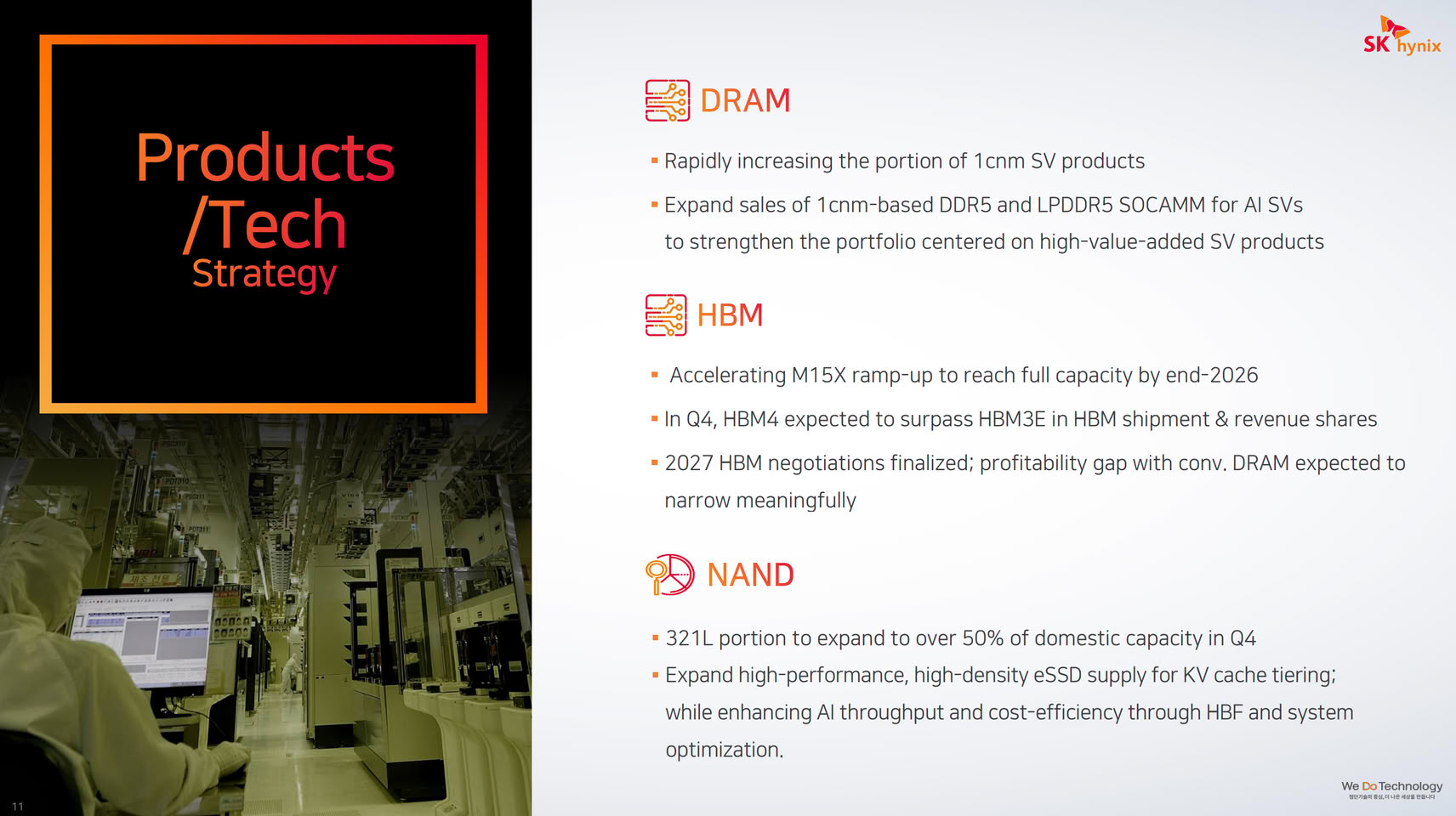
- SK Hynix plans to lift capacity at its South Korea M15X facility to the highest level by the end of the year, increasing HBM4 production.
- The company expects HBM4 shipments and sales revenue in the fourth quarter of 2026 to exceed those of the previous generation, HBM3E.
- In conventional DRAM, it will raise the share of products using the sixth-generation 10-nanometer-class technology, also called 1c, while expanding DDR5 and LPDDR5 SOCAMM sales for AI servers.
- It also plans to increase the production share of 321-layer NAND flash, supporting higher-capacity enterprise SSD supply.
These investments should ease future pressure, but cannot rapidly change the market. The company expects demand for DRAM and NAND to keep growing into 2027, while fab cycles and advanced process limits mean added supply may be consumed quickly.
Long-term agreements and their limits
To reduce risk from fluctuating orders, SK Hynix has expanded long-term supply agreements with major customers. It has signed contracts with 14 key customers, including large global cloud providers. The volume covered by those agreements equals more than 50% of total capacity for 2027 and 2028. Contracts with longer terms help customers secure allocation and help the company plan equipment, factories and capital spending. The company is also discussing longer durations, with typical terms around five years.
However, long-term agreements do not guarantee stable access for all buyers. Large cloud and AI chip firms have the purchasing scale to lock up capacity, while PC makers, mobile phone brands and retail channels may face leftover supply and price volatility.
Implications for device buyers
- Higher memory and flash costs can raise the input cost of laptops, smartphones and SSDs.
- Device makers may lower base configurations, raise prices for high-capacity models or narrow configuration gaps.
- Some companies may delay upgrades or prioritize limited chips for higher-margin models.
- Server memory demand can indirectly affect ordinary DRAM supply because wafer, packaging and investment choices may favor HBM.
A more careful read of the shortage forecast
The 2030 outlook should not be interpreted as a promise that every memory product will remain scarce or expensive for the next four years. Different memory categories can move apart. Fab progress, competitors' investment, customer procurement and AI industry shifts can alter prices. The report instead highlights that AI data centers have become a long-duration demand source, reducing the old PC and smartphone cyclicality as the only driver.
SK Hynix's quarter shows how the AI wave has redirected semiconductor capital. If AI adoption continues, memory firms may maintain heavy spending and prioritize HBM, server DRAM and enterprise SSDs. If growth slows or capacity releases coincide, market balance can change again. For now, the company's view is that advanced memory manufacturing is expanding more slowly than demand, and memory will remain a factor in pricing, configuration and supply-chain planning.
FAQ: three questions readers are likely to ask
Is the shortage caused only by AI data centers?
No. The company ties current growth to DDR5 server memory, HBM4 and 321-layer enterprise SSDs, but also expects future demand from physical AI such as autonomous vehicles and robots, not just cloud models.
Why is 2027 highlighted?
SK Hynix previously warned 2027 may become one of the tightest supply years. The logic is that capacity added after long construction cycles still needs to meet fast-growing demand from AI infrastructure.
Will consumers see immediate price increases everywhere?
Not necessarily. The next four years may include different supply conditions by product type. Consumer devices can still feel pressure when premium server products compete for manufacturing resources, but prices are also affected by competitors, customer plans and factory timing.