
AIdataNewsGlobal General: Synaptics Astra SR200 Series Moves Edge AI MCUs Into Tiered Memory
AIdataNewsGlobal General treats the Astra SR200 Series as a sign that microcontroller-class devices are being asked to carry workloads that were once associated with heavier processors. The company’s framing is simple: bring larger AI models, multiple sensor types, and always-on responsiveness into an MCU-shaped platform, while making memory capacity scale into hundreds of megabytes.
At Synaptics Tech Day in San Jose on Oct. 20, 2026, Synaptics CEO Rahul Patel described SR200 as an xMCU because it places multiple compute dimensions on one piece of silicon. Patel also characterized Synaptics as a processor company at the edge, a positioning statement that helps explain why the company is not treating the product as a conventional microcontroller upgrade alone.
Why Synaptics frames SR200 as a new MCU class
- Event anchor: Synaptics Tech Day, San Jose, Oct. 20, 2026.
- Leadership framing: Rahul Patel presented SR200 as an xMCU.
- Product scope: Astra SR200 Series edge AI MCUs combine multimodal compute with tiered memory.
- Core combination: The description identifies the industry’s first pairing of the Arm Cortex-M85 and the Cortex-M52 cores.
- AI performance range: The family is described with up to 400 GOPS of AI acceleration, while the pin-compatible tiers include 200 GOPS, 300 GOPS, and 400 GOPS options.
- Memory path: 256 MB of custom DRAM is part of the described configuration, and the broader architecture moves MCU memory discussions from hundreds of kilobytes toward hundreds of megabytes.
- NPU elements: Synaptics’s Torq NPU and Google Research’s Coral NPU are named as the processors used for CNN and transformer workloads.
John Weil, VP and GM for IoT and Edge AI Processor Business at Synaptics, said the company identified three fundamental tenets behind the design transition. “Synaptics went down this path to enable edge AI-capable devices with always-on low-power modes and a greater compute envelope found in entry-level microprocessor units,” Weil said, framing the series as a response to the need for entry-level processor-like capability inside MCU power and price expectations.
SR200’s core architecture is described as the industry’s first pairing of the Arm Cortex-M85 and the Cortex-M52 cores, combining high-performance compute, up to 400 GOPS of AI acceleration, 256 MB of custom DRAM, vision and audio capabilities, and hardware-rooted security. It uses Synaptics’s Torq NPU and Google Research’s Coral NPU for CNN and transformer workloads.
Weil said the architecture gives product teams more selection rather than a fixed performance target. “Synaptics brings a variety of Arm cores from an ultra-low-power domain to a high-performance domain,” he said. “This allows engineers to pick exactly the compute level they want.”
That flexibility becomes more meaningful when devices need to process multiple modalities at once. Weil said the combination of selectable compute levels and tiered memory is crucial for voice, vision, audio, motion, and contextual sensing, especially when responses must happen in real time on the device.
Memory becomes the central design constraint
Traditional MCU discussions often start with clock speed or instruction performance, but SR200’s architecture reflects a different problem: many AI applications strain the memory interface before they exhaust compute. Weil summarized the engineering focus this way: “We have put a lot of time and effort into bringing high-performance and efficient compute to a low price point and low power point,” Weil said. “But we also invested heavily in memory architectures that were designed to feed CPUs and NPUs more efficiently.”
Around on-chip memory, SR200’s tiered memory architecture supports high-performance compute while also adding a custom DRAM interface with in-package memory. The result is an approach that brings HBM-like high-performance memory concepts into a microcontroller rather than leaving the product at the old memory scale.
The memory path can be read in stages: traditional microcontrollers once offered hundreds of kilobytes, then megabytes became common, and now the discussion reaches hundreds of megabytes. This change matters because the memory system now feeds both compute performance and always-on AI functions, including listening applications that must respond without waiting for a cloud round trip.
Weil described the tiered memory architecture as addressing two problems: efficiently feeding compute cores, and supplying an appropriate amount of memory for ultra-low-power, always-on AI processing. “In this memory-constrained world that we live in right now, it offers design engineers the potential to build really differentiated edge AI devices,” he said. “No one else is talking about MCUs having this level of tiered memory architecture and going into the hundreds of megabytes of capacity.”
Power, tiers, and target devices
The SR200 microcontrollers come in three pin-compatible tiers, which makes the lineup less a single chip than a set of power and performance options for product designers. Weil added that the family blends high-performance compute with low-power consumption, a trait critical for battery-powered edge devices. The tiered memory architecture also supports ultra-low-power operation because feeding neural processors more efficiently can reduce overall power draw.
| Model | AI acceleration | Target use |
|---|---|---|
| SR210 | 200 GOPS | power-optimized, always-on voice and sensing |
| SR230 | 300 GOPS | mainstream multimodal devices with vision, display, and optional audio |
| SR250 | 400 GOPS | demanding edge applications with dual vision and display paths |
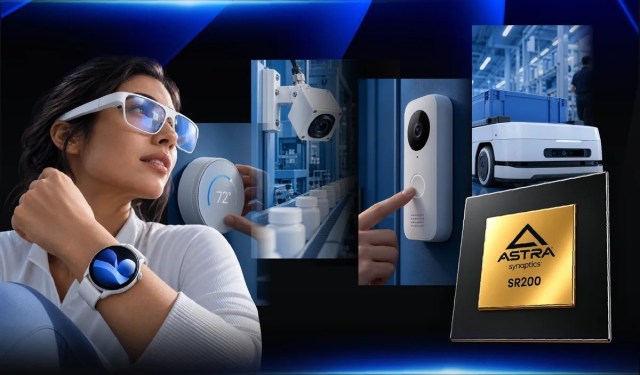
These MCUs are aimed at AI wearables, battery-powered sensing devices, connected cameras, streamers, and industrial vision and voice systems. Weil said the strongest traction so far has come from body-worn electronics, a detail that places the product squarely in the context of compact, power-sensitive devices rather than only general embedded computing.
What the architecture suggests for edge AI products
For General readers, the announcement can be read as a shift in where edge AI constraints are addressed. If memory interfaces are a bottleneck, then tiered memory and custom DRAM become as important as NPU throughput and CPU core choice. The SR200 narrative therefore connects three themes: multimodal sensing, power-sensitive operation, and model capacity that can no longer be squeezed into traditional MCU memory budgets.
That also changes the decision framework for device makers. Instead of selecting a microcontroller primarily by pin-compatible family and basic input/output features, engineers may need to weigh compute dimensions, memory hierarchy, always-on power states, and the types of AI workloads that must remain on-device. In this framing, xMCU is not merely a label; it signals a product category intended to bridge conventional embedded control and processor-class edge AI functions.
FAQ
- What makes Astra SR200 Series different from earlier MCUs?
SR200 pairs heterogeneous, AI-native compute and acceleration with integrated high-bandwidth custom DRAM scalable to hundreds of megabytes, allowing larger AI models and richer multimodal workloads to operate entirely on the device. - Why is tiered memory important for edge AI?
Weil described the architecture as addressing two problems: efficiently feeding compute cores and supplying memory for ultra-low-power, always-on AI processing. That is important because many AI applications strain the memory interface, not only the compute element. - Which NPU technologies are mentioned?
The design uses Synaptics’s Torq NPU and Google Research’s Coral NPU to run CNN and transformer workloads. - How does the lineup differ by model?
The SR210 targets power-optimized voice and sensing at 200 GOPS, the SR230 targets mainstream multimodal devices with vision, display, and optional audio at 300 GOPS, and the SR250 targets demanding edge applications with dual vision and display paths at 400 GOPS. - Which application areas are highlighted?
AI wearables, battery-powered sensing devices, connected cameras, streamers, industrial vision systems, and voice systems are listed, with body-worn electronics described as the area of strongest traction so far.
The takeaway for General readers is that Synaptics is not positioning SR200 only as a faster microcontroller. It is positioning the product as a platform where selectable Arm compute, AI acceleration, custom memory scaling, and power trade-offs are designed to work together for on-device multimodal intelligence.